When non-tech folks define “pen tester” literally in security conversations
Why is this Security meme funny?
Level 1: The Pen-Testing Department
Some jobs have names that sound silly if you take them word by word. In computers, a "pen tester" is really a safety expert — a friendly burglar that a company hires to try breaking into its own building, so they can find the unlocked windows before a real burglar does. But this joke pretends the name means exactly what it says: a person whose whole job is clicking pens — click click — and scribbling to check they write nicely. It's funny the way calling a firefighter "someone who tests if fire is hot" is funny: technically the words fit, and the serious version of the job only sounds sillier the longer you think about it.
Level 2: What a Pen Tester Actually Does
The terms behind the pun:
- Penetration testing ("pentesting"): a company hires a security professional to attack its own systems — websites, networks, employee phishing resistance, sometimes physical offices — under a signed agreement defining scope. The deliverable is a report: here's how I got in, here's what I could reach, here's how to fix it.
- Why it's shortened to "pen test": pure convenience, same way "kubernetes" became "k8s". The shortening is what makes the joke possible — nobody misreads "penetration tester" as a stationery role.
- Vulnerability: a weakness an attacker could exploit — an unpatched server, a predictable password, an input field that trusts users too much. Pentesters find these before someone malicious does.
- QA (Quality Assurance): the discipline of systematically testing products against requirements. The tweet essentially reassigns the pentester into pen QA, complete with the field's love of checkable criteria: does it click? does it write? ship it.
If you're considering security as a career path: yes, the job title will confuse your family forever, and yes, the actual work involves a lot more report-writing than movies suggest. The clicky pens, sadly, are out of scope.
Level 3: Scope of Work: One Ballpoint
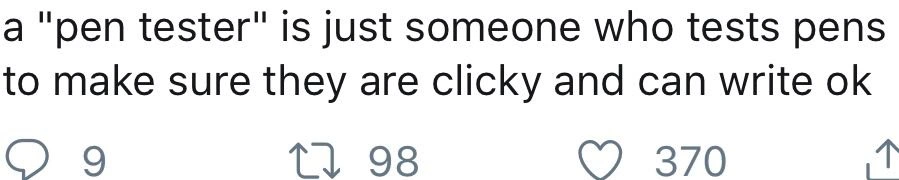
The tweet — > a "pen tester" is just someone who tests pens to make sure they are clicky and can write ok — is a textbook literal interpretation joke, and its 98 retweets and 370 likes (visible right there in the engagement row) confirm it landed squarely in infosec's funny bone. The mechanism: take an industry's most self-serious job title, strip the jargon compression, and read it like a five-year-old would. "Pen tester" is shorthand for penetration tester — someone paid to legally attack systems, networks, and occasionally office door locks to find vulnerabilities before criminals do. The abbreviation exists partly because the full phrase makes HR uncomfortable, which is its own quiet joke about the field.
What gives this staying power among security folks is that the deadpan reading accidentally describes a more rigorous methodology than some real engagements. "Clicky" and "can write ok" are concrete, testable acceptance criteria with binary outcomes. Compare that with the industry's open secret: a non-trivial number of commercial pentests are a vulnerability scanner run plus a re-branded PDF, priced like bespoke adversarial research. The community even has a derisive name for the lower tier — "scan-and-deliver" shops. So when an actual red teamer shares this joke, there's a barbed second layer: at least the pen QA guy verifies his findings by hand.
There's also a genuine taxonomy problem being satirized. Security job titles are a thicket of metaphor: red team, blue team, purple team, ethical hacker, offensive security engineer — none of which parse literally. The field communicates in borrowed military and locksmithing imagery, and outsiders (recruiters especially) genuinely do mangle it; every pentester has a story about a job posting or a relative who thought they did something adjacent to stationery. The tweet works because it's only one notch more absurd than real misunderstandings. And in the spirit of QA, note the tweet's implicit test plan covers both the mechanical interface (clickiness) and the core function (writes ok) — a two-case suite with full coverage of the pen API. Many production services ship with less.
Description
The image is a cropped screenshot of a tweet-style post on a white background with light-gray Twitter UI icons beneath it. The tweet text reads: “a 'pen tester' is just someone who tests pens to make sure they are clicky and can write ok”. Below the text are the standard reply, retweet, and like icons showing counts of 9 replies, 98 retweets, and 370 likes, rendered in Twitter’s pale blue and gray color scheme. The humor comes from a literal misinterpretation of the cybersecurity role “penetration tester,” conflating it with physically testing ball-point pens for clickiness and ink flow. For developers and security engineers, the joke highlights how specialized jargon can be misunderstood outside the infosec community, underscoring the importance of clear communication about security roles
Comments
7Comment deleted
Execs bragged we finally did a “pen test” - procurement delivered two pallets of ballpoints and compliance closed the ticket, while the red team still has root on prod shaking their heads
Wait until they hear about our "white hat" hackers who just test if fedoras match different outfit combinations
Honestly more rigorous than some pentest reports: at least the pen QA includes a reproducible click test instead of a rebranded Nessus scan PDF
This perfectly captures the moment when you're explaining your job at a family gathering and realize you should've just said 'cybersecurity' - because now Aunt Karen thinks you have the world's most boring QA job, and honestly, after your third consecutive 16-hour shift trying to exploit a zero-day in production, testing if a Bic clicks properly sounds like a vacation
We asked for a pentest; procurement shipped a carton of clicky pens - /admin still returns 200 without auth
Pen tester's CVE: Critical Vulnerability Exposed - ink evaporates post-prod deployment
Procurement misread “pentest” and hired someone to QA our Bic; the findings still mapped to OWASP: ballpoint injection, Sharpie persistence, and wet-signature privilege escalation