Skip to content
DevMeme
130 of 7435
That awkward moment when IoT’s nonexistent ‘S’ allegedly stands for security
IoT Post #164, on Feb 22, 2019 in TG

That awkward moment when IoT’s nonexistent ‘S’ allegedly stands for security

Why is this IoT meme funny?

Level 1: The Lock That Isn't There

It's a trick question, like asking "what does the dragon in your goldfish bowl eat?" — there is no dragon, and there's no S in "IoT." The joke is about all those "smart" gadgets people buy — talking doorbells, app-controlled lightbulbs, WiFi toasters. The companies that make them often forget the most important part: a good lock. So asking what the S in IoT stands for is a sneaky way of saying these gadgets have exactly zero security — so little of it that it didn't even get a letter in the name. It's the kind of joke where you laugh first and then go change your camera's password.

Level 2: The Letter That Was Never There

Unpacking the pieces:

  • IoT (Internet of Things): everyday objects — lightbulbs, doorbells, thermostats, fridges — with WiFi and a small computer inside, controllable via apps and talking to cloud servers. Spell it out: I-o-T. No S anywhere. That's the joke: the security is as present in the products as the letter is in the acronym.
  • Default credentials: the username/password a device ships with, like admin/admin. If the owner never changes it (most don't, and many devices don't even prompt), anyone on the internet who finds the device can log in. Automated scanners look for exactly this, constantly.
  • Firmware: the software permanently installed on the device. On your laptop, security holes get patched via updates. Many IoT devices never receive updates — whatever bugs they shipped with, they keep forever.
  • Botnet: a swarm of hijacked devices an attacker remote-controls, typically to flood websites with traffic (DDoS). Insecure IoT gadgets are the perfect recruits: always on, always connected, never watched.

Practical takeaway for your own projects and home: change default passwords, put smart devices on a separate network, and treat any device that can't be updated as already compromised — just politely waiting.

Level 3: Zero-Footprint Security by Design

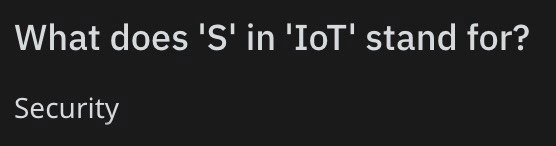
Two lines of text on a black background. Bold white: > What does 'S' in 'IoT' stand for? Muted gray, almost mumbled: > Security. That's the whole image, and the typographic deadpan is part of the craft — the answer is rendered quieter than the question, the visual equivalent of an engineer answering under their breath because everyone already knows.

The punchline, of course, is that IoT — Internet of Things — contains no S. And by 2019, when this joke was circulating as folk wisdom in security circles, the industry had earned it with receipts. The Mirai botnet had already weaponized hundreds of thousands of cameras and DVRs in 2016 by trying roughly sixty default credential pairs — admin/admin, root/12345 — and used the resulting army to launch DDoS attacks that knocked out Dyn's DNS and, with it, half the visible internet for an afternoon. Not a zero-day. Not cryptographic wizardry. Factory passwords nobody was ever going to change, on devices nobody was ever going to update.

What experienced engineers hear in this joke is the structural indictment, not just the anecdote. IoT security fails because every incentive points away from it: margins on a smart plug are measured in cents, so the firmware is a vendor-kit Linux from years ago; time-to-market beats threat modeling; the buyer can't evaluate security at the shelf, so it doesn't factor into the purchase; and once shipped, there's no update path — no auto-update, sometimes no update mechanism at all, and the manufacturer may not exist by the time the CVE lands. Unpatched firmware isn't an accident here; it's the business model's steady state. The result is a planet-scale fleet of network-attached computers with the patch cadence of a toaster, because they are toasters.

The riddle format itself does quiet work too. "What does the X in Y stand for?" presupposes the letter exists — and the answer's betrayal of that premise mirrors the marketing betrayal: the word smart on the box presupposes engineering diligence that was never allocated. The acronym has no room for security in exactly the way the bill of materials had no room for it. Same joke, different layer of the stack.

Description

Image: a simple black background with two centered lines of white text. First line, bold and larger, asks: “What does 'S' in 'IoT' stand for?”. The second line, normal weight, answers: “Security”. The joke relies on the fact that the acronym IoT (Internet of Things) contains no “S”, highlighting the notorious lack of built-in security in many connected devices. Engineers instantly recognize the punchline as commentary on rushed IoT deployments that prioritize connectivity over threat modeling and hardening

Comments

7
Anonymous ★ Top Pick Sprint 97 of our IoT roadmap and the only recurring carry-over ticket is still “Add the S” - turns out both that and the botnet scale horizontally
  1. Anonymous ★ Top Pick

    Sprint 97 of our IoT roadmap and the only recurring carry-over ticket is still “Add the S” - turns out both that and the botnet scale horizontally

  2. Anonymous

    The same letter that stands for "Support" in IoT vendor documentation - completely fictional but everyone pretends it exists until production goes down

  3. Anonymous

    IoT security is so robust they didn't even allocate a letter for it in the acronym - zero-footprint by design

  4. Anonymous

    This meme perfectly encapsulates the IoT industry's approach to security: it's so absent, it's not even in the acronym. After two decades of smart toasters joining botnets and baby monitors streaming to strangers, we've learned that the 'S' in IoT stands for 'Surely someone else will patch this' - right before your smart fridge DDoSes a Fortune 500 company. The real tragedy? We keep connecting everything to the internet anyway, because apparently convenience trumps the minor inconvenience of your lightbulbs participating in international cybercrime

  5. Anonymous

    In IoT, the 'S' stands for 'Shipped to prod with default creds' - threat model: NAT; patch window: never

  6. Anonymous

    IoT: Where 'S' stands for Security in slide decks, but 'Sacrificed' for ship velocity in prod - until the Mirai variant pings your fridge

  7. Anonymous

    IoT: 256KB of flash gets you Wi‑Fi, OTA, and RGB LEDs - ask for TLS and everyone remembers why there’s no S in IoT

Use J and K for navigation