The Lonely Developer's Lament: A PayPal API Tragedy
Why is this Documentation meme funny?
Level 1: Feeling Left Out
Imagine you’re at a birthday party, but you have a secret problem that no one else knows about. Let’s say you got a new complicated toy that you really want to play with, but the instructions that came with it are terribly written – so bad that you can’t figure out how to make the toy work. You spent all day trying, and now you’re at the party and still upset about those confusing instructions. Everyone else at the party is laughing, dancing, and having a great time, completely unaware of your toy troubles. You stand in the corner feeling left out because you’re the only one who knows how bad those instructions are and how frustrated you feel. It’s a bit funny and a bit sad – funny because it’s such a strange thing to be upset about at a party, and sad because you have no one to talk to about it. In the meme, the developer is like you with that toy: he’s the only one who understands how bad the situation is (in his case, the bad instruction manual is the PayPal guide for his work), and he feels alone with that knowledge while everyone else is just happily enjoying the party.
Level 2: API Documentation Woes
First, let’s break down the main pieces of this meme for a newer developer (or anyone unfamiliar with the terms). API stands for Application Programming Interface. It’s like a menu of commands and data formats that allows one software system to interact with another. In this case, the API in question is PayPal’s – which developers use when they want to add online payment features to their website or app. For example, if you’ve ever bought something and paid via PayPal on a website, that site’s code probably called PayPal’s API to charge your account. The PayPal API documentation is the official instruction manual from PayPal that teaches developers how to do this integration. It should explain what URL to send requests to, what information to include (like prices, currency, the payer’s details), and how to handle the responses and errors. Good documentation is super important for a smooth developer experience (DX) – it’s the difference between setting something up in an afternoon versus pulling your hair out for a week.
Now, the meme specifically jokes that PayPal’s API docs are “shit” – meaning really bad. This is a bit of developer humor exaggeration, but it comes from real frustrations. For years, many developers have found PayPal’s instructions difficult to use. Some common complaints include: instructions that are too confusing or too brief, outdated info that no longer applies to the current version of the API, or missing examples that force you to guess how things work. Imagine you’re following a recipe that suddenly skips an ingredient – that’s what bad API documentation can feel like. You might try to integrate PayPal into a project by following their docs only to hit weird error messages or behavior that the docs never mentioned. For instance, the docs might tell you “Call endpoint X to create a payment” but not clearly mention you first need to set up an authorization token in a specific way. As a newcomer, you could be left scratching your head: Did I miss a step? Is something wrong on my end, or are the docs incomplete? That uncertainty is frustrating.
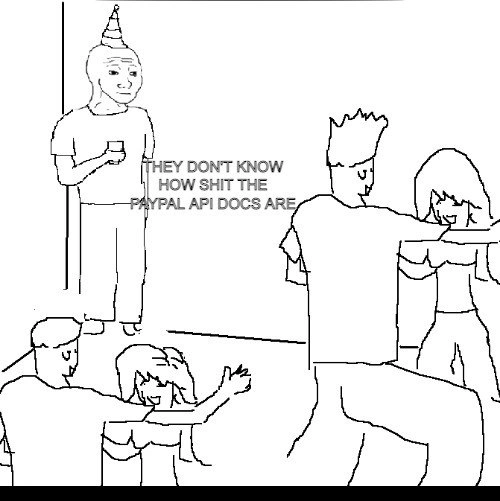
The visual format of the meme – often called the “guy in the corner at a party” meme – perfectly captures the feeling of having a very niche problem that no one around you understands. In the image, the developer is drawn in the corner with a party hat and a blank expression, holding a drink, while a group of people on the other side of the room are dancing and having fun. The caption next to him says: “They don’t know how shit the PayPal API docs are.” This is the thought bubble or the internal monologue of the developer. Essentially, he’s at a social event, but he can’t stop thinking about his struggle with PayPal’s documentation. And he’s not even going to bother telling anyone there about it, because “they don’t know” – the other party-goers likely aren’t developers, so they have no idea about this issue and probably wouldn’t even care. So he’s alone with this super-specific frustration.
For a junior dev or someone new to this world, picture it this way: you finally got invited to a fun party, but earlier that day you were wrestling with some code that uses PayPal’s services. The documentation (the how-to guide) was so unhelpful that you spent all day and still didn’t get it fully working. Now you’re at the party, everyone else is relaxing, talking about music or life, and you can’t stop thinking about that unsolved bug or confusing instruction. You might even feel a bit bitter: “If only they knew what I went through!” That’s exactly what’s happening in the meme. It humorously points out a common developer experience: being stuck on a tough tech problem and feeling totally alone because it’s not something you can share with the people around you.
The tags like DocumentationHumor, DeveloperPainPoints, and third_party_docs_frustration all reinforce this context. “Documentation humor” refers to jokes about how documentation can be flawed or funny in hindsight. Developer pain points are those frustrating things that cause developers grief (bad docs are a classic pain point!). And third-party docs frustration means the specific frustration of using documentation written by another company (a third party) like PayPal. When you use someone else’s service (say, a payment service, a maps API, etc.), you rely on their docs. If those are bad, you’re stuck because you can’t just fix it yourself – you have to somehow figure out what the docs fail to explain. The meme’s popularity suggests lots of developers have felt this exact pain. It’s basically saying: Integrating PayPal’s API is a real headache, and unless you’ve done it, you have no idea how bad it can be. For a junior dev, the takeaway is: good documentation is gold, and sadly, not all docs are good. When they’re bad, even a simple task can feel isolating and frustrating – sometimes so much that it sneaks into your thoughts at a party!
Level 3: Payment Integration Hell
The scene is comically painful for any seasoned dev: a lone programmer at a party, clutching his drink like a lifeline, internally screaming about the PayPal API documentation. The meme’s caption says it plainly: “THEY DON’T KNOW HOW SHIT THE PAYPAL API DOCS ARE.” And oh, does that hit home. It’s a wry nod to the shared trauma of integrating PayPal’s payment gateway – an endeavor that should be straightforward given PayPal’s size, but often turns into a marathon of confusion. While everyone else is dancing without a care (oblivious non-developers or lucky devs who haven’t touched PayPal’s API), our guy in the corner is reliving the horror of trying to decipher PayPal’s guides. He’s physically at the party but mentally still stuck in yesterday’s integration debugging session at 3 AM, cursing at a code sample that never worked as advertised.
Why is this funny to experienced developers? Because it’s true. PayPal’s API docs have a bit of an infamous reputation – a developer experience (DX) nightmare wrapped in walls of text and outdated PDFs. Imagine wading through documentation pages where half the information is for some “legacy API” you’re not even using, and the other half omits the one parameter that’s causing your requests to fail. It’s the perfect storm of complexity and poor writing that leaves you second-guessing your sanity. The meme nails that “if you know, you know” dynamic: only those who’ve wrestled with these docs appreciate just how maddening it is. It’s a silent bond among developers who have felt utterly alone in their struggle, much like our party wallflower. You can practically hear him thinking, “If I even mention ‘API’ right now, everyone will scatter.”
On a deeper level, this joke highlights a gap between technical reality and social reality. The party-goers on the right represent normalcy and ignorance-is-bliss. They could be non-tech friends or even colleagues from sales/management who think integrating a payment API is just a quick plug-and-play. Meanwhile, the developer stands apart, burdened with esoteric knowledge of PayPal’s clunky docs that nobody else there could possibly care about. The humor (tinged with bitterness) comes from that alienation – he’s got a war story no one at this party will ever want to hear. It’s mocking the fact that third-party APIs can be so user-hostile that using them turns into a war of attrition. The poor dev can’t even enjoy a party without being haunted by JSON payloads and cryptic error codes.
Let’s talk specifics: PayPal’s API documentation historically has been a scattered maze. They’ve had multiple API versions (remember the old NVP/SOAP API vs. the newer REST API?) and something called “Classic APIs” that linger like ghosts. The documentation often reads like it was written by four different teams who didn’t talk to each other. You’ll find yourself flipping between browser tabs of developer forums, Stack Overflow threads, and random GitHub gists because the official docs left gaping holes. Examples? Often minimal or using obscure proprietary terms. Error messages? Prepare for gems like {"name": "INTERNAL_SERVICE_ERROR"} with no further help – as if that’s supposed to tell you which of your 20 request fields is wrong. And don’t get a veteran started on PayPal’s OAuth flow documentation: it has you zigzagging through pages, trying to figure out if you need a bearer token or an SDK, and why the curl example isn’t working on Windows. It’s not just reading – it’s decoding. By comparison, integrating something like Stripe feels like a spa day; Stripe’s docs hold your hand with clear steps and sample code in every language. With PayPal, you’re lucky if the code snippet doesn’t have a typo.
This meme resonates because it encapsulates the absurd reality of developer life: we solve complex problems all day, then go to a party and realize we can’t even vent about our day because nobody would get it. The lonely party developer is a stand-in for all those times you’ve sat in meetings or social gatherings smiling blankly while non-devs chat, and you’re internally debugging some production issue or replaying that nasty integration bug. In this case, the bug is in the docs themselves. PayPal’s docs are supposed to be the map, but they often feel like a treasure map drawn by a trickster – half-complete and misleading. It’s a universal dev joke: the documentation is crap, but only we suffer quietly while the world carries on. The humor is equal parts catharsis (laughing so we don’t cry) and commiseration (we’ve all danced this painful dance… or rather, stood in the corner while everyone else danced). The next time someone at work says “It’s just an API integration, how hard could it be?”, imagine our party guy slowly sipping his drink, knowing the truth and saying nothing. Sometimes, being the only one who knows the truth – especially a crappy truth like bad API docs – is the loneliest feeling and the funniest joke when shared later with the right crowd.
Description
This is a black-and-white line drawing based on the 'They Don't Know' meme format. In the corner of a lively party, a Wojak character with a sad expression stands alone, wearing a party hat and holding a drink. In the foreground, other crudely drawn figures are dancing and socializing. A thought bubble next to the Wojak character contains the text: 'THEY DON'T KNOW HOW SHIT THE PAYPAL API DOCS ARE.' The stark contrast between the character's internal suffering and the cheerful party scene is the central visual theme. The meme humorously captures the profound frustration developers experience when dealing with notoriously poor API documentation, specifically calling out PayPal. Integrating payment gateways is a high-stakes task where clarity is crucial, and bad docs can lead to days of painful trial-and-error. For experienced engineers, this isn't just a complaint; it's a shared trauma. The joke is in the social isolation caused by a deeply technical problem that's impossible to explain to non-developers at a party
Comments
12Comment deleted
The PayPal API has two main integration paths: the one in their five-year-old documentation, and the one you discover after three days of sacrificial debugging that actually works
They’re over there debating Web3; I’m quietly spelunking PayPal’s docs where OAuth2 is demonstrated in SOAP and the only sample code still hits a Classic NVP endpoint - nothing like legacy Jenga to kill the vibe
After 15 years in the industry, you realize the real party trick isn't explaining blockchain at dinner parties - it's successfully implementing PayPal's webhook verification without having to reverse-engineer their undocumented response formats while their sandbox returns different schemas than production
Every senior engineer has that one API integration war story they don't share at parties - usually involving PayPal's docs, three days of debugging OAuth flows that contradict the examples, and the eventual realization that the community-maintained GitHub gist is more reliable than the official documentation. The real documentation was the Stack Overflow answers we found along the way
PayPal API docs: the eternal reminder that 'battle-tested' means they've survived decades without anyone fixing the docs
PayPal’s API docs are eventually consistent with reality - after three retries, a webhook that arrives out of order, and a sandbox nothing like prod
PayPal integration is software archaeology - Classic NVP, SOAP, REST v1/v2 and Smart Buttons; four timelines, three auth flows, and a sandbox that returns 201 while ghosting your webhooks
I know. Php... Deprecated library Comment deleted
We know! We KNOW! Comment deleted
fake transparency be like Comment deleted
jesus christ, what a stickerpack Comment deleted
will anyone fall for this scam smh Comment deleted