Skip to content
DevMeme
2796 of 7435
Stack Overflow Can't Solve Every Problem
DevCommunities Post #3092, on May 13, 2021 in TG

Stack Overflow Can't Solve Every Problem

Why is this DevCommunities meme funny?

Level 1: No Manual, No Party

Imagine you have a friend who won’t do anything new unless they read about it first. If you invite them to a costume party, the first thing they do is search their favorite advice book or website for “what costume to wear to a party.” Now, if they can’t find any instructions, they feel completely lost and decide, “Oh well, I just won’t go.” This meme is joking that some programmers are exactly like that friend. They’re so used to looking up instructions for everything on their special question-and-answer website (Stack Overflow, which they normally use for coding help) that when it’s time to do something normal – like picking clothes for a party – they panic if they can’t find a ready-made answer. It’s funny because most people just use common sense or personal style to get dressed for a party, but our programmer is treating it like a tricky homework problem! The last picture with the words “OH, YOU!” is basically the meme patting the jokester on the back, saying, “Haha, you got us with that silly joke.” In simple terms, the humor comes from seeing a normally super-smart coding person become totally confused by everyday stuff, all because they’re used to always having a step-by-step solution handed to them. It’s a gentle, goofy reminder that sometimes you just have to figure things out on your own – even if you’re a whiz at solving computer problems.

Level 2: Off-Topic Query

Let’s break down why this joke makes developers smirk. First, Stack Overflow is a famous question-and-answer website where programmers ask for help and share solutions to coding problems. It’s like a giant library of code snippets, troubleshooting tips, and best practices – all contributed by the developer community. Newcomers quickly learn that if you get stuck on a coding error or need to figure out how a library works, a quick search on Stack Overflow often points you to an answer (often with copy-paste-ready code). In fact, relying on it is so common that there’s a running gag about developers: “I don’t memorize solutions, I just Google and find answers on Stack Overflow.” This is the foundation of the meme’s humor.

Now, what about “dress code”? In everyday terms, a dress code is a rule about what you should wear in a certain setting – for example, a party might have a casual dress code or a requirement to wear a costume. It’s something non-technical, purely about social etiquette and clothing. Obviously, that’s not the kind of “code” you’d normally find on a programming site! And that contrast is the joke. The meme imagines a programmer treating a party invitation like a software problem: they want to look up the “solution” online. But Stack Overflow doesn’t have an answer, because a question about party attire would be completely off-topic on a site meant for debugging JavaScript or configuring servers.

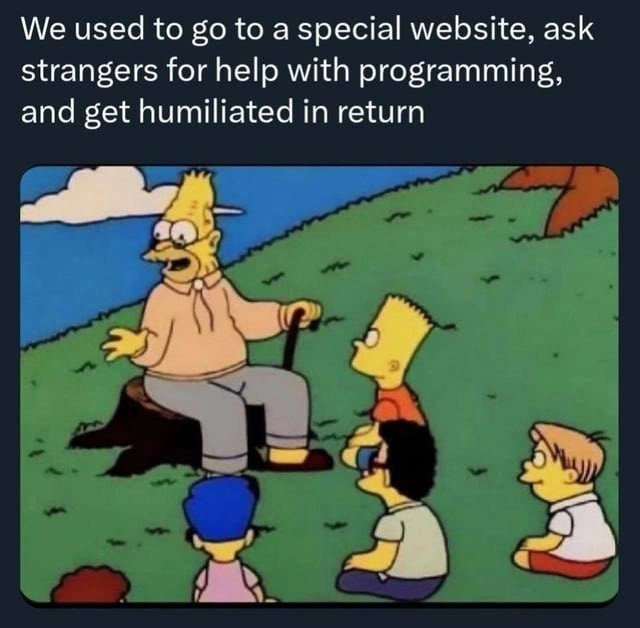
In the meme panels, the chubby tan dog with a sly expression is delivering the punchline. (Meme-loving developers might recognize that dog and the final “OH, YOU!” panel from older internet jokes – it’s a template used to respond to cheesy one-liners.) The dialogue goes like this: “Why can’t programmers go to parties?” – “I don’t know, why?” – “Because they can’t find a dress code on Stack Overflow!” This is a classic Q&A-style joke, similar to what you’d find in a kids’ joke book, but with techie content. The dog’s smirk and the “Oh, you!” are essentially saying, “Gotcha with the pun!”

For a junior developer or someone new to developer humor, here’s why it’s funny:

  • Developers and Stack Overflow: As you start coding, you’ll notice that whenever you face an error or need to implement something, someone else has likely asked a similar question on Stack Overflow. It becomes a crutch (in a useful way): you consult it frequently. The meme takes this habit to an extreme – implying a programmer would even search Stack Overflow for how to dress up for a party. It playfully suggests programmers trust advice from the internet more than their own common sense, which is a humorous exaggeration.

  • Community Culture: Stack Overflow, and dev communities in general, have rules. If you ask something unrelated to programming (like fashion advice), your question will get flagged or removed. People often say such queries will get “closed” for being off-topic. So the meme also hints: even if a programmer tried to ask how to dress for a party on Stack Overflow, they wouldn’t get an answer! This is an inside nod that anyone who’s participated in these Q&A forums can understand.

  • Wordplay - “Code”: There’s also simple wordplay at work. Non-developers hear “code” and think of secret codes or dress codes; developers hear “code” and think of programming. The joke bridges those meanings. A newbie developer will soon appreciate how their world revolves around code (programming) and might chuckle at the idea of applying that mindset to something as mundane as picking an outfit.

So, the meme is mixing a regular life scenario (going to a party) with a developer’s world (Stack Overflow and code). It highlights a common stereotype in a light-hearted way: programmers are so accustomed to structured problem-solving and online advice that they struggle with spontaneity or unstructured situations. It’s all in good fun – even many programmers who love parties would laugh at this, because they recognize a bit of themselves in that reliance on online Q&A. It’s a way the tech community pokes fun at itself and the tools we use daily.

Level 3: 404 Dress Code Not Found

In this classic developer joke, a programmer’s life hack collides with social reality. The meme’s Q&A format sets up a riddle:

Q: Why can’t programmers go to parties?
A: Cause they can’t find a dress code on Stack Overflow!

This punchline hits on a painfully relatable trope in developer culture – the almost reflexive habit of looking up every solution online, especially on Stack Overflow. For seasoned developers, the humor works on multiple levels:

  • Stack Overflow Dependency: Experienced devs chuckle because they’ve seen (or lived) StackOverflow-driven development, where every bug fix or code snippet is copy-pasted from the internet’s favorite Q&A site. The meme exaggerates this to absurdity: a coder won’t attend a party without finding a “solution” on Stack Overflow. It’s a playful jab at how reliant we become on community-provided answers. If it’s not indexed in Stack Overflow’s knowledge base, does it even exist? The punchline yells “404: Dress Code Not Found”, riffing on the HTTP error for missing resources – in this case, missing fashion instructions.

  • Off-Topic Questions: Veteran Stack Overflow users know that asking “What should I wear to a party?” on that site would be immediately downvoted and closed as off-topic. The community has strict guidelines about what’s a programming question and what isn’t. So the meme hints that the poor programmer literally can’t find an answer because such a question wouldn’t survive on the forum. It’s an inside joke about how dev communities enforce focus... sometimes to the point of absurdity.

  • Double Meaning – Code vs. Dress Code: Seasoned engineers appreciate the wordplay. In coding, “code” is what we write and debug. A dress code is an entirely non-technical term for attire rules at events. By conflating the two, the meme tickles that nerdy part of our brains that’s always parsing language for technical meaning. It pokes fun at the stereotype that programmers think in code so much that even a “dress code” sounds like something to be implemented or looked up as documentation.

  • Stereotype of Social Skills: Beneath the joke is a gentle ribbing of the socially awkward programmer cliché. The idea that a dev wouldn’t know how to behave at a party without a manual is an exaggeration of reality – but not too far off, as many in tech have joked about preferring computer problems to social ones. Senior devs laugh (maybe a bit self-consciously) because it’s a shared experience: spending so much time in code and online forums that “normal” social events feel like unsupported territory.

  • Meme Format and Tone: The meme uses a four-panel “Oh, you!” template – a recognizable format where the last panel (blue background, big white text) acknowledges the corny joke. The smirking dog delivers the pun with a mischievous face, and the human’s mock-confused shrug sets it up. Seasoned meme connoisseurs note that using a cute dog (reminiscent of the Doge meme era) adds an extra layer of silliness. The final “OH, YOU!” panel is basically the meme winking at us. It’s saying: “Yes, that was a cheesy pun, but you loved it.” In developer circles, we embrace these cringe-worthy puns — they’re a bonding ritual for the community.

From an experienced perspective, this meme humorously encapsulates the Stack Overflow generation of programmers. It’s a loving roast of how we’ve become so dependent on readily available answers that we joke about needing them for even the simplest life situations. The experienced dev nods knowingly, remembering late-night coding sessions saved by a Stack Overflow snippet – and laughs at the hyperbole that without a Q&A thread, we’d be paralyzed even at a party. In short, the meme cleverly highlights a truth every programmer learns: we often feel more at home debugging code with online help than navigating unwritten social “protocols.” And that mix of truth and exaggeration is exactly why it’s hilarious.

Description

A four-panel comic meme format. The first panel features a dog with an awkward, sideways glance asking, 'Why can't programmers go to parties?'. The second panel shows a man with a goatee and a smirking expression, tilting his head and replying, 'I don't know. Why?'. The third panel returns to the dog, who delivers the punchline: 'Cause they can't find a dress code on Stack Overflow!'. The final panel is a blue, circular graphic reminiscent of a sitcom outro, with the words 'OH, YOU!' in bold, white letters. The faces of both the man and the dog are shown in circles within this graphic. The meme humorously plays on the stereotype that programmers rely excessively on the Q&A website Stack Overflow to solve all their problems. It suggests this dependency is so extreme that they would search for solutions to social norms, like what to wear to a party, on a platform designed for technical coding questions. For experienced developers, it’s a self-deprecating joke about the community's reputation for being more comfortable in digital forums than in social settings

Comments

8
Anonymous ★ Top Pick My party-going algorithm: 1. `curl --silent 'https://social-event/dress-code'`. 2. On 404, `git blame` the host. 3. Default to hoodie and `exit(0)`
  1. Anonymous ★ Top Pick

    My party-going algorithm: 1. `curl --silent 'https://social-event/dress-code'`. 2. On 404, `git blame` the host. 3. Default to hoodie and `exit(0)`

  2. Anonymous

    I told the team I’d show up to the release party once they clarified whether “business-casual” is strongly or eventually consistent - my wardrobe changes need ACID guarantees

  3. Anonymous

    The real reason programmers avoid parties is they're still waiting for someone to accept their pull request to merge 'social_skills' into main branch - it's been stuck in review for years with 47 unresolved comments about edge cases in small talk implementation

  4. Anonymous

    The real reason programmers avoid parties isn't the dress code - it's that social interactions don't have a 'try-catch' block, there's no rollback strategy for awkward conversations, and worst of all, you can't just Stack Overflow your way through small talk. Plus, the latency on human responses is terrible compared to API calls, and there's no documentation for handling edge cases like 'someone asks what you do for fun.'

  5. Anonymous

    Dress code violations: the only runtime error without a Stack Overflow bounty

  6. Anonymous

    If the dress code doesn’t come with a JSON Schema and an accepted Stack Overflow answer, my deployment defaults to Hoodie LTS

  7. Anonymous

    If your team won’t attend the offsite until there’s an accepted Stack Overflow answer for ‘party dress code,’ you’ve turned social protocol into a hard dependency with no SLA

  8. @spiritualattunement 5y

    Bruh

Use J and K for navigation