Skip to content
DevMeme
3789 of 7435
The Ideological War: Pavel Durov vs. the Facebook Machine
DevCommunities Post #4130, on Jan 29, 2022 in TG

The Ideological War: Pavel Durov vs. the Facebook Machine

Why is this DevCommunities meme funny?

Level 1: Candy-Coated Hypocrisy

Imagine a kid who yells, “I hate candy! Candy is the worst!” but at the same time, he’s got a big jar of candy clutched in his arms. He’s in his room, hugging that jar tightly, and if you even hint that you might take a piece, he shouts, “No! It’s my candy, you can’t have it!” Pretty funny, right? Because obviously, if he truly hated candy, he wouldn’t care about the candy or try so hard to keep it. This meme is just like that, but with Facebook things instead of candy. The grinning cartoon face is like the kid saying he hates Facebook over and over, while still holding onto Facebook’s little reaction emojis (those thumbs-up 👍, hearts ❤, laughing faces 😂 – the things people click on when they like a post). It’s silly and funny because he’s doing the opposite of what he says: he says he doesn’t like Facebook, but he acts like those Facebook goodies are super important. We laugh because we all know someone (or maybe even ourselves!) who complains about something constantly but never lets it go. It’s that goofy scene of saying one thing and doing another that makes it humorous and easy to get.

Level 2: Love-Hate Relationship

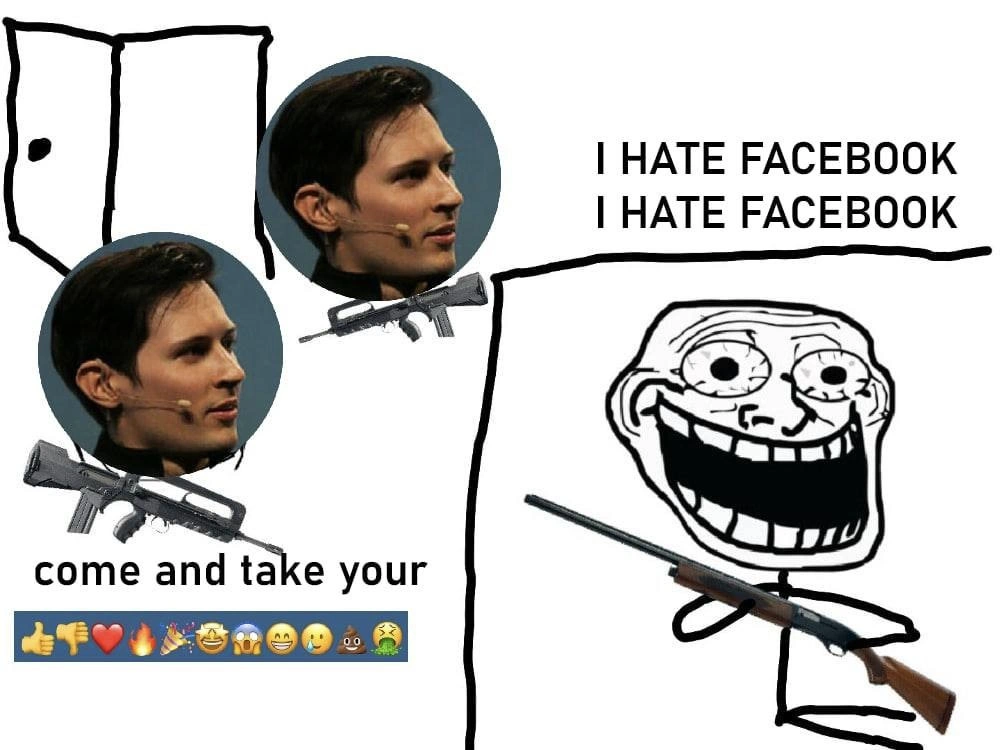
Let’s break down the meme in simpler terms. On the right side, we see the Trollface, which is that big goofy black-and-white grin. The Trollface is a famous internet meme character used to represent someone who is trolling – basically, being an internet prankster or hypocrite just for laughs. Here, Trollface is holding a shotgun and yelling “I HATE FACEBOOK I HATE FACEBOOK.” This obviously shows he wants everyone to know how much he dislikes Facebook. However, the joke is that he’s inside a room guarding a bunch of Facebook reaction emojis (those little reaction faces like thumbs up, heart, fire, laughing 😁, etc.). So he’s saying he hates the thing, but he’s also holding onto something that belongs to the thing he hates.

Now, what are those emojis exactly? They’re the Facebook reaction emojis – the icons people click on to react to a post. Originally Facebook just had the “Like” 👍 button, but later they added more options: a heart ❤️ for “love,” a flame 🔥 maybe for something “hot” or exciting (Facebook sometimes uses a wow 😮 or angry 😡 emoji too – the meme seems to include some custom ones like 💩 for poop and 🤢 for disgust to exaggerate). These are part of Facebook’s engagement features – ways to get users to interact more with posts. Developers often implement similar features in their own apps or websites because users enjoy reacting with emojis (it’s quick and expressive).

On the left side of the meme, there’s a crudely drawn open door, and just outside are two identical pictures of a man with an assault rifle. Underneath them it says “come and take your 👍❤️🔥🎉😂😱😬💩🤢”. This phrase “come and take your [something]” is basically a challenge or taunt. It’s like Trollface is saying to Facebook (or whoever these soldiers represent), “I’ve got your precious reaction emojis, if you want them back so badly, come and get them!” It’s drawn like a showdown – think of a cowboy standoff but with emojis as the treasure. This is referencing a popular saying “Come and take it,” often used in a rebellious context (historically on flags or memes about not giving something up without a fight). So the meme creator is comparing Facebook’s reaction feature to something so valuable that Trollface, even while hating Facebook, refuses to give it up. The two armed figures could represent Facebook’s enforcers or maybe just the idea of Facebook’s presence trying to reclaim its stuff. The man in those images isn’t immediately important (his face is blurred; possibly it’s the same person twice to be funny), it’s more about showing a determined guard or attacker at the door.

So why is this funny to developers or tech folks? Because it highlights a “love-hate relationship” many people in tech have with big social media platforms like Facebook. A love-hate relationship means you dislike something in some ways but also depend on or use it in other ways. Developers often criticize Facebook for various reasons – for example, its privacy issues (like how it tracks user data) or how it’s a closed ecosystem that’s hard to integrate with or leave (that’s the API lock-in part – an API is an interface that lets your software talk to another service, and lock-in means once you use it, you’re kind of stuck with it because switching would be a pain). They might say things like “I hate Facebook, I’d never use their OAuth login on my site” or complain about how Facebook’s changes break their apps. This is the “I HATE FACEBOOK” sentiment in the meme.

However, despite all the complaining, those same developers or users often can’t completely escape Facebook’s influence. For instance, a dev may end up integrating “Login with Facebook” anyway because it’s convenient and so many users already have Facebook accounts. Or they include similar reaction features in their own app because users expect it – like how GitHub (a platform for developers) added emoji reactions on comments, or how Slack (a work chat app) lets people react with any emoji. These features originated or were popularized by platforms like Facebook, but now everyone uses them. In other words, even if a dev says they hate what Facebook does, they might still copy Facebook’s ideas or use their tools because it benefits their project or community. This is a form of social media hypocrisy – publicly hating on it, yet privately or indirectly embracing it.

The meme exaggerates this hypocrisy to make it obvious. Trollface screaming “I hate Facebook” while clutching Facebook’s emoji stash is like a kid shouting “I don’t even like this toy!” while playing with that toy non-stop. In developer terms, it’s pointing out the silliness when, say, a programmer rants on Twitter about how awful Facebook is… via a thread that’s getting tons of likes and retweets (thus using the engagement of social media to trash social media). It’s also calling out how people in tech sometimes use sarcasm and corporate humor to cope with the fact that we are all a bit dependent on the big platforms. We crack jokes like “It’s not a bug, it’s a Facebook feature” whenever something about these platforms annoys us, yet we continue to build on them or use them. The FacebookPlatform has become almost unavoidable – if you want your app or content to reach people, chances are you’ll touch Facebook or another big social platform somehow. So even the detractors end up contributing to Facebook’s ecosystem (by using its features or data). That’s why the Trollface is depicted as guarding the Facebook reactions: it’s a funny way to show someone who badmouths Facebook but also values or needs what Facebook provides (the engagement, the audience, the little dopamine hit of a like or laugh emoji). It’s both a tech industry in-joke and a bit of relatable self-own for anyone who has ever said “I’m quitting Facebook!” and then logged back in later.

Level 3: Walled Garden Warfare

The meme humorously captures a tech hypocrisy that seasoned developers know all too well. On one side, we have the classic Trollface – a grinning internet meme character emblematic of trolling and irony – holed up in a room with a shotgun. He’s loudly proclaiming “I HATE FACEBOOK I HATE FACEBOOK” at the top of his lungs. Yet, look closely: he’s also guarding a stash of Facebook reaction emojis (👍 👎 ❤️ 🔥 🎉 😂 😱 😬 💩 🤢) like a doomsday prepper hoarding canned goods. At the door stand two identical armed figures (their faces blurred, maybe representing faceless Facebook agents or ironic clones) with rifles, and a caption “come and take your [👍❤️🔥…]”. This phrase riffs on the defiant “come and take it” slogan – essentially a dare for the invaders (Facebook, in this parody) to reclaim their precious reaction icons. It’s a ridiculous standoff: the Trollface is inside Facebook’s walled garden yelling he hates it, even as he clings to the platform’s engagement loot. This absurd scene lands because it reflects a real-world irony: developers and users often rail against Big Tech platforms (especially Facebook), yet they’re unwilling or unable to let go of the very features those platforms pioneered.

From a senior engineer’s perspective, the meme is a shot-on-target reference to corporate social media cynicism. How many times have we heard colleagues roar “Ugh, I can’t stand Facebook’s data policies and walled-garden API!” in developer communities and tech meetups? Facebook’s known for things like tightly controlled APIs (ever dealt with the agony of a breaking change in the Graph API?), aggressive user data collection, and endless engagement gimmicks. API lock-in is real: once your app or site relies on Facebook’s login or their social graph, you’re handcuffed to their platform. Engineers gripe about it constantly: “This is the last time we integrate the Facebook SDK, I swear!” But of course, next project comes around and someone will still say, “Let’s add ‘Login with Facebook’ for user convenience.” It’s a love-hate cycle many veterans recognize. The meme nails this by showing the Trollface vehemently hating Facebook while literally stockpiling its Facebook reaction emojis – a stand-in for all those sticky features and userbase assets that keep us coming back. The visual exaggeration (guns drawn at the door) is basically an engineer’s inner rebel yelling, “Sure, I bad-mouth Facebook, but pry these 👍😂🔥 reactions (and their millions of users) from my cold dead hands!”

There’s also an industry in-joke here about engagement mechanics. Facebook’s reaction emojis aren’t just cutesy icons – they were introduced as an upgrade to the simple Like, giving users a whole menu of emotional responses. This was a calculated move: more nuanced reactions mean more data on how content makes people feel, which feeds into the almighty algorithm. Those of us who’ve been around remember when timelines were strictly chronological and SocialMediaPlatforms didn’t gamify our emotions. Now, every platform chases these dopamine-inducing feedback loops. The meme’s Trollface hoarding reactions highlights how even the haters feed the engagement machine. It’s sarcastic humor pointing out that yelling “I hate Facebook!” on Facebook (or about Facebook) still boosts engagement – negativity and outrage are just another kind of reaction that keeps the platform’s gears turning. In developer terms, it’s like complaining about a memory leak while your process is still happily consuming memory – you’re part of the problem you protest. Seasoned devs smirk at this because they’ve seen it: the loudest critics often inadvertently become active users. It’s the hater’s paradox: your public dissent still contributes content and traffic to the platform. As the saying goes in online communities, “Don’t feed the troll” – but here the troll is feeding the very thing it claims to loathe, and doing so with gusto.

On a meta level, this also pokes fun at DevCommunity trends. It’s common on tech forums to see folks rant about Facebook’s evils (privacy scandals, algorithmic manipulation, monopolistic behavior) – essentially performing the “I HATE FACEBOOK” chant – yet those same people often use Facebook-owned technologies. A classic example: developers who bash Facebook the company, but love React (Facebook’s open-source JavaScript library) or can’t quit Instagram and WhatsApp (also Facebook properties). Or open-source die-hards who rant against corporate control but get giddy when their project gets a ton of ⭐ stars on a GitHub repo (hello, another social validation metric!). The meme exaggerates this hypocrisy to comic effect by using the over-the-top Trollface and a gun-toting standoff scenario. It’s pointing out that in tech culture, talk is cheap – you can shout anti-corporate slogans all day, but ultimately you’ll still chase those likes and reactions when they benefit you. In the workplace, developers might roll their eyes at management’s obsession with engagement metrics, yet be secretly pleased when their feature gets a flood of 👍❤️ on the company’s social post. We’ve all seen the engineer who snarks about “stupid emoji reactions” in commit comments, but then fights to get a 😄 or 👍 on their own conference talk announcement. In short, the meme calls out the devil’s bargain: we hate the gatekeepers (Facebook platform and its ilk) but still crave the goodies behind the gate (user engagement, reach, familiarity of features). It’s a truth that stings just enough to be funny.

Description

This is a surreal, two-panel meme depicting a conflict of internet cultures. On the left, two images of Pavel Durov, the founder of Telegram, are shown alongside images of FAMAS rifles. Below them is the phrase 'come and take your' followed by a series of Facebook reaction emojis (like, heart, laugh, etc.). This panel is positioned outside a crudely drawn open door. On the right, a classic, crazed Trollface character holds a shotgun, with the text 'I HATE FACEBOOK I HATE FACEBOOK' above it. The meme contrasts the perceived ethos of Telegram - often associated with free speech and defiance ('come and take your') - against the corporate, emotionally curated experience of Facebook, symbolized by its reaction emojis. The unhinged Trollface represents a raw, visceral rejection of Big Tech platforms. For senior developers, this resonates as a commentary on the platform wars, the battle between open/encrypted systems and centralized/data-mining ones, and a general disdain for the sanitized, corporate nature of mainstream social media
Comments

10
Anonymous ★ Top Pick Facebook's API gives you sophisticated tools to A/B test which emoji best monetizes your grandma's data. Telegram's API lets you build a bot to alert you when your production server is on fire. Different priorities
  1. Anonymous ★ Top Pick

    Facebook's API gives you sophisticated tools to A/B test which emoji best monetizes your grandma's data. Telegram's API lets you build a bot to alert you when your production server is on fire. Different priorities

  2. Anonymous

    Chanting “Kill Facebook!” in the architecture review while clutching the Graph API token that keeps our engagement SLA green is the purest form of vendor-lock-in zen

  3. Anonymous

    Nothing says "we're building a privacy-focused alternative to Big Tech" quite like implementing the exact same engagement-optimized dopamine features you spent five years criticizing in your manifesto

  4. Anonymous

    Every messaging app's roadmap converges to the same place: the feature set of the platform its users were escaping

  5. Anonymous

    The irony of building a distributed system where the only thing more persistent than your data replication is users' inability to actually leave the platform - turns out the real vendor lock-in was the dopamine hits we collected along the way. Facebook's reaction system is essentially a pub/sub pattern where you're both the publisher and the product, and the only unsubscribe button that works is the one you'll never click

  6. Anonymous

    In growth-land, every “I hate Facebook” is event-sourced into eleven ReactionEvents, a dwell-time spike, and a PM promotion for shipping more emojis

  7. Anonymous

    Facebook's VR strategy: Acquire the wizard, fire him for politics, rebrand as Quest - because nothing scales like grudges

  8. Anonymous

    “I hate Facebook,” says leadership - then assigns the ticket to turn liked: boolean into a sharded reactions join table, backfill years of data, and A/B the emoji order by Monday

  9. @VladislavSmolyanoy 4y

    admin add reactions !

    1. @Eugene1319 4y

      +

Use J and K for navigation