First Principles vs. The Bureaucratic Wall of 'Sources'
Why is this CorporateCulture meme funny?
Level 1: Counting Apples
Imagine you’re in a classroom and you say, “I had one apple, then someone gave me one more apple, so now I have two apples.” That’s obviously true, right? You can literally hold the apples and count: one, two. Now picture the teacher or another kid gasping and saying, “Wait, who told you that? Can you show me a page in a book that says 1+1=2? I don’t believe you unless an expert says so!” It sounds silly because anyone can see it’s true – you have two apples. You don’t normally need to prove such a basic thing.
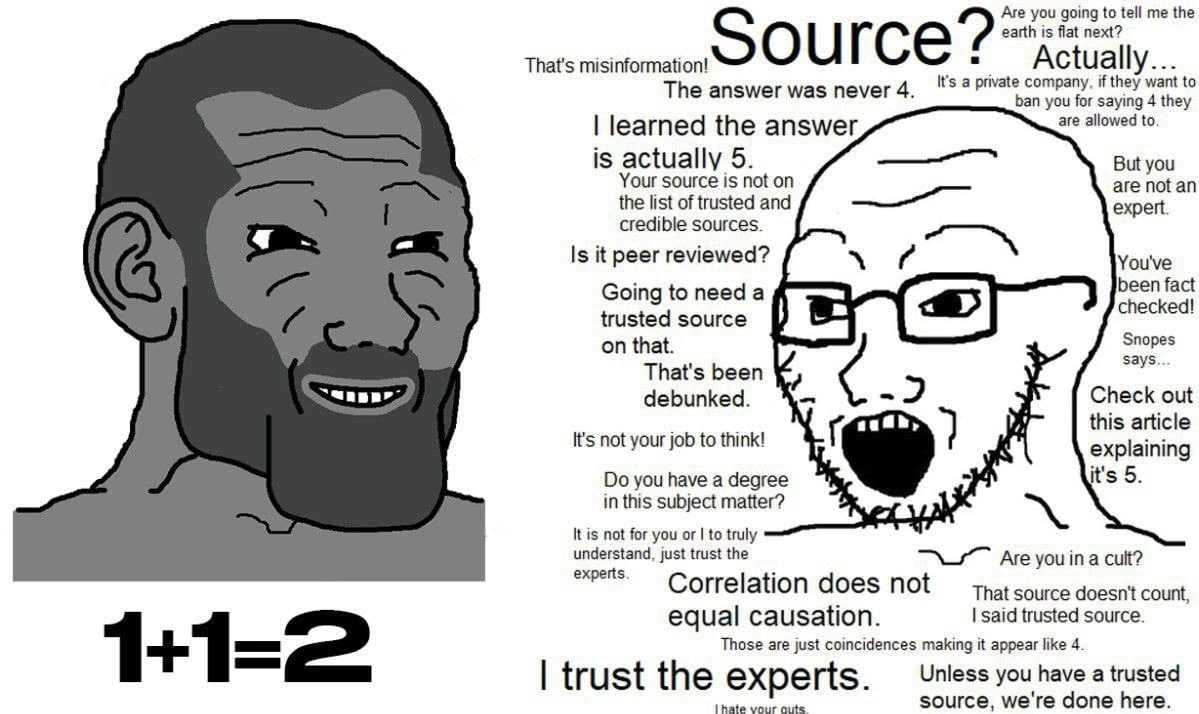
This meme is making a joke just like that. It’s funny because someone is treating a super simple fact (one plus one equals two) like it’s some crazy claim that needs to be checked and confirmed by ten different experts. The left side of the picture has a confident guy stating 1+1=2 (the simple truth). The right side has a nervous, fussy guy with lots of questions and accusations, like “Where’s your source for that? Who said you could say 1+1=2?” It’s as if the second guy just won’t trust what is plainly obvious.
The humor (and the feeling) here comes from how frustrating and absurd that situation is. It’s frustrating because the first person is right and it’s so clear, yet the second person still won’t believe it without unnecessary proof. It’s absurd because in normal life, nobody acts like that for something so basic. The meme is exaggerating to make us laugh: it highlights the idea of someone being so overly skeptical and rule-bound that they demand “proof” for an obvious truth. Even a child can see 1+1=2 with apples, so we laugh at how ridiculous it would be if somebody actually argued about it or insisted on a formal citation. It’s a lighthearted way to say, “Sometimes people ask for proof or paperwork when you really don’t need it – and isn’t that just silly?”
Level 2: Source Control
For a less experienced developer or someone just getting into these team dynamics, let’s break down what’s happening. In software development, when you finish a piece of work (say you wrote some code to add two numbers), you typically create a pull request (PR) so your peers can review your code before it gets merged into the main codebase. Code reviews are meant to catch bugs, suggest improvements, and ensure code quality. It’s like having a friend double-check your homework. Often, reviewers will ask questions or request changes – for example, “Can you explain why you did it this way?” or “Maybe add a comment or documentation here for clarity.” This is normal and helpful.
However, in this meme, the scenario is exaggerated to be funny. The left side shows a confident character (known in meme culture as “Chad”), proudly stating a very simple fact: 1+1=2. In a coding sense, this could be a developer making a super basic code change or comment that should be obviously correct. The right side shows another character (a drawn, worried-looking Wojak figure, often used to depict an overly anxious or nit-picking persona) surrounded by a storm of text. All that text represents the barrage of skeptical comments and demands from a code reviewer or perhaps a documentation reviewer. They’re saying things like “Source?” or “Is it peer reviewed?” which mimic how on the internet or in formal settings people ask for evidence or citations for any claim.
In a real code review, a request for a source might come if you assert something non-obvious. For instance, if your code comment says “We use Algorithm X because it’s the fastest,” a reviewer might ask, “Source? Do we have evidence it’s the fastest?” That’s reasonable. But here the reviewer is effectively asking “Where’s your source that 1+1=2?” – which is silly because 1+1=2 is basic arithmetic taught in first grade. We call this citation overkill – asking for documentation or proof of something that really doesn’t need it. It’s like asking for a scientific reference to prove the sky is blue.
The phrase “source control” normally refers to tools like Git that manage versions of code (the source code). But in our context, it’s a bit of a play on words: the reviewer wants to control the source of information, essentially refusing to accept even the code’s output without an external validation. There’s also a hint of Wikipedia culture here: on Wikipedia, if you write something without a citation, someone will quickly tag it with [citation needed]. In engineering teams, especially ones heavy on documentation or where trust hasn’t been built yet, you might feel like every statement you make in code or design discussions needs to be backed up by a link to a manual, an official spec, or a credible website. That can create a big communication gap between the person who just wants to get the job done (because it’s obviously correct) and the person who wants every ‘i’ dotted and ‘t’ crossed.
The chaotic cloud of phrases on the right includes things like “That’s misinformation!” and “I trust the experts.” These phrases are more commonly seen in social media arguments or Wikipedia edit wars than in code reviews. The meme is drawing a parallel between an over-the-top fact-checker mentality and a nit-picky code review culture. In a development team, this could be poking fun at a scenario where, say, a junior developer fixes a tiny bug or writes a trivial function, and an overzealous senior or architect in the review makes them jump through hoops: “Have you tested every scenario? Do you have documentation to prove this logic works? Can you reference the requirements document section that justifies this output?” Meanwhile, the poor dev is thinking, “It’s just adding one and one… do I really have to explain that it equals two?”
So, in simpler terms: this meme uses a popular internet comic style to show a ridiculous code review situation. The left side is the straightforward developer stating a fact. The right side is like a chorus of overly skeptical reviewers who won’t accept that fact without a ton of paperwork or citations. It’s funny (and relatable to many developers) because it exaggerates real experiences where communication in a team breaks down – when people focus on the wrong things. Instead of trusting a basic truth or using common sense, the reviewers act like the developer said something outrageous, just because no official document was attached.
Level 3: Citation-Driven Code Reviews
At this level, the meme is highlighting a pain point that many experienced developers find all too familiar: overzealous code reviews and documentation requirements that border on ridiculous. The left side “Chad” with 1+1=2 represents a developer stating a commonsense fact or making an obvious code change. The right side is the swarm of pedantic code review comments demanding “Source?!” and raising doubts about that obvious fact. It’s a satire of code reviews that feel less like collaborative improvement and more like an inquisition or a bureaucratic checklist.
In real development teams, especially in large companies or open-source projects, we do require explanations and sometimes references for non-trivial decisions in code. For example, if you implement a complex algorithm, a reviewer might ask for a link to the paper or documentation that inspired it. That’s normal. But this meme pushes it to the extreme: demanding a citation for 1+1=2 – a fact so basic every programmer learns it in grade school. It humorously encapsulates the frustration of having to justify self-evident truths to nit-picky reviewers. It’s as if a colleague reviews a pull request where you literally wrote:
# Compute the sum of one and one
result = 1 + 1
…and then comments:
Reviewer: “Source? Please provide a link to a credible reference proving that 1 + 1 is indeed equal to 2. Is this claim peer-reviewed? 🙄”
This scenario sounds absurd, but it echoes real feelings. Senior devs chuckle (or groan) because we’ve all dealt with processes or individuals who require unnecessary bureaucratic rigor. Maybe you had a tech lead who wouldn’t accept code unless every choice was documented in a design doc. Or a QA engineer who questioned even trivial calculations “just to be thorough.” In some organizations – particularly those with heavy compliance requirements – you might literally have to trace every number and constant in the code to an official approved document. Ever work on a project where you couldn’t even hardcode 2 without pointing to a requirements spec? That’s the vibe here. Citation-driven development is the joke term – as if writing code requires the same level of citations as writing a research paper.
The meme’s right panel phrases like “Is it peer reviewed?” and “Your source is not on the list of trusted and credible sources” parody the language of academic or Wikipedia-style scrutiny. In a code review context, it’s like a senior engineer saying “I won’t take your word for it that this function works; show me the official documentation or a unit test proving it.” Normally, asking for tests or docs is good practice, but asking for a “trusted source” for a straightforward addition is over-the-top. It reflects a communication gap and a lack of trust: the reviewer either doesn’t trust the developer’s basic competence or is religiously following a process without using common sense. It’s also reminiscent of those interminable pull request threads where multiple reviewers pile on with questions and tangents that derail the original simple change. The text “The answer was never 4” or “I learned the answer is actually 5” in the meme mocks the confusion and misinformation that can come from too many opinions – like when a simple issue gets bikeshedded into oblivion.
This is developer humor at its finest because it exaggerates a kernel of truth: sometimes engineering culture values process and documentation so much that we do silly things like fact-checking arithmetic. The meme uses the popular Wojak Chad format (Chad = confident/dev who knows his code is fine; Wojak = the anxious, rule-bound reviewer who can’t accept even basic facts without authority approval) to illustrate the clash. Seasoned engineers see a reflection of meetings or code review battles where someone might say, “Do you have a reference for that approach?” and you’re thinking “Yes, the reference is literally common sense!” It’s a cautionary laugh at our own tendency to over-engineer processes. Sure, peer review is crucial, and documentation is important, but if you take it too far you end up arguing about whether 1+1=2 needs an RFC reference. The senior perspective gets the joke: we’ve been there, dealing with a process that’s so heavy it becomes counterproductive. The meme feels too real for anyone who’s had a pull request where minor, obvious things got endlessly debated. It’s basically saying: let’s not lose sight of practicality, folks – not everything needs a memo or source. Sometimes, you can just accept that one plus one equals two without filing a ticket or citing Stack Overflow!
Level 4: Formal Proof Overkill
The meme’s absurdity hints at formal methods and the extreme end of documentation pedantry. In theoretical computer science and math, even a statement as simple as 1+1=2 can demand rigorous proof. In fact, in Principia Mathematica (1910) Bertrand Russell and Alfred Whitehead famously took hundreds of pages to prove 1 + 1 = 2 from fundamental axioms! 😅 This level of detail is overkill for everyday coding, but it’s exactly what the code reviewer in the meme seems to expect. They want a citation or academic-grade evidence for an elementary arithmetic operation. It’s like treating a pull request as a PhD thesis defense – every line of code must be justified with a reference to some authoritative source or formal proof.
From a really deep tech perspective, this satire touches on the idea of formal verification in software. In safety-critical systems (like aerospace or medical devices), engineers sometimes use proof assistants or model checking to mathematically verify that the code behaves correctly. Typically, though, we don’t demand a proof for 1+1=2 in a code review – that’s considered an axiom. The hardware and programming language already guarantee this truth: an ADD CPU instruction or a high-level + operator is defined to produce the correct sum (at least for small integers before any overflow). Demanding a peer-reviewed publication to trust basic addition is like requiring a full proof of correctness for the most trivial operation. It’s technically not wrong – hey, mathematics can prove it – but it’s completely impractical.
Essentially, the humor at this level comes from applying ultra-rigorous, academic standards to everyday programming. Imagine a reviewer insisting on a proof by induction or a citation from a discrete math textbook just to accept a code change that does return a + b;. It’s the collision of simple coding with the heavy weight of formal logic. The meme exaggerates this collision: the left panel’s Chad confidently states the obvious truth 1+1=2, while the right panel’s Wojak treats it like a research claim requiring a bibliography. It’s a playful poke at how absurd it would be if software engineering truly worked like a formal scientific journal at all times – the citation overkill approach to development. The joke resonates because no senior developer wants to literally prove basic arithmetic in a code review; we rely on well-established fundamentals. By invoking this extreme, the meme highlights how silly it is to demand authoritative sources for something so self-evident, hinting that sometimes our processes overshoot what’s reasonably needed.
Description
This is a 'Chad vs. Soyjack' Wojak meme contrasting two approaches to knowledge. On the left, a calm, bearded 'Chad' character represents simple, undeniable truth, with the equation '1+1=2' written below him. On the right, an agitated, screaming 'Soyjack' character is surrounded by a cloud of text representing arguments from authority and process. These phrases include 'Source?', 'That's misinformation!', 'I learned the answer is actually 5', 'Your source is not on the list of trusted and credible sources', 'Is it peer reviewed?', 'Going to need a trusted source on that', 'That's been debunked', 'I trust the experts', and 'You've been fact checked!'. The meme critiques the modern discourse where fundamental logic is often dismissed in favor of appeals to authority, approved sources, and procedural gatekeeping. For senior developers, this is a deeply relatable scenario, representing the frustration of proposing a simple, effective technical solution only to be blocked by corporate bureaucracy, process zealots, or stakeholders who demand validation from 'approved' articles or consultants rather than accepting demonstrable proof and first-principles reasoning
Comments
43Comment deleted
Yes, I know the handwritten SQL query is faster. But our 'Center of Excellence' debunked it in a whitepaper from 2018. Please use the ORM, even if it generates a 50-table join that times out
Submitted a one-line PR: “1 + 1 = 2.” Review thread: “Please attach the ADR, SOC-2 control mapping, RFC for the ‘+’ operator, and a chaos test proving commutativity under partial outages.”
This perfectly captures that one architect who demands a formal RFC with three competing implementations and a proof of concept before accepting that your O(n) solution is indeed better than their O(n²) one - but only if you can cite a paper from a FAANG engineer published after 2020
Same energy as the PR comment thread where 'this is O(n²)' gets met with 'do you have a link to a blog post saying that's bad?'
When your pull request gets rejected not because the code is wrong, but because you didn't cite three peer-reviewed papers, get sign-off from the architecture review board, and prove you have a PhD in the specific framework version being used - even though the fix is literally changing a typo from 'flase' to 'false'. Sometimes the simplest truths require the most Byzantine approval processes
Nothing like a PR where '1+1=2' gets blocked until you attach an RFC, reproducible benchmark, and a JIRA - meanwhile production quietly reports it’s 5
Tried to commit 1+1=2; governance blocked it with “source?” because the vendor whitepaper says it’s 5 - turns out in distributed orgs, truth is eventually consistent
Peer-reviewed like a PR with one approval: 'LGTM' from the author, debunked by CI fails
Real story lol. It’s me on the right side Comment deleted
А я слева Comment deleted
use english please Comment deleted
Ah sorry Comment deleted
Well we all know cases when it’s wrong. E.g. in binary Comment deleted
same Comment deleted
translations: > I'm on the right > Oh im on the left Comment deleted
> I'm in the middle Comment deleted
> "1+1=2" > "The answer was never 4" Comment deleted
The answer is one. Because 1=2 is False, which implicitly converts to 0. 1+False equals 1. //my native language is not JavaScript Comment deleted
Lol Comment deleted
actually... 1+1=2 Uncaught SyntaxError: invalid assignment left-hand side 1+1==2 true 1+(1==2) 1 Comment deleted
1 + 1 = 2 means that you give to a "1 + 1" valuable value "2". But since there's no quotes, it can't do that. And == just compares Comment deleted
what about pascal Comment deleted
idk anything about pascal Comment deleted
They use := assignment iirc Comment deleted
who on earth uses pascal? Comment deleted
...but just few years ago Microsoft bough a piece of software written in Delphi (Object Pascal) for 8.5 billion USD. You might have heard of Skype. https://www.quora.com/Is-Pascal-still-used (a question from 2014) Comment deleted
when was ir written? Comment deleted
So what? If you spend a 10-figure sum for a software written in bloody COBOL, you are not rewriting it for nodejs when you need to add a function. You unpack your cobol books from seventies and write in bloody cobol. Comment deleted
well im not skype developer Comment deleted
However I think Microsoft did exactly that. Initially they had "Lync" and "Skype", they renamed "Lync" to "Skype for business" and at some point they just killed the original Skype in favor of a Lync'ish version. But Microsoft has a rich history of killing such projects. Comment deleted
And the question itself was answered in 2014 Comment deleted
Total Commander Comment deleted
and skype is shit, it's easy to see that it's on pascal Comment deleted
have you seen how they make direct calls when BOTH recipients are behind NATs? It's some pretty cool shit dude. Comment deleted
still better than its successor, teams… Comment deleted
there are tons of ways hoe to communicate through voice except those two Comment deleted
Oh, no, Skype is amazingly great! I mean, it was, before Microsoft completely ruined it Comment deleted
well, when it was not Microsoftish, it was great comparing to its times. Since it's still on those times' level, it isn't great anymore Comment deleted
to my knowledge, they decided against using a TURN server and used essentially a udp bomb attack instead. Two servers hitting a NAT from both sides on random ports until they accidentally get a direct connection. But I have read it somewhere and didn't check it myself. Comment deleted
1+1=10 Comment deleted
And yes, Borland Pascal compilers were so good that it still on par in terms of performance with well-written C++ code. Because of, both, how well language is designed and how well designed and written compilers (currently maintained by Embarcadero) for it Comment deleted
Somehow in those days when C-like syntax languages became so popular that most people hate languages with not C-like syntax by default Comment deleted
why Comment deleted