Skip to content
DevMeme
457 of 7435
Asynchronous Jokes and Synchronized Tears
DistributedSystems Post #526, on Aug 6, 2019 in TG

Asynchronous Jokes and Synchronized Tears

Why is this DistributedSystems meme funny?

Level 1: Don’t All Cry at Once

Imagine you’re in a classroom and the teacher asks, “What game do we want to play?” and the kids shout “Hide and seek!” Then the teacher asks, “When do we want to play it?” and all the kids yell “Right now!” That’s a normal scenario. But now picture this: one cheeky kid stands up and says, “What do we want? A game where we don’t have to wait for turns! When do we want it? Right now!” The class might giggle because it’s a bit silly — if the game is one where you don’t wait for turns (everyone can play at once), asking for it “right now” is kind of obvious, yet also a little contradictory if the game itself is about not waiting. It’s like saying “we want a no-waiting game, and we can’t wait to play it!” There’s a funny loop in that logic.

Now, think about a bunch of people trying to talk or do something all at the same time. It becomes chaotic, right? In our daily life, if everyone tries to speak at once, nobody understands anything — it’s just noise. That’s what happens in computers too when a bunch of things run at the same time without coordination. In the meme, when they say “Asynchronous messaging jokes!” it’s like saying “we want everyone telling jokes at once, without waiting.” And then shouting “Now!” is like everyone actually starts trying to tell their joke simultaneously. What would that sound like? A crazy babble of voices — pretty confusing and funny in a ridiculous way.

So one person in the conversation responds by joking, “Cries in multithread.” Imagine one of the kids in that chaotic everyone-talks-at-once game just covering their ears and pretending to cry because it’s so confusing. They’re basically saying, “This is too much! I can’t handle everyone joking at the same time!” It’s a humorous way to show the feeling of being overwhelmed.

Then another person suggests a “Solution” in a sort of pretend-code way: let’s make a rule that only one person can cry at a time. It’s like the teacher stands up and says, “Okay, new rule: everyone will take turns crying or complaining, one by one, so it’s orderly.” This is funny because it’s over-the-top. The kids went from wanting a game where no one waits, to now having a strict rule that even crying (or reacting) has to be done one at a time, in sync.

Finally, the last comment just says “synchronized { }” which, in our classroom analogy, is like holding up a sign that says “ONE AT A TIME” and nothing else. No specific activity, just the concept of taking turns enforced on everything. It’s as if someone concluded, “We can solve all this chaos by making sure only one person does anything at any given moment.” It’s obviously the exact opposite of the original idea of everyone doing stuff without waiting, and that’s why it’s amusing.

At its core, the joke is funny because it’s showing a bunch of people (or threads, in computer terms) trying to do things together and the result is so messy it makes someone want to cry. The “solution” they give is basically the simplest, most extreme fix: make everyone wait their turn. It’s like if a group project was too unorganized with everyone working at once, so the teacher says “Alright, you’ll all work on it, but one after the other while the rest of you sit quietly.” That would certainly stop the chaos, but it also kind of defeats the purpose of working together at the same time!

The whole meme is an inside joke among programmers. They often deal with “many things happening at once” in their code (just like kids all talking at once) and have to figure out rules to keep things from getting tangled up. If they get it wrong, the program can act crazy or break — which is really frustrating (hence the crying). One way to fix those problems is to make the program do only one thing at a time in certain places (like making kids take turns). That fixes the confusion but also means you lost the benefit of doing things simultaneously. The meme captures this dilemma in a playful way. Even if you’re not a programmer, you can relate to the idea of too many people talking at once causing trouble, and the overly strict solution of “one at a time, please.” It’s the contrast between wanting freedom (everyone do stuff whenever) and needing order (wait your turn) that makes it humorous. Plus, the dramatic “Cries in multithread” line is like a little cartoon moment — you can almost see a frazzled character in a busy room just weeping because it’s so nuts around them.

In short, it’s funny and charming because it turns a nerdy concept (how computers handle multiple tasks at once) into a relatable scene: a protest and then a classroom with a teacher enforcing turn-taking. Whether you get all the tech terms or not, the image of going from “We want it now with no waiting!” to “Alright, nobody do anything at the same time!” is a goofy reversal that anyone can chuckle at.

Level 2: One at a Time, Please

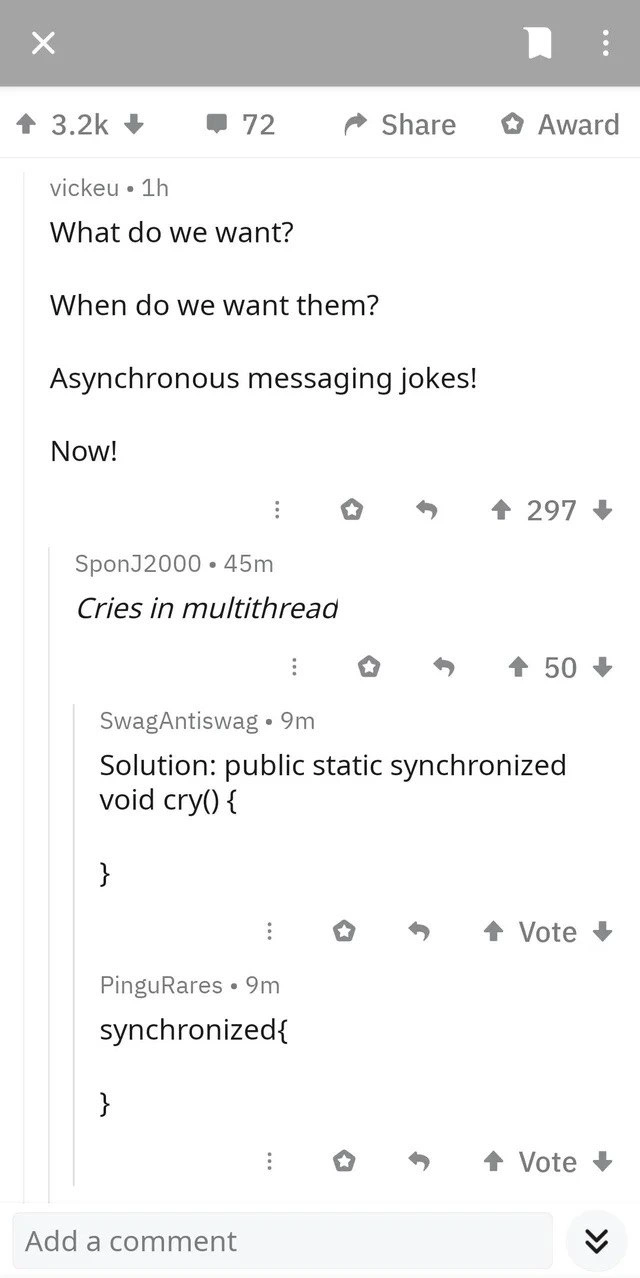
Let’s break down the joke in simpler terms and explain the jargon. The meme is structured like a little skit using a protest chant. You know those scenes where a leader shouts, “What do we want?” and the crowd yells something back, then “When do we want it?” and the crowd hollers “Now!” This meme imitates that, but with a programmer twist:

  • Question: “What do we want?”
  • Answer: “Asynchronous messaging jokes!”
  • Question: “When do we want them?”
  • Answer: “Now!”

Now, asynchronous messaging in programming means sending messages or doing work in a way that doesn’t block or wait. If something is asynchronous (async for short), you kick it off and then go do other things; you don’t stall everything until it’s done. A classic example is sending someone a text message: you send it (that’s async) and you don’t just stand there frozen until they reply — you can do other stuff and when they reply, you deal with it. In code, async might look like starting a task or making a request and handling the response later via a callback, a promise, or an event. In contrast, synchronous means you wait right there for the task to finish, like making a phone call and not doing anything else until the call is over.

So the first line, “Asynchronous messaging jokes!”, implies the crowd wants jokes about asynchronous messaging (the concept of doing things without waiting). The very next line, “Now!”, is the funny part because “now” implies not waiting — which is exactly what asynchronous operations avoid guaranteeing. It’s a playful contradiction. It’s like saying “We want to hear jokes about not waiting for things… and we don’t want to wait for them!” 😄 This sets up the comedic tone by using a CS fundamental concept (asynchrony) in a silly human way.

The comment that follows is “Cries in multithread.” This line is written in italics (at least in Reddit’s formatting, putting text between asterisks like this makes it italic). When someone writes *cries in X*, it’s an internet meme way of humorously saying “I’m so frustrated by X that I could cry,” or “This situation with X is making me emotional.” Here, X is “multithread,” referring to multithreaded programming.

Let’s explain multithreading: A thread is like a mini-program or a stream of instructions that can run in parallel with others within the same application. When a program is multithreaded, it has several threads running at the same time, possibly on different CPU cores, performing various tasks concurrently. This can make programs faster or more responsive, because they can do multiple things at once. However, if those threads need to work with the same data or resources, things get tricky. Without careful coordination, two threads might try to change the same data at the same time, leading to a mess called a race condition (where the program’s outcome “races” and depends on who finishes first, often causing bugs). Managing threads is hard; they can run in unpredictable orders, and you get problems like deadlocks (two threads waiting on each other forever) or other synchronization issues. In short, multithreading is powerful but comes with a lot of headaches.

So when someone says “Cries in multithread,” they’re joking that dealing with threads is so painful or complicated that it makes them want to cry. It’s a humorous way for the commenter to say, “Haha, I feel the pain of trying to make asynchronous things work — been there, and it’s rough!” This resonates with many developers, which is why that comment got a lot of upvotes (in the screenshot you see a little score next to it, meaning many people liked it).

Now the next reply provides a tongue-in-cheek solution in actual code:
Solution: public static synchronized void cry() { }

Let’s unpack that Java code:

  • public means the method is accessible from anywhere (not too important for the joke itself, but it’s part of typical method declaration).
  • static means this method belongs to the class, not to any one object instance. There will be one lock for all calls to this method across all objects (since it’s tied to the class).
  • synchronized is the big one: this is a Java keyword used for synchronization (controlling access in multithreading). When a method is declared synchronized, Java will allow only one thread to execute that method at a time for a given object (or class, if static). It’s like putting a big “One at a time, please” sign on the method. If Thread A is inside cry(), Thread B trying to call cry() will have to wait until A is done. This prevents them from running it simultaneously and possibly messing up shared data. In this joke, we don’t even have shared data – the method is empty – but that’s part of the humor.
  • void cry() is just the method name and the fact that it returns nothing (void). They named the method cry — because, well, the previous comment was about crying in multithread, so they’re making it a literal function.
  • { } the curly braces are empty, meaning the method body has no code inside. It doesn’t actually do anything (no print, no change in state, nothing). It’s literally a no-operation method.

So putting it together: public static synchronized void cry() { } defines a globally synchronized method to cry that does absolutely nothing. The commenter labeled it “Solution:” as if this is the answer to the problem of crying in multithread. It’s a joke that basically says: Alright, if multithreading is making you cry, here’s a safe way to cry. We’ll make sure only one thread can cry at a time, so there’s no chaos. It’s poking fun at how developers sometimes respond to concurrency problems by just slapping synchronized on everything. That does solve a lot of threading issues (because if only one thread runs at a time in a critical section, you avoid conflicts), but it also kind of defeats the purpose of having multiple threads (since you’re forcing them to wait their turn anyway!). It’s both a tech joke and a bit of self-deprecation on developers: sometimes our grand concurrent designs end with us effectively making the code single-threaded again just to stop the bugs.

The fact that cry() has no code inside is also humorous. It implies that calling this function doesn’t actually fix anything or produce output — it’s just a formal way to cry. Imagine a team of threads each wanting to cry about the complexity; this method lets them do it one by one, in a controlled fashion. It’s like saying “we haven’t fixed the bug, but at least our threads are politely taking turns sobbing.” The empty braces could also be seen as the code that made us cry has been removed (since inside the synchronized block there’s nothing left – maybe we deleted the problematic concurrent code entirely and now there’s just tears).

Finally, the last reply simplifies it even more to just:
synchronized{ }

In Java, normally you’d use a synchronized block with an object, like:

synchronized(lockObject) {
    // some code
}

But here they just wrote synchronized{ } as a humorous shorthand. It’s not valid Java syntax by itself — it’s missing the lock object or the context — but everyone reading the thread understands the gag. This user basically stripped the idea down to its bare minimum: Just synchronize. That’s it. That’s the joke. It’s almost like a punchline that says, “the answer to all our multithreading woes: just use synchronized (and do nothing else)”. This makes the previous “Solution” even more absurd by reducing it to a conceptual essence. In plain terms, it’s like saying: “To solve the problem, we’ll simply synchronize... whatever, doesn’t matter what’s inside, we’re just going to synchronize everything and hope for the best.” It’s cheeky and it made other developers chuckle because it satirizes a very real inclination when you’re fed up with thread issues — you just lock things down without even thinking about what the code does anymore.

All of this is happening on a Reddit thread (the screenshot shows Reddit’s interface with upvotes and comments). Reddit is an online community platform, and subreddits like r/ProgrammerHumor or r/codingmemes are places where developers share jokes, memes, and funny anecdotes about programming. This particular thread shows multiple users building on each other’s jokes. That’s common in dev communities: one person makes a reference, others pile on with increasingly geeky twists. It’s almost like an improv comedy scene but with code and tech references.

To recap the terms in a beginner-friendly way:

  • Asynchronous (async): not happening immediately or not causing the program to wait. Like sending a letter versus making a phone call.
  • Synchronous (sync): happening in step, often means one thing must finish before another can start. Like having a face-to-face conversation (you speak, then wait for the other to reply right then).
  • Thread: a smaller sequence of operations within a program that can run concurrently with others. Think of threads like multiple workers in a kitchen cooking at the same time.
  • Multithreading: using multiple threads (workers) at once. Great for getting things done faster or handling many tasks, but if they need to use the same resources (like two cooks needing the same pan), you need rules.
  • synchronized (Java keyword): one of those “rules” to manage threads. It’s like a sign on a resource that says “one at a time.” If a method or block is marked synchronized, a thread must acquire a lock to enter, and if another thread is already inside, the second thread must wait. Once the first leaves (releases the lock), the next can enter. It prevents chaos (like two threads writing to the same file at once) but also forces waiting.
  • Race condition: when two threads are competing (racing) to do something and the outcome changes based on who wins the race. This is a bug because you get inconsistent results.
  • Deadlock: when two or more threads are stuck waiting for each other to release resources, so nobody can proceed (like two people each holding one end of two sticks of butter, and neither can cook because each is waiting for the other to give up their butter — they’ll wait forever).
  • “Cries in X” meme: an internet way to express frustration or emotion about X. Example: “cries in JavaScript” might be said when JavaScript does something weird, meaning the person is jokingly crying because of it.
  • What do we want? X! When do we want it? Now!: A meme formula derived from protest chants, used for comedic timing especially when X and “now” don’t logically fit together. Here X = asynchronous jokes, which by logic can’t be demanded “now” without irony.

So the whole Reddit exchange is a multi-layered joke about concurrency. It starts simple and gets more technical as it goes, ending in a snippet of Java code. If you’re newer to programming or Java, the key thing to understand is they’re joking about how hard it is to coordinate things happening at the same time (async and multithreading), and how the “solutions” can be a bit ridiculous (like making a special synchronized function just for crying). The conversation exaggerates the scenario to make us laugh, but it’s rooted in real experiences. Developers often vent through humor in this way.

Level 3: Synchronized Sobbing

For seasoned developers, this meme hits right in the feels (or should we say, right in the threads). It takes a well-known protest chant formula and twists it with tech lingo, creating instant hilarity. Why is it so funny? Because it reflects a scenario we’ve all lived through: wanting the benefits of asynchronous systems (more performance, no waiting) but ending up dealing with the headaches of thread synchronization and timing issues. The call-and-response joke goes:

  • Leader: “What do we want?”
  • Crowd: “Asynchronous messaging jokes!”
  • Leader: “When do we want them?”
  • Crowd: “Now!”

This is a classic meme format where the punchline is a mismatch – here the mismatch is between asynchronous tasks and wanting them immediately. Every experienced dev smirks at this because it’s a common irony: managers say “make it asynchronous for scalability, but also I need real-time results.” It’s the kind of unrealistic demand that leads to a lot of eye-twitching in stand-up meetings. We recognize that asynchronous operations by nature don’t complete “now” on command. That’s the whole point – you fire them off and do other things in the meantime. The chant humorously exposes how absurd it sounds to demand “async, now!” in one breath. It’s like yelling at a background job to hurry up: sure, you can yell, but the whole design is that you can’t have it instantly. Developers with battle scars from mismanaged concurrency chuckle (and maybe wince) at this because it’s a scenario that plays out in real projects all the time.

Then comes the comment “Cries in multithread.” This line is pure developer humor gold, riffing on a broader meme format where you express an emotion “in [language/framework].” You’ve probably seen jokes like “laughs in SQL” or “screams in JavaScript.” Here, crying in multithread perfectly encapsulates the collective pain of debugging concurrent code. Any senior engineer who’s spent nights chasing a heisenbug or a race condition will tell you that multithreading can indeed reduce one to tears. It’s a shared trauma in the dev community: threads can misbehave in nondeterministic ways, and when things go wrong (e.g., random crashes, data corruption, deadlocks), you might literally feel like crying. So this comment is both a humorous exaggeration and a nod of commiseration — “I too have suffered in the chaos of threads.” On Reddit’s DevCommunities, this is how we bond: by joking about the nightmares of our craft. Seeing that comment with 297 upvotes means a lot of folks went “yep, been there, friend.”

Next, user SwagAntiswag swoops in with a “Solution”:

public static synchronized void cry() { }

Now, to an experienced dev, this is hilarious on multiple levels. First, it’s mocking the idea that the only thing left to do is to cry, but hey, let’s at least do it in a thread-safe way! The code defines a cry() method that’s synchronized and static. Synchronized in Java is a keyword that makes the method a critical section — only one thread can execute it at any given time. By making it public static synchronized, they’re essentially saying: “No matter how many threads want to cry, we’ll force them to take turns crying one-by-one in an orderly fashion.” 😅 It’s a tongue-in-cheek reference to a common senior developer coping mechanism: when faced with insane concurrency bugs, sometimes the “solution” is to slap synchronized everywhere to stop the bleeding. Sure, it might tank your parallel performance, but it prevents threads from stepping on each other’s toes. This comment is playfully suggesting: if multithreading makes us cry, let’s at least serialize the breakdown so we don’t get tangled up in each other’s tears (no tear race conditions here!).

For those of us who have dealt with Java, the humor goes deeper: a static synchronized method uses the class-level lock. That means even if you had 100 objects, they all share one lock for that method. It’s like declaring, “Only one thread in the entire JVM can be crying via this method at once. Others must wait their turn in line to sob.” It’s absurd but relatable — how many times have we effectively disabled concurrency by overusing locks because the concurrent approach was too hard to get right? This one line of code lampoons that knee-jerk reaction. It’s the coder’s equivalent of saying, “Alright, everybody calm down, form an orderly queue to have your breakdowns.” The empty { } body of the method is the cherry on top: it implies that cry() actually does nothing (no logging, no fixing, just an empty function). In other words, it’s not actually resolving the problem — it’s just a formalized way to express despair. The code does nothing except ensure that only one thread at a time can do that nothing. That’s hilariously dark to an experienced programmer: we’ve essentially halted progress (synchronized) and accomplished zilch, which sometimes feels like our late-night debugging sessions in a nutshell.

Finally, PinguRares replies with just:

synchronized{ }

This is a super minimalist wink to the crowd, simplifying the previous solution to its bare bones. It’s as if they’re saying, “Let’s not even bother with method names or crying logic — let’s just throw a synchronized block around the void and call it a day.” It’s a bit of absurdist code humor. Any Java developer knows synchronized normally guards a block of code or a method, and you’d specify an object to lock on (e.g., synchronized(this) { ... }). Here we see just the keyword and braces, no object, no code — almost like a code-golfed protest sign reading “synchronized block goes here.” It symbolizes the ultimate surrender to synchronization: just lock everything down, period. Experienced folks see the meta-joke: sometimes in a multi-threaded fiasco, you get tempted to just lock { } everything, wrapping your entire logic in one giant mutex. We laugh (perhaps a bit nervously) because we know that feeling. The progression of the thread’s replies is essentially telling a story every senior dev knows well: start with ambitious async plans, hit the wall of concurrency complexity, end up making everything synchronized (and crying anyway).

Also notable is that this conversation is happening on Reddit – the screenshot’s context (3.2k ↑ 72 → Share Award) suggests it’s a popular r/ProgrammerHumor style thread where devs riff off each other’s jokes. This collaborative joke-building is common in dev communities. One person lays the setup (“async jokes now!”), the next adds a witty follow-up (“cries in multithread”), and others escalate with deeper technical punchlines (synchronized void cry()). For a seasoned dev, it’s delightful to see multiple layers of inside jokes stacked like this, each one upping the ante. It’s practically a mini code-review of humor: each reply refactors the last comment into an even geekier joke. By the end, everyone in the thread is in on it — we’ve gone from a high-level concept (async vs now) to a low-level code construct (synchronized) as the final comedic mic drop.

In summary, the humor resonates strongly with anyone who’s dealt with asynchronous programming and multithreading in real life. It’s funny because it’s true: we want things to be concurrent and fast, but managing that is hard enough to make us cry, and the blunt instrument of synchronization, while not elegant, often becomes the go-to fix. This meme pokes fun at that reality. As a senior dev, you laugh, then sigh, remembering that time you effectively turned an async system into a single-file line with locks because nothing else was working. Synchronized sobbing, indeed.

Level 4: Parallel Protest Paradox

At the heart of this meme is a concurrency contradiction that tickles any computer scientist’s brain. The chant format — “What do we want? Asynchronous messaging jokes! When do we want them? Now!” — sets up a paradox of time and order in computing. In a truly asynchronous system (like message-passing between threads or distributed nodes), tasks don’t complete immediately on demand. They progress independently, and results are delivered whenever ready (think of sending a message and eventually getting a reply). Demanding an asynchronous result “Now!” is inherently contradictory, much like expecting a reply from an email the instant you hit send. This irony is the crux of the humor: it highlights the tension between concurrency models that favor independence and the human desire for instant gratification.

In computer science terms, asynchronous messaging decouples senders and receivers in time, often leading to eventual outcomes rather than immediate ones. It's akin to the actor model or an event loop where messages are handled one by one, but the sender doesn’t wait around. By contrast, shouting “Now!” implies a synchronous, blocking expectation — something will happen right this moment in a deterministic order. The meme cleverly brings this theoretical conflict to the surface in a simple protest chant. It’s essentially pointing out a parallel paradox: wanting the benefits of concurrency (lots of things happening at once, no waiting) while also wanting the predictability of sequential timing (having results right away).

The replies dive deeper into concurrency control concepts. The italicized “Cries in multithread” evokes the reality of thread-based parallelism: multiple threads running at once can lead to chaos if not coordinated. In formal terms, threads executing concurrently can interleave in unpredictable ways (due to scheduling by the OS or runtime). Without constraints, you get race conditions — those notorious bugs where the system’s outcome depends on unlucky timing. The joke here is almost a tongue-in-cheek nod to the happens-before relationship defined in the Java Memory Model and Leslie Lamport’s concurrency theory: developers cry when they realize that without proper synchronization, there’s no well-defined order of events across threads. The humor intensifies when the next comment suggests a remedy by introducing Java’s synchronized keyword, which is a classic mechanism to impose order on chaos.

The code public static synchronized void cry() { } is more than just a witty snippet — it’s referencing a fundamental concept from operating systems and concurrent programming. In theory, synchronized in Java uses a monitor (an internal lock) to enforce mutual exclusion: only one thread can execute that method at a time. This effectively creates a happens-before guarantee — any thread that calls cry() must wait its turn until the previous one finishes (no two threads can cry in parallel, so their tears are neatly ordered 😅). It’s a direct application of the classic mutual exclusion problem that Edsger Dijkstra and Tony Hoare tackled in the 1960s and ’70s (Hoare’s Monitors being the inspiration for Java’s synchronized). By making the method static synchronized, it locks on the class object itself, meaning all threads across all instances line up to use cry(). In essence, it’s a comically over-engineered “solution” that serializes crying — a play on how heavy-handed synchronization can solve concurrency issues by practically eliminating concurrency.

The final reply simplifies it further to just synchronized { }. This references a synchronized block with nothing in it, which in a way satirizes the ultimate end-state of overusing locks: sometimes we end up synchronizing blocks of code that do nothing or locking everything so much that concurrency is nil. It’s a minimalistic nod to the idea that if multiple threads cause too much trouble, you can always lock (synchronized) literally everything down to restore order — an extreme theoretical solution where the system’s throughput might halt, but at least it’s safe from race conditions. In concurrency theory, this is like taking the two generals problem or any asynchronous coordination problem and “solving” it by forcing a strict order on events (no general moves until the other is completely done — which, while eliminating uncertainty, also destroys parallel progress). The meme’s humor lives in this nerdy realization: it’s exposing a core truth of concurrent systems in a lighthearted way. The protest for asynchronous freedom quickly devolves into synchronous control, reflecting the eternal trade-off in computing between letting things run wild in parallel and needing to reign them in for consistency. The asynchrony paradox presented is both absurd and relatable — a tiny protest that educates us about the fundamental nature of multithreading and synchronization through a comedic lens.

Description

A screenshot of a Reddit comment thread where a user tells a joke that plays on the structure of protest chants. The first comment reads: 'What do we want? When do we want them? Asynchronous messaging jokes! Now!'. The humor comes from the punchline 'Now!' being delivered out of order, mimicking the nature of asynchronous operations. Below this, a comment chain builds on the joke. The first reply says, 'Cries in multithread', alluding to the complexities of concurrent programming. The next reply offers a solution in Java-like syntax: 'Solution: public static synchronized void cry() {}', a method to ensure only one thread can 'cry' at a time. A final reply offers a more concise version: 'synchronized{}'. This meme is a layered joke for experienced developers. It starts with a clever pun on asynchronous messaging and then dives into a common backend problem - managing state in a multithreaded environment - and its solution using synchronization, a fundamental concept in concurrent programming


Comments

7
Anonymous ★ Top Pick The original post is a great async joke. The replies are the thread-safe callback function
  1. Anonymous ★ Top Pick

    The original post is a great async joke. The replies are the thread-safe callback function

  2. Anonymous

    Reddit just replayed our architecture review: product chants “async or bust,” SRE whispers “cries in multithread,” and the Java lead proudly offers `public static synchronized void cry()` - an “event-driven” system with one gigantic global lock

  3. Anonymous

    The real joke is that we spent years moving from threads to async/await just to end up wrapping everything in synchronized blocks anyway because someone's SharedMutableState singleton is crying harder than a junior dev discovering their first race condition in production

  4. Anonymous

    The beautiful irony here is that wanting asynchronous messaging 'Now!' perfectly captures the cognitive dissonance every senior engineer experiences when stakeholders demand 'real-time async updates' - a phrase that makes about as much sense as 'synchronized void cry()'. Though honestly, after debugging enough race conditions in production at 3 AM, that synchronized cry() method might be the most relatable code I've seen all week. At least it's thread-safe emotional breakdown management

  5. Anonymous

    We asked for async messaging and someone shipped public static synchronized void cry(); congrats - you’ve globally serialized humor with a single class monitor

  6. Anonymous

    When the PO demands “async jokes now,” we ship public static synchronized void cry(), because human linearizability is still cheaper than distributed ordering guarantees

  7. Anonymous

    Async for scalability dreams, sync with 'public static synchronized' when the deadline single-threads your soul

Use J and K for navigation