Skip to content
DevMeme
1030 of 7435
Password Policy Requires Emoji Entropy
Security Post #1158, on Mar 19, 2020 in TG

Password Policy Requires Emoji Entropy

Why is this Security meme funny?

Level 1: The Magic Sticker

This is like a door guard saying your giant strong key is not allowed unless it has a funny sticker on it. The sticker might make the key look special, but it does not automatically make the door safer. The funny part is that the website acts very serious while asking for something strangely specific.

Level 2: Strong Is Not Weird

A dictionary attack is when an attacker tries many common words or known password patterns to guess a password. Defenses include using long random passwords, limiting repeated login attempts, checking against breached-password lists, and storing password hashes properly.

An input validation rule checks whether a user typed something acceptable. Password forms often require uppercase letters, numbers, symbols, or minimum length. The image makes that idea absurd by requiring an emoji. It is funny because the form acts like the missing emoji is the one thing preventing disaster.

For a junior web developer, the key lesson is that password rules should work with password managers and real users. A good password manager can generate long random passwords that humans do not need to memorize. If a site rejects those passwords because they lack a special decorative character, the site may be making users less safe by encouraging predictable hacks like adding the same extra symbol every time.

The screenshot is a UX failure because the user sees the error only after entering a password. The form does not explain the rule ahead of time, and the error message gives no reason beyond compliance. Security controls should reduce risk without turning account creation into a guessing game.

Level 3: Unicode Security Theater

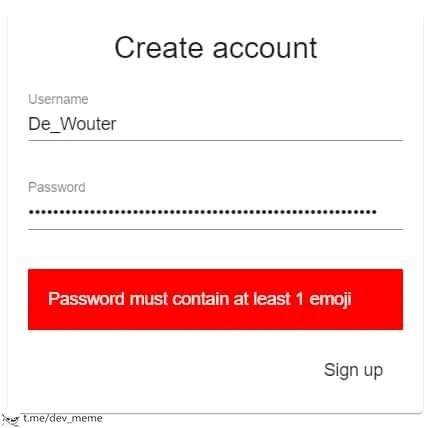
The screenshot shows a simple signup form:

Create account

with username:

De_Wouter

and a red validation error:

Password must contain at least 1 emoji

The post message jokes that this is how you “protect you users” from dictionary attacks. The humor is that the rule sounds like password hardening, but it has the smell of security theater: a visible requirement that feels sophisticated while pushing complexity into places users and systems are least prepared to handle it.

Password strength is not created by collecting one symbol from each novelty bucket. A password like Password1! satisfies many old complexity policies and is still terrible. Requiring an emoji could increase the search space in theory, but real security depends on length, unpredictability, password-manager compatibility, rate limiting, breach detection, secure hashing, and not training users to invent memorable patterns just to appease a form.

The nasty engineering detail is Unicode. Emoji are not a tiny, simple character class. They can involve multiple code points, variation selectors, skin-tone modifiers, zero-width joiners, platform-specific rendering, and normalization behavior. A system that says “must contain at least 1 emoji” now has to answer annoying questions:

  • What counts as one emoji?
  • Does the backend validate the same way as the frontend?
  • What happens when a mobile keyboard inserts a composed sequence?
  • Can the user type the same password reliably on another device?
  • Does logging, masking, copy-paste, or password-manager storage preserve it exactly?

That is a lot of operational risk for a signup form whose visible behavior is already hostile: the user has typed a long masked password, and the application blocks them with a bright red rule that may not map to actual safety. The best version of security vs usability helps users choose strong credentials without forcing them into weird rituals. This version makes the auth system look like it was designed by someone who heard about entropy during a lunch meeting and immediately opened Jira.

Description

A minimalist account creation form shows the heading "Create account" with fields labeled "Username" and "Password." The username field contains "De_Wouter," the password field is filled with hidden bullet characters, and a large red validation error says "Password must contain at least 1 emoji." A "Sign up" action appears at the lower right. The joke targets arbitrary password-complexity policies and UX-hostile validation rules that look like security but often just optimize for user frustration and weird credential patterns.

Comments

1
Anonymous ★ Top Pick Nothing says mature auth posture like turning Unicode normalization into part of the incident response plan.
  1. Anonymous ★ Top Pick

    Nothing says mature auth posture like turning Unicode normalization into part of the incident response plan.

Use J and K for navigation