Pascal's version of 'braces at home'
Why is this Languages meme funny?
Level 1: We Have {} at Home
Imagine you’re a kid who really wants the newest, coolest toy that all your friends have – say, a fancy action figure. You ask your dad for it, but he says, “No, we have that at home.” Then you get home and the “action figure” you have is just an old doll made of wood. You’d probably chuckle or groan because it’s so not the same thing you were excited about. That’s exactly the feeling this meme gives, but with coding. The “kid” (Pascal) wants the shiny new curly braces that most modern languages use (like a cool toy everyone else has). The “dad” (Pascal’s old-school style) says, “No, we have that at home,” and pulls out the old wooden toy: the words BEGIN and END. It’s the same general idea – both curly braces and “begin/end” are ways to wrap up a bunch of code, just like both the fancy toy and the wooden doll are playthings – but one is clearly the boring, old version. The humor comes from that disappointment and absurdity: Pascal has to play with the archaic block syntax it has at home. It’s like asking for a smartphone and your dad handing you a rotary phone. Not quite what you had in mind! That little twist — wanting one thing but getting a not-as-cool substitute — is what makes us laugh. It’s a programmer’s way of poking fun at how different (and sometimes old-fashioned) each programming language can be, wrapped up in a family-friendly joke format anyone can understand.
Level 2: Syntax Family Drama
Let’s break down the meme and its tech references in simpler terms. First, Pascal is a programming language created in the late 1960s, widely used in the 70s and 80s to teach programming. It’s known for its clear, structured style. In Pascal syntax, you group a block of code by writing the word begin at the start and end at the finish (often with a semicolon after end to conclude the statement). For example, if you wanted to group several steps together in Pascal, you’d do something like:
begin
writeln('Hello');
writeln('World');
end;
Many modern languages, especially those influenced by C (like C++, Java, C#, JavaScript, and Go), use the curly brace characters { and } to serve the same purpose: they mark the beginning and end of a block of code. For instance, in a C-like language you might write:
{
printf("Hello\n");
printf("World\n");
}
Those { ... } are literally called curly braces, and they do the same job as Pascal’s begin ... end – they delimit a block of code. They’re just a different style. These kinds of differences are what we call LanguageQuirks or syntax differences. Every programming language has its own little rules for syntax (the grammar of how you write code in that language). A block delimiter is one such rule – it’s how the language knows a bunch of code lines belong together in one section (for example, the body of an if statement or a function). Pascal’s block delimiters are the words begin and end; in C-like languages, the delimiters are curly brace symbols.
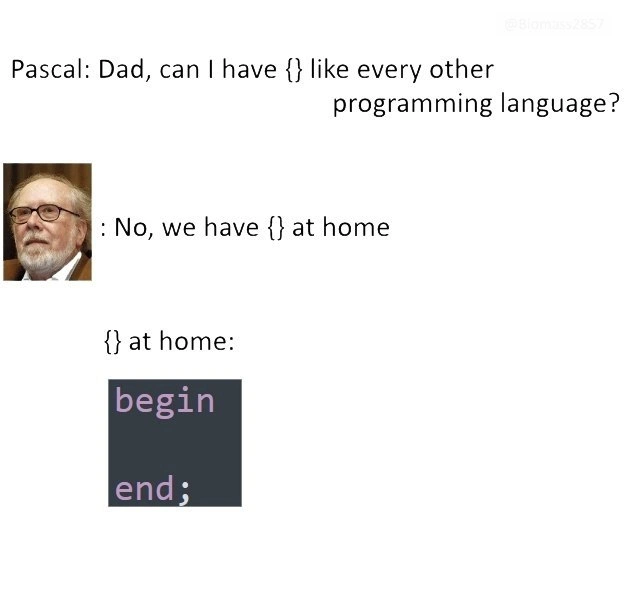
Now, the meme itself uses a popular format: “Dad, can we have X? – No, we have X at home. – X at home: (bad version of X).” This is a classic Internet meme formula where “X at home” is never as good as what the kid wanted. Here, Pascal is depicted as a kid asking for “{} like every other programming language.” The curly braces {} represent the cool new thing that “every other language” has (a bit of an exaggeration, but many languages indeed use {} for blocks). The dad says “No, we have {} at home,” and then the “{} at home” turns out to be begin ... end; shown in a code snippet. In other words, Pascal already has something to delimit blocks of code – it’s just not the hip curly braces, it’s the old-school BEGIN/END. This is the punchline: the thing at home is a makeshift or less exciting version of what the kid actually wanted.
To a new developer or someone early in their career, here’s why this is funny: it’s highlighting a language comparison in a jokey way. Think of LanguageWars as the friendly rivalries between programming language fans. People often compare languages and poke fun at their syntax differences – these are DeveloperHumor inside jokes. Pascal using BEGIN/END is a bit like a parent who insists you speak very formally, whereas curly braces are like using a trendy slang that all the other kids use. So the meme is effectively saying, “Pascal’s dad (the language’s design) forces it to use the formal old style (BEGIN ... END) instead of the cool new style ({}).” It’s syntax humor — pointing out the peculiarities of Pascal’s syntax in contrast to the more ubiquitous curly brackets.
Let’s clarify a few terms from the tags:
- Pascal syntax: The specific way you have to write Pascal code. Every language has its own syntax rules; Pascal’s just happens to use a lot of English-like keywords (such as
begin,end,then, etc.) instead of symbols. - Curly brace envy: This is a tongue-in-cheek way of saying Pascal (or a Pascal programmer) might feel jealous seeing other languages use
{}for blocks. It’s like looking at other kids on the block (pun intended) and wanting their toys. - Begin/end blocks: This refers to the use of
beginandendto create a block of code in Pascal. Whenever you see abegin, you know later in the code anendwill mark where that block stops. - Block delimiters: General term for characters or words that mark the start and end of a block (
{}in C,begin/endin Pascal, or even indentation in Python). You need them so the computer knows which lines of code belong together. - Syntax family drama: This isn’t a formal term, but here it suits the meme: it implies there’s a family of languages and they have “drama” over syntax. Pascal and C come from different families (Pascal from the Algol family, C from the, well, C family). It’s like two sides of a family that don’t agree on fashion sense. The drama is that Pascal’s side uses one style and C’s side uses another, and they playfully argue about it.
- Back home meme format: The meme’s structure (“We have X at home”) is a well-known format. Knowing this format helps you predict the joke: the thing “at home” is always a disappointment. In our case, curly braces are what Pascal wants, and
begin/endis what Pascal gets at home.
For a junior dev or someone just learning: don’t worry, there’s nothing functionally different or wrong with either style of block delimiter. This meme isn’t dissing Pascal’s capability – it’s just riffing on how uncool it feels to someone who’s used to another style. It’s like having an old reliable family car when all your friends have shiny new sports cars. The car works fine, but you might feel a tinge of envy. Here the cars are programming syntax. And for many of us, that feeling is very relatable and funny in hindsight. If you’ve ever learned one language and then moved to a second one, those little differences (like “do I write {} or begin/end or do I indent?”) stand out and can trip you up. This meme takes one of those little stumbling blocks (no pun intended) and exaggerates it into a parent-child conversation for comedic effect. In summary: it’s a playful jab at Pascal’s old-fashioned way of doing things, using a meme format that every internet-savvy person knows, making it a cocktail of relatable humor for programmers.
Level 3: Curly Brace Envy
On a practical level, this meme hits home for any seasoned developer who’s lived through the LanguageWars and syntax fads of different eras. Here we have the programming language Pascal personified as a whining kid, saying “Dad, can I have {} like every other programming language?” This line nails the feeling of curly brace envy: Pascal looks over at all the trendy C-style languages with their neat curly braces delimiting blocks and feels left out of the cool club. The “Dad” in the meme – shown as an older man (possibly a nod to Niklaus Wirth, Pascal’s father figure, or just the old guard of programming) – replies, “No, we have {} at home.” Any experienced dev recognizes this classic meme format setup: you just know the punchline is coming. And indeed, “{} at home” turns out to be a screenshot of Pascal’s very own begin ... end; syntax highlighted in a code block. In other words, the thing we have at home is a bootleg version of what the kid actually wanted.
Why is this so funny to developers? It’s poking fun at LanguageComparison quirks and that universal dev experience of switching between languages with incompatible syntaxes. Seasoned programmers remember (perhaps with a mix of frustration and fondness) times they wrote Pascal in school while pining for the terse style of C, or vice versa. It satirizes the syntax wars that often erupt in developer communities – those fiery yet ultimately harmless debates over whether one language’s way of doing things is superior. Here, the syntax war is about block delimiters: should code blocks be wrapped in elegant curly braces like in C/C++/Java, or in the verbose BEGIN and END keywords like in Pascal and Ada? It’s a trivial distinction that takes on almost comic proportions because of tribal loyalty to languages. Every veteran dev has seen teams split over such preferences, sometimes jokingly treating them like matters of personal identity.
The meme also resonates because of the generational vibe. Pascal is an older language (born in 1970) — in the family tree of programming, it’s like the slightly old-fashioned parent that still insists on doing things the “proper” way. C and its descendants are like the younger generation who all wear the curly braces uniform. When Pascal “asks for braces,” it’s hilariously relatable to any dev who’s watched old tech try to keep up with new trends. It’s the syntax_family_drama we’ve all seen: think of an old programmer who still uses verbose COBOL or Pascal style trying to appease a young coder who’s all about concise JavaScript-like notation. The dad’s response is basically, “use what we already have” – we’re not changing our ways just because everyone else is doing it. This mirrors real life in companies stuck with legacy code. Many senior engineers have heard a junior ask, “Why can’t we use [shiny new tool] like everyone else?” and the reply is, “We have [older tool] at home” — meaning use the legacy system we’ve got. RelatableHumor, isn’t it?
Digging deeper, this joke underscores how LanguageQuirks can become running gags. Pascal’s begin/end is a well-known quirk — a bit verbose, a bit old-school. The C-style {} has become almost universal in popular languages, so much that a Pascal programmer might indeed feel envy or annoyance. In fact, developers who have survived multiple language migrations (Pascal to C, C to Java, Java to whatever’s next) often carry scars of constantly relearning how to do the “same thing” in a new syntax. There’s a shared understanding — a DeveloperHumor collective memory — of mixing up syntax when jumping between projects. (Who hasn’t accidentally typed a { in a Pascal code editor out of habit, only to get a compiler error?). The meme crystalizes that experience into a simple father-child joke.
There’s also an implicit nod to the futility of SyntaxWars: if you’ve been around long enough, you know every language has its own little way of marking blocks, and in the end they all accomplish the same thing. The dad’s dismissive “we have that at home” is the veteran perspective: Braces? Keywords? Eh, same difference; just use what you’ve got. From an old-timer’s viewpoint, this is darkly funny — we spend so much energy arguing about surface-level syntax. It’s a gentle roast of both Pascal (for being behind the times) and of younger devs (for obsessing over trendy syntax). In short, the humor works on multiple levels: it’s RelatableHumor for anyone who’s had to deal with “that’s just how this language is,” it’s a sly commentary on curly_brace_envy in the programming world, and it perfectly repurposes a familiar meme format to lampoon a decades-old LanguageWars debate. The result is a joke that seasoned devs can chuckle at knowingly — perhaps while recalling the beginning of their own coding journey and how it eventually ended with curly braces.
Level 4: Block Delimiter Dilemma
In the theoretical landscape of programming language design, the choice of block delimiters (how a language marks the beginning and end of a code block) is a fascinating study in syntax evolution. Pascal’s use of begin ... end versus the curly brace { ... } convention of the C family reflects two branches of language lineage tracing back to the 1960s. Formally, both approaches are equivalent in a compiler’s eyes – they’re just tokens in the grammar:
<block> ::= "begin" <statements> "end"
<block> ::= "{" <statements> "}"
Whether a block is enclosed by keywords or braces, the underlying Abstract Syntax Tree (AST) node for a block will look the same. The difference is purely lexical. This is the Algol legacy versus the BCPL/C legacy: Algol 60 (a predecessor of Pascal) introduced begin ... end for structured blocks as part of the structured programming revolution, emphasizing code that reads like structured English. In contrast, C (influenced by BCPL and B) adopted { and } for brevity and simplicity – a single-character token to denote scope. Early system architects favored concise symbols partly due to technology constraints (saving bytes in source code and compiler simplicity), whereas academic language designers like Niklaus Wirth (Pascal’s creator) prioritized human readability with words.
Interestingly, these syntax choices have no impact on what computations are possible (Turing completeness doesn’t care if you use braces or keywords), but they do influence the culture of a language’s community. A coder moving between languages must adapt their muscle memory and eye to different block markers, even though conceptually a block is the same in Pascal as in C. It’s a minor cognitive shift with outsized emotional attachment – something as trivial as a { versus a begin can spark endless SyntaxWars debates. In fact, this “curly brace envy” is really about aesthetic preference and familiarity, not technical capability. From a compiler theory standpoint, the block delimiter dilemma is a non-issue: context-free grammars handle either just fine. But in the human realm of language design, it became a defining characteristic of language families.
Over time, curly braces became iconic due to C’s success – they proliferated into C++, Java, C#, JavaScript, and many others, creating a dominant syntax convention. Meanwhile, Pascal’s lineage (which includes Modula-2, Ada, and even modern Rust for certain constructs) stuck with keywords or added unique twists. There’s also a third path: languages like Python and Haskell abolished explicit delimiters altogether, using indentation (the “offside rule”) to denote blocks – a radical idea that shows there’s no one true way. The meme’s absurdity highlights how a pedagogical decision from the 1970s (Pascal’s verbose blocks) stands out today in a world saturated with braces. In the grand timeline of programming languages, this is a small stylistic fork that nonetheless carries almost tribal significance for developers. It’s the reason a lighthearted meme can wink at a LanguageWars footnote: academically, {} vs begin/end is moot, but culturally, it’s the stuff of tongue-in-cheek rivalries and nostalgic chuckles among veteran programmers.
Description
A three-part meme in the 'we have food at home' format, making fun of the Pascal programming language's syntax. The first line shows text from 'Pascal' asking its 'Dad' (Niklaus Wirth, the creator of Pascal), 'can I have {} like every other programming language?'. The second part shows a picture of an elderly Niklaus Wirth replying, 'No, we have {} at home'. The final part, the punchline, is labeled '{} at home:' and displays a code snippet with the Pascal keywords 'begin' and 'end;'. The joke humorously highlights the verbosity of Pascal's syntax for defining code blocks (`begin...end;`) compared to the concise curly braces (`{...}`) used by the vast majority of modern, C-style programming languages
Comments
43Comment deleted
Pascal walked so YAML could run
Still easier than explaining to management why your new microservice needs BEGIN, END, and a full Terraform module just to print “Hello World.”
After 20 years in the industry, I've realized Pascal's 'begin...end' blocks were just preparing us for Python's whitespace debates - at least Pascal let you see where the block actually ended without counting invisible characters
Pascal's `begin...end` is the programming equivalent of saying 'commence' and 'terminate' instead of just using parentheses - technically correct, impressively verbose, and a constant reminder that your language predates the C syntax hegemony. It's like driving a classic car: sure, modern vehicles have power steering and fuel injection, but there's something oddly satisfying about manually cranking your code blocks into existence while younger developers wonder why you're not just using braces like a normal person
Pascal's begin-end: explicit structure for codebases that outlive their authors, but good luck diffing nested changes without a brace-matching IDE
Pascal’s block syntax scales end; count with cyclomatic complexity, so every nested refactor ends in eight consecutive end; and one missing semicolon the compiler finds 600 lines later
Pascal’s {} at home: begin…end; - with a semicolon, because in this grammar blocks are statements; nothing like ceremony to make your diff look productive
Verilog things…. Comment deleted
Mmmmmm semicolons after end🥲 Comment deleted
Public Class Form1 Private Sub Form1_Load(sender as Object, e as EventArgs) Event Form1.Load MessageBox.Show("Visual Basic .NET") End Sub End Class Comment deleted
>microsoft Comment deleted
No its FreeBSD /s Comment deleted
Is this Pascal? Comment deleted
totally vb Comment deleted
I see. Thanks Comment deleted
it's a loop, just making new form instances totally looks like something that shouldn't even be legal to do Comment deleted
I can see the recursive call now Comment deleted
Lol I even mentioned it in the code Comment deleted
Sorry, I didn’t read it in details. And I know I don’t know this and I skip it. Comment deleted
Np Comment deleted
and python lacks the curly brackets and uses indents Comment deleted
As if there is anything wrong with begin/end. C/C++ were and are too US-centric if you look at the frequency if characters needed in typical source code. Lots of keyboards around the world don't make it very easy to type { or } and a number of other characters. Digraphs and trigraphs were added into the language for that very reason. Comment deleted
I can understand and it is really a historical reason that keyboard is in a different design that time. Comment deleted
They've recently removed trigraphs because nobody uses it Maybe replacing digraphs like && and || with 'and' and 'or' respectively would be nice (stares at chromeOS devs) but replacing curly brackets with begin and end today is useless Comment deleted
https://en.wikipedia.org/wiki/Niklaus_Wirth Comment deleted
Callback hell in pascal: end; end; end; end; end; ... Comment deleted
Same as store procedures like PLSQL and TSQL Comment deleted
Maybe those ends are trying to tell you to split up your huge functions? 😆 Comment deleted
Somehow they tell to end writing shitty code with callback hells Comment deleted
Or say "end coding, you cannot it at all" Comment deleted
In Delphi and pascal ppl just decrease font size and use tab size 2 or even 1, I know one person that does that Comment deleted
if fi Comment deleted
iffy Comment deleted
<if> </if> Comment deleted
the worst way Comment deleted
I know)0) Comment deleted
<iftree id="ift1" class="iftrees" name="checks evenness"> <if id="if1" class="ifs" name="is even" condition="round($a/2)%2==0"> <pass/> </if> <else> <print out="XML programming language - XPL?"/> </else> </iftree> I hate myself now Comment deleted
(if if) Comment deleted
{} at home: /**/ Comment deleted
while(1) elihw Comment deleted
For the sake of code readability, I always put comments about the closing curly brace: } // end if } // end for } // end function Class::Method } // end class Class } // end namespace NameSpace That's because the code is not always read and fixed from a full-fledged IDE with syntax highlighting, block folding and all that stuff, but from a bare console editor or debugger. Comment deleted
reminds me MFC's DECLARE_MESSAGE_MAP(...) --- END_MESSAGE_MAP(... /*same thing*/) Comment deleted
Lol I can remember being bothered when I switched to c# from vb but I don't have any problems now with code readability. Also I am switching to c++ Comment deleted