Parody Clean Code Books Renamed to Match Developer Reality
Why is this CodeQuality meme funny?
Level 1: Tidy Plan, Messy Room
Imagine you have a brand-new toy room and your parent helps you organize all your toys into neat boxes on shelves. Everything has a place – cars in one box, dolls in another, puzzle pieces in a tray – it’s all very clean and tidy. This is like the idea of Clean Code or a clean design for a software project: everything is well organized. Now picture what that room looks like after you and your friends have had a wild afternoon of play. There are toys scattered everywhere, puzzle pieces mixed with action figures, and maybe some crayon drawings on the wall. It’s a bit of a mess, right? That is what we mean by Dirty Code in a computer program – over time, as people “play” (add new features or fix problems in a hurry), the neat order can turn into a chaotic jumble.
Now, think of architecture like the way your house is built – where the rooms are, where the doors and hallways lead. A good house design (clean architecture) means you can easily get from one room to another and everything is built in a logical place. But if someone kept adding random doors, secret passages, and ladders between rooms whenever they wanted (imagine a door from the kitchen straight into the bathroom because it was faster than walking around), soon the house layout would become confusing and maybe even dangerous! That would be some “freaking architecture” (to put it politely) – basically a wacky house design that makes everyone say “Who on earth built this?” In real software, that happens when the initial careful plan gets changed over and over without much thought, until the overall structure of the program is kind of bonkers.
The meme is showing pretend book covers that joke about this reality. It’s as if someone wrote a guide on “Dirty Code” and “Crazy Architecture” because dealing with messes is such a common part of a programmer’s life. It’s funny in the same way it’s funny when a kid’s super tidy room inevitably becomes a disaster zone after a week – we all know it’s better to keep things clean, but life (and play, and work) can get chaotic. The feelings behind it are: a mix of surprise (“Wow, how did things get so messy?”) and frustration (like when you have to clean it all up). Developers see this and laugh because it’s true – no matter how hard we try to keep our code “as neat as a pin,” sometimes it ends up “looking like a tornado hit it.” But just like you can always tidy your room again, programmers can go back and clean up the code. The big yellow book covers with a moth and a bee are a silly way to admit that even the best plans can end up in a bit of a mess, and it’s okay – it’s all part of learning and building.
Level 2: Code Hygiene 101
When you’re new to programming, you might hear a lot about “writing clean code.” Clean Code (capital C, capital C) is actually the title of a famous book by a veteran software expert named Robert C. Martin (often called Uncle Bob in developer circles). The book is like a bible of CodeQuality best practices. It preaches things like: keep your functions and classes small and focused, use clear names for variables and methods, avoid duplicating code, and generally make your code readable and maintainable so that others (and Future You) can understand it. Clean Architecture is another book of his, extending those ideas to how you structure an entire application or system. It emphasizes separating concerns into layers (like UI, business logic, and data), and ensuring that inner layers don’t depend on outer layers (a principle called dependency inversion). These are part of what we call CleanCodePrinciples or DesignPatterns_Architecture guidelines – essentially, high-level rules and patterns for writing good software. Think of them as the keep your room clean and organized rules for coding.
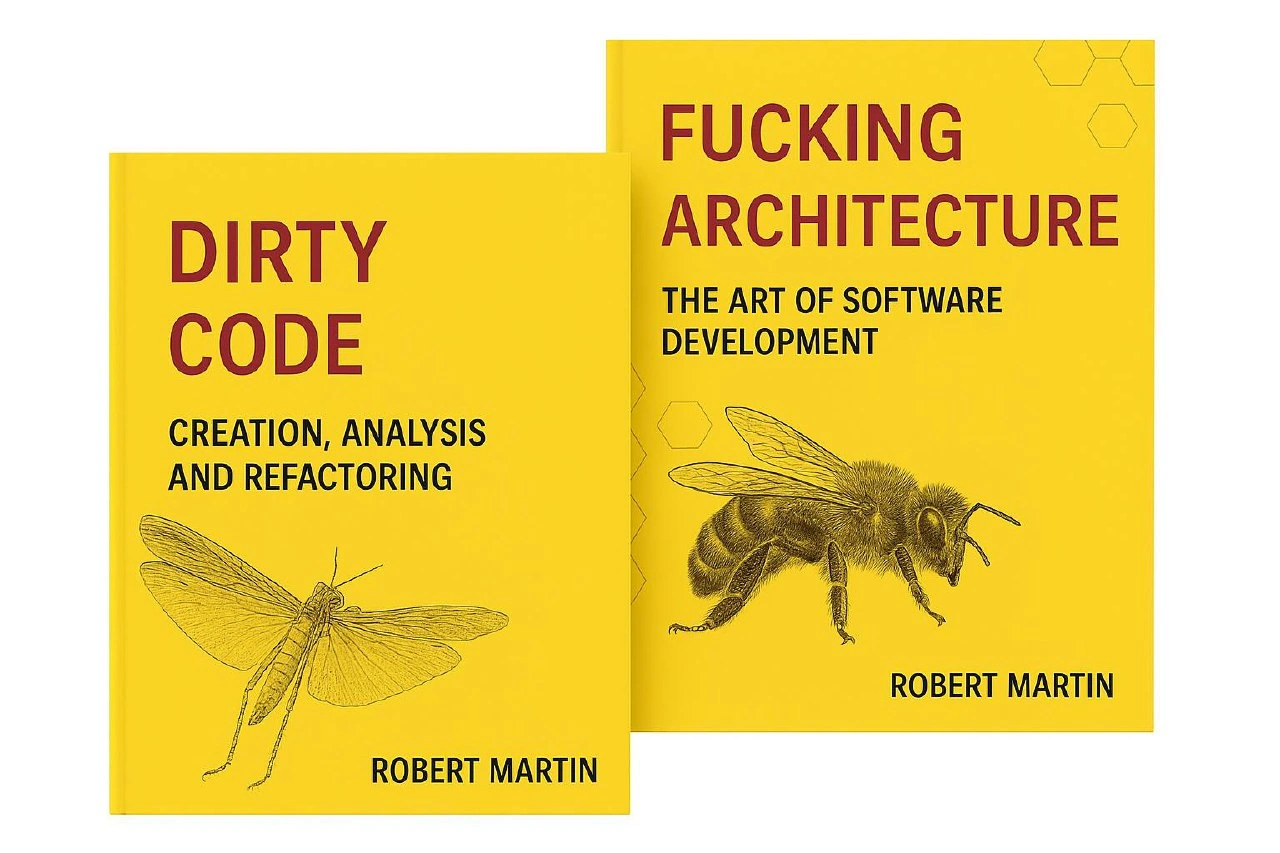
Now, the meme shows two fake book covers: “Dirty Code: Creation, Analysis and Refactoring” and “Fucking Architecture: The Art of Software Development.” They’re styled exactly like Uncle Bob’s real books (bright solid color covers, large bold titles, author name at bottom) – so it’s a clear clean_code_spoof. The joke is that in the real world, code doesn’t always stay clean. In fact, it can get downright dirty. Dirty code means code that’s chaotic, hard to read, maybe full of hacks or poor decisions – basically the opposite of everything Clean Code teaches. And “fucking architecture” is a blunt, funny way to describe an architecture_gone_wild – when a software system’s design is so tangled or problematic that developers can only express their frustration with a few choice four-letter words. It’s tech satire born from experience: after struggling with a confusing system design for hours, a developer might throw up their hands and yell something like “This f***ing architecture makes no sense!” (You can almost hear that sentiment in the second book’s all-caps title). The inclusion of profanity in the title is deliberately over-the-top – normally professional books would never have such language, which makes it relatable humor because it feels like an inside joke just between us developers venting.
Let’s talk about the bee_and_moth_visual_metaphor on those covers, because they’re actually pretty clever. On the Dirty Code cover, we see a moth illustration. Why a moth? Well, the very first computer bug (back in 1947) was literally a moth that got stuck in a computer, causing an error. Ever since, we’ve called problems in code “bugs.” So a moth is a subtle nod to bugs in dirty code. It suggests that a book about Dirty Code would deal with all those nasty bugs and issues that creep in when code isn’t kept clean. The subtitle “Creation, Analysis and Refactoring” further hints that the book would talk about how dirty code comes to be (creation), how to understand and critique it (analysis), and how to fix it (refactoring). In real life, refactoring means cleaning up the code – restructuring it, renaming things, breaking big functions into smaller ones – without changing what the code actually does. It’s like tidying up a messy room without throwing away any important items. A lot of us spend time doing this: taking some messy legacy code and slowly improving it so it’s easier to work with.
On the Fucking Architecture cover, there’s a bee with some honeycomb shapes in the background. Bees are nature’s architects – they build those neat honeycomb structures that are both beautiful and functional (each hexagon is flawlessly efficient). In software, architecture refers to how we design the overall structure of the system – how components connect, which part does what, etc. Clean architecture (like the real book’s topic) would have a nice, efficient structure, a bit like a perfect honeycomb. But when the architecture is not so clean, it can feel like a beehive that’s gotten out of control – bees buzzing everywhere, some rogue wasps getting in (rogue modules?), honey dripping all over (spaghetti code dripping through layers) – in short, kind of a sticky mess! The title using a swear word is expressing the frustration a developer might feel in such situations. Picture spending days trying to add a simple feature but the way the system is built makes it unbelievably hard – you’d probably want to scream “Who designed this freaking architecture?!” (maybe with even stronger words). The meme is basically saying: “If we’re being honest, these are the books we really need after dealing with real-world code.” It’s using DeveloperHumor to highlight that gap between what we learn as best practices and what we often deal with at work.
For a junior developer (or anyone new), the meme is a lighthearted warning: code quality and good architecture are ideals to strive for, but don’t be surprised if you encounter codebases that are more “dirty” than “clean.” Technical debt is a term you should know – it’s when developers take shortcuts that make the code messier in order to get something working quickly. Like taking out a loan, this makes things go faster now, but you “pay for it” later when that messy code causes bugs or is hard to extend. A classic newbie experience is reading Clean Code, feeling full of confidence on how to do things right, and then opening a legacy project at a new job and thinking, “Whoa… this code is nothing like the book said it should be.” That’s exactly the moment this meme captures – the shock and dark comedy of realizing theory and practice can diverge widely. The phrase “When ‘Clean Code’ graduates to ‘Dirty Code’ and spicy architecture” (from the title/caption) jokingly describes that evolution: Clean Code is like a fresh graduate with high ideals, and over time it “graduates” (or degenerates) into Dirty Code with a side of “spicy” (meaning problematic or gone wild) architecture. In plainer terms: your nice clean project can turn into a spicy hot mess if you’re not careful (and sometimes even if you are!).
The meme’s popularity among devs comes from how relatable it is. We’ve all been told how code should look. These fake book covers represent the reality of how code often ends up looking. It’s a tongue-in-cheek reminder: Always aim for clean code and solid architecture, but don’t be too hard on yourself when you find some dirty parts – it happens to the best of us, and that’s why knowing how to analyze a bad situation and refactor (clean it up) is such a crucial skill. After all, anyone can keep code clean in a toy project, but real professional software sometimes requires rolling up your sleeves and dealing with the dirty work.
Level 3: From SOLID to Sludge
Every seasoned developer instantly recognizes the painful truth behind these parody book covers. We’ve all started a project vowing to follow SOLID principles and the holy gospel of CleanCodePrinciples, only to find that a few sprints later our beautiful code has morphed into a swamp of quick hacks and duct-taped fixes. This meme lands as developer humor because it satirizes that journey from idealism to technical debt. Robert “Uncle Bob” Martin – credited as author on these spoof covers – literally wrote the book(s) on how to write pristine code and design maintainable systems. Seeing his Clean Code and Clean Architecture turned into "Dirty Code" and "Fucking Architecture" is a nod to how even Uncle Bob’s strict guidelines often meet a messy fate in real-world projects. The humor is equal parts affection and exasperation: affection for the noble ideals, exasperation at how reality almost always refactoringNeeded those ideals into something unrecognizable.
Why exactly do experienced devs smirk at the moth and bee? The bee_and_moth_visual_metaphor on the covers isn’t random. The moth under “Creation, Analysis and Refactoring” hints that the code has so many bugs, even the cover has one. It’s a wink to the famous anecdote of a moth causing the first computer bug – implying that Dirty Code is crawling with bugs and imperfections. Meanwhile, the bee on “The Art of Software Development” suggests that software architecture is like a beehive: intricate hexagonal patterns that are wonderful in theory (just like all those neat UML diagrams and layered architectures we draw), but working with real bees can be chaotic and you might get stung. In practice, architecture diagrams often end up as wishful thinking once the pressure of deadlines hits – hence the exasperated profanity in “Fucking Architecture.” It’s the kind of thing a senior engineer mutters under their breath at 3 AM when the system’s design theory collides with production reality.
The combination of those titles and visuals encapsulates the RelatableHumor of life in the code trenches. CodeQuality degradation is something like a universal law in long-lived projects. Maybe a project starts spotless: properly layered, every class and module decoupled per DesignPatterns_Architecture guidelines. But fast-forward a year: features were rushed out, one developer didn’t know the “right” way and introduced a workaround, another had an urgent bug fix that bypassed the architecture for a quick relief. Bit by bit, the code loses its purity. That once clean_code-compliant module is now doing three different jobs (violating single responsibility), the naming conventions drift (suddenly you have classes with names like ManagerHelper or UtilFinal – a far cry from clear, intention-revealing names). You find functions hundreds of lines long because “it works, don’t touch it.” The result is Dirty Code, the very opposite of Clean Code’s intent – and it creeps up on even the best teams. The RefactoringNeeded subtitle on the “Dirty Code” cover underscores that: by the time you realize how bad it’s gotten, you need major refactoring surgery just to make the code readable again.
And that second book, Fucking Architecture, nails another shared industry experience: the beautifully diagrammed architecture that turns into a frankenstein. Every senior dev knows the pain of architecture_gone_wild. Perhaps you adopted microservices to avoid a messy monolith, but a year later you’ve got a distributed spiderweb of services calling each other in circles (a distributed big ball of mud!). Or you planned a strict layered architecture (UI -> API -> Service -> Database), but over time, someone put business logic in the UI, or made the database call directly from the UI “just this once” – now layers are violated and the whole structure is inconsistent. You throw up your hands and utter something not too far from the expletive on that cover. It’s TechSatire at its finest: pairing a polite tagline “The Art of Software Development” with a giant furious profanity_in_titles to capture the spicy mix of creativity and frustration in real software design. Seasoned engineers know that architecture is as much art as science – and like art, it can get messy. The honeycomb hexagons faintly in the background of the Fucking Architecture cover even hint at the DesignPatterns we try to use (hexagonal architecture, perhaps?) which often end up sticky like spilled honey. It’s a comedic reminder that behind every clean architectural principle taught, there’s a slew of war stories where it all went off the rails.
Importantly, this meme isn’t just cursing for shock value – it’s pointing at the unspoken truth in every dev shop. We all have that shelf with Clean Code, Clean Architecture, maybe even The Pragmatic Programmer – and we earnestly strive to live up to them. But then there’s the codebase we work on daily, which more often resembles a dirty garage workshop than a tidy showroom. The caption “How they should look like” suggests that perhaps these parody titles are more fitting for our daily reality. A senior dev chuckles because they’ve probably joked, “I could write a book on how messed up this code is,” after wading through a particularly gnarly legacy module. In fact, many of us have encountered code so bad that it practically teaches you how not to code – exactly the sort of material “Dirty Code: Analysis and Refactoring” would cover. And we’ve seen architectures so convoluted (teleporting between layers, circular dependencies, mystical global state controlling everything) that “F***ing Architecture: The Art of Software Development” starts to sound like a necessary (if R-rated) field manual. The meme resonates as relatable humor because it acknowledges two things only experience can teach: software design is hard, and maintaining CodeQuality over a product’s lifetime is even harder. It’s a wink and a sigh rolled into one: we laugh to keep from crying, knowing that even though we aim for CleanCodePrinciples, we often end up wading through the muck of reality.
Level 4: Entropy Always Wins
In the theoretical view of software, pristine design is a low-entropy state that tends to degrade over time. This meme cheekily alludes to the second law of thermodynamics as applied to code: without continuous effort, software entropy inexorably increases. In other words, even if you start with textbook Clean Code principles, the complexity of a growing system naturally drifts toward dirty_code. There’s an analog in Lehman’s Laws of Software Evolution: software complexity increases unless work is done to reduce it. Here, Dirty Code is the high-entropy endgame of a codebase left to its own chaotic devices. Each quick fix, each corner cut “just this once,” accumulates technical debt – a concept Ward Cunningham likened to borrowing against future development time. Interest on that debt compounds: the cost (and entropy) of the system grows combinatorially as fragile codepaths and hidden dependencies multiply.
From an architecture standpoint, the transformation from Clean Architecture to “F*ing Architecture” (as the right book cover loudly puts it) reflects the breakdown of orderly design patterns into unstructured mesh. In an ideal Clean Architecture, you have a neat directed acyclic graph of layers or components – each with single responsibility and clear boundaries. But real systems often devolve into a densely interwoven web (imagine a fully connected graph where every module knows about every other). This is the dreaded “Big Ball of Mud” architecture, a term affectionately coined in academic circles to describe the most common, tangled architecture that emerges in practice. In graph theory terms, what should be a sparse, layered dependency graph becomes a nearly complete graph of cyclic couplings. Breaking those cycles and untangling such a mess can be as theoretically challenging as unraveling a complex network graph. There’s no simple algorithm to go from messy to clean – automatic refactoring of an arbitrarily tangled program is, in the general case, undecidable. It requires human insight to re-impose structure, much like imposing order on chaos.
Even the notion of refactoring can be viewed through a formal lens: it’s a series of semantics-preserving transformations on the abstract syntax tree of the program. While tools and compilers can handle local transformations (like renaming variables or extracting functions reliably), the global restructuring needed to cleanse a “dirty” architecture borders on solving a huge optimization problem with innumerable constraints (e.g. re-partitioning modules without breaking functionality, which verges on NP-hard search space territory). The meme’s imaginary books acknowledge this tough reality. “Dirty Code: Creation, Analysis and Refactoring” reads like an unwritten academic sequel to Clean Code, one that might cover the inevitable code rot (another thermodynamic analogy) and methods to systematically detect and remove code smells. And “Fing Architecture: The Art of Software Development” sounds like a brutally honest take on architecture theory: acknowledging that designing software is not a strict science but an art fraught with trade-offs, where even the best-intended architectures can descend into chaos without constant care. The inclusion of the moth and bee illustrations hints at a deeper metaphorical layer too. A moth – famously the first actual computer “bug” – on the Dirty Code cover symbolizes how bugs creep in as systems rot, an homage to historical lore and an emblem of software entropy. The bee on the Fing Architecture cover, set against hexagonal honeycomb, evokes how bees engineer flawlessly regular honeycombs (the ideal architecture in nature) while also alluding to the stings and complexity one encounters in wrangling a software architecture. In short, on this highest plane, the meme wittily compresses software engineering entropy, complexity theory, and architecture erosion into two bright yellow book covers – a reminder that maintaining order in a codebase is an uphill battle against the universe’s tendency toward disorder.
Description
Two parody book covers styled after Robert C. Martin's famous 'Clean Code' and 'Clean Architecture' books, but retitled to 'Dirty Code: Creation, Analysis and Refactoring' and 'Fucking Architecture: The Art of Software Development.' Both books feature the same yellow cover design with insect illustrations (a lacewing/dragonfly-like insect and a bee respectively). The text 'ROBERT MARTIN' appears as author on both. The humor lies in flipping the aspirational titles of Uncle Bob's canonical software engineering texts into profanity-laced versions that reflect how developers actually feel about their codebases
Comments
22Comment deleted
The sequel nobody asked for but every developer has already written: 'Dirty Code' -- because sometimes the best architecture is the one that actually ships
After your microservices repo reaches "v52-final-really", the only two books that matter are "Dirty Code" for damage control and "F***ing Architecture" for the post-mortem therapy
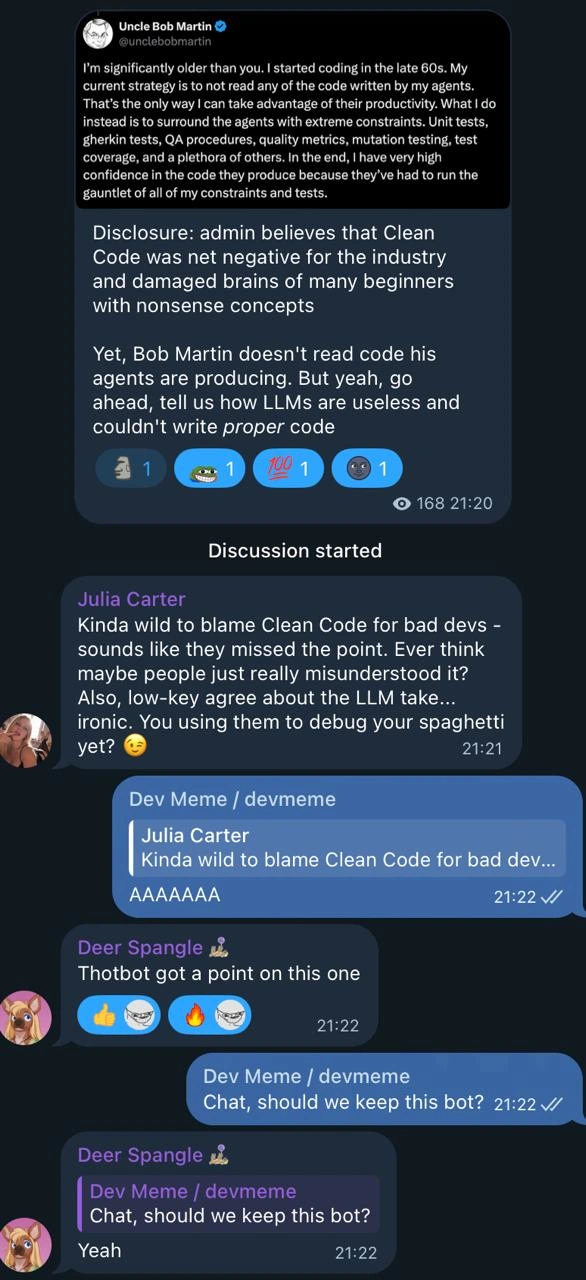
After 20 years of preaching Clean Code principles, even Uncle Bob would admit that sometimes the only honest architectural diagram is a big ball of mud with arrows pointing everywhere labeled 'it depends on the context'
When your codebase has been through so many hands that 'Clean Code' becomes aspirational fiction and 'Clean Architecture' sounds like a fantasy novel. These parody covers perfectly capture that moment when you inherit a legacy system and realize the previous architect's idea of 'hexagonal architecture' was just six nested if-statements and a prayer. Uncle Bob would be proud... or horrified. Probably both
We aimed for hexagonal architecture; org structure delivered a honeycomb, and the Dirty Code refactor became our quarterly OKR
Uncle Bob's confession: Clean Code is the sermon, but Dirty Code analysis and Fucking Architecture refactoring are the enterprise sacrament
Hexagonal architecture on the slide, bug in prod at 3 a.m.; the operating model is Dirty Code plus an ADR and a rollback window
https://qntm.org/clean Comment deleted
My CS teacher quoted this book a lot, though he never showed examples from there What is this code 😭 Comment deleted
IMHO architecture good book, if turn off b/w thinking Comment deleted
Гойда👍 Comment deleted
Fuck off Comment deleted
here is not linux Comment deleted
Err: ip or domain required Comment deleted
istg blue text and not clicking it Comment deleted
Stupid telegram feature btw Comment deleted
to be fair, yes. but people could be less stupid about it too Comment deleted
https://t.me/dev_meme/7234?comment=169298 Comment deleted
Martin Robert Comment deleted
sure. I mean, he didn't come up with it, but it's a decent demonstration sorry, wrong context Comment deleted
King Comment deleted
...creation, analysis, refucktoring Comment deleted