Skip to content
DevMeme
6609 of 7435
South Korea Lost 858TB of Government Data Due to No Backup Strategy
Infrastructure Post #7242, on Oct 9, 2025 in TG

South Korea Lost 858TB of Government Data Due to No Backup Strategy

Why is this Infrastructure meme funny?

Level 1: All Eggs in One Basket

Imagine you have a very special collection of all your favorite things – let’s say all your toys, or all the stories you’ve ever written – and you keep them in one single place. Maybe it’s one box in your house. Now, picture that one day, unfortunately, the house has a fire. If those toys or stories were only in that one box in the house, you would lose everything in the fire, right? That would be devastating and sad, and you wouldn’t be able to get them back because there were no other copies or backups anywhere else.

This meme is laughing (in a shocked way) at a real situation like that, but with computer data. The “one basket” was the government’s one building where they stored all their data, and the fire burned that basket. The phrase “don’t put all your eggs in one basket” is a simple way to say: don’t keep everything valuable in one place, because if something happens to that place, you lose it all. In the story here, the Korean government learned that lesson the hard way. They kept all their “eggs” (data) in one “basket” (data center), and when that basket dropped (caught fire), all the eggs broke.

So the simple idea is: always have a spare copy of important things in case something bad happens. Just like you might keep some favorite photos both on your phone and also printed out in an album, or saved on another computer – so if one gets lost, you still have the other. The meme is funny and sad at the same time because skipping that simple safety step led to a huge loss that everyone thought would never happen. It’s a reminder that even grown-ups (and governments) need to remember the basic rule: don’t risk everything on one single place – always have a backup!

Level 2: RAID != Backup

At a more basic level, this meme is teaching a fundamental lesson in IT: always have backups in more than one place. Let’s break down the key terms and concepts so newer developers and tech enthusiasts can understand why this is such a big deal:

  • Data Center: A data center is a facility full of computer servers and storage systems. Think of it as a giant library for data, with many computers working to store and serve information. In this story, all the Korean government’s servers were located in one data center (in the city of Daejeon). It’s like having one huge warehouse that holds all the copies of important documents.
  • 858 TB of Data: “TB” stands for terabytes, a unit of digital storage. 1 TB is 1,000 gigabytes, roughly enough to hold about 250,000 high-quality photos or 500 hours of HD video. 858 TB is astronomically large – we’re talking hundreds of millions of documents, images, records, etc. This was the amount of government data at risk. All that was stored on a system the article calls the “G-Drive” (short for Government Drive, an internal storage service for government staff, not to be confused with Google Drive).
  • Backup: A backup is simply a second copy of data kept in case the first copy is lost or damaged. Standard practice is to have off-site backups, meaning you store that second copy in a different physical location. That way, if one location has a problem (fire, flood, theft, anything), the other copy is safe. In this scenario, the shocking part is there were no backups of the 858 TB anywhere else. All data existed only in that one data center. It’s like writing a novel and keeping it only on one laptop, with no copies printed or saved elsewhere – if the laptop dies or is lost, your novel is gone.
  • Single Point of Failure: This phrase means a part of a system that, if it fails, brings everything down. Here, the single point of failure was the one data center building. Because all servers were there, the moment that building had a disaster, everything failed. In robust system design, we try to eliminate single points of failure by adding redundancy (spares) and distribution (spreading out). The meme is highlighting that the government treated an entire data center as if it could never fail – a risky gamble that didn’t pay off.
  • RAID vs. Backup: RAID stands for Redundant Array of Independent Disks. It’s a technology that combines multiple hard drives to act like one large drive. Depending on the RAID type, it can survive one (or sometimes two) hard drive failures without losing data by having duplicates or parity information. Many big servers use RAID, so if one disk dies, the data is still available from another disk. However, RAID is not a true backup. Why? Because RAID protects against hardware failure, but not against disasters that affect the whole machine or site. If the entire server or rack is destroyed (say, by a fire or a power surge), a RAID won’t save you — all its disks could be wiped out together. A backup means having data on a completely separate device or location that’s unaffected by what happens to the primary system. In simpler terms: RAID might keep your car running if one tire blows out (you have a spare in real-time), but it won’t help if the entire car falls off a bridge into a river. For that, you needed a second car parked safely elsewhere — that’s the backup.
  • Disaster Recovery (DR): This is the field of planning and processes for what to do when a disaster strikes your IT systems. A DR plan often includes taking regular backups, storing them off-site, and having procedures to restore services quickly. In professional environments, teams do “DR drills” where they simulate a data center loss and see if they can restore everything from backups in a different location. The sad comedy here is that it appears there was no effective DR plan for South Korea’s government data. They put all faith in that one facility never having a major issue, which is contrary to every lesson in IT management.
  • DataLoss Impact: Losing 858 TB of government data isn’t just a technical oops — it means potentially losing citizen records, official documents, perhaps years’ worth of information that government employees and systems rely on daily. The news article suggests this data “may be lost for good.” For a government, that’s an administrative catastrophe. Imagine records for taxes, identification, property, etc., suddenly gone. The reason engineers are almost morbidly amused by the meme is because it’s such an obvious thing to prevent (with backups), yet it was allowed to happen. It’s like a cautionary tale come to life.

For a junior developer or someone new to IT, the key takeaway is: always assume anything can fail, and prepare for it. Even if failures are rare, when they do happen they can be devastating. So:

  • Keep backups of your important data, and keep those backups in a separate place. For example, if you’re working on a coding project on your PC, push your code to a service like GitHub or copy it to an external drive periodically. Don’t keep the only copy on your PC.
  • Understand that terms like “redundancy” and “high availability” generally mean having spare capacity or copies ready to take over if something breaks. But those don’t automatically mean you’ve handled disaster recovery. High availability might keep your website online if one server out of ten crashes, but it won’t save you if the whole data center loses power or burns down. That’s why geographically distributed backups (or systems in multiple regions) are important for truly critical data.
  • If you see the phrase “single_point_of_failure”, think about the light bulb in your room: if it’s the only source of light and it burns out, you’re in darkness. In a system, if there’s one database and it fails with no replacement or copy, your application is down. Here, the single data center was like one giant light bulb for a country’s IT – and it went dark.

The meme’s context also mentions a dramatic backdrop: a hacker magazine (Phrack) claimed South Korea’s data might have been compromised by foreign hackers, which prompted an investigation. Then the fire happened, wiping out the data and any evidence of hacking (if it was there). This almost sounds like a plot from a thriller movie – talk about bad timing (or suspicious timing, some might say). Furthermore, an official involved in dealing with the crisis sadly died by suicide, highlighting how serious and stressful the fallout was. These details underscore that data loss at this scale isn’t just a funny meme; it has real consequences for national security and personal lives.

In summary, at Level 2 we see the meme as a stark lesson in basic IT practices:

  • Don’t rely on just one anything (server, data center, drive) for important data.
  • Do regular backups and keep them in a safe, separate location.
  • Prepare for disasters even if they seem unlikely (fires, floods, cyber-attacks, etc.). That’s what disaster recovery is all about.

The humor in the meme comes from how unbelievable and avoidable this situation was. It’s the kind of mistake you learn to avoid in “IT 101,” yet it happened at a national level. For a junior dev, it’s a memorable example of why those seemingly paranoid backup drills and extra copies are absolutely worth it. Think of it as a very costly lesson: if you neglect backups, eventually you’re going to have a very bad day.

Level 3: All Eggs, One Basket (On Fire)

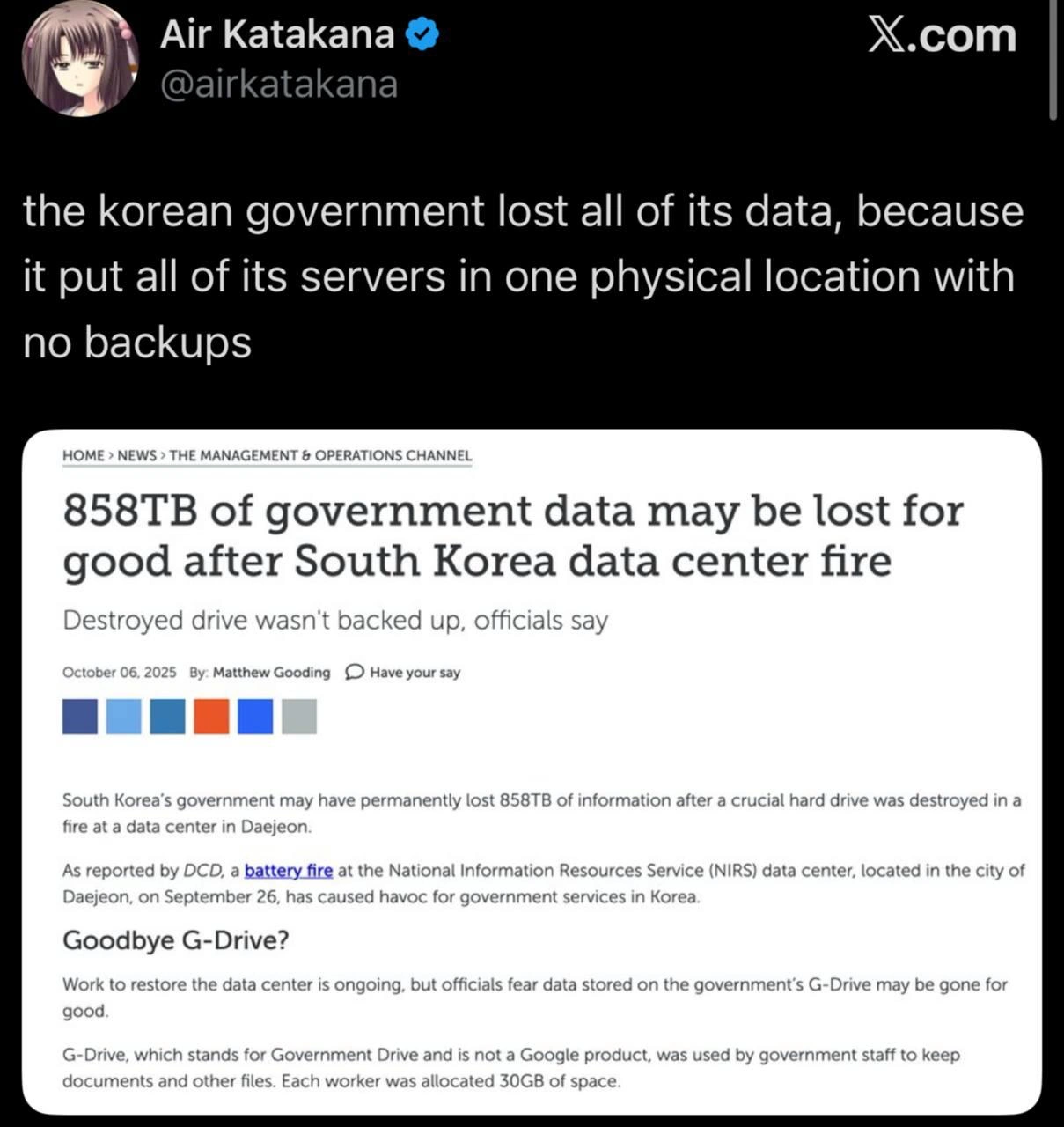
“the korean government lost all of its data, because it put all of its servers in one physical location with no backups”

This meme highlights a disaster recovery nightmare so extreme it sounds like IT urban legend: an entire country’s government data (a whopping 858 TB of it) was stored in a single data center, nicknamed the G-Drive, with zero off-site backups. A battery fire at that data center in Daejeon literally turned that single point of failure into a single point of catastrophic data loss. For seasoned engineers, this hits like a gut punch of dark humor and horror rolled into one.

Why is this so jaw-dropping? Because it violates the most basic rule of Infrastructure and Storage management: never rely on one location or device as your sole copy. We call that a single_point_of_failure (SPOF), and this is the ultimate example. All the fancy high-availability servers, RAID arrays, and redundant power supplies didn’t matter, because everything was in one building. When that building went up in smoke, so did every byte of data. It’s like deploying a mission-critical database and keeping the only backup on the same hard drive — an absurd oversight at any scale, let alone national.

This meme’s top half (the tweet by @airkatakana) delivers the news with casual incredulity, while the bottom half (the news article screenshot) confirms the tragic details. The contrast is stark: a snarky internet post vs. a formal headline, both pointing out the same unbelievable fact – South Korea had no backups for its government data. For senior engineers who’ve spent nights crafting backup strategies and cross-region replicas, this scenario is equal parts “I can’t believe they did that” and “I sadly can believe they did that”. We’ve all seen corners cut on BackupAndRecovery because “what are the odds of a total loss?” – until the unthinkable happens. This time it happened on a massive scale.

Let’s break down the layers of failure and why it resonates:

  • Monolithic Infrastructure: Instead of spreading risk across multiple data centers or cloud regions, everything was centralized. No offsite_backup meant the entire government’s digital life was one giant failure domain. It’s the equivalent of keeping all your production databases, file servers, and archives in one server room with a big “Do Not Disturb (or Else)” sign.
  • Risk Management Failure: It’s almost certain someone, at some point, raised a red flag about lack of backups or a secondary site. If they did, they were ignored or shot down, likely for budget reasons or false confidence in the primary site’s safety. This is a textbook risk_management_failure – betting that a low-probability disaster will never happen and losing that bet spectacularly. Seasoned ops folks have a saying: “Hope is not a strategy.” Here, they hoped nothing would go wrong, and lost.
  • “RAID is not a Backup”: Government IT might have used fancy storage arrays (maybe RAID or mirrored drives) thinking that would protect data. Sure, RAID can handle a disk dying, but it can’t handle the building burning. HighAvailability setups often protect against single component failures, but not site-wide disasters. Without true backups, even the best RAID setup is just an expensive bunch of disks destined to fail together in a fire. This meme is essentially screaming a sysadmin mantra: RAID != Backup.
  • OnCall_ProductionIssues at national scale: Imagine being the on-call engineer getting the 3 AM alert: “All systems down – data center on fire.” That’s beyond a nightmare. There’s no failover to trigger, no quick fix – it’s pure DataLoss. You’re basically left writing a very apologetic status report while watching news helicopter footage of your servers roasting. It’s darkly humorous because every on-call dev dreads a call about a data center outage, though we usually assume there’s some fallback. Here there was none. The only thing to do was to report upwards that everything’s gone. As the meme implies, this is the zero backups lesson you never want to learn the hard way.
  • Human Cost and Absurdity: This story has an even darker twist: reportedly, a member of the team investigating the incident felt such immense pressure that he took his own life. That’s a tragic reminder that these failures aren’t just about servers and disks – they affect real people. The meme doesn’t make light of that, but it underscores how high the stakes were. In a way, the absurd negligence (no backups) set up individuals for unbearable stress. It’s a sobering piece of context behind the “wry humor” of the meme: the failure domain wasn’t just technical, it became personal and fatal.

In essence, this meme resonates because it’s a hyperbolic real-world analogy to every cautionary tale we tell junior devs: don’t deploy on Friday, test your backups, spread out your risk. Here, an entire government treated a data_center as infallible, and fate delivered the ultimate “I told you so.” Seasoned engineers are shaking their heads with a bitter grin, thinking, “I’ve seen minor-league versions of this, but wow, this is next level.” It’s the kind of colossal oversight that will be cited in IT textbooks and conference talks for years as the example of what not to do.

To illustrate the absurdity in code form, here’s a satirical snippet of the “backup strategy” in play:

# Government's data storage setup (satire)
infrastructure = {
    "primary_data_center": {"location": "Daejeon", "data": "858TB_G-Drive"},
    "backups": None  # Off-site backups? Nah, too expensive/forgotten.
}

# Disaster strikes the single data center
import random
fire_event = random.choice(["no fire", "battery_fire"])  # fate rolls the dice
if fire_event == "battery_fire":
    infrastructure["primary_data_center"]["data"] = None  # data gone
    print("Oops, all government data lost. 😱 Single point of failure triggered!")

In this tongue-in-cheek code, backups is set to None (meaning no backups at all). When a battery_fire event occurs, the primary data gets set to None – poof, all data vanished. The printed message is basically the post-mortem: “Oops, all government data lost.” The emoji 😱 might be the only tiny silver lining – at least someone recognized this outcome is horrifying.

For veteran engineers, the humor here is bitter. It’s a facepalm-inducing reminder that DisasterRecovery planning is not optional, no matter how “secure” or “modern” your setup seems. Mother Nature (or Murphy’s Law) doesn’t care about your confidence. You can implement cutting-edge cloud microservices, boast 99.999% uptime on paper, but if you neglect something as basic as keeping an extra copy of your data in a different geography, you’re one freak accident away from total oblivion. This meme’s scenario is extreme, but it magnifies real issues many have encountered on a smaller scale: backup scripts that weren’t actually running, “redundant” systems that shared a hidden common failure, managers who only realize the value of backups after the data is gone.

In summary, Level 3 perspective is that this meme is a cautionary horror story every seasoned dev can relate to. It wraps dark humor around a very real lesson: don’t be the person explaining to your nation (or company) why nothing was backed up. The absurdity makes us laugh (or cry), because deep down, we know there but for the grace of good planning go the rest of us.

Description

A screenshot of a tweet from @airkatakana on X.com stating 'the korean government lost all of its data, because it put all of its servers in one physical location with no backups.' Below it is an article from October 06, 2025 headlined '858TB of government data may be lost for good after South Korea data center fire.' The article explains that a battery fire at the National Information Resources Service (NIRS) data center in Daejeon destroyed a crucial hard drive that wasn't backed up. The government's G-Drive (Government Drive, not a Google product) which allocated 30GB per worker may be permanently lost. This is a textbook case of violating every disaster recovery principle -- single point of failure, no geographic redundancy, no backup strategy

Comments

15
Anonymous ★ Top Pick The '3-2-1 backup rule' stands for: 3 copies, 2 different media, 1 offsite. South Korea implemented the '1-0-0 backup rule': 1 copy, 0 backups, 0 hope
  1. Anonymous ★ Top Pick

    The '3-2-1 backup rule' stands for: 3 copies, 2 different media, 1 offsite. South Korea implemented the '1-0-0 backup rule': 1 copy, 0 backups, 0 hope

  2. Anonymous

    Apparently their DR plan was RAID-0 across geopolitical hopes and a smoke-detector SLA

  3. Anonymous

    After 20 years of preaching '3-2-1 backup strategy' and disaster recovery planning, we finally found the one architect who thought RAID 0 was a backup solution and put them in charge of an entire nation's data infrastructure

  4. Anonymous

    When your disaster recovery plan is 'hope the data center doesn't catch fire' and your backup strategy is 'YOLO,' you've essentially implemented RAID 0 at the organizational level. This is the infrastructure equivalent of putting all your eggs in one basket, then storing that basket in a building with a lithium battery collection. At least they're consistent - single point of failure for both location AND backup strategy. The real tragedy? Some architect probably got promoted for 'cost optimization' by consolidating everything into one facility

  5. Anonymous

    They optimized for “simplicity” with N=1, AZ=1, backups=0 - RPO = infinity and the postmortem now doubles as the data catalog

  6. Anonymous

    G-Drive: Government edition, skipping the 3-2-1 rule for that authentic single-SSD-of-doom vibe

  7. Anonymous

    Putting 858TB in one DC with no backups is the enterprise version of “RAID is DR” - RPO set to hope, RTO set to press conference

  8. @JackOhSheetImSorry 9mo

    Who is phrack? 🥲

  9. @mrYakov 9mo

    somebody cleaned up traces

  10. @RiedleroD 9mo

    they've been hacked by China or North Korea honestly would've surprised me if they never tried - and at this level of IT incompetency (no backups for sensitive data) I'm even less surprised that they succeeded. considering this, they've probably been spied on by every major country on earth. china, russia, japan, germany, USA, france… all of the ones that have a nonzero budget for espionage

    1. @RiedleroD 9mo

      just yknow, countries that have been doing this for more than 20 years are better at not leaving traces than china and *especially* north korea

    2. dev_meme 9mo

      So they just should ask for backups from intelligence agencies of other nations, right? 🌚 After all, it’s not a data leak: it’s surprise backup 🎉🎉🎉

  11. dev_meme 9mo

    I didn't know Crucial makes 858TB hard drives, gotta look into it

  12. @Bestfast 9mo

    Ah yes, "kills himself" loool

  13. @Bestfast 9mo

    If only the sk president didn't have a history of "people killing themselves near him" ahah ...

Use J and K for navigation