Misunderstanding Pair Programming
Why is this Agile meme funny?
Level 1: One Big Box, Two Helpers
Imagine you and a friend are trying to carry a really heavy box together because it’s too heavy for either of you to lift alone. Along comes an adult (maybe a teacher or a parent) who doesn’t realize how heavy that box is. They see both of you holding the same box, and they say, “Hey, it would be faster if each of you carried a box by yourselves.” 🙃 You both look at each other, puzzled, because there is only one big box, and neither of you can carry that big box alone. The suggestion sounds silly, right? If you tried to split the box into two and carry one piece each, it either wouldn’t work (because you can’t just split what’s inside, or each half is still too heavy alone) or it would create a big mess.
This is exactly why the cartoon is funny: the boss in the picture doesn’t understand that the two people need to work together on that one heavy thing. Telling them to each do it alone would actually make things worse, not better! It’s like if two people are solving a giant puzzle together and someone says, “You’d finish quicker if you each did a different puzzle.” Sometimes one puzzle is so hard you truly need two people on it. The humor (and a bit of frustration) comes from the boss giving advice that completely misses the point – and the two workers are probably thinking, “That makes no sense at all!”
Level 2: Two Heads, One Task
Let’s break this down in simpler terms. Pair programming means two developers work together at one computer on the same code. Imagine one dev is typing (the driver) and the other is watching, reviewing, and thinking ahead (the navigator). They swap roles often. This is a real practice in Agile software development (especially in a method called Extreme Programming (XP)). The idea is that two brains on one problem can produce better code with fewer bugs and share knowledge between the pair. It’s like having an instant code review – as one writes the code, the other can spot mistakes or suggest improvements in real-time. In theory (and often in practice), this leads to higher-quality outcomes and faster problem-solving on difficult tasks, even if it doesn’t necessarily cut the coding time in half. Agile teams value this kind of collaboration because it can prevent mistakes that might take much longer to fix later on. It’s part of the Agile focus on communication, teamwork, and adaptability over just raw individual output.
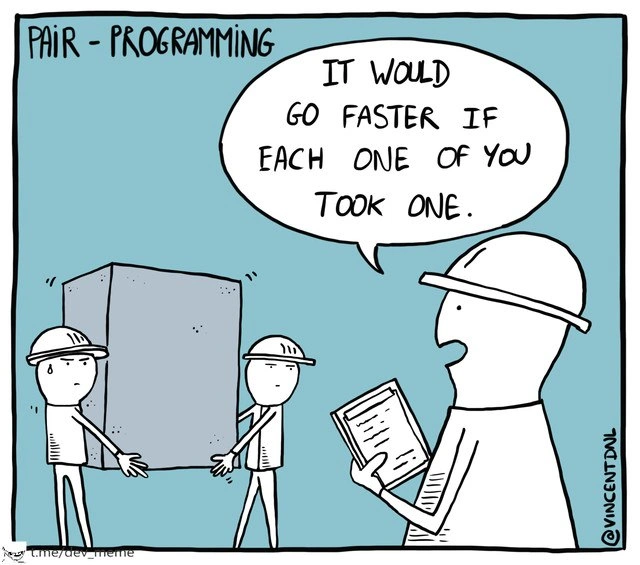
Now, in the cartoon, we see two tiny construction worker figures carrying a big rectangular block together. That block is so large and heavy that it clearly needs two people to carry it. This is an analogy: in the real dev world, think of that block as a single big task or problem – maybe a huge feature to implement or a nasty bug to fix – that effectively requires two people’s combined effort (either because of its complexity, or simply to get it done correctly). The text at the top says “PAIR – PROGRAMMING,” so it’s directly labeling this scenario as pair programming in action.
On the right side, there’s a taller stick-figure with a hard hat and a clipboard – that’s the manager (or project manager, or some non-technical lead). The manager looks at these two workers carrying one item and says, “It would go faster if each one of you took one.” He’s basically suggesting: “Hey, you both are working on one thing. Why not split this into two things so you can each work separately and be done quicker?” This comment shows a misunderstanding of what’s happening. The manager sees two people on one task and assumes it’s inefficient. He thinks if there are two workers, they should be producing two outputs (carry two blocks, work on two tasks) at the same time.
The joke is that the manager doesn’t realize some tasks can’t be split like that. If you tried to cut that big block in half, each half might still be too heavy for one person, or maybe the block is a single object that isn’t meant to be split at all. In software terms, the manager doesn’t understand pair programming’s value. They only see what looks like “one unit of work” being done by two people. This is a common communication gap between engineering teams and management or Project Managers (PMs). The dev team might know that working together on this one tough problem is the best way to solve it correctly. But a manager who isn’t familiar with the technical side might mistakenly think the team is under-utilized or wasting time.
This ties into developer productivity and how it’s measured. Some managers focus on metrics like “tasks completed” or “features delivered per developer.” When they see two devs on one task, their mental metric signals a red flag – as if productivity is 50% of what it could be. They might not see the invisible benefits: with two people coding together, maybe the code has zero bugs in QA, or it doesn’t blow up in production at 2 AM, or it was built in half the calendar time it would take one person working unassisted. These things are harder to measure. For a newer developer (or anyone unfamiliar with pair programming), it might also be counterintuitive: wouldn’t two people working separately get more done? The answer in complex projects is often no – because of issues like sharing knowledge, dealing with complexity, and avoiding mistakes. In fact, if each developer took a separate half of a tightly interlinked problem, they’d have to spend a lot of time later connecting the pieces and fixing mismatches (imagine each worker carrying half a heavy machine – you still have to bolt those halves together later, which might be just as hard as carrying the whole thing together). That integration and communication overhead is exactly why sometimes working together from the start is smarter.
So this cartoon is a bit of Agile humor about how non-technical folks might misinterpret Agile practices. Agile (and specifically XP) encourages teamwork like pair programming for better outcomes. But someone on the outside might think, “Why are two people pairing on one task? Surely that’s slowing things down.” The frustration for developers is real here – it’s funny because it’s a situation many have experienced. The team is trying to do the right thing (collaborate on a hard problem), and a manager who doesn’t fully get it suggests something that actually goes against the whole point. Team dynamics suffer if the manager can’t trust or understand the team’s way of working. That’s why this meme resonates: it highlights a simple but frequent misunderstanding in workplaces about what productivity looks like for complex tasks.
Level 3: The Mythical Pair Month
At first glance, this cartoon nails a classic management vs. engineering mismatch that seasoned developers know all too well. Two hard-hat developers (in stick-figure form) are straining to lift one giant monolithic task (a huge gray block of work). Enter the manager with a clipboard – our very own pointy-haired boss cameo – blithely suggesting: "It would go faster if each one of you took one." This one-liner is dripping with irony and triggers immediate flashbacks to The Mythical Man-Month principle: not every problem scales by simply throwing more bodies (or splitting tasks) at it. In fact, Fred Brooks famously quipped that nine women can’t make a baby in one month – some tasks just aren’t parallelizable. Here the manager is essentially committing that fallacy in miniature: assuming that if two people carrying one load is slow, each should carry their own load to double throughput. It’s a hilariously misaligned expectation that every senior dev recognizes, because we’ve all witnessed (or survived) similar management "hacks" that ignore the nature of the work.
The humor works on multiple levels of developer pain. First, there’s the obvious Agile satire: pair programming – an Extreme Programming practice where two devs share one problem at a single workstation – is often misunderstood by non-technical managers. To an uninformed manager obsessed with “resource optimization,” seeing two engineers on one task looks like a waste. “Two people doing one person’s job? Surely we could double output if they split up!” It’s the kind of naive managerial calculus that has battle-scarred devs rolling their eyes. In reality, pair programming is used for quality and collaboration, not instant speed. It’s about two brains attacking a gnarly bug or complex design, each catching the other’s mistakes in real-time, trading the keyboard (driver/navigator style), and collectively writing better code. But here we have a manager who only measures productivity in raw units of work, completely blind to intangible benefits like fewer defects or shared knowledge. This communication gap – management counting heads while engineering values heads together – is exactly what the meme skewers. We chuckle (or groan) because it’s too real: how many times have we had to justify to upper management why spending two dev-days together now saves ten dev-days later on debugging and maintenance?
From a senior perspective, the cartoon’s construction metaphor is brilliant. The single massive block represents a heavy task that quite literally requires two people to handle. In software terms, think of a huge legacy code refactor or an elusive production bug – one person alone struggles, but two minds together can finally lift it. The manager, however, sees only inefficiency. He’s effectively saying, “Stop working together on one big problem; work separately on two problems!” But what if there is only one big problem to solve? Or what if splitting it creates two equally intractable half-problems? This is where those in the trenches grin knowingly: splitting a complex task often introduces overhead. It’s like a misguided attempt at parallel processing without recognizing the synchronization cost. We’ve all seen project plans where a manager slices a task into artificial halves to assign to two devs, only to discover later that integrating those halves (or ensuring they make sense) takes twice as long. The meme captures that absurdity with the physical comedy of two workers potentially dropping a block that no single person could carry alone. The boss’s proposal isn’t just ignorant – it’s potentially destructive. In code terms, it’s like telling two programmers pair-debugging a critical outage, “Hey, each of you go handle a different outage instead – we’ll solve two outages in parallel!” Meanwhile, the actual issue is one big outage that needs joint focus. Developer productivity isn’t a simple linear equation, and experienced engineers have the scars from late-night failures to prove it.
Historically, this joke echoes the lessons the software industry keeps re-learning. Extreme Programming (XP) popularized pair programming in the late ’90s as a way to improve code quality and team knowledge. Agile principles emphasize individuals and interactions (two heads working together) over just tools or siloed effort. Yet decades later, some management mindsets still lag behind, stuck in old-school assembly-line thinking – as if coding were like screwing bottles caps where two people on one cap is clearly redundant. It’s a communication failure between the agile development philosophy and a managerial impulse to maximize “utilization.” The result? Facepalm-worthy moments like the one in this meme, where the boss unintentionally broadcasts, “I have no idea what you do, but I’m going to optimize it anyway.” For veteran devs, it’s funny because it’s true – we’ve heard variations of “why are two of you on this one task?” in sprint retrospectives or status meetings. The developer frustration is real: it’s hard enough lifting a giant block of technical debt or a complex feature, without someone questioning the obvious need for teamwork. So we laugh (a bit darkly) at the meme because it perfectly encapsulates that exasperating dynamic in one speech bubble. The manager thinks he’s found a productivity cheat code, while the devs are thinking, “Really, genius? You clearly don’t understand the weight of what we’re carrying.”
Description
A single-panel cartoon by Vincent DNL (@VINCENTDNL) with a light blue background, titled "PAIR-PROGRAMMING" at the top. The cartoon depicts three stick-figure-like characters wearing white hard hats. Two of them are struggling to carry a large, heavy grey cube together. One has a bead of sweat on his face, showing the effort. A third character, presumably a manager or supervisor, stands to the right, looking at a clipboard and saying in a large speech bubble, "IT WOULD GO FASTER IF EACH ONE OF YOU TOOK ONE." There is a watermark for "t.me/dev_meme" in the bottom left corner. The humor comes from the manager's complete misunderstanding of the concept of pair programming. They've taken the 'pair' part literally and applied a simplistic, assembly-line logic to a collaborative task that, like carrying a heavy object, requires joint effort
Comments
7Comment deleted
This is the same manager who thinks you can deliver a baby in one month with nine women. Some problems don't parallelize
Pair programming is just RAID-1 for the codebase - looks like 50 % utilization to management until a “drive” actually hits the bus
Same manager who thinks nine women can deliver a baby in one month, but somehow still can't understand why the migration from the monolith is taking longer than the original two-sprint estimate
This perfectly captures the eternal struggle: explaining to management that pair programming isn't about halving the work, it's about doubling the quality. You can't just 'take one microservice each' and expect the architecture to magically align - though I've definitely been in sprint planning meetings where someone suggested exactly that. The hard hats are a nice touch; at least in construction, when you split the load incorrectly, the failure is immediately visible. In software, we don't find out until production
Pair programming: 2 devs, 1 task, 0.5x velocity - XP's gift that keeps on context-switching
Every time a PM says “two devs should take two tickets,” a queuing theorist cries - pairing optimizes flow and defects, not CPU utilization; enjoy your two PRs, three reviews, and one incident
Pair programming: “It’d go faster if each of you took one.” Sure - once the legacy monolith has seams and Amdahl’s Law takes the day off