Skip to content
DevMeme
4071 of 7435
P2P handshake standoff: both peers insist on receiving the first packet
Networking Post #4440, on Jun 10, 2022 in TG

P2P handshake standoff: both peers insist on receiving the first packet

Why is this Networking meme funny?

Level 1: After You... No, After You!

Think of two very polite kids coming to a door at the same time: each one says, “You go first!” to the other. They could end up standing there forever, each waiting for the other to move. It’s a funny situation because nothing gets done even though both kids really want to get through the doorway. This meme makes us laugh for the same reason. Both computers want to talk to each other, but each one is stubbornly waiting for the other to start the conversation. Just like those polite kids stuck at the door saying “after you,” the two machines in the joke are stuck in an endless waiting game. It’s the ridiculousness of nobody taking the first step that makes it so funny.

Level 2: No, You Hang Up First

If you’re a newer developer, think of what happens during a handshake in networking: it’s like the computers’ way of saying “hello” and setting up the rules for communication. In a client-server model (like when your browser contacts a web server), it’s clear who speaks first: the client sends a request and the server answers. But in a peer-to-peer (P2P) system, there isn’t a fixed client or server — both are equal peers. That can lead to confusion about who sends the first packet of data. (A packet is just a small chunk of data sent over the network, kind of like a tiny mail package.) In a well-planned handshake, one peer will send a greeting packet and the other will respond. The meme jokingly shows what happens when that plan is missing: both sides yell at each other “you send the first packet!” and as a result, no one sends anything at all.

This is basically a communication deadlock. Deadlock in simple terms means everyone is waiting and nothing can move forward. It’s also related to a race condition – usually a race condition is when two operations happen at the same time and mess things up, but here it’s like a race where both runners refuse to leave the starting line. The phrase "simultaneous-open problem" mentioned in the context is about this exact kind of situation: both peers are ready to talk, but their protocol (the set of rules they follow to communicate) doesn’t specify who should start, so they end up stuck in a staring contest.

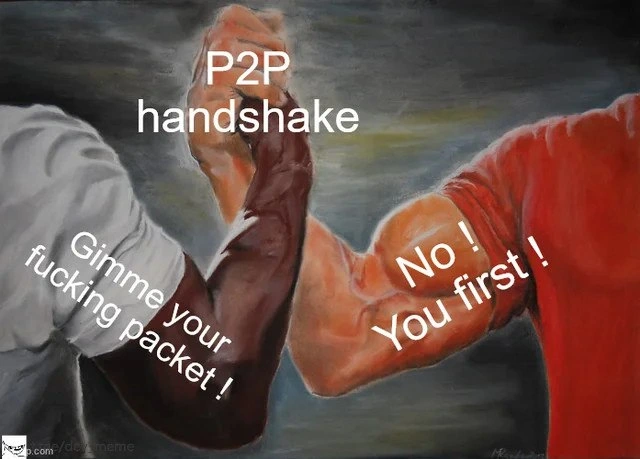
The image itself is a fun nod to a classic action movie meme. It parodies the famous arm-clasp handshake from Predator (with Arnold Schwarzenegger and Carl Weathers). Normally, that meme format represents two groups strongly agreeing on something. Here, however, each muscular arm is labeled with opposing demands: one arm (in a white sleeve) says "Gimme your packet!" and the other arm (in red) says "No! You first!". And above their clasped hands it says "P2P handshake". The joke is that a P2P handshake is supposed to be two equals shaking hands (sharing data), but instead it’s portrayed as an argument where neither side actually hands over a packet. For a junior developer, it’s a playful reminder: if you ever try to build two programs that need to talk to each other, make sure one of them actually initiates the conversation! Otherwise, you might end up like two people on a phone call, each one silently waiting for the other to say hello.

Level 3: Peer Pressure

For seasoned engineers, this meme hits close to home because it satirizes a networking snafu that is all too easy to create. In a typical scenario, one side usually acts as a client (initiating contact) and the other as a server (listening for incoming connections). But in a peer-to-peer (P2P) design, both nodes are equal peers – so who talks first? If your protocol design doesn’t answer that question explicitly, you might end up in a situation exactly like this. Each peer process is stubbornly waiting for the other to send the first message. The left arm in the image yelling "Gimme your packet!" and the right arm retorting "No! You first!" is a hilarious personification of two network nodes each expecting an incoming packet from the other. It's a handshake turned into a standoff.

This kind of standoff is essentially a distributed race condition gone wrong – instead of two processes racing to do something first, they’re racing to do nothing first. Experienced developers recognize this as a protocol design pitfall: if both sides have the same priority and both default to "passive mode", the result is a dead connection. In practice, we've seen issues like this cause real headaches. Picture two microservices or peer clients that were each accidentally configured as servers: both opened a listening socket and then sat there waiting indefinitely for the other side to connect. The logs on each side would just say “waiting for handshake…” forever. It’s the sort of bug that might sneak through testing if all your tests assumed one side would always act as the client. Once in production, though, this oversight can lead to hours of head-scratching and packet tracing, until someone realizes, "Oh wait, both sides are in listen mode!"

One common real-world example comes from P2P networking like torrent clients or mesh networks. They often have to handle a rendezvous problem similar to this meme’s scenario. Well-designed network protocols include safeguards: maybe one peer is assigned to initiate based on a simple rule (for instance, the peer with the higher IP address connects first), or both peers attempt to connect at the same time and then accept whichever connection succeeds. Another safety net is using timeouts: if a peer has been politely waiting too long with no data, it might concede, "Okay, fine, I'll send something first." Seasoned engineers have learned (sometimes the hard way) that without these measures, two machines can be as immovable as two super-polite drivers at a four-way stop. The humor here comes from recognizing that this “P2P handshake” isn’t a friendly shake at all – it’s more like an arm-wrestling match where both opponents refuse to make the first move.

Level 4: Mutually Assured Deadlock

The scenario depicted in this meme touches on a fundamental concept in distributed systems and concurrency: the necessity of symmetry breaking. Here we have two equal peers in a network handshake, each one unwilling to initiate communication. In theoretical terms, both nodes are in a symmetrical state waiting for an input that will never arrive. This is essentially a classic deadlock in a network protocol: each peer is waiting on a condition (receiving a packet) that the other peer must fulfill, but neither peer ever takes that first action. Without an external trigger or a built-in rule to break the tie, the system reaches a stable but useless equilibrium where no progress is possible.

In distributed computing theory, it’s well-understood that deterministic processes can’t break symmetry on their own without some difference in initial state or an outside intervention. This is a bit like a digital version of the Two Generals Problem, although in our case the failure isn’t due to lost messages but due to both parties refusing to send a message in the first place. Both peers are effectively engaged in a simultaneous waiting game. The principles that govern deadlock (like the classic Coffman conditions: mutual exclusion, hold-and-wait, no preemption, and circular wait) loosely apply here: each peer “holds” its idle status and waits for the other to do something, forming a circular wait with no escape. The result? A communication channel that’s logically open but practically silent.

Network protocols normally have to account for this kind of situation. For example, the TCP three-way handshake cleverly avoids this exact impasse. If both sides ever attempt a simultaneous open (where each side sends a SYN packet at nearly the same time), TCP has rules to handle it so that a connection is still established. But if both sides do nothing but listen (a true “both sides passive” scenario), no connection will ever form. Formal protocol design often requires selecting a leader or using randomness to break these standoffs. In the absence of a designated client or server, a peer-to-peer handshake algorithm must incorporate a symmetry-breaking mechanism (like flipping a coin or comparing unique node IDs) to decide who speaks first. Otherwise, as the meme humorously demonstrates, two well-meaning peers can enter a state of mutually assured deadlock, confidently but futilely waiting for a packet that will never come.

Description

Painting-style remake of the classic Arnold-Carl Weathers arm-clasp meme shows two muscular forearms meeting mid-frame in a powerful handshake. Centered above the clasped hands in large white letters is the caption “P2P handshake”. Text on the left (white-sleeved) arm reads “Gimme your fucking packet !”, while text on the right (red-sleeved) arm says “No ! You first !”. The image humorously depicts the simultaneous-open problem in peer-to-peer networking where each node waits for the other to transmit, resulting in a deadlock. It resonates with distributed-systems engineers familiar with race conditions, TCP handshakes, and protocol design pitfalls

Comments

11
Anonymous ★ Top Pick Spent six sprints perfecting NAT punch-through, only to watch both nodes reenact the Two Generals problem - just with TCP and louder profanity
  1. Anonymous ★ Top Pick

    Spent six sprints perfecting NAT punch-through, only to watch both nodes reenact the Two Generals problem - just with TCP and louder profanity

  2. Anonymous

    After 15 years of implementing P2P protocols, I've realized the handshake isn't the hard part - it's explaining to the PM why we still need a centralized STUN server for our 'completely decentralized' application

  3. Anonymous

    This meme perfectly encapsulates the P2P handshake paradox that every distributed systems engineer has battled: both peers aggressively demanding the other send first, creating a beautiful deadlock. It's the networking equivalent of two overly-polite people stuck in a doorway saying 'no, you go first' - except here nobody's polite, everyone's yelling, and your connection timeout is ticking down. The real solution? Someone implements exponential backoff with jitter, or you just admit defeat and use a TURN server like the rest of us who've learned that pure P2P is a lie we tell ourselves to feel clever

  4. Anonymous

    Every P2P handshake behind symmetric NAT is two endpoints LARPing as 2PC coordinators - timers ticking, retransmits rising, and a TURN bill quietly accruing

  5. Anonymous

    P2P handshakes: Where 'gimme fist' meets 'serialize first' - because loose packets don't DHT

  6. Anonymous

    P2P handshake: two NATed peers politely deadlock over who sends the first SYN, then ICE/STUN mediates like HR - and somehow we still call it decentralized

  7. Deleted Account 4y

    udp approach: take my fucking packet

    1. @SamsonovAnton 4y

      True UDP approach: take my packet fucking 👌

      1. Deleted Account 4y

        yes

  8. Deleted Account 4y

    what

    1. @feedable 4y

      well...

Use J and K for navigation