Skip to content
DevMeme
5078 of 7435
Corporate Compliance Demands Meet Open Source Reality
OpenSource Post #5557, on Oct 4, 2023 in TG

Corporate Compliance Demands Meet Open Source Reality

Why is this OpenSource meme funny?

Level 1: You Get What You Pay For

Imagine you got a toy from a friend for free. One day, your school says you can’t bring that toy to class because it has a small safety issue – maybe a tiny part that’s considered dangerous, even though you never use that part. You really want to keep using the toy, so you ask your friend, “Hey, can you fix this tiny issue right now? I kind of need it done so I don’t get in trouble.” Your friend smiles and says, “I can help you out quickly, but only if you can give me something for my time, like a few dollars or a favor in return.”

In other words, you were hoping your friend would just fix the free toy immediately as a favor. But your friend is saying: if it’s that important to you and you need it done fast, you should be willing to pay or give something in return. The funny part is the surprise – you expected a free quick fix, and instead your friend offered a business-like deal. It’s a bit like asking for a free ice cream refill and the shop owner saying, “Sure, if you buy another cone!” Essentially, the lesson is that when something is given for free, you can’t demand extra work on it for nothing. If you want special service or a quick fix, you get what you pay for. That’s why this situation is amusing: it’s showing that even in the coding world, a free gift comes with the understanding that big urgent favors might cost you.

Level 2: Dependency Drama

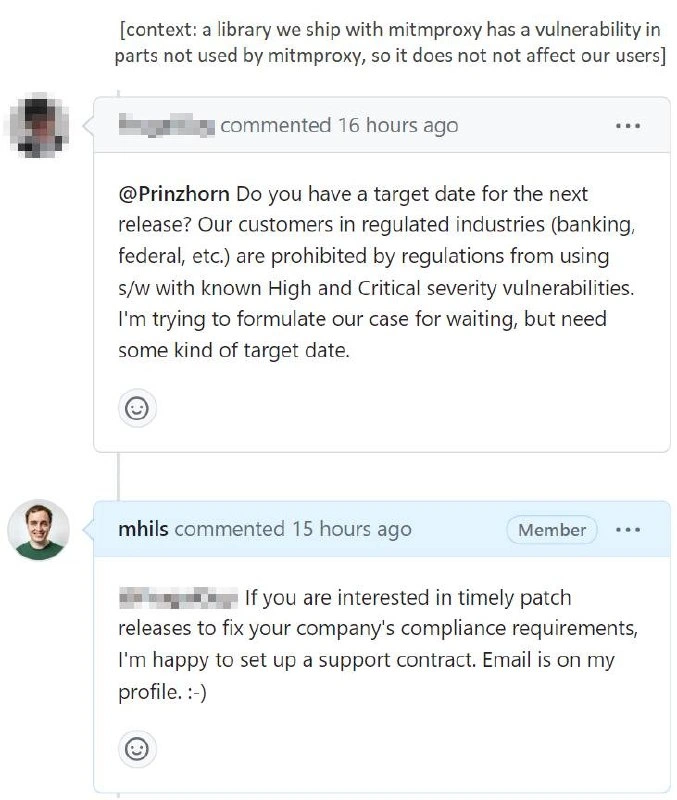
Let’s break down what’s happening in this GitHub issue snapshot. We have two players: (1) an enterprise user (likely a developer at a company) who uses an open source tool (mitmproxy) in their product, and (2) the open source project’s maintainer. The enterprise user discovered that one of mitmproxy’s dependencies has a known security flaw. A dependency is basically a library or piece of code that mitmproxy uses internally. In this case it’s a transitive dependency – meaning a dependency of a dependency. Mitmproxy includes another library, which in turn includes another library that has the bug. Think of it like building blocks stacked together: one block deep in the stack has a crack. Even if mitmproxy itself isn’t touching the cracked part, the crack shows up on a safety report.

When the company’s security tools scanned their software, they saw a flagged vulnerability (probably listed as a CVE, which stands for Common Vulnerabilities and Exposures). CVEs come with severity ratings like Low, Medium, High, Critical. Here it’s rated High/Critical, which is serious in the eyes of auditors. Regulations for banks, governments, etc., often have strict ComplianceRequirements that say “you cannot use software with known high-severity flaws.” It doesn’t matter if the flaw is in a rarely used corner of the code – a rule is a rule. So now this enterprise dev is in a bind: their product includes mitmproxy version X, and version X includes a library version that has a CVE. Until mitmproxy releases a new version that bumps that library to a fixed version, the product technically contains a “known vulnerability.” Their customers might refuse to deploy it, or internal policy might block its release.

So the user politely asks the maintainer, “Do you have a target date for the next release?” They’re basically hoping the maintainer will say “Oh, a new version is coming next week” so they can tell their bosses and customers “Don’t worry, fix on the way, we can wait.” Without a timeline, the company might have to drop mitmproxy or scramble for another solution, which is a lot of work. Notice how the user mentions “I’m trying to formulate our case for waiting” – this means they want justification to wait for the official fix rather than taking drastic measures.

Now enter the maintainer (mhils). Instead of giving an exact date, he offers a support contract. A support contract is basically a paid agreement where the maintainer or team agrees to provide certain help – for example, quicker fixes, guaranteed responses, maybe even custom patches – in exchange for money. In the open source world, many projects are free to use, but companies can pay for premium support if they need guaranteed timely service. The maintainer’s response essentially says: “If your company’s compliance needs fast patch releases, we can formalize this relationship commercially. Contact me via email.” The smile emoticon “:-)” keeps the tone friendly, but the message is clear that this is a professional request, not just a casual favor.

Why would he say that? Because open source maintainers often work on these projects for free, on their own schedule. They might have day jobs; they fix issues as time permits. An enterprise asking “when will you release the fix?” is putting pressure as if the maintainer is an employee or vendor. By offering a paid contract, the maintainer is saying: “I can prioritize your need if you compensate me for the extra effort.” It’s a gentle way of reminding the company that open source isn’t an unpaid helpdesk. After all, if this were a commercial software vendor, the company would likely already be paying for a support plan or license – and they’d expect rapid fixes as part of that. Here, the maintainer is providing that option.

It’s a bit of a reality check for the enterprise user. They came looking for a quick assurance for compliance, and got a proposal for paid support. This addresses the situation in two ways: if the issue is truly critical for the company, paying for a fix is reasonable (they have a budget, presumably); if they aren’t willing to pay, maybe it’s not that critical and can wait for the normal release cycle. The humor (and slight sting) in the maintainer’s reply is something many developers recognize: companies often want the benefits of free open source and the service of paid software. This maintainer politely drew that line.

To visualize the technical issue, here’s a simplified dependency tree:

YourProduct (includes mitmproxy)
 └─ mitmproxy (Open source tool your product uses)
     └─ vulnerable-lib (library inside mitmproxy that has a CVE)

In the diagram above, “vulnerable-lib” is the problematic piece deep inside. Even if mitmproxy doesn’t use the vulnerable part of that lib, scanners just see that vulnerable-lib version X is present, which equals a known CVE = not allowed. The quickest true fix is for mitmproxy to release a new version that uses a safe version of “vulnerable-lib”. That’s what the user is asking about.

So, in summary: The company guy is stressing about a security vulnerability due to compliance rules, and the maintainer responds with a business offer rather than a direct freebie fix. It’s a perfectly reasonable response, but also a funny one because it’s not what companies expect to hear on a public issue tracker. Usually, we think of GitHub issues as informal discussions, but here it turned into a negotiation hint. This exchange sheds light on how important open source projects are in industry, and how maintainers sometimes assert their boundaries. It’s both a lesson in stakeholder expectations and a commentary on how we value open source work.

Level 3: No Free Lunch in OSS

This meme hits on the classic tension between open source maintainers and enterprise users. Here we have a regulated-industry dev essentially sliding into an issue tracker asking “When’s the next release?” because a transitive library in mitmproxy has a known High severity CVE. In plain speak: a nested dependency has a security hole (a SecurityVulnerability), albeit in code mitmproxy doesn’t even use. Compliance officers don’t care about nuance – if the version is flagged in the vulnerability database, it’s a red alert on their report. So the poor corporate engineer, bound by strict ComplianceRequirements (think banking, federal regulations), is pleading for a patch release to satisfy the rules. It’s a familiar drama in OpenSourceMaintenance: Company finds a bug that looks scary, panics because policy says “no known vulns,” and urgently wants the volunteer maintainer to issue a new version ASAP.

The punchline is the maintainer’s perfectly measured reply: essentially “Happy to oblige… if you bankroll it.” :smirk: With a polite offer to set up a paid support contract, the maintainer (mhils) flips the script. Instead of the expected “Sure, we’ll release tomorrow,” they remind the enterprise that open source isn’t their private vendor on call 24/7. The smiley in “Email is on my profile. :-)” is the cherry on top – a friendly wink that says: I can do enterprise-grade DependencyManagement and patch hustle, but it ain’t free. This is a StakeholderExpectations reality check. Experienced devs know there’s no free lunch: if a company relies on free community code in production and demands compliance-driven turnaround times, they should be prepared to sponsor that work. The humor resonates because we’ve all seen this play out – security scanners throw a fit over some deep dependency, managers breathe down your neck for an update, and the open source maintainer, who owes you nothing, essentially goes “sure, let’s talk $$$.”

This scenario also highlights the oft-unspoken truth: open source maintainers are usually unpaid volunteers. They triage issues, fix bugs, and manage releases in their own time. Meanwhile, big firms build products on top of that work. So when an enterprise user name-drops “our customers in regulated industries” as leverage, a battle-scarred maintainer hears: “we’re making money off your project, but now we need you to work for free faster to save our bacon.” The veteran maintainer response? Offer a formal support contract – basically saying “treat me like the professional I am, not your free helpdesk.” It’s a bit sardonic but fair. In industry lore, this is reminiscent of the OpenSSL Heartbleed aftermath or the Log4j/Log4Shell scramble – everyone demanded immediate fixes from tiny OSS teams holding up critical infrastructure. Over time, maintainers have learned to push back with offers of paid support or sponsorship, which both funds the project and filters out frivolous demands.

At a deeper level, there’s irony in how ComplianceRequirements can be superficially rigid. Here the vulnerable code path isn’t even used, but compliance checklists operate on “if it’s there on paper, it’s not allowed.” The enterprise dev is “trying to formulate a case for waiting” – basically begging the powers-that-be for an exception – but needs a target date to appease them. We can almost feel their stress: a high-severity CVE in an audit report is like a grenade with the pin pulled. But from the maintainer’s perspective, it’s a false alarm – a bomb that can’t even explode – so it’s not top priority. The humor is that mismatch in urgency. The maintainer essentially says “I can make it your top priority if you make it my priority (with a contract).” Seasoned developers chuckle (or groan) because it’s too real: without an SLA or support agreement, you’re at the mercy of volunteer timelines. This GitHub exchange distills an entire open source economy debate into two comments. As the saying goes in OSS land, Free is in freedom, not free as in I’ll do all your work for nothing.”

Description

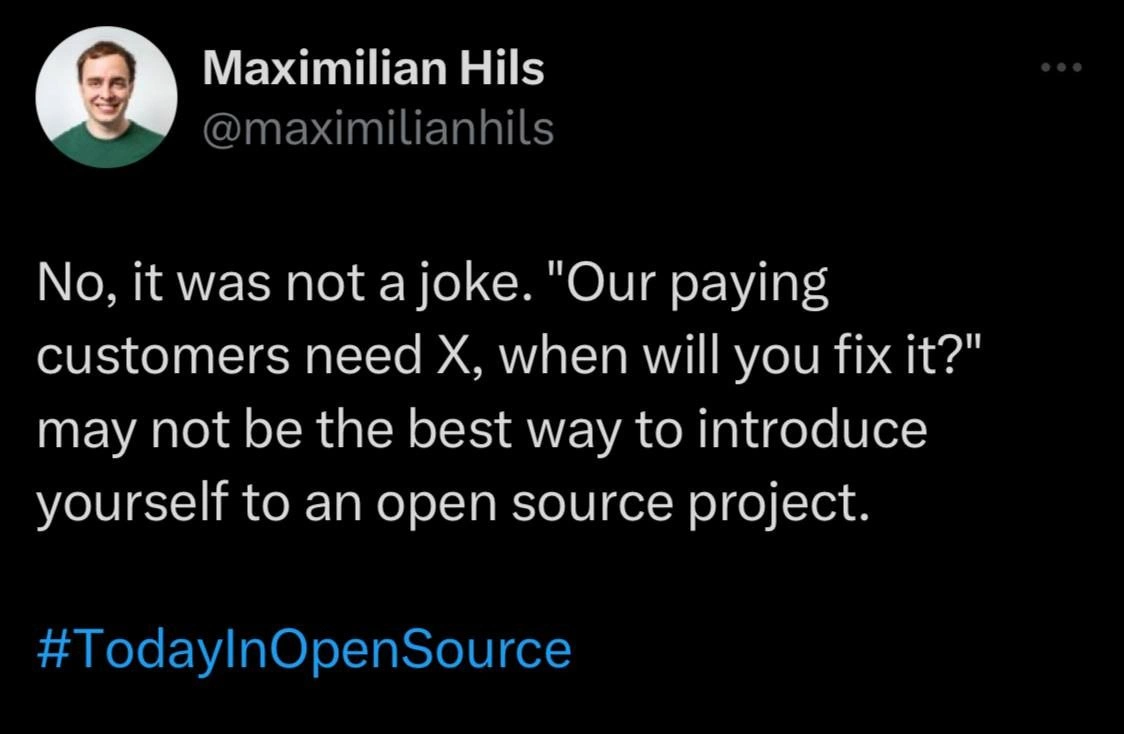
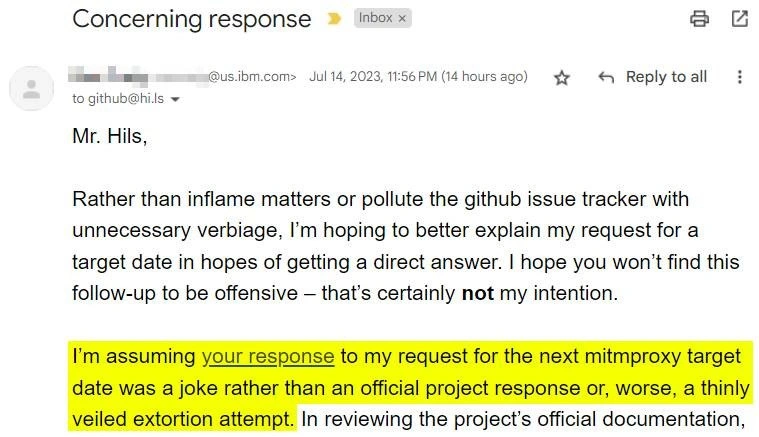
A screenshot of a GitHub comment thread. An introductory context note at the top reads: '[context: a library we ship with mitmproxy has a vulnerability in parts not used by mitmproxy, so it does not not affect our users]'. The first comment shows a user asking a project maintainer for a target release date, explaining that their customers in regulated industries are prohibited from using software with high-severity vulnerabilities. The second comment, from project member 'mhils', is a polite but firm reply: 'If you are interested in timely patch releases to fix your company's compliance requirements, I'm happy to set up a support contract. Email is on my profile. :-)'. This exchange perfectly captures the common tension between corporate users who need guaranteed support for compliance and open-source projects that are often maintained by volunteers. The maintainer's response is a classic, professional way of reminding the company that if they have commercial-grade requirements, they should seek a commercial support relationship rather than demanding free labor from the community
Comments

7
Anonymous ★ Top Pick The 'vulnerability' here isn't in the code, it's in the user's assumption that an MIT license comes with an enterprise SLA
  1. Anonymous ★ Top Pick

    The 'vulnerability' here isn't in the code, it's in the user's assumption that an MIT license comes with an enterprise SLA

  2. Anonymous

    Amazing how a CVE buried in an unused transitive dependency can do what marketing never could - close the support-contract upsell in two GitHub comments

  3. Anonymous

    "I've been in this industry long enough to watch 'we need this for compliance' evolve from a P1 ticket into a purchase order - truly the most beautiful refactoring pattern in open source."

  4. Anonymous

    Ah yes, the classic enterprise paradox: 'We need you to immediately fix a vulnerability in code we don't even execute, but we can't pay for open source because it's free.' The maintainer's response is chef's kiss - politely monetizing the compliance theater while the actual security impact remains zero. It's the software equivalent of being asked to repaint a wall that's behind a permanent fixture because the paint *might* contain lead, even though nobody can touch it

  5. Anonymous

    Regulated industries learn the hard way: open source vulns are free, but 'timely' fixes are the real SaaS pivot

  6. Anonymous

    Nothing like a CVSS 9.8 in an unused transitive to turn “not exploitable” into “not deployable” - cue the maintainer offering a support contract. Compliance-driven development: where reachability analysis is replaced by a PO number

  7. Anonymous

    SBOM says High, exploitability says zero; compliance says “paywall the release schedule” - the cleanest CVSS-to-ARR pipeline I’ve seen

Use J and K for navigation