When Programmers Flirt Using Version Control Metaphors
Why is this VersionControl meme funny?
Level 1: Escaped Programmers
Imagine a few friends who love video games talking in their own special gamer language while hanging out. One of them puffs out his chest and says, “I’m like the final boss of coolness, not just a beginner character!” He’s basically bragging, but in a video-game way. His buddy plays along and asks, “Whoa, can I clone your character then?” – which is a silly way of saying “you’re so cool, I wish I could copy you!” The first friend laughs and replies, “Only if you promise to be on my team forever,” with a wink. Now a third friend overhearing all this rolls his eyes and yells, “Mom, the gamers are talking weird again!” To someone who isn’t into their game, this whole exchange sounds like pure gibberish. But to the friends, it’s hilarious – they’ve turned a normal conversation about who’s cool and hypothetical flirting into a bunch of in-jokes from their favorite hobby. It’s funny because they’re using their secret club words (video game talk) in everyday life. In the end, it’s just a bunch of nerdy friends having fun, speaking their own language outside of their usual space, and that mix of tech talk with regular life makes everyone who gets it laugh.
Level 2: Fork & Commit 101
Let’s break down the technical jargon and inside jokes in this thread, in plain terms. The conversation in the screenshot has people swapping normal social language with programming and version control terms (especially from Git, the popular tool for tracking code changes). If you’re just learning these concepts, here’s what each part means:
Alpha release vs. Stable release: In software development, an alpha release refers to a very early version of a program. Alpha versions are usually incomplete and likely to have lots of bugs; they’re often only tested internally (think of an alpha like a rough draft). After an alpha comes a beta (a more polished test version given to a limited audience), and finally the stable release – the official finished version of the software that’s considered reliable for everyone to use. So when the commenter says “I’m a stable release male,” he’s humorously comparing himself to a piece of software that’s out of the shaky alpha stage and is now a dependable final product. It’s a geeky twist on the term “alpha male.” (Outside of tech, an “alpha male” is slang for a dominant, leader-type guy. By replacing alpha with stable release, he implies he’s beyond just an alpha – he’s the fully tested, ready-for-production version of a man!) In other words, “I’m not some experimental newbie version; I’m the solid, debugged edition.” It’s a self-aware, tongue-in-cheek brag told in developer lingo.
Git – Forking a repo: Git is a tool developers use to manage changes in code (it’s a form of version control). On platforms like GitHub, if you find someone’s project and you want your own copy to tweak or contribute to, you can fork it. To fork a repository means to make a personal copy of someone else’s code project under your account. It’s like clicking “Copy” on a codebase so you can play with it independently. In the thread, when a user says “Damn bro, can I fork you?”, they’re treating the person (the “stable release male”) as if he were a great open-source project on GitHub. It’s a playful way of saying “You’re awesome, I want a version of you,” using Git terminology. (It also cheekily echoes a certain phrase that sounds like “fork,” giving it a little edgy humor.) In real programming, forking is a normal action – for example, you might fork a library’s repository to add your own features, or fork someone’s project to start a new variant. But forking a person is not a thing, of course, which is why it comes off as absurd and funny.
Git – Committing changes: After you fork a repo and make some changes, the next step is usually to commit those changes. In Git, a commit is like a save point that records a snapshot of your project at a certain state. You typically write a message to describe what you changed. For instance, you might run
git commit -m "Fixed the login bug"to save your work with a note. Each commit becomes part of the project’s history. Now, outside of programming, to “commit” to something means to dedicate yourself to it or make a serious promise (like committing to a relationship or a decision). So when the witty commenter replies “Only if you commit 😉,” he’s continuing the Git metaphor with a double meaning. Technically, he’s saying “Sure, you can fork (copy) me, but only if you make commits (actual contributions afterward).” And in the playful social sense he’s saying, “Only if you commit (as in commit to me, i.e. show you’re serious).” The winking emoji is there to make sure we know it’s a joke. Essentially, he turned a normal step in the coder workflow (forking and then committing) into a flirtatious condition. It’s like he’s joking, “You can’t just copy me and bail; you gotta stick around and put in effort!” For someone new to Git: remember, forking is copying a project, and committing is saving your changes. The humor comes from using those actions as romantic metaphor – something you definitely won’t find in the official Git documentation!“Mooom, the programmers escaped again!”: This final comment is written as if someone is yelling to their mother about a chaotic situation. It’s a meme-y way to poke fun at how this whole thread became full of programmer inside jokes. The phrasing implies that programmers are like creatures that were supposed to stay in their own space (say, a programming forum or their “cages”) but have now “escaped” into a general discussion and are causing confusion with their jargon. In simpler terms, the user is joking that the conversation has gotten too nerdy for normal folks to follow. It’s the kind of line you might see when a discussion unexpectedly turns into a niche in-joke session. If you’re not familiar with programming culture, this comment is basically saying, “Uh oh, the tech nerds have gotten loose and are being nerdy here again!” It’s all in good fun – a light-hearted way to acknowledge how weird (and funny) the thread looks to anyone who isn’t a part of that nerdy circle.
For a new developer or an outsider, the key to this meme is understanding those tech terms in context. Once you know that an alpha build is an early test version, a stable release is a fully-finished version, a fork is making a copy of a code project, and a commit is saving your changes (or a way to say “pledge yourself to something”), the jokes click into place. They’re basically taking a macho brag and a flirty exchange, and rephrasing them in pure Git speak. This is a great example of how dev communities have their own language and communication style. What looks like gibberish at first is actually a bunch of programmers having a laugh, using the tools and terminology from their daily coding lives to be witty. Now that it’s all decoded, you can see the humor: it’s like a little skit where coding and dating slang get hilariously tangled. And if you ever hear someone drop a line like “I’m a stable release male” or “only if you commit” in a conversation, you’ll know they’re pulling your leg with some classic coding humor. Enjoy being in on the joke!
Level 3: Version Control Courtship
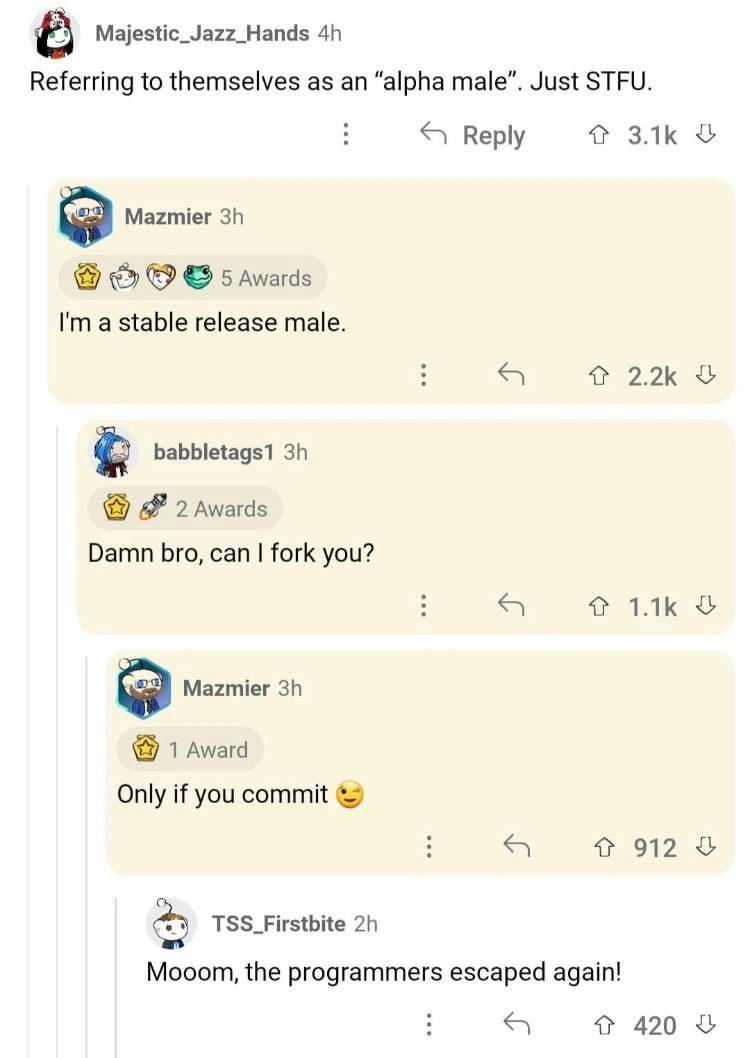
This meme captures a Reddit comment thread where a discussion about self-proclaimed “alpha males” gets hilariously hijacked by developers brandishing version control puns. The original poster expresses frustration at someone calling themselves an “alpha male,” telling them to “just STFU” (internet shorthand for “be quiet”). In swoops a commenter with the quip: “I’m a stable release male.” Instantly, an ordinary macho trope is reframed in software terms. Seasoned devs can appreciate the layers here: in software, an alpha release is an early, unfinished version – often unstable and likely full of bugs – whereas a stable release is the polished, reliable version ready for production. By calling himself a stable release male, the commenter is jokingly elevating his status above an “alpha male.” It’s a playful insider twist: he’s basically saying “I’m not some untested prototype of a man; I’m the fully-tested final build.” For anyone fluent in product release cycles, this crack lands perfectly – it’s like bragging you’re the LTS (Long-Term Support) edition of manhood, not some crash-prone preview.
The banter doesn’t stop there. Another user jumps in with, “Damn bro, can I fork you?” This is where the humor veers straight into Git territory. In developer terms, to fork a repository means to create your own copy of someone’s codebase – typically to experiment with it or contribute back. But read in a social context, “Can I fork you?” sounds like a cheeky pick-up line (with a punny echo of that other f-word for extra spice). The commenter is essentially joking, “Wow, you’re such a great stable release of a man that I’d love to copy (fork) you for myself.” It’s a classic case of developer humor mixing with flirtation: only in a community of coders would duplicating someone’s repository be akin to expressing romantic interest! The absurdity of using Git jargon as courtship language is exactly why this is funny to those in the know. It’s version control humor at its finest, turning a technical action into a flirtatious one-liner.
The repartee continues when the original punster responds, “Only if you commit 😉.” This line is the perfect cherry on top for any programmer: it seamlessly blends the technical and the tongue-in-cheek. In Git, making a commit is the act of saving your changes – you fork a project, then you have to commit code to actually contribute something. But outside of coding, to commit to someone means to fully invest or dedicate yourself (like committing to a relationship). By saying “Only if you commit” with a winking emoji, he’s implying, “Sure, you can fork (copy) me, but you’d better commit (promise to stick around and put in effort) afterwards.” It’s a double entendre that elicits a knowing groan (or laugh) from programmers who live and breathe git commit. The wink 😉 underscores that he’s aware of the double meaning: one cannot simply fork without committing – neither in GitHub collaboration nor in dating! For experienced devs, there’s an extra layer of wit here: it subtly pokes fun at the stereotype that developers might prefer code commits over emotional commitments. The entire exchange reads like a geeky open-source romance – two people flirting in pull requests and diffs instead of pickup lines and winks.
Finally, another user interjects with the punchline that caps the thread: “Mooom, the programmers escaped again!” This meta-comment is a tongue-in-cheek way of saying, “Uh oh, the coders are on the loose, bringing their nerdy jokes into the wider world!” It’s a popular humorous trope on forums whenever a niche group’s inside jokes spill over into public view. Essentially, this person is playfully acting like an exasperated outsider who just witnessed a bunch of programmers trading Git jokes as if it were normal conversation, and is now alerting the authorities (Mom) that the programmers have broken free from their natural habitat. For veteran developers, this comment is the wink to the audience acknowledging how hilariously out-of-place (yet endearing) this all looks to non-tech folks. Within dev communities, we often see threads where one clever pun begets another – branching out like a code repository – until the entire comment chain is a cascade of niche references. The “escaped programmers” line wryly observes this phenomenon. It’s both a gentle roast and a badge of honor: our quirky coding humor is so distinctive that it’s as if we need to be corralled back into our code caves once we start punning about forking and committing in public.
All together, this meme showcases a perfect storm of developer wit and cultural reference. It highlights how communication among programmers is often laced with technical jargon used playfully. You’ve got a mix of software development lingo (alpha builds vs. stable releases) and Git commands (“fork”, “commit”) being remixed into everyday social commentary. The humor clicks because it’s an insider joke: if you know version control and the absurdity of tech terms in a dating scenario, you’re in on the laugh. Seeing thousands of upvotes and awards on these comments, it’s clear that the community loved this exchange – it’s practically a mini-celebration of how even our everyday tools can double as comedy material. For seasoned devs, it’s both cringey and brilliant: cringey because, well, these pickup lines would earn some eye-rolls outside of Reddit, but brilliant because they cleverly bridge two very different worlds. The next time someone online brags about being an “alpha male,” don’t be surprised if a witty coder counters with software release terminology – after all, why settle for alpha when you can be stable? This is how developers have fun: riffing on version control concepts to create a shared laugh, and honestly, it’s a commitment to humor we can all appreciate.
Description
A screenshot of a Reddit comment thread. The initial comment expresses annoyance at men referring to themselves as 'alpha male'. A user replies with a software development analogy, 'I'm a stable release male.' This prompts another user to flirt using a Git term: 'Damn bro, can I fork you?', which means to create a personal copy of a project. The original commenter cleverly replies, 'Only if you commit 😉', a double entendre playing on the Git command to save changes and the concept of relationship commitment. The thread ends with a final comment, 'Mooom, the programmers escaped again!', humorously pointing out the nerdy nature of the exchange. The joke lies in applying technical software version control concepts to social dynamics and dating, a classic example of developer humor

Comments
8Comment deleted
Their first date will be a pull request, and if it goes well, they'll merge to main. Let's just hope there are no merge conflicts with their ex-branches
I’m not an alpha male or a beta male - I’m the LTS branch: feature-frozen, backward-compatible, and inevitably the one everyone forks when prod catches fire
Finally found someone who understands that 'stable release' is more attractive than 'alpha' - though we all know the real commitment issues start when someone tries to rebase your entire history after the honeymoon phase
When you've been in production so long that 'stable release' becomes your entire personality. At least he's not a 'bleeding edge alpha build male' - those guys segfault at the first sign of conflict. The real question is whether he's semantic versioning compliant or just incrementing randomly like a startup's API
Alpha males force-push egos to main; stable release males tag after surviving prod outages
Stable-release male: feature freeze in effect; forks welcome, but merges require a signed CLA, squash-commit, and two CODEOWNERS approvals
Skip “alpha male” - that’s just a pre-release full of breaking changes; be LTS: stable API, semver, and only accept forks that upstream their fixes - commitment beats charisma
I wish he also pushed after a commit😅 Comment deleted