Entitled Demands on Open Source Projects
Why is this OpenSource meme funny?
Level 1: Ask Nicely
Imagine your friend built a cool treehouse in their yard and said anyone can come play in it for free. They’re not charging money; they just made it for fun and to share. Now picture a kid from another neighborhood, who your friend doesn’t even know, walks up and says in a bossy voice, “My friends want to play in your treehouse, but it needs a slide. When will you build a slide for us?” 😮 That would sound pretty rude, right? Your friend might think, “Excuse me? I built this myself as a nice gesture, and you’re demanding I do more work for you?” The kid is acting like he’s a paying customer at an amusement park, but really he’s just using something that was offered for free. The polite thing would be to ask nicely: “Hi, your treehouse is awesome! It would be so fun to have a slide — do you think that could happen, and can I help somehow?” See the difference? In the world of coding, an open source project is like that free treehouse — developers build it and let everyone use it without charging money. The meme is joking about a real situation where someone was like that rude kid, demanding a new feature as if they paid for it. It’s funny in a cringe-y way, because it’s so obviously the wrong way to ask. The lesson: if something is given to you for free, be polite and appreciative when you ask for changes or help. Always remember to ask nicely, not boss people around, especially when they’re volunteering to help everyone for free.
Level 2: Open Source Etiquette
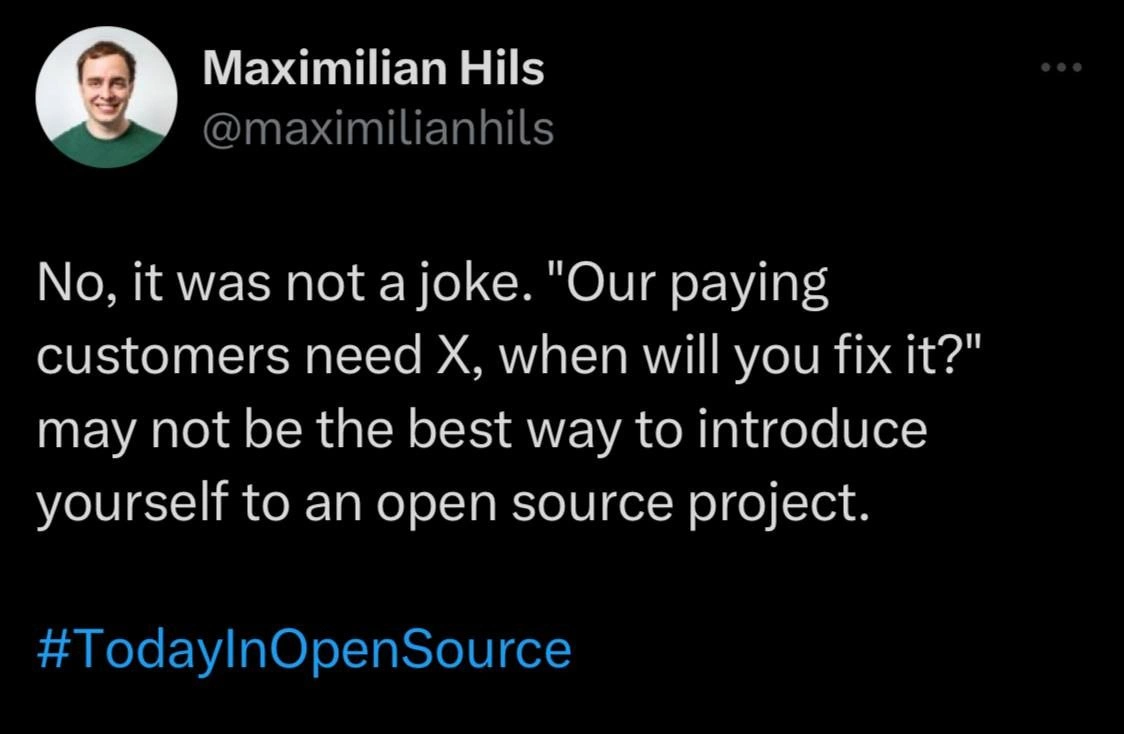
This meme shows a screenshot of a tweet about someone approaching an open source project in a very unfriendly way. Let’s break down what’s happening in simpler terms. An open source project is a software project where the code is made freely available for anyone to use or modify. It’s usually maintained by volunteers or a community of developers. A maintainer is one of those developers who takes care of the project — merging changes, fixing bugs, adding features, and generally keeping it working. Importantly, these maintainers are often doing this work for free, because they care about the project. They’re not employees you can boss around.
Now, in the tweet, someone said: “Our paying customers need X, when will you fix it?” to the maintainer. Why is this a problem? The person asking the question likely works at a company that uses the open source project in their own product. “Paying customers” means that this company has its own clients who pay them for a service. Perhaps the company’s product depends on feature X from the open source software. So the company representative, having pressure from their customers, came to the open source project and essentially said, “Hey, we need this feature for our business, when are you going to deliver it to us?” They treated the volunteer maintainers like a service provider. But here’s the catch: the maintainers are not being paid by that company at all. There’s no contract, no payment, no formal relationship. It’s a communication breakdown because the tone sounds like a boss giving an order to an employee, which is inappropriate in this context.
In open source culture, there’s an expectation of respectful communication. If you find a bug or need a feature, you typically ask nicely. For example, you might open an issue on the project’s repository and say, “Hi, thanks for this project. We have a need for X feature. Is it something already on the roadmap or that we could help with?” This way, you’re being polite, showing appreciation, and offering to collaborate. The person in the meme did the opposite: they essentially said “We need this from you, and we need it now” without any introduction or appreciation. That’s why the tweet says this “may not be the best way to introduce yourself to an open source project.” It’s a bit of dry humor pointing out the obvious: coming in hot with demands is a wrong approach.
Consider the difference in tone:
| 🚫 Don’t do this: Demanding tone |
✅ Do this instead: Respectful tone |
|---|---|
| “Our paying customers need X, when will you fix it?” | “Hello! We’re using your project and love it. We’re interested in feature X – is it planned, or could we maybe help implement it?” |
In the left column, the person sounds bossy and entitled. They act like the maintainer owes them a fix because they have paying customers. In the right column, the person is polite, acknowledges the value of the free project (“we love it”), and even offers to help. The right way respects that the maintainers are volunteers, and it opens a friendly conversation. The wrong way is like barging into a stranger’s house and shouting orders. 😬
The hashtag #TodayInOpenSource included in the tweet is used humorously by developers to share daily experiences (good or bad) while working in open source. It implies this kind of entitled request is something that unfortunately happens regularly. The maintainer, Maximilian, is basically calling out this behavior so others can learn: In open source communities, everyone is typically donating their time. There’s a saying, “open source is free, as in free puppies.” This means while the software may be free to use, it still requires effort and care to keep healthy — effort that people are giving willingly. If you need something from an open source project, you have to remember there’s a human on the other side. Instead of treating them like a paid vendor, you should approach with gratitude and cooperation. After all, the code was given to you for free; any help you get beyond that is a kindness, not an obligation. The meme humorously reminds developers (especially newer ones who might not know): if you ever interact with an open source maintainer, mind your manners and don’t act entitled. It’s a key part of OpenSourceCulture and helps avoid frustrating the very people who create the tools you rely on.
Level 3: Not Your Vendor
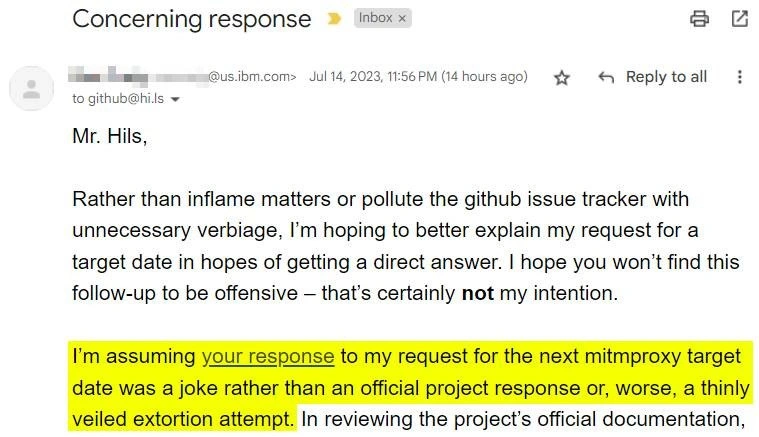
For seasoned open source developers, this tweet hits a nerve. It highlights a scenario that’s all too familiar in OpenSourceCulture: a corporate user treats a volunteer project like a paid service. The text in the meme is a verbatim quote from someone who waltzed into an open source project and demanded, “Our paying customers need X, when will you fix it?” Cue maintainer facepalms 😣. The humor (and horror) comes from the blatant communication breakdown and entitlement. Essentially, the person is acting as if the open source maintainer is their on-call vendor obligated to satisfy StakeholderExpectations. But open source maintainers are volunteers, not your company’s contractors. They don’t have a Service Level Agreement (SLA) with you — in fact, most open source licenses explicitly say there’s no warranty or guarantee. This fundamental misunderstanding is what makes developers smirk and cringe at the same time.
Let’s unpack why this approach is so wrong. In a typical business setting, if you’ve paid for software or services, it’s normal to ask, “When will you fix this bug? Our paying clients are waiting.” That’s because there’s a commercial relationship; money has changed hands, and support is part of the deal. Open source software, on the other hand, is usually free to use. The maintainers build and share it out of passion, altruism, or the desire to solve a common problem. They might be coding on nights and weekends, juggling this work with a full-time job. They do it for the community, not for a paycheck from you. So when someone they’ve never met shows up with, “We need X, when will you deliver?”, it’s jarring. It ignores the reality that the maintainer has no obligation to deliver anything on a schedule, especially not for a third party’s “paying customers”. The entitlement is almost comical — like asking a friendly neighbor who gave you a free cake, “My clients didn’t like raisins in it. When will you bake us a new one?” We laugh because it’s absurd, yet maintainers actually encounter this attitude disturbingly often.
This meme also touches on the burnout and frustration in the OpenSourceMaintenance world. Many experienced devs have war stories about demanding users. Over time, constant entitlement can lead to maintainer_burnout: maintainers feel unappreciated and overwhelmed. There’s even a famous cartoon (an xkcd comic) that jokes about the entire tech world relying on a tiny open source project supported by one stressed person in Nebraska. It’s funny because it’s true. Large companies build profitable products on top of free open source libraries, but then sometimes act like they’re doing the maintainer a favor by using it. 🙄 In reality, the power dynamic is reversed: the company is getting value from the maintainer’s work for free. The StakeholderExpectations in a company (like delivering features to paying customers on time) get misdirected at an unrelated open source volunteer. No wonder maintainers gripe about feeling like unpaid support staff.
The tweet’s hashtag #TodayInOpenSource hints that this is just another day in the life of an open source maintainer. It’s a tongue-in-cheek way developers share the latest “you won’t believe this” moment. The fact that Maximilian Hils (the author of the tweet) had to clarify “No, it was not a joke” shows how outrageous this message was — people thought it had to be satire. But it was real, which is both hilarious and depressing. The senior developers reading this meme immediately recognize the anti-pattern being called out. It’s a reminder of the unwritten social rule: if you benefit from open source, be respectful. Don’t treat maintainers like free helpdesk agents. Instead, maybe offer to contribute a fix or fund the feature. By highlighting this one rude question, the meme speaks to larger themes of OpenSource etiquette, the gap between corporate ClientExpectations and community values, and the ongoing struggle to make open source sustainable and respectful for those who keep it running.
/* Typical open source license snippet (no guarantees):
THE SOFTWARE IS PROVIDED "AS IS", WITHOUT WARRANTY OF ANY KIND, EXPRESS OR IMPLIED.
In plain terms: you use it at your own risk, and maintainers aren't obligated to fix your issues on demand.
*/
Description
A screenshot of a tweet from user Maximilian Hils (@maximilianhils). The tweet, on a black background, reads: "No, it was not a joke. 'Our paying customers need X, when will you fix it?' may not be the best way to introduce yourself to an open source project." Below the text is a blue hashtag, #TodayInOpenSource. The user's profile picture shows a smiling man with short brown hair. This tweet captures a common frustration experienced by open-source software (OSS) maintainers. It highlights the culture clash that occurs when corporate users, accustomed to commercial support contracts and SLAs, treat free, community-driven projects like paid vendors. The quoted demand is seen as entitled and disrespectful because it implies an obligation for the maintainer to prioritize a company's commercial needs without compensation or prior contribution, fundamentally misunderstanding the ethos of open source collaboration
Comments
7Comment deleted
The fastest way to get your issue closed in an OSS repo is to mention your paying customers. The second fastest is to fix it yourself and open a PR
Nothing like a $50M-ARR startup escalating an SLA on GitHub - outsourcing the roadmap to someone else’s caffeine budget
The same Fortune 500 company that rejected your $50k/year support contract just opened their third critical issue this week, each one starting with "our revenue depends on this."
Ah yes, the classic 'our paying customers need this' opener on a volunteer-maintained OSS project - because nothing says 'I understand the social contract of open source' quite like treating unpaid maintainers as your outsourced development team. It's the technical equivalent of walking into a community potluck, demanding filet mignon, and asking when the chef will have it ready. Pro tip: if your business model depends on free labor from strangers on the internet, maybe budget for a support contract - or at least learn to phrase feature requests without the implicit threat of a Yelp review
Enterprise OSS opener: 'Our VCs demand SLAs on your volunteer repo' - instant block material
In OSS, “Our paying customers need X” just routes you to the standard SLA: fork it, fund it, or file a PR
If your GTM depends on a library whose on‑call rotation is “whoever’s kid fell asleep early,” your escalation path is the Sponsor button - not an ETA demand