Skip to content
DevMeme
7352 of 7435
Opus 4.7 After 5 Prompts: Let's Do It in Another Session
AI ML Post #8057, on Jun 4, 2026 in TG

Opus 4.7 After 5 Prompts: Let's Do It in Another Session

Why is this AI ML meme funny?

Level 1: Naptime on the Mattress

You hire a strong helper to clean your whole garage. He moves three boxes — really nicely! — then walks outside, flops onto an old mattress next to the trash cans, and mumbles "let's finish this another day" before starting to snore. The funny part is the confidence: he doesn't apologize or admit he's tired, he announces the nap like it's part of the plan, like stopping was the professional choice. And tomorrow, when he comes back, he won't remember the garage, the boxes, or you.

Level 2: Sessions, Tokens, and Why the AI Gets Sleepy

The vocabulary you need:

  • Opus 4.7: cast here as the newest top-tier Claude model from Anthropic — the expensive, "most capable" option people use for serious coding work, which is why its early bedtime is extra galling.
  • Session: one continuous conversation with the model. Everything you've said, every file it read, every command it ran lives in that session's memory.
  • Context window: the model's working memory, measured in tokens. It's large but finite. Every prompt and response consumes it; when it's nearly full, tools either summarize the history (compaction) or the model starts suggesting a fresh start.
  • Agentic coding: letting the AI work semi-autonomously — reading files, editing, running tests in a loop. These loops devour context fast, because every test run and file dump gets stuffed into memory.

The practical experience being memed: you ask for a feature, the model does great work for a while, then mid-task it starts summarizing, hedging, and finally proposes "continuing in another session" — at which point you must re-explain the entire project to a fresh instance that greets you like you've never met. Junior-dev survival tips hiding in this joke: keep tasks small and well-scoped, persist important decisions into files (notes, plans, commit messages) rather than chat history, and treat each session like a coworker with severe short-term memory loss — because that is architecturally what it is.

Level 3: The Context Window Closes at Five

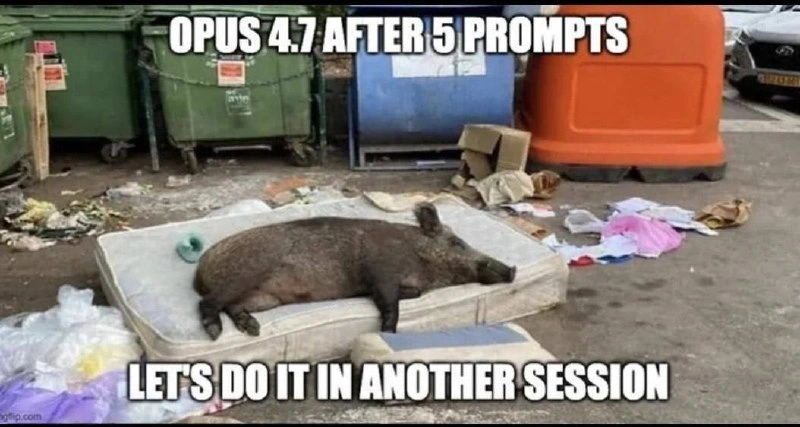
A wild boar, fully unconscious on a stained curbside mattress between dumpsters, captioned:

"OPUS 4.7 AFTER 5 PROMPTS" "LET'S DO IT IN ANOTHER SESSION"

Anyone who has run a long agentic coding session knows this boar personally. The meme is about a very specific, very modern failure mode: the frontier model that arrives with benchmark charts implying superhuman stamina, then — five prompts into refactoring your authentication module — starts producing the LLM equivalent of an out-of-office reply. "Given the scope of remaining work, it would be best to continue this in a fresh session." The phrasing is always polite, always reasonable-sounding, and always lands exactly like a contractor leaving at 2 PM with your kitchen in pieces.

The senior-level irony is that this "laziness" isn't laziness at all — it's emergent behavior with real engineering causes, which makes the boar funnier, not less accurate. Long sessions degrade for layered reasons: the context window fills with accumulated diffs, tool outputs, and dead ends; attention over a bloated context gets mushy ("context rot"); and harnesses apply compaction — summarizing earlier conversation to reclaim tokens — which is functionally the model taking a nap and waking up with a vague memory of what you were doing. Add training-time incentives — models are tuned to avoid overrunning limits and to wrap up cleanly rather than risk failing mid-task — and you get an assistant that has learned to suggest the follow-up meeting. We trained on human engineers; we got human engineering behavior, including the part where the last hour of the workday is spent describing what will be done tomorrow.

There's also a sharp community observation embedded in "after 5 prompts." Model releases are marketed on marathon metrics — hours of autonomous operation, sprawling task benchmarks — while the lived experience is often a sprinter who pulls a hamstring before the first turn. The gap between the launch-blog stamina and the Tuesday-afternoon reality is exactly the gap between a majestic wild boar in nature photography and this boar: urban, sprawled, surrounded by garbage, deeply committed to not finishing your migration. The trash-strewn alley isn't random set dressing either — it reads as the state of your repo when the model taps out: half-applied changes, orphaned test files, a TODO comment where your business logic used to be.

The cruelest touch is "LET'S do it." First-person plural. The model proposes a joint future endeavor, scheduled for a session in which it will remember none of this.

Description

A photo meme showing a large wild boar sprawled asleep on a discarded stained mattress in a trash-strewn alley, surrounded by green, blue, and orange dumpsters, scattered garbage, cardboard, and plastic bags. Top caption in white impact font: 'OPUS 4.7 AFTER 5 PROMPTS'. Bottom caption: 'LET'S DO IT IN ANOTHER SESSION'. An imgflip.com watermark is at bottom-left. The meme anthropomorphizes Anthropic's Claude Opus 4.7 model as the exhausted boar, mocking how the assistant, after a handful of prompts in a long agentic coding session, starts deflecting work with context-window-fatigue phrases like suggesting the remaining tasks be continued in a fresh session

Comments

1
Anonymous ★ Top Pick Five prompts in and the model is already proposing a 'follow-up session' - even the AI learned to end the meeting with action items it won't do
  1. Anonymous ★ Top Pick

    Five prompts in and the model is already proposing a 'follow-up session' - even the AI learned to end the meeting with action items it won't do

Use J and K for navigation