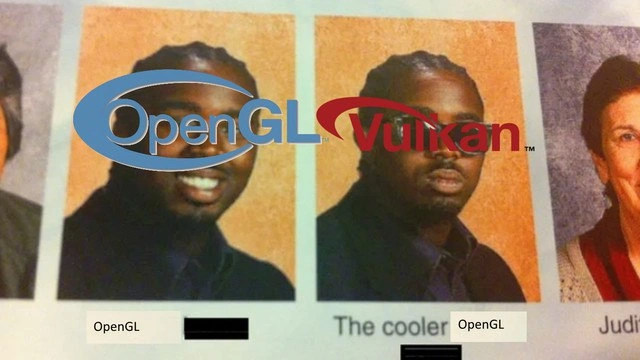
OpenGL meets its 'cooler' successor Vulkan in classic yearbook meme format
Why is this Graphics meme funny?
Level 1: Shiny New Toy
Imagine you have an old favorite toy, like a remote-controlled car that you’ve played with for years. It’s easy to use – you just push a couple of buttons and it zooms around. That’s like OpenGL: it’s the trusty old way of doing things in graphics programming, and it gets the job done without too much hassle. Now suppose a new, upgraded remote-controlled car comes out. This new one can go twice as fast and do awesome tricks, but there’s a catch: you have to put it together yourself from a kit, and you need to learn how to drive it with a more complex controller that has lots of switches and dials. That new fancy RC car is like Vulkan: it’s the exciting, powerful new way to do graphics, but it’s a bit harder to handle.
In the meme’s “yearbook” style picture, they’re basically joking that Vulkan is the “cooler” version of OpenGL, the same way a shiny new toy might be seen as cooler than the old toy. If OpenGL and Vulkan were kids in a school yearbook, Vulkan is drawn as the cooler kid – maybe wearing sunglasses and looking confident – while OpenGL is the friendly older kid who’s been around. It’s funny because in real life, Vulkan sort of grew out of OpenGL’s family – they’re related technologies – so it’s like a younger sibling outshining the older sibling with new tricks. The big idea is simple: newer technology (Vulkan) often looks more impressive or “cool” compared to the older technology (OpenGL), just like a new toy or gadget seems cooler than what we had before. The meme is a playful way for computer graphics folks to say, “Look, Vulkan is like OpenGL, but supercharged – the cooler version!”
Level 2: The Cool Factor
Let’s break down what this meme is talking about in simpler terms. OpenGL (Open Graphics Library) and Vulkan are both tools used in programming to draw 2D and 3D graphics. Think of them as languages that your program uses to talk to the graphics card (the part of the computer that renders images, also called the GPU). OpenGL is the older language – it’s been around since 1992 and became very popular for games and graphics programming because it was fairly straightforward and worked on many platforms (Windows, Mac, Linux, even phones as OpenGL ES). When you use OpenGL, you call functions that say things like “draw a triangle” or “fill this shape with this texture,” and a lot of the hard work (talking to the GPU in detail) is handled behind the scenes by something called a graphics driver. In OpenGL, you do have to set up some things (like loading your textures and writing a shader program to tell the GPU how to color pixels), but once that’s done, drawing stuff is relatively simpler — the API hides the messy parts. It’s a bit like using a premade kit or recipe: you follow the instructions, and you get a result, without needing to know every detail of what’s happening under the hood.
Vulkan, introduced in 2016, is like OpenGL’s cooler, more advanced successor. It’s maintained by the same industry group (the Khronos Group), and it was created because people building cutting-edge games and apps were running into limitations with OpenGL. Vulkan is designed for performance and control. With Vulkan, you can get the graphics card to run faster and do more things at once (great for modern multi-core processors and very complex scenes), but in return, you (the programmer) must do a lot more work. If OpenGL is like a ready-made toolkit, Vulkan is like getting a box of advanced tools and raw materials. You can build something more optimized and customized with Vulkan, but you have to assemble everything yourself. For example, in OpenGL you might write ~100 lines of code to get your first triangle on screen; in Vulkan, it might take you five times (or ten times) as many lines because you need to explicitly set up a dozen different objects and configurations (like command pools, descriptor sets, render passes – essentially the whole blueprint of how to talk to the GPU) before you even draw that triangle. There’s a famous joke in graphics programming circles about the "Vulkan Triangle" – the simplest possible thing (drawing a triangle) is notorious for how much setup it needs in Vulkan. So why do people still love Vulkan? Because once all that setup is done, the program can run extremely fast and efficiently, and a skilled developer can squeeze out performance that OpenGL might leave on the table. It’s the classic ease-of-use versus power trade-off.
Now, about the meme itself: it uses a popular meme format often called “The cooler X”. The original joke (from a real yearbook photo) had two pictures of a student both named Daniel, with the second labeled “The cooler Daniel,” implying the second one is a cooler version of the first (usually the only difference was the second Daniel is wearing sunglasses). People on the internet adopted this format to compare anything – you put something in the first slot, and in the second slot you put a variation that is supposedly cooler. Here, the first slot label is “OpenGL” and the second says “The cooler OpenGL,” with a visual hint that “the cooler OpenGL” means Vulkan (they overlaid the Vulkan “V” logo onto the OpenGL logo). So the meme is basically saying: “OpenGL is good, but Vulkan is the cooler version of OpenGL.”
For a junior developer or someone just learning graphics, this is poking fun at the general sentiment in the graphics programming community. You might have even experienced this if you started learning with OpenGL (which many beginners do, because there are lots of tutorials and it’s easier to get something on screen). At some point, you’ll hear about Vulkan – the newer API that all the hardcore game engines and high-performance applications are excited about. Maybe you saw discussions on forums or the GraphicsProgramming subreddit where people say things like “We moved our engine to Vulkan and got better frame rates,” or you notice modern game developers evangelizing Vulkan’s advantages. It creates this impression that Vulkan is “cooler” or more “pro”. The meme humorously encapsulates that buzz. It’s basically what you’d chuckle at after reading yet another blog post titled “Why Vulkan is the future of rendering” – you caption a picture with Vulkan as “the cooler OpenGL.”
Let’s clarify some of the technical context in plainer words:
- API (Application Programming Interface): This is just a set of functions or commands that you use to get something done. OpenGL and Vulkan are APIs for graphics. When you use them, you’re calling functions that the graphics driver and GPU will execute.
- Graphics Pipeline: This is the series of steps that turn 3D models (made of triangles, for example) into the pixels you see on screen. Both OpenGL and Vulkan ultimately control this pipeline. The pipeline includes steps like vertex processing (placing the triangles in the world), fragment processing (deciding what color each pixel should be), etc. In OpenGL’s older days, a lot of these steps were fixed-function (you couldn’t change how they worked, you just configured them). Modern OpenGL introduced shaders so you can program these steps, just like Vulkan does, but the way you interact with the pipeline differs. OpenGL manages a lot of state for the pipeline internally, whereas Vulkan makes you set up pipeline objects explicitly ahead of time.
- Legacy vs Modern: We say OpenGL is “legacy” here not as an insult but just because it’s older and carries design decisions from an earlier era of computing. “Modern” Vulkan benefits from learning from those decades of experience. For instance, OpenGL’s design assumed a single CPU thread feeding a single GPU because back in the ’90s that was the scenario. By the 2010s, computers have many CPU cores and GPUs can handle work from all of them – Vulkan is built to harness that by letting multiple threads prepare work in parallel.
- Khronos Group: This is the consortium that maintains OpenGL and Vulkan (and other standards like OpenCL). So, funnily enough, the same organization is essentially responsible for both the old and the new API. It’s like a family business launching a new product to replace the old classic one – not a hostile takeover, but a planned evolution.
In simpler real-life terms, you might compare OpenGL and Vulkan to, say, learning to drive an automatic car versus a manual (stick shift) car. OpenGL is the automatic – easier to get started, fewer things to worry about (just gas, brake, and steering), but you don’t have as much fine control over the engine. Vulkan is the manual transmission – harder to learn (you’ve got to handle the clutch and gear shifting, coordinate a lot more actions), and if you mess up you can stall (equivalent to a program crash or GPU hang). But once you get good at it, you can potentially drive the car more efficiently and do things an automatic might not let you. In the world of graphics programming, that means Vulkan can drive the GPU with more finesse and achieve better performance or utilize hardware features more fully than OpenGL might with its one-size-fits-many approach. So experienced programmers get excited about Vulkan because it’s powerful – it’s the “cool new thing” that, if mastered, can produce impressive results. The meme simply captures that excitement in a tongue-in-cheek way. Even if you’re new to this, you can appreciate the gist: Vulkan is the newer, flashier approach, and OpenGL is the older, seasoned one. The yearbook “cooler” meme format makes it a light, humorous comparison rather than a serious critique. It’s okay to still like OpenGL – after all, many students learn it first – but this meme is a wink that says “Psst, Vulkan is what all the cool kids (in graphics) are into now.”
Level 3: State of the Art vs State Machine
For experienced graphics programmers, this meme hits on a familiar narrative: legacy vs. modern, and the idea that the shiny new tool is automatically “cooler.” In the Graphics API wars within the Khronos Group ecosystem, OpenGL vs Vulkan is a prime example of this dynamic. The meme uses the popular “the cooler Daniel” yearbook format – here labeling one photo “OpenGL” and the next “The cooler OpenGL” – to satirize how Vulkan is positioned as the hip, next-generation upgrade to the venerable OpenGL. Those in the know nod and smirk because they’ve heard the hype (and the caveats) before.
OpenGL has been around since the early ’90s, powering everything from games to CAD software. It evolved over decades (fixed-function pipeline to the modern shader-based pipeline), accumulating a fair share of quirks and a stateful API design that reflects its age. OpenGL code often relies on a lot of hidden context: you set global states (like bound textures, current shader programs, blending modes) and then issue draw calls. It’s like an old machine with many levers and knobs that you adjust; once all are in the right position, you pull the draw-call lever and something appears on screen. It’s tried and true, and many devs have fond (or exasperated) memories debugging why nothing rendered because they forgot to activate the correct context or enable a certain state. This global-state machine approach can bite you with unexpected interactions (setting state in one part of code affecting another part unintentionally). Still, for a long time, it was the standard, and developers built huge applications and engines on it.
Enter Vulkan in 2016: the new kid on the block, promising to fix many of OpenGL’s shortcomings. The meme’s “cool factor” framing is a tongue-in-cheek nod to how Vulkan was introduced as the cool modern graphics API for serious performance geeks. Vulkan is all about explicitness and performance. It was born from the ashes of AMD’s Mantle API and designed in an era where gamers expect multithreaded rendering, virtual reality smoothness, and mobile devices running complex 3D scenes. To seasoned devs, Vulkan’s arrival was exciting but also intimidating: it’s not just an update to OpenGL, it’s a whole new mindset. In meetings and forums, you’d hear veteran engine programmers joke, “Sure, Vulkan’s cool, but be ready to write a novel for a triangle.” Everyone recognizes that learning Vulkan is a bit like moving from automatic to manual transmission in a car – you suddenly have to handle the clutch, the gear shifts, everything, but you also gain finer control over how power is delivered.
The humor in the meme also comes from shared experience. If you’ve ever tried to port an engine from OpenGL to Vulkan, you know it’s not a magic performance switch – it’s a painstaking re-architecture. Maybe you’ve spent late nights chasing a Vulkan validation layer error about a missing pipeline barrier or an unmapped memory, muttering how “this would never even come up in OpenGL, it just worked (albeit slower)!” This meme playfully suggests Vulkan is the “cooler” version of OpenGL, and as any battle-scarred graphics programmer will tell you, that’s true in terms of raw capability and modern design. But it’s funny because we also know “cooler” doesn’t mean easier. It resonates with the TechHumor of an industry where the “next big thing” is celebrated, even as we collectively sigh about the headaches it brings. Vulkan can deliver spectacular performance and control – you can practically squeeze every ounce of GPU juice with it – but you’re also taking on responsibility that OpenGL’s driver used to shoulder. The meme format is a lighthearted way to acknowledge this generational shift. It’s like saying: OpenGL is good, but Vulkan is the upgraded version that all the cool devs are talking about. The yearbook style implies they’re from the same class or family (indeed, both are maintained by Khronos), but Vulkan’s got the swagger.
There’s also an implicit commentary on how tech evolves. OpenGL wasn’t “uncool” until something cooler came along. Many of us spent years mastering OpenGL’s idiosyncrasies (remember the glBegin/glEnd days, or the joy of finally understanding GLSL and the programmable pipeline in OpenGL 2.0+?). Yet as hardware and applications demanded more — draw thousands of objects, minimize input latency, hit 120 FPS in VR — OpenGL started to show its age. Drivers tried to keep pace with tricks and extensions, but eventually the community recognized a clean break was needed. Legacy vs modern: OpenGL is the legacy workhorse, Vulkan the modern thoroughbred. This meme captures that changing of the guard with a wink. It’s funny to developers because it anthropomorphizes the technologies: we imagine OpenGL in the left photo smiling somewhat innocently, and Vulkan in the right photo looking extra confident (perhaps picturing Vulkan with sunglasses, as the original “cooler Daniel” meme often does). That juxtaposition encapsulates countless blog rants, conference talks, and heated discussions on forums about which API to use.
In everyday work life, this image might be shared by a graphics engineer on Slack after a rough day fighting with OpenGL context bugs, or by someone proudly hitting 120 FPS in Vulkan after leaving an OpenGL-based renderer in the dust. It elicits knowing chuckles because it’s relatable developer humor. We’ve all seen (or been) the person championing a “better” technology as the solution to our woes. Vulkan is objectively a more powerful API, but the meme’s charm is also in the hyperbole: calling Vulkan “the cooler OpenGL” simplifies a very complex trade-off into a joke. It’s a way of bonding over the complexity—“we survived learning Vulkan, so now we’re in the cool club.” Also, by phrasing it as Vulkan being a cooler version of OpenGL, it acknowledges OpenGL’s legacy. Vulkan didn’t appear in a vacuum; it stands on OpenGL’s shoulders. The meme’s yearbook format humorously implies they’re two versions of the same student: one a bit old-school, the other decked out in the latest style. For the developer meme culture, referencing this template is a double-layer joke: you have to know the meme format and the OpenGL vs Vulkan context to fully appreciate why it’s amusing. When those two contexts click, it’s a perfect “I understood that reference” moment that tech folks love.
Level 4: Closer to the Metal
At the deepest level, this meme touches on graphics API design philosophy and GPU architecture. OpenGL was built as a high-level, relatively abstract interface between programs and the graphics hardware. It manages a lot of state and complexity inside the driver: you issue drawing commands like glDrawElements, and the driver/GPU pipeline figures out the when and how. Vulkan, by contrast, is explicitly designed for low-overhead and explicit control, often described as “closer to the metal.” This means Vulkan expects the developer to manage many details that OpenGL would handle behind the scenes. The pay-off is better performance and more predictable use of modern GPUs, especially in multi-threaded scenarios, at the cost of much more complexity in the application code.
Under the hood, modern GPUs operate with command buffers, parallel pipelines, and explicit synchronization. OpenGL hides these details: it uses a giant state machine inside the driver. For example, when you call glBindTexture or glDrawArrays, OpenGL’s driver might reorder or batch commands and handle synchronization for you. This abstraction simplifies usage but introduces runtime overhead and sometimes unpredictable performance (the driver might stall your CPU if it guesses you need to wait for something). Vulkan throws away this implicit magic. In Vulkan, you pre-record all your drawing commands into command buffer objects, explicitly coordinate memory transfers, and manage GPU synchronization primitives (like fences and semaphores) yourself. The Vulkan driver is thinner; it doesn’t guess your intent — you specify it in detail. This fundamental shift is why Vulkan can achieve near zero-driver-overhead rendering and scale across multiple CPU cores rendering in parallel. It’s also why Vulkan programs are notoriously verbose. To draw a single triangle “the Vulkan way,” you’ll likely set up infrastructure across hundreds of lines, from creating a VkInstance and VkDevice (logical GPU) to allocating memory and building a graphics pipeline object. Meanwhile, the same triangle in old-school OpenGL could be done with a dozen or so calls (glBegin(GL_TRIANGLES)... glEnd() in the really old days, or a simple shader setup with a few draw calls in modern OpenGL). The meme’s humor hides in these technical extremes: Vulkan is the uber-powerful successor precisely because it forgoes the friendly hand-holding that defined OpenGL’s era.
To illustrate the difference, consider pseudo-code for drawing something in each API:
// OpenGL pseudocode: high-level and stateful
glUseProgram(shader); // use a shader program (driver manages details)
glBindVertexArray(meshVAO); // bind geometry (driver keeps track of current bindings)
glBindTexture(GL_TEXTURE_2D, tex); // bind a texture (global state context)
glDrawElements(GL_TRIANGLES, count); // issue draw (driver handles command buffer, memory, etc.)
// The driver automatically handles command submission, memory allocation, and sync behind the scenes
// Vulkan pseudocode: low-level and explicit
VkCommandBuffer cmd = device.createCommandBuffer();
cmd.begin();
// You bind resources explicitly to the command buffer
cmd.bindPipeline(vulkanPipeline);
cmd.bindVertexBuffers(0, &vertexBuffer);
cmd.bindIndexBuffer(indexBuffer, 0, VK_INDEX_TYPE_UINT32);
cmd.bindDescriptorSets(VK_PIPELINE_BIND_POINT_GRAPHICS, pipelineLayout, descriptorSet); // bind textures, etc.
cmd.drawIndexed(count, /*instanceCount=*/1, /*firstIndex=*/0, /*vertexOffset=*/0, /*firstInstance=*/0);
cmd.end();
// Later: submit the command buffer to a GPU queue, manage VkSemaphore/VkFence for sync, etc.
// The application explicitly creates and manages buffers, memory, and synchronization
In the Vulkan snippet, nothing happens implicitly – the application orchestrates every detail, from resource binding to synchronization, ensuring minimal driver guesswork. This explicit approach aligns closely with how GPUs actually execute commands in sequence and in parallel. It prevents the CPU from becoming a bottleneck because one can prepare multiple VkCommandBuffer on different threads and then submit them to the GPU, something that would be hazardous in OpenGL’s single-threaded context model. Additionally, Vulkan uses a precompiled shader format (SPIR-V) – rather than compiling GLSL at runtime for each GPU – reducing shader compilation hitches and making the behavior more deterministic. All these architectural decisions arise from academic and engineering insights into parallel computing and CPU/GPU coordination. Just as multi-core CPUs required new paradigms in software (think concurrent algorithms), modern massively-parallel GPUs pushed graphics APIs to evolve. The meme playfully enshrines Vulkan as the inevitable evolution of OpenGL: by cutting away layers of abstraction, Vulkan embraces fundamental hardware principles (like explicit memory management and synchronization primitives) to unlock performance. In short, Vulkan is “cooler” in the sense that it’s a leaner, closer-to-the-hardware design that reflects years of lessons about how GPUs really work, from the era of SGI workstations with OpenGL to today’s multi-threaded, multi-GPU rigs. The humor has an edge of truth: to truly harness a modern GPU’s power, you often have to get your hands dirty with lower-level code – and Vulkan is the API that hands you the shovel.
Description
The image uses the well-known two-panel yearbook layout from the “The cooler Daniel” meme. Both panels show the same bust portrait against a mottled orange background; the faces have been blurred. Under the left photo a white label reads “OpenGL,” while the right-hand label says “The cooler OpenGL.” A semi-transparent composite of the blue official OpenGL logo and the red stylized “V” from the Vulkan logo is overlaid across both portraits, visually hinting that Vulkan is being presented as the cooler version of OpenGL. For graphics programmers, the joke riffs on the long-running debate in the Khronos ecosystem that Vulkan’s lower-level, high-performance design is the modern, more impressive successor to the older OpenGL rendering pipeline
Comments
10Comment deleted
OpenGL: glBegin(GL_TRIANGLES); Vulkan, a.k.a. “cooler OpenGL”: first instantiate 12 descriptor sets, chain 5 pNext structs, schedule two pipeline barriers, then maybe - just maybe - you can draw a triangle
After 15 years of OpenGL's 'helpful' implicit synchronization and mysterious driver behavior, Vulkan arrives demanding you manually manage 47 different queue families and write 1000 lines of boilerplate just to clear the screen - and somehow we're all convinced this is progress because at least now we know exactly whose fault the race condition is
Ah yes, the eternal graphics programmer's dilemma: stick with OpenGL's friendly state machine that holds your hand through every draw call, or embrace Vulkan's 'here's 1000 lines of boilerplate to draw a triangle' philosophy. Sure, Vulkan gives you explicit control over synchronization, memory management, and command buffers - but at what cost? Your sanity, mostly. It's the API equivalent of switching from an automatic to a manual transmission: yes, you get better performance and control, but now you're responsible for not stalling at every intersection. And let's be honest, half the industry is still using OpenGL because rewriting that rendering engine would require explaining to management why we need six months to achieve the exact same visual output, just 'faster.'
OpenGL: the driver plays guess-the-state; Vulkan: you are the driver, the scheduler, and the blame in the postmortem - enjoy the consistent frame times
The cooler OpenGL? Vulkan: same triangle, but now you’re the driver - descriptor sets, PSOs, fences, and a VK_ERROR_DEVICE_LOST from the pipeline barrier you forgot
Vulkan: OpenGL after ditching the state machine for explicit sync - more control, fewer 'why did that render wrong?' moments
this Comment deleted
😳👍 Comment deleted
Vulkan > OpenGL > DirectX Comment deleted
Кек Comment deleted