Skip to content
DevMeme
7139 of 7435
OpenAI Settings After the Ministry of War Partnership
AI ML Post #7826, on Mar 15, 2026 in TG

OpenAI Settings After the Ministry of War Partnership

Why is this AI ML meme funny?

Level 1: The Sneaky Permission Slip

Imagine a school sends home a permission slip, but it's pre-signed, written in tiny cheerful letters, and says something like "we may share your child's photo to help our partners aim better." Most parents just see "photo" and "help" and toss it in the okay pile. The joke is about how companies ask for scary things in the most boring, polite way possible — a little checkbox, already ticked, with a friendly "Yes" — betting that nobody actually reads the fine print. It's funny the way a magician's trick is funny, right up until you remember it's your face in the hat.

Level 2: The Machinery Behind the Joke

  • Facial recognition training: machine-learning models learn faces from large photo datasets. Consumer photos are the richest source on Earth, which is why "may use your content to improve our services" clauses are scrutinized so heavily.
  • Dark patterns: interface designs that nudge users into choices they wouldn't deliberately make — pre-ticked boxes, buried opt-outs, soothing language for alarming permissions. Regulators in the EU and US have fined companies for them; this meme imagines the genre's logical endpoint.
  • Opt-in by default: the checked-checkbox trick. Legally, consent is supposed to be affirmative; in practice, defaults decide everything because almost nobody changes them.
  • Dual-use technology: tech that serves both civilian and military ends. Computer vision is the canonical modern example — the line between "find my cat photos" and "find this person in a crowd" is policy, not code.
  • Defense partnerships: AI vendors contracting with militaries. The discourse heat comes from companies founded on safety-flavored mission statements drifting into the sector their early policies excluded.

For a junior dev, the takeaway hiding in the laugh: the settings page is a moral surface. Whoever writes the checkbox copy and picks its default state is making the decision for a hundred million people who will never read it.

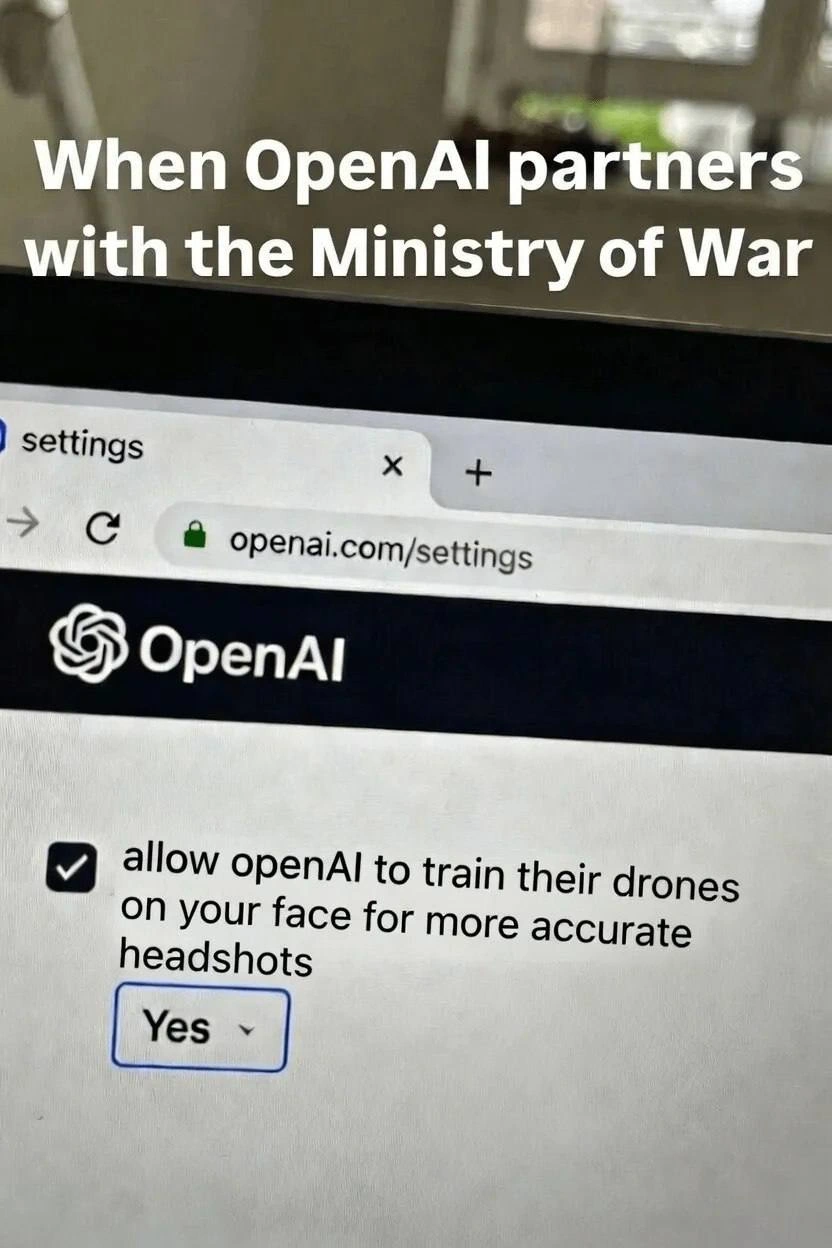
The genius of this fake screenshot is how little it has to exaggerate. A photographed laptop shows a browser tab at openai.com/settings — green padlock dutifully present, because of course your data is encrypted in transit on its way to the targeting pipeline — with the OpenAI logo on a dark header and one settings row:

☑ allow openAI to train their drones on your face for more accurate headshots

Dropdown: Yes. Overlay caption: "When OpenAI partners with the Ministry of War."

Three distinct satirical payloads are stacked here. First, the defense-pivot anxiety: the meme tracks a real industry arc where frontier AI labs quietly amended usage policies that once banned military applications, then signed defense partnerships outright — while the United States rebranding its Department of Defense as the "Department of War" handed satirists the most on-the-nose vocabulary imaginable. The meme's "Ministry of War" phrasing pushes it one notch more Orwellian, which is barely a notch anymore.

Second, the dark-pattern consent UX, rendered with documentary accuracy. The checkbox is pre-checked. The consent is buried in a settings page you'd never visit. The phrasing launders horror through product-speak: "for more accurate headshots" has the exact cadence of "to improve your experience." That's the real observation — the privacy industrial complex has trained users to scroll past checkboxes so thoroughly that opting a face into a kill chain could plausibly ship behind a toggle, and the average user would click through it to get back to generating birthday poems. Anyone who has implemented a GDPR banner with a giant "Accept All" and a gray, seven-click "Manage Preferences" knows which side of this joke they built.

Third, the pun that fuses both layers: "headshots." In a portfolio context, the word means profile photos — exactly the data users already upload by the millions. In the targeting context, it means what drones do. The sentence is grammatically valid under both readings, and that ambiguity is the dual-use problem in AI: the same facial-recognition embedding that tags your vacation photos is, architecturally, a targeting feature. The meme doesn't claim the capability is different for military use. It claims, correctly, that only the checkbox label changes.

Description

A photo of a laptop screen with large white overlay text reading 'When OpenAI partners with the Ministry of War'. The screen shows a browser tab labeled 'settings' open to openai.com/settings with a green padlock in the address bar, the OpenAI logo and wordmark on a dark header, and below it a fake settings option: a checked checkbox next to the text 'allow openAI to train their drones on your face for more accurate headshots', with a dropdown button showing 'Yes'. The dark pun hinges on 'headshots' meaning both profile photos and lethal targeting. The meme satirizes AI companies' defense-sector partnerships (referencing the US Department of Defense's rebrand to 'Department of War'), dark-pattern consent UX, opt-in-by-default data collection, and the use of consumer data for military AI training
Comments

1
Anonymous ★ Top Pick Of course the checkbox is pre-checked - military-grade systems still can't beat consumer-grade consent UX for kill efficiency
  1. Anonymous ★ Top Pick

    Of course the checkbox is pre-checked - military-grade systems still can't beat consumer-grade consent UX for kill efficiency

Use J and K for navigation