OpenAI Proposes Paying AMD for Chips with Stock Market Appreciation
Why is this AI ML meme funny?
Level 1: Counting Chickens Early
Imagine a kid trying to get a huge box of candy from a store without paying for it normally. The box of candy costs a ton of money (let’s say $100, which is huge for candy). The store owner says, “That’ll be $100, please,” but the kid has a wild idea. He says, “What if you give me the candy for free right now? I’ll tell all my friends I got it from your store. Then you’ll get so many new customers buying candy that you’ll earn $100 extra, which covers the cost. See, then it’s like I paid you!” The store owner frowns and says, “Nice try, but you still have to pay for the candy.” So the kid tries another plan: “Okay, I’ll pay you $100 now, but you give me a $100 gift card for the store in return. After my big candy purchase makes your shop famous and tons of people come, I’ll use this gift card later and get $100 of candy free. That way I get my money back, and you get lots of new customers!” At this point the store owner is either laughing or facepalming, saying, “Kid, I can maybe give you a small bonus, but I can’t run my business on maybe-future sales. I need real payment.” In simple terms, the kid was trying to pay with future success instead of real money – basically counting his chickens before they hatch.
Level 2: Chips and Stocks
Let’s break down what’s happening in simpler terms. OpenAI (the company behind ChatGPT) wants to buy a huge number of chips from AMD (short for Advanced Micro Devices, a big competitor to Nvidia in making processors and GPUs). OpenAI’s AI system – a Large Language Model (LLM) – needs a lot of computing power to run. We call the act of the AI running and answering questions inference. To handle all the users and calculations, OpenAI would need many, many GPUs (Graphics Processing Units). GPUs are specialized chips that are really good at doing lots of math in parallel, which is why they’re the workhorses for training and running machine learning models.
In the meme’s script, OpenAI asks for “six gigawatts” of GPUs. That’s not a normal way to order computer hardware – gigawatts usually measure electricity or the output of power plants! They’re jokingly saying they need an enormous amount of processing power (imagine a warehouse full of servers, all whirring away consuming around 6 billion watts). This exaggeration highlights how hungry for hardware modern AI projects can be. It’s like saying, “We need enough GPUs to power a small country.”
AMD replies that such a colossal order would cost about $78 billion. To put that number in perspective: $78B is an extremely large sum of money – more than the yearly revenue of most tech companies, and close to the entire value of AMD as a company at that time. It’s a humorous way to show how expensive big AI ambitions have become. (Think of asking for so much candy that the store owner says, “Uh, that’s like half my store’s worth of candy.”)
Now comes the funny plot twist. Instead of paying $78B the normal way, OpenAI suggests they can cover it by simply announcing the deal and riding the stock market’s reaction. When they say announcing the deal would add $78B to AMD’s value, they’re talking about market capitalization (or market cap). Market cap is basically the total value of all a company’s shares of stock. If AMD gets huge news – like “AMD is supplying all the chips for OpenAI!” – people buying AMD’s stock might drive the stock price up. If the stock price goes up a lot, the total value of the company (on paper) increases. OpenAI is suggesting that increase could be $78B, which magically equals the cost of the chips.
Here’s why that idea is absurd in real life: a rise in stock value isn’t the same as cash in the bank. AMD can’t actually spend that kind of value bump without selling shares. It’s mostly a paper gain. That’s why AMD in the meme goes, essentially, “No, you really do have to pay for the chips.” The joke is highlighting that you can’t pay a factory with stock market hype. The factory wants real money for raw materials and work, not just a high stock price.
So OpenAI tries a more complex deal: “We’ll pay you $78B in cash, and you immediately give us $78B worth of AMD stock. Then, when we announce this deal and your stock price jumps, the stock you gave us will be worth much more – and we’ll sell it to get our $78B back.” In simpler terms, OpenAI would temporarily give AMD a huge amount of money, but then OpenAI would hold a bunch of AMD’s stock shares. If the announcement makes AMD’s stock price double, for example, the shares OpenAI holds could be sold for double the money. That means OpenAI recovers the $78B it spent (and maybe even profits), effectively getting the chips “for free” in the end. It’s like an elaborate cashback scheme, using the stock market as a piggy bank.
AMD’s response: they don’t want OpenAI to be the only one benefitting from that stock jump. So AMD says, “We should get some of that value too.” The compromise they reach is that OpenAI would get back about half of the benefit (roughly $35B in value) and AMD keeps the other half of the windfall in its stock value. In other words, if AMD’s stock skyrockets, OpenAI can cash out some gains but not all of them.
This scenario is of course a parody – in real business, deals aren’t usually structured in such a perfectly speculative way because it’s risky and assumes everything goes right. But it’s making a point about the current tech climate. AI hype is so high and GPU supplies are so crucial that people joke about doing crazy things to secure hardware. Companies do sometimes pay each other in stock or do investments as part of deals, but using a future stock price jump to effectively pay for a purchase is a comical extreme. The meme is funny because it’s like saying, “What if a company tried to buy expensive stuff not with money, but with the promise of future success?” It’s a bit like a startup telling a landlord, “Let me live here free because my company’s gonna be huge and then you’ll be glad you gave me that break.” Most folks know that’s not how it works – you usually can’t pay today’s bills with tomorrow’s hypothetical earnings, which is exactly the joke here.
Level 3: Balance-Sheet Sorcery
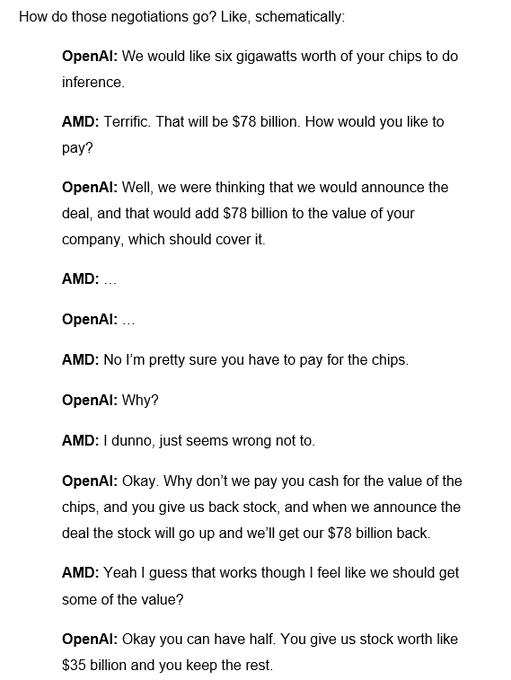
At first glance, this conversation looks like pure corporate satire. OpenAI is asking AMD for “six gigawatts worth of your chips” – an impossibly huge request for GPU hardware, measured in gigawatts as if AI runs on raw power from a grid. (For perspective, 6 GW is about five nuclear power plants’ output, a tongue-in-cheek way to say “a ludicrous amount of GPUs.”) AMD responds with a price of $78 billion. That sticker shock isn’t random – it’s a comically exaggerated number to match the insane scale, roughly on the order of half of AMD’s entire company valuation. It highlights that running advanced LLMs at scale has gotten so expensive that the line between buying hardware and buying the hardware company itself is blurring.
Then the meme dives into financial engineering wizardry. OpenAI essentially proposes paying with hype instead of cash: “We’ll announce this giant deal, your market cap (the total value of your company’s stock) will jump by $78B, and that magic stock boost should cover our bill.” It’s a hilarious bit of balance-sheet sorcery. They’re treating AMD’s future stock price increase as a form of currency. To any seasoned engineer or finance person, this sounds like trying to pay for servers with Monopoly money. We’ve officially left the realm of normal procurement and entered fantasy-land economics where simply greenlighting a deal supposedly creates enough new market value to fund itself.
AMD’s stunned silence in the dialogue ("...") is the perfect comedic beat. It’s basically the real-world reaction of a sober accountant or ops engineer hearing, “We’ll pay you with your own stock’s rise.” After a pause, AMD says what we’re all thinking: “No, I’m pretty sure you have to pay for the chips.” In other words, you can’t run a data center on stock market fumes. This touches on a very real tension: in the current AI hype economy, executives talk about massive valuations and future gains, but vendors still want cold hard cash (or something of actual value) for their silicon. It’s an inside joke about how tech dealmaking can get dangerously detached from reality.
OpenAI, undeterred, doubles down with a stock-based barter scheme. “Okay, we’ll pay $78B in cash, and you immediately hand us back $78B worth of AMD stock. Once we announce the partnership, your stock price will soar, and our new shares will double in value – giving us our money back. Free GPUs!” This is basically a market cap payment plan: use stock market hype to reimburse the cost. It’s the kind of elaborate win-win scenario an over-caffeinated CFO might dream up at 2 AM – essentially printing money via press release. The meme exaggerates it to highlight how absurd it sounds when you say the quiet part out loud. It’s poking fun at the idea that tech companies sometimes act as if simply declaring a partnership can financially justify itself.
AMD’s final reply is the icing on the cake: “...I feel like we should get some of the value?” In negotiation-speak, AMD’s saying, “If our stock is going to moon because of this, we’re not letting you walk away with all the gains.” So they settle on splitting the imaginary windfall: OpenAI gets $35B worth of that stock surge and AMD keeps the other half. This mirrors real high-stakes deals where both sides want a share of the upside. It’s reminiscent of dot-com era arrangements and modern cloud contracts where companies trade equity or future revenue shares instead of straightforward payment – each betting on a skyrocketing future that may or may not materialize.
The humor lands especially for those who’ve seen hype bubbles before. It’s a satire of AIIndustryTrends where valuations and hardware demands are through the roof. The negotiation reads like two savvy-but-slightly-delusional execs trying to outsmart economics: one side leveraging the GPU arms race supply crunch and the other leveraging their stock price as currency. A cynical veteran in tech has watched similar “magical thinking” play out in real life – from companies announcing buzzword-laden partnerships just to boost stock, to giant AI projects with fuzzy economics. This meme takes that to an extreme: paying for real, power-hungry chips with an imaginary pile of future money. It’s both hilarious and a sharp commentary on how out-of-whack things can get when AI hype meets corporate finance.
Description
A screenshot of text presenting a satirical/schematic dialogue about how OpenAI might negotiate a chip deal with AMD. The conversation goes: OpenAI wants 'six gigawatts worth of chips for inference,' AMD says that'll be $78 billion, and OpenAI suggests paying by announcing the deal (which would add $78 billion to AMD's market cap). AMD objects, so OpenAI proposes paying cash for chips, getting stock back, and when the deal announcement drives the stock up, recovering their $78 billion. AMD wants some value too, so OpenAI offers half: '$35 billion in stock and you keep the rest.' The text is captioned 'How do those negotiations go? Like, schematically:' This satirizes the current AI hardware market dynamics where deals are so large they literally move market caps, creating circular valuation games
Comments
12Comment deleted
OpenAI's negotiation strategy: the deal pays for itself if we announce the deal, because the announcement of the deal increases the value of the payment for the deal. It's deals all the way down
When your inference cluster can’t hallucinate silicon, you start hallucinating AMD’s share price instead
This is basically how every AI startup's Series B pitch goes: 'We need $78 billion in compute, but hear us out - what if we just tweet about it and call it ARR?'
This negotiation perfectly captures the AI gold rush economics: OpenAI needs six gigawatts of compute for inference (because apparently GPT-5 will require its own nuclear power plant), but proposes paying AMD with the announcement-driven stock bump from their own acquisition - essentially asking AMD to finance OpenAI's infrastructure with their own market cap inflation. It's the tech equivalent of 'I'll pay you in exposure, but the exposure is literally just me telling people I'm paying you.' The awkward ellipses after AMD realizes they're being asked to pay for their own chips is *chef's kiss* - that's the exact moment a seasoned chip executive realizes they're negotiating with people who've raised so much VC money that traditional concepts like 'payment' have become mere suggestions
At hyperscale, the real inference engine isn’t the LLM; it’s the CFO orchestrating a stock-for-silicon swap and reducing cash‑flow latency to zero
When gigawatt-scale training clusters meet public markets: announce the deal to buy the chips that fund the announcement
Classic circular dependency: pay for inference by announcing inference - NASDAQ does the dependency injection, and the CFO’s consistency checks start throwing at runtime
Wait, each has two arms. What are they holding! Comment deleted
stocks Comment deleted
Cocks Comment deleted
dicks of each other? Comment deleted
That would be an accurate representation on what they doing Comment deleted