Corporate User Accuses Open Source Maintainer of Extortion
Why is this OpenSource meme funny?
Level 1: Playground Promises and Free Help
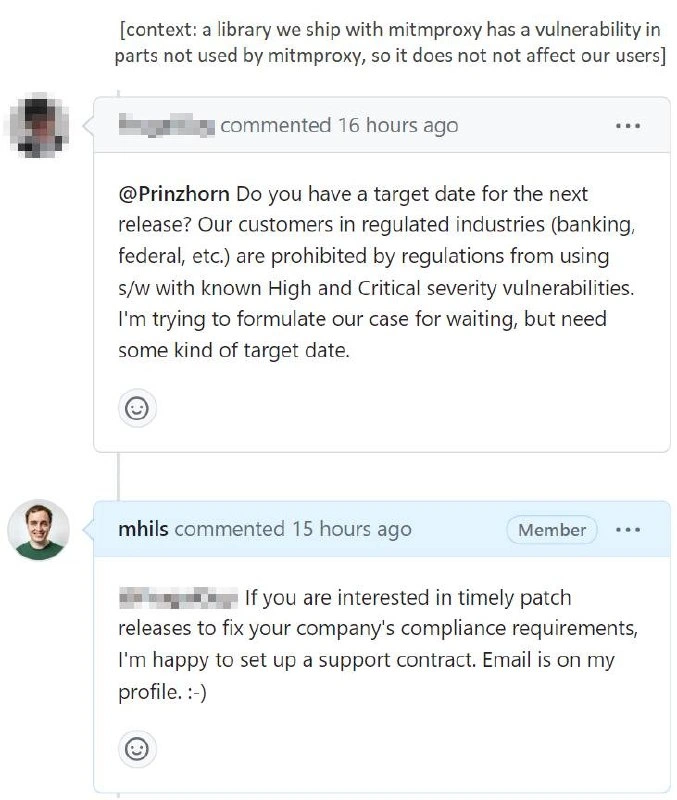
Imagine you and your friends built a free community playground after school – a fun project you did just because you love making things. One day, a kid from another neighborhood (let’s call him Big Corp 😏) comes to play. Big Corp’s parents have a big party planned next week and they expect you to add a new swing set to the playground before the party. They ask, “When will the new swing be ready? We really need it by next Tuesday.” You shrug and say, “We’re not sure – maybe if more people help us build it, it’ll be done faster.” Now, Big Corp’s dad hears that and gets upset. He writes you a formal letter that sounds polite at first, but then basically says, “I hope you’re joking, because if you’re saying we need to help or pay to get that swing by our deadline, that sounds like you’re extorting us!” 😲
You’d probably scratch your head at that. Extortion? That’s like accusing you of being a bully who’s demanding candy to do the work. But really, you were just a volunteer saying, “Hey, I can’t promise it’ll be done in time without help.” The funny/sad part is the dad acting like he’s a paying customer when this is all a free, community effort. He’s essentially demanding a favor on his schedule and calling you the bad guy when you suggest he pitch in. It’s a mismatch of expectations: you thought you were generously sharing something for free, and he thought he could boss the process around. That’s why this meme is amusing – it’s like watching someone get mad at a volunteer because the free lemonade isn’t served fast enough, then accusing the volunteer of charging a secret price. It highlights how misunderstandings and a sense of entitlement can turn a simple request into a big, silly argument over nothing.
Level 2: Stakeholder vs. Maintainer Misalignment
For a newer developer, let’s break down what’s going on. Open-source (OSS) projects like mitmproxy are software tools publicly available for free. They’re often maintained by people in their free time or small teams, not by a big company with paid support staff. In this meme, a stakeholder (basically a person whose company relies on mitmproxy) emailed the project’s maintainer, Mr. Hils. The stakeholder asked, “When is the next release coming?” – essentially seeking a target date for new features or fixes. Instead of replying on the public GitHub issue tracker (where users normally discuss bugs or features), this person took it to email, possibly trying to get a quick, direct answer.
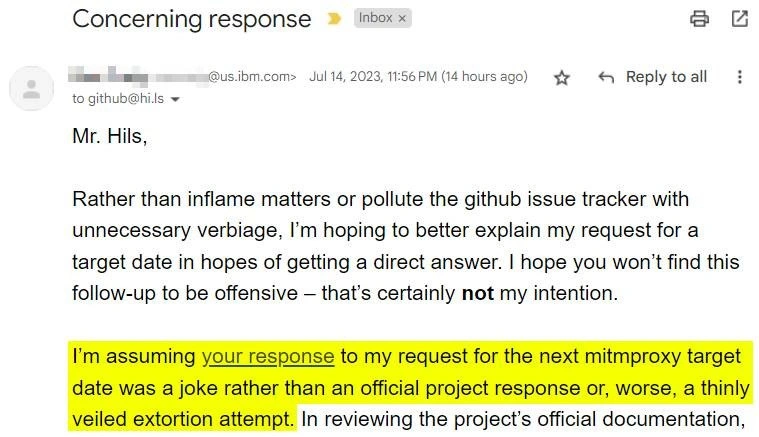
Now, something in the maintainer’s initial response clearly didn’t satisfy them. We don’t see that first reply in the meme, but we can guess: maybe the maintainer said the next release will be ready “when it’s done” (a common OSS phrase meaning they can’t promise a date), or perhaps they jokingly said “it’ll be done faster if someone sponsors the work.” The stakeholder interpreted that as offensive – maybe thinking the maintainer was asking for money up-front. They wrote a follow-up email accusing the maintainer’s answer of being either a joke or “a thinly veiled extortion attempt.” Extortion is a strong word; it means trying to get something (usually money) through threats. “Thinly veiled” means not very well hidden. So the stakeholder is basically saying: “I assume you weren’t serious or trying to secretly force us to pay you to get the release out.” This is the communication breakdown at the heart of the meme.
For context, mitmproxy is a free tool used to intercept and inspect network traffic (like a hacker’s man-in-the-middle tool, but for developers debugging apps). It’s super useful, and companies might use it in testing or security work. But if a company like IBM depends on it, they might treat it with the same expectations as paid software – thinking they can demand a roadmap or deadlines. That’s where StakeholderExpectations get misaligned with reality. The maintainer isn’t IBM’s employee or contractor; they’re a volunteer (or at best, a very indie developer). They don’t owe IBM a detailed timeline. If the company needs a feature by a certain date, often the respectful approach is to either contribute code (OpenSourceContribution – e.g., IBM’s developers write some patches) or offer support (some projects accept sponsorships or funding).
The email in the image is written in formal corporate-speak: “Rather than inflame matters… not my intention” – the stakeholder is trying to sound polite and reasonable. But then they drop that extortion comment, which is actually quite accusatory. In open source communities, this kind of tone can be seen as unprofessional or entitled. It’s like saying: “I hope I’m not offending you, but by the way, I think you might be scamming us.” 😓 That’s why the situation is awkwardly funny. The OpenSource maintainer likely felt frustrated – hence DeveloperFrustration. They probably thought, “I’m giving you this tool for free, and now you’re upset that I’m not doing even more, on your schedule?” Many of us learn early in our careers that while communication with stakeholders is important, you also have to set boundaries – especially in OSS. If you’re a junior dev using open source libraries, this meme is a reminder: maintainers are not your paid employees. Ask nicely, offer help if you can, and don’t assume a volunteer project can commit to your deadline. Otherwise, things blow up into release timeline drama like this, with hurt feelings on all sides.
Level 3: Release Ransom Reality
At the senior engineer level, this meme hits uncomfortably close to home. It's spotlighting the classic corporate vs OSS clash where an enterprise stakeholder treats an open-source maintainer like a vendor on the hook for deadlines. In the highlighted email, an IBM employee asks for a firm release date for the next version of mitmproxy, and then accuses the volunteer maintainer of making a joke or even a “thinly veiled extortion attempt” in their timeline reply. This is dripping with irony: the corporate user implicitly expects free labor on a fixed schedule, but when the maintainer likely hinted “contributions or funding welcome”, the user cried extortion. Senior devs recognize this absurd role reversal immediately. After all, extortion is a loaded word – usually we talk about ransomware or shady vendors, not maintainers politely suggesting OpenSourceContribution.
Why is this so funny (or cringey) to experienced folks? Because it's a tale as old as open source. Big companies build critical systems on community-maintained projects like mitmproxy (a popular tool for intercepting and debugging HTTP(S) traffic), yet they often balk at the idea of sharing the load. Here, the stakeholder’s StakeholderExpectations are completely MisalignedExpectations with how volunteer projects run. The email’s tone is couched in corporate politeness (“I hope you won’t find this follow-up offensive…”) but then it goes nuclear by suggesting the maintainer’s response was some kind of shakedown. 😬 Talk about an unprofessional_email_tone – it’s passive-aggressive on a whole new level. The maintainers gave a timeline update that didn’t satisfy IBM’s internal project plan, and suddenly the free, volunteer-driven timeline is framed as a Release Ransom scenario. This is humorous to seasoned devs because we recognize the CommunicationBreakdown: the enterprise person imagines they’re a paying client and the maintainer is a service provider obligated to stakeholder deadlines. But in reality, OpenSource maintainers are often juggling day jobs and coding on nights/weekends. The only “thinly veiled” thing here is the entitlement behind the email – an assumption that open-source = free help desk.
This release_timeline_drama highlights the systemic issue: corporate users want the stability and predictability of vendor software without the invoice. They forget that without a support contract or active contribution, OpenSource software comes with no guaranteed SLA. It’s maintained “best effort”. When the maintainer likely gave a tongue-in-cheek answer (maybe “the next release will ship when it’s ready – or sooner if someone contributes a PR”), the stakeholder saw red. Senior engineers have either witnessed or directly experienced these scenarios: crucial library maintainers being pushed for ETAs, threatened with forks, or accused of being “unprofessional” for not bending to a random company’s timeline. This meme resonates because it condenses that whole drama into one outrageous email. It’s a reality check: this is how not to handle OSS engagement. Instead of offering help or funding (which would be the professional way to accelerate a feature), the stakeholder chose an email rant, labeling the maintainer’s gentle nudge toward contribution as blackmail. The humor is dark and a bit painful – essentially, the DeveloperFrustration of being a volunteer maintainer under pressure from a Fortune 500’s schedule. Seasoned devs chuckle (and groan) because they know communication pitfalls like this plague many OSS projects whenever corporate timelines collide with volunteer schedules. Everyone nods knowingly: “Yep, seen that before. OSS dev asks for support -> gets called extortionist. Par for the course.” The meme underscores that behind many polite corporate requests lurk unrealistic demands, and when reality intrudes (no, you can’t always get a hard target date for a free project’s next release), things get spicy. In short, it’s a StakeholderExpectations horror story we all recognize – funny because it’s true, and frustrating because it keeps happening.
Description
A screenshot of an email sent from a user with a '@us.ibm.com' address to 'Mr. Hils', an open-source maintainer. The email subject is 'Concerning response'. The sender states they are writing to avoid polluting the GitHub issue tracker and hopes their follow-up isn't offensive. The most critical part of the email is highlighted in yellow: 'I'm assuming your response to my request for the next mitmproxy target date was a joke rather than an official project response or, worse, a thinly veiled extortion attempt.' This image is the third part of a story where a corporate user demanded a release timeline for compliance reasons, the maintainer offered a paid support contract, and the user has now escalated the situation via email, completely misinterpreting the offer of paid support as 'extortion.' It's a stark example of the culture clash between the transactional expectations of large enterprises and the community-driven, often voluntary, nature of open-source software development
Comments
7Comment deleted
In the corporate dictionary, 'extortion' is apparently a synonym for 'an unexpected item that requires a new purchase order'
Enterprise email: “Your ‘when it’s ready’ roadmap feels like a thinly veiled extortion attempt.” Maintainer: “Says the guy shipping my weekend project to prod behind a 40-page MSA and a $0 support contract.”
IBM employee discovers the one pricing model their company didn't invent: asking to be paid for your time before someone wastes it
When your enterprise stakeholder mistakes 'we'll get to it when we get to it' for extortion, you know they've never experienced the true joy of maintaining an open source project with zero SLA guarantees. Nothing says 'I understand OSS culture' quite like threatening legal language over a release timeline question - clearly someone's KPIs depend on a roadmap that doesn't exist outside their Gantt chart
"Thinly veiled extortion" or just indie maintainer hinting at sponsor tiers to fund the next sprint? OSS economics in a nutshell
Enterprise rule of thumb: if you want a date from a volunteer OSS maintainer, that’s called a purchase order - not a 11:56 PM reply‑all; CAP can’t give you Consistency, Availability, and a free SLA
Enterprise OSS strategy in one email: demand a mitmproxy release date at 11:56 PM and call sponsorship “extortion” - that’s not extortion, it’s an SLA without a PO when your vendor is a README