Skip to content
DevMeme
1397 of 7435
The Mythical OnlyFans for First-Try Code
DevCommunities Post #1570, on May 12, 2020 in TG

The Mythical OnlyFans for First-Try Code

Why is this DevCommunities meme funny?

Level 1: Paying to See a Unicorn

Imagine you have a friend who says, “Give me some money every month, and I’ll show you a real unicorn.” 🦄 You decide to subscribe and pay them. Month after month, you wait and wait, but no unicorn ever appears – because unicorns aren’t real (or if they are, they’re so rare that you’ll probably never see one). You’d probably laugh and say, “Hey, I’m paying you, but there’s nothing to see because that thing doesn’t exist!”

This meme is just like that, but instead of a unicorn, it’s about writing code that works perfectly on the first try. All programmers know that getting code right the first time is almost like a fairytale. Usually, when you write a program and run it the first time, something goes wrong – maybe you made a small mistake, or it doesn’t do exactly what you wanted. So the joke here is a programmer saying, “I’ll charge people money to watch my code run without any errors on the first try,” and someone replying, “So we’ll never get any content?” because it’s so unlikely to ever happen. It’s funny in a friendly, “we’ve all been there!” way. Even if you’re not a coder, it’s like trying to do a tricky task perfectly without practice – almost nobody can do that, and that’s why we find it silly and chuckle.

Level 2: First Run Frustrations

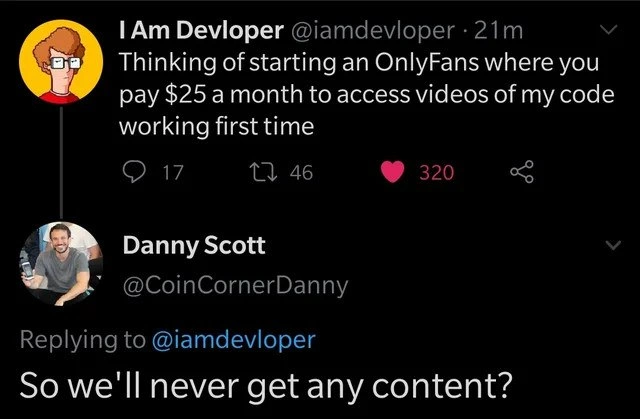
At its core, this meme is showing a conversation about how writing software usually doesn’t go smoothly on the first attempt. In the screenshot, a developer quips on Twitter about starting an OnlyFans page where people would pay $25 each month to watch videos of his code working perfectly on the first try. If you’re not familiar, OnlyFans is an online subscription platform where creators post exclusive content for paying subscribers (imagine paying a monthly fee to see special posts or videos that you can't see elsewhere). It’s usually known for entertainment or personal content, not programming, which makes the joke even sillier. The developer is basically saying, “Hey, my code is so rarely perfect on the first run that it would be a super-rare, exclusive event – worth paying to see!” The reply to that tweet is another person dryly asking, “So we’ll never get any content?” This reply jokes that since the code never works on the first try, subscribers would be paying for nothing. In other words, the page would be empty because the event (code working without any hiccups) never happens. It’s a humorous exaggeration of a very relatable developer experience: no matter who you are, your first attempt at running new code almost always reveals some problem.

To a new programmer, it might seem like experienced developers write flawless code from the start. In reality, bugs (errors or flaws in the code) are a normal part of the development process. The first time you run a program you just wrote, it’s common to see some kind of error message or incorrect behavior. Debugging is the act of finding out why that happened and fixing it. The meme highlights this common cycle in a funny way. Instead of showing frustration, the developer makes fun of it by pretending he could sell the incredibly rare occurrence of “code working on the first try” as if it were premium entertainment. It’s funny because every coder knows how unlikely that is – so the “premium channel” would be empty!

Let’s break down some of the terms and ideas here:

  • Code working first time: This means writing a program and having it run perfectly, with no errors, the very first time you try it. It’s the software equivalent of a hole-in-one in golf or winning the carnival game on your first shot. It happens, but it’s really rare, especially for anything more complex than a textbook example. Usually there’s a mistake somewhere that stops the code or messes up the output on the first run.
  • Bug: In software, a bug is just a mistake or problem in the code that causes it to behave in an unintended way. It can be as simple as a typo in a variable name or as complicated as a logical error in an algorithm. The term “bug” actually comes from an old story of a real moth (an actual insect) found in a computer in the 1940s, but nowadays it just means “there’s something wrong in the code.”
  • Debugging: This is what developers do when the program doesn’t work as expected. You investigate the issue (often with print statements, a debugger tool, or just staring at the code), find the bug, and fix it. Debugging is like being a detective for your code: you see the error or weird behavior, then trace it back to the cause and correct it. Every developer, from beginner to expert, spends a lot of time debugging. It’s an essential skill in Troubleshooting problems.
  • Why code rarely works on the first try: There are many reasons! You might have a syntax error (like forgetting a quotation mark or a parenthesis), or maybe you misunderstood how a function works. Sometimes you run into things you didn’t anticipate (like what if a user inputs a 0 and your code tries to divide by zero?). Other times, everything might be logically right but you misconfigured something external – for example, a file path is wrong or you didn’t realize you needed to install a certain library. The point is, it’s normal that your first attempt will reveal something you need to fix. That’s why we test and run code: to find those issues.

For example, imagine you wrote a short piece of Python code:

# A simple function to greet someone
def greet(name):
    print("Hello, " + nam)  # Oops, typo: using 'nam' instead of 'name'

greet("Alice")

If you run this for the first time, instead of greeting Alice, the program will throw an error like:

NameError: name 'nam' is not defined

Right away, the very first run fails because of a tiny mistake – nam isn’t defined due to that typo. To fix it, you’d go back into the code, correct the variable name to name, and run it again. This little snippet demonstrates on a small scale what happens with larger programs too. Maybe the mistake isn’t a one-letter typo; it could be forgetting to handle an edge case or calling an API the wrong way. But invariably, something usually needs to be fixed after the first run.

Now, about the OnlyFans joke aspect: The developer is equating “code that works on the first try” to some super-rare, premium content that people would pay to see. It’s humorous because, in the dev world, seeing code work without any debugging is almost like spotting a rare unicorn. By bringing in OnlyFans (a site far removed from coding) and a payment model, the meme exaggerates the idea. Essentially it says: “My code never works on the first try, so if you paid to watch it happen, you’d be paying for nothing at all!” This merges CodingHumor with a bit of pop culture. Even if you didn’t know much about OnlyFans, you get that paying $25 for nothing is ridiculous – which matches how ridiculous the notion of first-try perfect code is to developers.

In simpler terms, every programmer has been in the situation where they confidently hit the run button or refresh the page, and immediately face an error message or a blank screen instead of the expected result. The initial disappointment or DebuggingFrustration is so common that the only way to cope is often to laugh about it. That’s why this meme is popular: it takes that universal “ugh, of course it didn’t work” feeling and turns it into a joke. It’s saying “Don’t worry, it’s not just you – this happens to all of us, every day!” in a fun, roundabout way. If you’re a new dev and your code doesn’t work on the first try, be assured that you’re absolutely not alone – even the pros are joking about it because it happens to them too. The difference is that experienced developers expect to do multiple iterations: writing code, running it, debugging the issues, and repeating. It’s just how programming works.

In summary, the meme uses an absurd scenario (a paid subscription for perfect code runs) to highlight a very real aspect of coding: it usually takes several tries to get things right. It’s a nod to all the time spent troubleshooting and a lighthearted way to say, “Hey, coding is hard, mistakes are normal, and we can all laugh at ourselves.”

Level 3: Green Build Unicorn

This meme hits on a deep truth in software development: code almost never works perfectly on the first run. The tweet (a screenshot of a Twitter thread) uses a clever twist on the exclusive content model to highlight this reality. The original poster jokes about monetizing the mythical scenario of code running flawlessly on the first attempt. On a platform like OnlyFans (known for paid exclusive content), they’d charge $25/month for videos of their code working on first try. The punchline comes from a reply asking, “So we'll never get any content?” – implying that such videos would never exist because, well, code never works on the first try. It’s a piece of classic developer humor (DeveloperHumor) steeped in the pain experience of real-world coding.

I Am Devloper (@iamdevloper): "Thinking of starting an OnlyFans where you pay $25 a month to access videos of my code working first time."
Danny Scott (@CoinCornerDanny): "So we'll never get any content?"

For seasoned engineers, this joke lands because it satirizes the almost mythical unicorn status of a one-and-done, bug-free code push. We’ve all encountered the smug demo or the conference talk where someone’s snippet runs without a hitch – and we know not to trust it. In reality, even “Hello World” can fail on first try due to an environment issue or a missing semicolon. If a developer ever tells you their complex feature worked “first time, no bugs”, you might check if they’re secretly running git push --force on the timeline of reality. Bugs are practically a given on that initial run. The idea of charging for footage of a bug-free first run is absurd in just the right way to make coders smirk: it’s like charging for photos of a unicorn you can’t actually capture.

From an industry perspective, the humor stems from how relatable this scenario is. Software development is inherently an iterative process. Even with meticulous planning, there are always unforeseen issues: a missed edge case, a typo in a variable name, a configuration file you forgot to update. The first run of any non-trivial code is more often a quick way to generate a list of things to fix. The tweet’s proposal of an exclusive “first-try success” channel parodies the fact that developers wish this was a thing, but know it’s practically fantasy. It lampoons the debugging frustration we all share by exaggerating it into a pay-per-view spectacle. The second tweet’s deadpan reply nails the truth: paying for such content would be like subscribing to an empty feed. It’s a communal wink among developers – a bit of CodingHumor that says, “We’ve all been there, and we know how bugs in software always humble us.”

On a technical level, there are many reasons why code rarely works on the first go. Here are a few battle-tested culprits that experienced devs will immediately recognize:

  • Syntax slip-ups: A missing semicolon (;), an extra comma, or a forgotten parenthesis can halt a program before it even runs. The dreaded "SyntaxError" or "Compilation failed" message is basically a rite of passage on first runs.
  • Logical errors: Maybe your code runs, but it doesn’t work correctly. An off-by-one mistake in a loop, using = instead of == in a comparison, or flipping min and max – these bugs ensure the first output is wrong or weird. You print results and go, “Huh, that’s not right…”
  • Runtime exceptions: The code might compile, but as soon as you run it, boom – a wild exception appears. Think of a NullPointerException in Java or a TypeError in Python on the first click of “Run”. Perhaps you tried to index something that isn’t there or divide by zero on that initial input.
  • Environment and configuration issues: “Works on my machine!” – famous last words. Maybe you wrote the code correctly, but on the first run it fails because the database isn’t connected, an environment variable wasn’t set, or you forgot to npm install one last package. Modern apps have complex setups, and it’s easy to miss a step the first time around.
  • Integration woes: You call an API or microservice and get a 400 error because you misformatted something. Or two modules of your own code don’t talk nicely on the first try due to a misnamed field. The more moving parts, the more likely something mismatches initially.

Even the best engineers have a troubleshooting checklist in their head for that inevitable moment when the new code crashes immediately. It’s basically an unwritten rule of programming that you’ll spend 90% of the time debugging what you thought was a 5-minute change. There’s a famous tongue-in-cheek adage: “If my code compiles on the first try, I immediately get suspicious.” Why? Because experience has taught us that a green build on attempt number one is often just a fluke or means the tests aren’t thorough enough! We expect that first run to fail; it’s practically Newton’s law of coding at this point. This shared understanding is exactly why the meme is so relatable. It turns our everyday struggle (chasing pesky bugs through countless reruns) into a joke about an “exclusive content” channel. It’s both a nod to how impossible that scenario is and a bit of sarcastic commiseration: “Wouldn’t it be nice if our code just worked? Hah, keep dreaming.” The relatable developer experience of spending more time debugging than coding is being playfully exaggerated. We laugh (maybe a bit darkly) because it’s funny precisely due to how true it is. Each time we hit that run button, there’s a mix of hope and resignation – hope that by some miracle it works, and resignation that we’ll be diving back into the code to fix something.

Lastly, there’s an undercurrent of playful cynicism about monetization in tech here. In recent years, many developers joke about starting a side-hustle or using platforms like Patreon or OnlyFans for coding content (sometimes called “OnlyDevs” in jest). The tweet riffs on that trend, essentially saying: “I’ll make you pay for something that is virtually never going to happen.” It’s a tongue-in-cheek poke at both our coding reality and the idea of putting everything behind a subscription paywall. The humor works on multiple levels: if you’re in on the tech jokes, you chuckle at the code_works_first_try fantasy; if you know the modern internet culture, you smirk at the absurd notion of an OnlyFans for debugging victories. All combined, it’s a succinct meme that unites developers in the sentiment that writing software is hard, mistakes are guaranteed, and we might as well laugh about it together. After all, shared laughter over futile first tries is cheaper than $25/month and far more satisfying.

Description

A screenshot of a humorous exchange on Twitter between two users against a dark background. The initial tweet is from the popular satirical account 'I Am Devloper' (@iamdevloper), featuring a cartoon avatar. It reads: 'Thinking of starting an OnlyFans where you pay $25 a month to access videos of my code working first time'. Below this, a reply from user Danny Scott (@CoinCornerDanny) delivers the punchline: 'So we'll never get any content?'. The joke hinges on a universally accepted truth in the software development world: code almost never works correctly on the first attempt. The concept of a subscription service for such a rare event is inherently absurd, and the reply wittily points out that the service would have zero content, making it a clever roast of the original poster and a relatable jab at the daily struggles of every programmer
Comments

7
Anonymous ★ Top Pick I'd subscribe to an OnlyFans of my code working the first time, but the content would just be a 404 error and a link to a Stack Overflow page from 2011
  1. Anonymous ★ Top Pick

    I'd subscribe to an OnlyFans of my code working the first time, but the content would just be a 404 error and a link to a Stack Overflow page from 2011

  2. Anonymous

    OnlyFans for first-try builds: five nines on the Stripe webhook, zero bytes in S3 - finally, a serverless architecture that’s perfectly honest about its deliverables

  3. Anonymous

    The real premium tier would be $500/month for videos of code passing all tests without a single 'fix typo' commit in the git history - but that violates the laws of physics as we understand them

  4. Anonymous

    The real premium tier would be a livestream of production deployments on Friday afternoons - but that's less OnlyFans and more like a horror movie subscription service. The joke brilliantly captures the universal developer truth: code working perfectly on the first attempt is so statistically improbable that it's essentially vaporware. Even with decades of experience, TDD, static analysis, and peer reviews, that first green CI pipeline is always suspiciously surprising - making you wonder what you missed rather than celebrating the win

  5. Anonymous

    OnlyFans for code that works on the first try? So a green CI badge guarding an empty playlist - finally, an SLO we can hit

  6. Anonymous

    Senior dev wisdom: If code works first try, you clearly misunderstood the requirements - or it's a honeypot for the next prod outage

  7. Anonymous

    An OnlyFans for first-try code has the same uptime as our flakiest e2e suite: five nines of downtime

Use J and K for navigation