Jira Doesn't Magically Grant Agility
Why is this Agile meme funny?
Level 1: Not a Magic Wand
Imagine you have a toy magic wand. Just holding the wand doesn’t actually make you able to do real magic, right? You’d still be the same kid waving a stick around unless you learned real spells (and in real life, there are no magic spells!). This meme is saying the same thing about a company using Jira. Jira is like a fancy tool or wand that some teams use when they’re doing agile work. But simply having that tool doesn’t suddenly give everyone “agile superpowers.” It’d be like a soccer team putting on professional jerseys and expecting to play like champions without practice. In real life, to get better at soccer, you have to train and work together as a team – the jerseys alone don’t win the game. Similarly, a software team has to actually change how they work together and plan things (that’s what being agile really means). If they just start using a new app or tool but keep doing everything the old way, nothing really changes. The meme joke is basically saying: some bosses think buying a fancy tool will magically fix their old slow methods, but that’s as silly as thinking wearing a cape will make you fly. It’s a funny way to remind us that tools aren’t magic – it’s how people use them that matters.
Level 2: Tool vs Culture
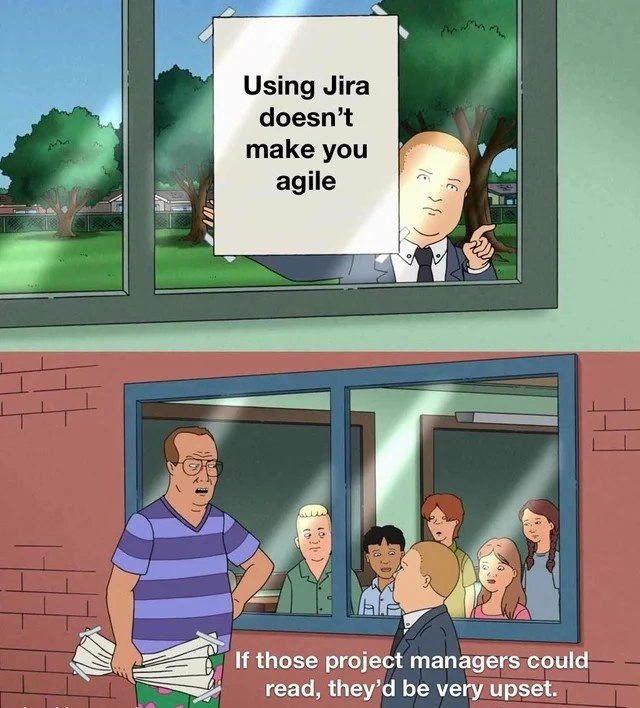
This meme highlights the difference between using a tool and adopting a culture or mindset. Jira is a popular project management and issue-tracking software (made by Atlassian) that many software teams use to organize their work. In agile teams, Jira often holds the backlog of tasks, user stories, and bugs, and it tracks progress during sprints (short development cycles, typically 1-2 weeks in Scrum methodology). Because Jira is so widely used by agile teams, some companies mistakenly believe that simply using Jira makes them “agile.” The top panel of the meme literally shows someone holding a sign that says, “Using Jira doesn’t make you agile.” This is a reality check: agile is not something you become just by adopting a tool or software. It’s like putting on a lab coat doesn’t make you a scientist — you need to actually follow the scientific method. Likewise, to be agile, a team needs to follow Agile practices and principles, not just use the same software agile teams use.
Agile (often capitalized to refer to the Agile methodology) is a way of developing software that emphasizes flexibility, collaboration, and customer feedback. Instead of doing a big project in one go (that’s the waterfall method, where you do all planning, then all building, then all testing in distinct stages), agile teams break work into small increments and iterate. They plan just a little, deliver a piece of working software, get feedback, then plan the next piece. Agile teams value communication, adaptability, and delivering real value continuously. There are frameworks like Scrum (with roles like Scrum Master and Product Owner, and events like daily stand-up meetings, sprint reviews, retrospectives) or Kanban, but all Agile methods share that mindset of continuous improvement and flexibility. An “agile guru” would be someone deeply experienced in these practices, able to guide teams to truly embody agility.
In contrast, a waterfall team is a team that still follows the traditional sequential approach: first gather all requirements, then design the whole system, then build it all, then test at the end, and finally deliver. It’s called “waterfall” because each phase flows into the next, and it’s hard to go back upstream. Waterfall management often means long-term planning and reluctance to change the plan once it’s set. For many years, this was the standard way to manage projects, and some project managers (PMs) were trained heavily in that style. Now, imagine such a waterfall-oriented team or PM suddenly being told “We’re doing Agile now” and installing Jira. Without changing their habits, they might just treat Jira as a fancy new way to enforce the old process. For example, they might create a year’s worth of tasks in Jira upfront (mimicking a big plan), or require exhaustive documentation attached to each Jira issue, or use Jira to generate strict progress charts. The tool ends up being used to support waterfall practices, rather than enabling real agility.
The meme’s bottom panel shows children in a classroom looking surprised or upset, and a subtitle jokes, “If those project managers could read, they’d be very upset.” The “children” here represent the project managers or the management folks who believe using Jira made them modern and agile. The sign outside the window is basically calling them out, saying “You’re not actually agile just because you use Jira.” If they truly understood that message (or read up on agile principles), they might feel attacked or embarrassed – hence they’d be upset. The joke implies that these PMs are ignorant of what real agility means. It’s a tongue-in-cheek way of saying the PMs are perhaps willfully blind or not very self-reflective; they see themselves as cutting-edge for adopting Jira, but they fail to grasp the substance behind agile practices.
A junior developer or someone new to Agile might wonder: isn’t Jira used in agile? Why would using it not make you agile? The key is understanding that Agile is primarily about how people work and think, not which software they use. You can manage an agile process on a whiteboard with sticky notes, or in a simple spreadsheet – it could still be agile if the team is iterating, collaborating, and adapting. Conversely, a team could use all the latest tools like Jira or Trello but still operate in a very rigid, old-fashioned way. Think of Jira as a hammer: in the hands of a carpenter building something new step-by-step (agile), it’s great; but if someone uses that hammer to just bang on a locked blueprint (waterfall plan), it doesn’t magically create flexibility. The meme emphasizes an AgilePainPoint: many organizations latch onto surface-level indicators of agility (tools, terminology, ceremonies) without embracing the deeper changes – like empowering the team, trusting individuals, and welcoming changing requirements. That’s why simply “Using Jira” isn’t a shortcut to agility. The team has to learn and practice the actual agile values.
In summary, the top image literally spells out the meme’s message as a sign: tooling ≠ transformation. The bottom image uses humor to say management might not get this message. It’s poking fun at a common scenario in project management humor: bosses who proudly say “We’re doing Agile, we have Jira now!” while the development team still feels like nothing has really changed (except maybe more forms to fill in Jira). This disconnect between tool vs culture can be frustrating for developers, but it’s also a bit funny when exaggerated in a cartoon. For someone early in their career, the takeaway is: Agile is about how you work, not the tools you have. A fancy tool like Jira can help an already agile team stay organized, but it won’t turn a slow, bureaucratic process into an agile one by itself. Just as owning a cookbook doesn’t make you a master chef, using Jira doesn’t make a team agile unless they also change their recipe for how they plan, work, and collaborate.
Level 3: Cargo Cult Agile
At first glance, this meme skewers the cargo cult mentality behind some corporate “Agile” transformations. In the top panel, a suited character literally holds up a sign: “Using Jira doesn’t make you agile.” This blunt message speaks to seasoned developers who’ve survived management fads. The joke lands because we’ve all seen it: a waterfall organization buys an Agile tool like Jira, mandates daily stand-ups and sprint rituals, and declares “We’re Agile now!” – all while nothing fundamentally changes. The meme’s bottom caption delivers a dark punchline: “If those project managers could read, they’d be very upset.” In other words, the PMs (project managers) pushing Jira can’t read the room – they’re oblivious to how real agility works. The humor is biting: it suggests these managers haven’t even read the Agile Manifesto (or maybe can’t read, period), because if they did, they’d realize tools and ceremonies alone won’t turn them into “agile gurus.”
This scenario is painfully familiar in enterprise software teams. The meme highlights an industry anti-pattern: adopting process over people. Agile’s first value literally says “Individuals and interactions over processes and tools,” yet here we have management clinging to a tool (Jira) as a silver bullet. It’s a classic case of tool vs culture. Veteran developers know that slapping issues into a Jira board is easy – truly empowering a team to adapt and self-organize is hard. The result is what cynics call “Agile in name only” or “checkbox agile.” The team goes through motions: stand-ups that are just status meetings, “sprints” that are really mini-waterfalls, backlogs treated like fixed requirement documents, and burndown charts gamed to appease higher-ups. I’ve seen teams religiously update every ticket field in Jira, yet still deliver in one big bang at the end (very waterfall style). Managers, meanwhile, proudly point to Jira reports as proof of agility, even as release dates remain locked and any change request triggers a bureaucratic storm.
To experienced eyes, this meme exposes the gap between true Agile and corporate Agile™. True agile teams embrace change and continuously improve; cargo cult agile teams just change their terminology. We trade Gantt charts for Jira boards but still demand fixed scope, fixed deadlines, and rigid phase gates – basically “water-Scrum-fall.” It’s the same old game with new stickers. The bottom caption’s irony (“if they could read…”) hints that management has missed every retrospective hint and every blog post explaining Agile vs waterfall. They’ve reduced Scrum to a checklist, thinking mere tools and ceremonies will summon agility like a magic incantation. Seasoned devs chuckle (or cringe) because they’ve been there: the Agile Coach comes in, introduces Jira and Scrum terminology, but leadership never relinquishes top-down control. The product roadmap is still a 12-month fixed plan, just split into sprints in Jira. Daily stand-ups become micromanagement sessions (“Why isn’t Ticket-1234 done yet?”). Instead of collaborating with developers or customers, some PMs obsess over velocity metrics and ticket counts, confusing activity with progress.
The meme format itself – a truth bomb on a sign held up to a clueless crowd – accentuates that we’re dealing with a stubborn reality. It’s basically a developer (or maybe Bobby Hill from King of the Hill in the image) trying to enlighten a room of oblivious project managers. But those inside are willfully blind; they only see what they want to see. This parallels real-life office dynamics: try telling a PM that their Jira-centric “agile” process isn’t actually agile, and watch them get defensive. 😅 The satire shines through: if these PMs could truly read (i.e., comprehend Agile principles), they’d be offended by how accurately the sign calls them out. Instead, they continue clutching their crumpled print-outs of burn-down charts, blissfully unaware. It’s humorous in a dark way – as developers, we often resort to gallows humor when faced with management edicts that miss the point. This meme validates that frustration: tooling ≠ transformation.
Let’s break down the irony with some Agile Manifesto context. Here’s how a truly agile mindset compares to a tool-driven faux agile approach some teams take:
| Agile Principle (from 2001 Manifesto) | Cargo-Cult Agile Interpretation (Reality) |
|---|---|
| Individuals and interactions over processes and tools | Emphasis on Jira process: ticket statuses and workflows trump face-to-face discussion. Developers spend more time updating fields than collaborating. |
| Responding to change over following a plan | A rigid year-long plan lives in Jira. Changes require multiple approvals or are discouraged, so the team still follows a plan to the letter, just with digital tickets. |
| Working software over comprehensive documentation | “Working software” is replaced by “all tickets closed.” Success is measured in story points burndown and documentation attached in Jira, rather than real user feedback on the software. |
| Customer collaboration over contract negotiation | Internal project managers treat scope like a contract in Jira – once defined, it’s set in stone. The customer/end-user isn’t interacting with the team; they just see reports. |
In a true agile practice, tools like Jira are supporting actors, not the stars. By contrast, the waterfall-turned-“agile” teams treat Jira like a magic control panel that will enforce agility on people. It’s akin to cargo cults building bamboo airplanes: copying the form without understanding the function. A veteran engineer will tell you that agile is a culture change: it requires trust, flexibility, and continuous learning – none of which you can configure with a Jira admin screen. In fact, misusing Jira can make things worse. I’ve been on projects where Jira tickets multiplied into a labyrinth of subtasks and sub-subtasks, with managers thinking more granularity = more control. Developers ended up spending evenings updating ticket statuses instead of coding or talking to teammates. The process became heavier than the old waterfall, the opposite of the intended lightweight Agile approach.
So the humor hides a serious truth: Agile isn’t a license you purchase, it’s a discipline you practice. Jira, Trello, or any tool can help visualize work, but they don’t grant agility by mere presence. AgilePainPoints like this persist because true agility demands letting go of some predictability. Many organizations aren’t ready for that; it’s safer to check the “we use Agile (see: Jira)” box. It’s easier for management to demand Jira reports than to empower teams and embrace uncertainty. The meme resonates with developers and agile purists because it calls out that lip-service. It’s a shared eye-roll at all the times we’ve heard “We have Jira and stand-ups, why aren’t we magically faster and innovative?” Meanwhile, the Development Team is still stuck waiting on endless approvals or fixed scope commitments. It’s a classic management blind spot – and the meme’s joke is essentially putting that blind spot in writing (literally on a sign) for everyone to laugh at.
Description
A two-panel meme format from the animated series 'King of the Hill.' In the top panel, the character Bobby Hill is inside a school classroom, pointing emphatically at a sign he has taped to the window. The sign reads, 'Using Jira doesn't make you agile.' In the bottom panel, his father, Hank Hill, stands outside, looking perplexed and holding rolled-up papers. He says, with a caption at the bottom, 'If those project managers could read, they'd be very upset.' The meme criticizes the common corporate fallacy of equating tool adoption with genuine process improvement. It humorously suggests that project managers often enforce the use of tools like Jira, believing it automatically makes their teams agile, while developers (represented by Bobby) are aware that the principles and mindset of agility are being ignored. The punchline implies that project managers are oblivious to this distinction
Comments
7Comment deleted
Some teams use Jira for 'agile' development the same way I use a calendar for 'time travel.' I can see the future, but I'm still gonna be late
Rolling out Jira to “become agile” is the project-management equivalent of deploying Kubernetes to avoid refactoring the monolith - you’ve just wrapped the waterfall in YAML
After 15 years of 'agile transformations,' I've learned that most companies treat Jira like a $10,000 todo list while their 'scrum masters' are just renamed project managers who still demand fixed scope, fixed timeline, and wonder why velocity isn't a commitment
Ah yes, the classic enterprise transformation: rebrand your waterfall as 'sprints,' rename your status meetings to 'standups,' migrate from Excel to Jira, and congratulations - you're now 'agile.' Meanwhile, your two-week sprints still require three months of upfront planning, change requests go through a five-person approval chain, and deployments happen quarterly. But hey, at least the burndown charts look pretty in the retrospective deck that nobody reads
Jira is a strongly typed spreadsheet; agility is shortening decision latency - show me the marketplace plugin for that
Jira won’t make you agile; it just lets you run waterfall in two-week installments and plot the blame under “Blocked - compliance dependency.”
Jira tracks epics flawlessly; pity it can't sprint past the PMs' ever-shifting baselines