The Modern DevOps Toolchain vs. Touching Grass
Why is this DevOps SRE meme funny?
Level 1: Go Outside
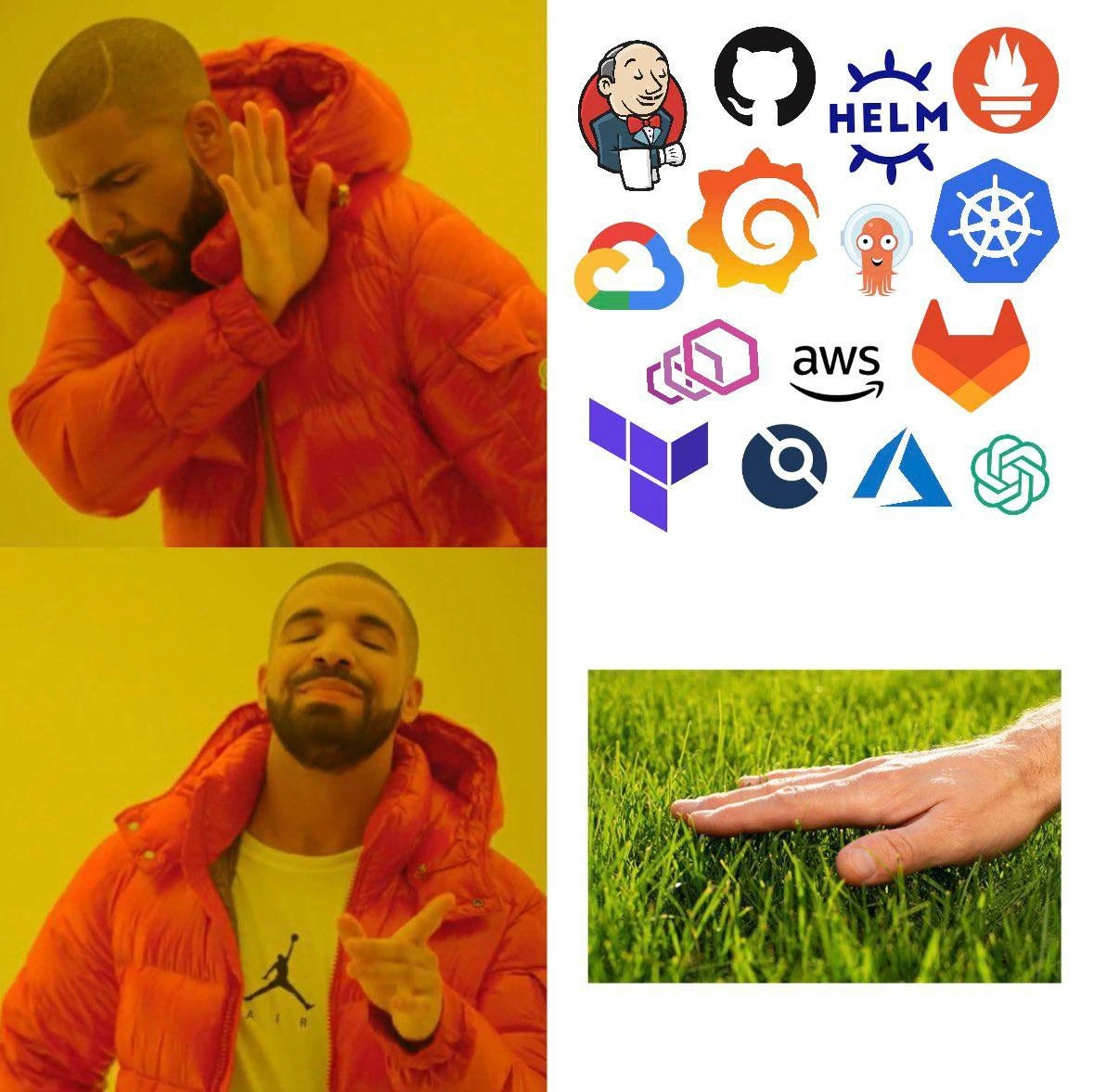
Imagine you have a HUGE collection of different toys and games all spread out on your floor – puzzles, LEGO sets, video games, robots, everything – and they’re all beeping or making noise at once. It’s so confusing that it stops being fun, and you just feel tired looking at it. In the top part of this meme, the guy in the orange jacket (that’s Drake) is basically saying, “No, I don’t want to deal with all that mess!” He’s reacting to a big clutter of computer tools (those colorful icons) that are stressing him out.
Now, think of what you do when you feel overwhelmed by homework or too much screen time. A grown-up might tell you, “Why don’t you go play outside for a bit?” The bottom part of the meme shows Drake happy and pointing to something super simple: a hand touching green grass. That’s like saying, “Yes, this is a good thing.” It means taking a break and doing something in the real world. Touching grass literally means going outside and feeling the nice, soft lawn or nature. It’s a way to relax.
So, the joke here is comparing two things: one is a crazy-complicated world of tech stuff that can make your brain hurt, and the other is the easiest, most calming thing you can do – go outside and touch some grass. It’s funny because sometimes adults (especially those who work with computers) forget to take breaks. This meme reminds everyone in a silly way: when you’re upset or burnt out from too much computer work, just step away, go breathe some fresh air, and touch the grass. It will make you feel better, just like taking a time-out from a tough game can help you calm down. After all, even big tech experts sometimes need to do the simple things, like enjoying a sunny day, to recharge and feel happy again!
Level 2: Continuous Integration, Continuous Exhaustion
This meme uses the well-known Drake meme format: two panels with Drake rejecting something in the top image and approving something else in the bottom image. In the top-right panel, we see a cluster of DevOps and cloud logos all jammed together. For a newcomer, let's decode that logo soup:
- Jenkins (cartoon butler logo): a popular automation server for running builds and tests – part of Continuous Integration (CI). Jenkins can pull your code and execute a pipeline (like compile, run tests, package the app) every time you push changes.
- GitHub (black Octocat logo) and GitLab (orange fox logo): platforms for hosting your source code repositories. They also include CI/CD pipeline features (e.g. GitHub Actions, GitLab CI) to automate building and deploying your code.
- CircleCI (black circle logo): another Continuous Integration service – basically a tool that automatically runs your build/test jobs in the cloud whenever you update code.
- AWS, Google Cloud (GCP), Microsoft Azure (cloud icons for Amazon, Google, Microsoft): these are major cloud providers. Instead of running your own physical servers, companies rent computing resources from these clouds. Each has its own ecosystem of services and quirks. Many projects use a mix, so engineers end up needing familiarity with all three.
- Terraform (purple T blocks logo): an Infrastructure as Code tool. It lets you define cloud infrastructure (servers, networks, databases) in configuration files. With Terraform, you can spin up or tear down entire environments with one command. It’s powerful for managing cloud resources consistently, but you have to manage its state files and learn its configuration language.
- Kubernetes (blue hexagon with ship wheel): often called K8s, this is a system for containerization orchestration. Containers (like Docker containers) package applications along with their environment. Kubernetes helps run and manage lots of containers across many machines, handling scaling, load-balancing, and restarts. It’s basically the operating system for cloud data centers – incredibly useful for big applications, but notoriously complex (lots of YAML config files and moving parts).
- Helm (helm wheel icon): a package manager for Kubernetes. Think of Helm as a way to bundle a bunch of Kubernetes config files into a single chart that you can install or upgrade easily. Instead of manually configuring 10 different K8s resources, one Helm chart can deploy an entire application stack with sane defaults.
- Octopus Deploy (the orange octopus logo): a deployment automation tool. It helps coordinate releases of applications, databases, etc., often used in .NET/Windows environments. It’s another piece of the CI/CD puzzle, focusing on getting the built code onto the servers reliably.
- Prometheus (orange flame icon): a monitoring system for collecting metrics from your applications and infrastructure. It gathers data like CPU usage, memory, request rates, etc. Prometheus is loved in DevOps/SRE because it uses a powerful query language to alert you when things go wrong (e.g., “send an alert if five web servers all have >90% CPU for 5 minutes”).
- Grafana (multicolor swirl logo): a visualization and dashboard tool that works great with Prometheus. Grafana takes all those metrics and lets you make interactive graphs and panels. For example, you might have a Grafana dashboard showing web traffic over time, or how many errors your application threw in the last hour.
- OpenAI (green circle swirl): this one stands out a bit – OpenAI is the AI research company behind ChatGPT. Seeing its logo here suggests that even AI tools (perhaps using ChatGPT to generate code, scripts, or help troubleshoot) have become part of the developer toolkit. It’s a tongue-in-cheek addition because lately everyone is talking about AI, even in DevOps.
All those logos in one panel signal devops_tool_sprawl, meaning there are a lot of tools to manage. If you’re a junior engineer stepping into this world, it can feel overwhelming like, "Wait, I have to learn all of these?!" This overwhelming feeling is often called tool fatigue – getting mentally exhausted by the constant learning and context-switching between tools. Modern Cloud Native development (building apps specifically to run on cloud infrastructure using containers, microservices, etc.) brings many moving pieces. Each piece (CI/CD pipelines, cloud hosting, container orchestration, monitoring, etc.) has its own specialized solution and you might be expected to know several of them.
The top half of the meme shows Drake saying "no" to this pile of tech—reflecting an engineer’s frustration with the complexity. Have you ever had that moment where you've been debugging pipeline errors for hours and someone asks, "Hey, did you also set up the new monitoring tool and update the Terraform for the new region?" and you just feel like face-palming? That’s the vibe. Even experienced DevOps folks sometimes look at the ever-growing tool list and want to scream.
Now, the bottom half is Drake happily pointing to a very different image: a hand gently stroking bright green grass outdoors. This references the phrase “touch grass.” If someone tells you to go touch grass, they mean "take a break from the digital world and get in touch with real life." It’s internet slang, often joked about when people are too absorbed in video games, social media arguments, or in this case banging their head against a complex system setup. Literally touching grass (going outside, feeling nature) is a simple act, but it symbolizes clearing your head and gaining perspective.
The meme’s punchline is that instead of drowning in DevOps complexity, the preferred solution is actually to step away and practice work-life balance. In tech, there’s a growing awareness that constantly grinding on configuring tools or fighting fires leads to burnout. Burnout is when you’re mentally exhausted, cynical, and feeling less effective at work due to chronic stress. One common antidote is to take breaks – yes, literally stepping away from your keyboard (stepping_away_from_keyboard as the tag says) and maybe going for a walk outside. It sounds almost too simple, but often when you come back from a breath of fresh air, you solve the problem faster. As a junior dev, you might even have had a mentor or teacher say "if you get stuck, take a walk." It’s good advice!
So this meme is both funny and a bit wise. It contrasts the super high-tech world of DevOps – full of cloud servers and automation – with the very low-tech solution of going outside to touch some grass. Drake giving the thumbs-up to grass is like the community reminding itself (and you) that no matter how advanced our BuildSystems_CICD or monitoring setups get, we’re still humans who need balance. In short: DevOps is awesome and all, but don’t forget to take care of yourself. Sometimes, the best debugging session is the one you skip in favor of a 10-minute walk outdoors. You can tackle that Kubernetes YAML after you’ve had a moment of real sunshine. 🌱
Level 3: Burnout by a Thousand Tools
In the top half of this meme, rapper Drake is making that famous "Nope" face at a wall of DevOps logos. It's a whole cicd logo collage up there – Jenkins, GitHub, Helm, Prometheus, Grafana, Kubernetes, Google Cloud, Octopus Deploy, AWS, GitLab, Terraform, CircleCI, Azure, even the OpenAI swirl – basically the entire cloud-native zoo. This is poking fun at DevOps tool sprawl: the modern reality that delivering software means juggling an ever-expanding roster of services, platforms, and pipelines. Each logo represents a tool that was supposed to make our lives easier, yet seeing them all at once feels outright overwhelming. Drake’s hand-up gesture says “Nope, I reject having to deal with ALL of that.” And honestly, every senior DevOps/SRE engineer knows this feeling – when your day starts to look like a NASCAR jacket of tool logos, it might be time to re-evaluate.
The humor hits home because it's DevOpsHumor drawn from real life. We’ve been sold the dream of automation and cloud nirvana: “Just use Kubernetes for containers! Terraform your infrastructure! Monitor everything with Prometheus! CI/CD all the things!” – all great in theory, but in practice you end up maintaining a Rube Goldberg machine of YAML files, dashboards, and scripts. The meme exaggerates this by cramming a dozen tool icons together, but it’s only a slight exaggeration. In a real production environment, you might truly have that many systems chained together: code on GitHub, built by Jenkins or GitLab CI, containerized with Docker and orchestrated by Kubernetes (with Helm charts), cloud infrastructure managed by Terraform on AWS/Azure/GCP, logs and metrics shipped to Prometheus and visualized in Grafana... plus now someone’s experimenting with ChatGPT (OpenAI) to auto-generate configs. It’s the “everything plus the kitchen sink” approach to modern infrastructure. No wonder Drake is like, "Enough! This is too much."
What makes seasoned engineers smirk (and newbies nervous) is the unspoken truth: the more tools you adopt, the more accidental complexity you introduce. Each tool solves a specific problem but also comes with its own learning curve, quirks, and maintenance headaches. Sure, container orchestration with Kubernetes brings powerful scaling, but then you spend nights debugging Helm chart errors or tweaking Terraform state files. Yes, monitoring with Prometheus and Grafana gives insight, but now you're also managing retention policies and Grafana plugin updates. As the quip goes, “We saved time with automation, only to spend it maintaining the automations.” It’s a paradox: the industry’s push for microservices, multi-cloud, and CI/CD means we need these specialized tools — yet keeping up with them can burn you out. This meme nails that irony by contrasting the saturated toolchain against a single simple solution.
So what’s Drake pointing approvingly at in the bottom half? A human hand softly touching grass – literally. The phrase “go outside and touch grass” has become slang in tech and gaming circles meaning “take a break from the virtual grind and reconnect with reality.” In other words, step away from the keyboard. The meme humorously suggests that after drowning in DevOps complexity, the best DevOps therapy isn’t another fancy SaaS platform or Terraform script – it’s embracing work-life balance. It’s a reminder that even the most hardened engineers sometimes need to come back down to Earth (quite literally) and recharge. After all, we spend our days in the cloud, but we’re still humans who need solid ground and fresh air. The absurd contrast is relatable: one moment you’re dealing with an avalanche of alerts, pipeline fails, and container restarts… the next you fantasize about just walking outside and feeling actual grass under your fingers. It’s self-care for the burnt-out engineer, distilled into meme form. And behind the humor lies a comforting truth: when the dashboards are all red at 3 AM and the on-call stress is high, even a grizzled SRE will admit — sometimes you gotta log off, go outside, and touch some grass to stay sane.
Description
This image uses the popular two-panel 'Drake Hotline Bling' meme format to comment on the state of modern software development. In the top panel, the artist Drake is shown with a gesture of refusal towards a dense collage of logos from various DevOps, cloud, and software engineering tools. Recognizable logos include Jenkins, GitHub, Helm, Prometheus, Grafana, Kubernetes, Argo CD, Google Cloud, AWS, GitLab, Terraform, CircleCI, Azure, Spinnaker, and Sentry. This collection represents the complex, and often overwhelming, ecosystem of technologies that developers and operations professionals manage daily. In the bottom panel, Drake has a look of approval, pointing towards an image of a human hand gently touching lush, green grass. The joke is a commentary on developer burnout and the ever-increasing complexity of the modern tech stack. The term 'touching grass' is internet slang for disconnecting from the digital world and going outside, implying that the overwhelming nature of the DevOps toolchain makes a simple escape to reality highly desirable
Comments
7Comment deleted
The five stages of DevOps grief: denial, anger, bargaining, depression, and finally, `git checkout main && cd ../outside && touch grass`
Team rule: the moment the CI/CD diagram needs zoom controls, Terraform auto-applies lawn.yaml and we all get paged to touch the prod grass
After 15 years of evolving from FTP uploads to Kubernetes operators with GitOps workflows, the most reliable deployment method remains asking Dave to SSH in and run that bash script he wrote in 2009 - at least when it breaks, you know exactly who to blame
After spending three weeks debugging a Helm chart that deploys a Kubernetes cluster to manage containers that run microservices which could've been a single Python script on a $5 VPS, sometimes the most architecturally sound decision is literally touching grass. The real cloud-native strategy is realizing that not every problem needs a service mesh, twelve monitoring tools, and a GitOps workflow - sometimes 'kubectl delete cluster' is the most elegant solution
Touching grass: infinite horizontal scaling, zero egress fees, no CRD approvals required
My favorite part of the CNCF landscape is the patch with actual grass - best MTTR, zero YAML, and truly vendor-neutral
After a quarter gluing Jenkins, Helm, Terraform, Prometheus, and three clouds together, I realized the only vendor‑neutral orchestration that actually scales is ‘touch grass’