npm audit Confronts a Developer in Dependency Hell
Why is this Dependencies meme funny?
Level 1: Messy Room Surprise
Imagine you have a bedroom where you never throw anything away – toys, clothes, trash, everything just piles up over time. Now your friend visits, steps inside, and immediately exclaims, “Whoa! You live like this?” They’re shocked at the mess. In this meme, the software project’s dependencies are like that messy room. The npm audit tool is like the friend seeing the chaos and calling it out. The developer is the embarrassed person sitting in the middle of the mess, surrounded by tangles of stuff (in her case, lots of old code libraries represented by all those cables and computer junk). It’s funny because we know we should keep things tidy – whether it’s our room or our code – but sometimes we let the clutter pile up. And when someone (or a tool) finally sees it, their startled reaction says it all: this place is a disaster! The meme makes a simple point: clean up your stuff, or even a goofy friend (or Goofy himself!) might be shocked at how you’re living with all that clutter.
Level 2: Tangled Dependency Tree
Let’s break down what’s happening here. Node.js developers use npm (Node Package Manager) to add libraries (packages) to their projects so they don’t have to write everything from scratch. Over time, a project can collect a lot of these NPMPackages. Each package might rely on other packages, forming a huge dependency tree – picture a family tree of code libraries, or in the meme’s imagery, a heap of boxes and cables all interconnected. Running the command npm audit will scan all these dependencies to see if any have known security vulnerabilities (flaws that could let hackers exploit the app). The text in those black terminal overlays (for example, 168 vulnerabilities with some marked critical) is exactly the kind of output you get if many of your packages are outdated or poorly maintained. A “critical” vulnerability is a serious security problem, while “low” or “moderate” ones are less severe. Seeing dozens or hundreds of issues listed at once is a big red flag – it means the project’s dependency hygiene is pretty poor.
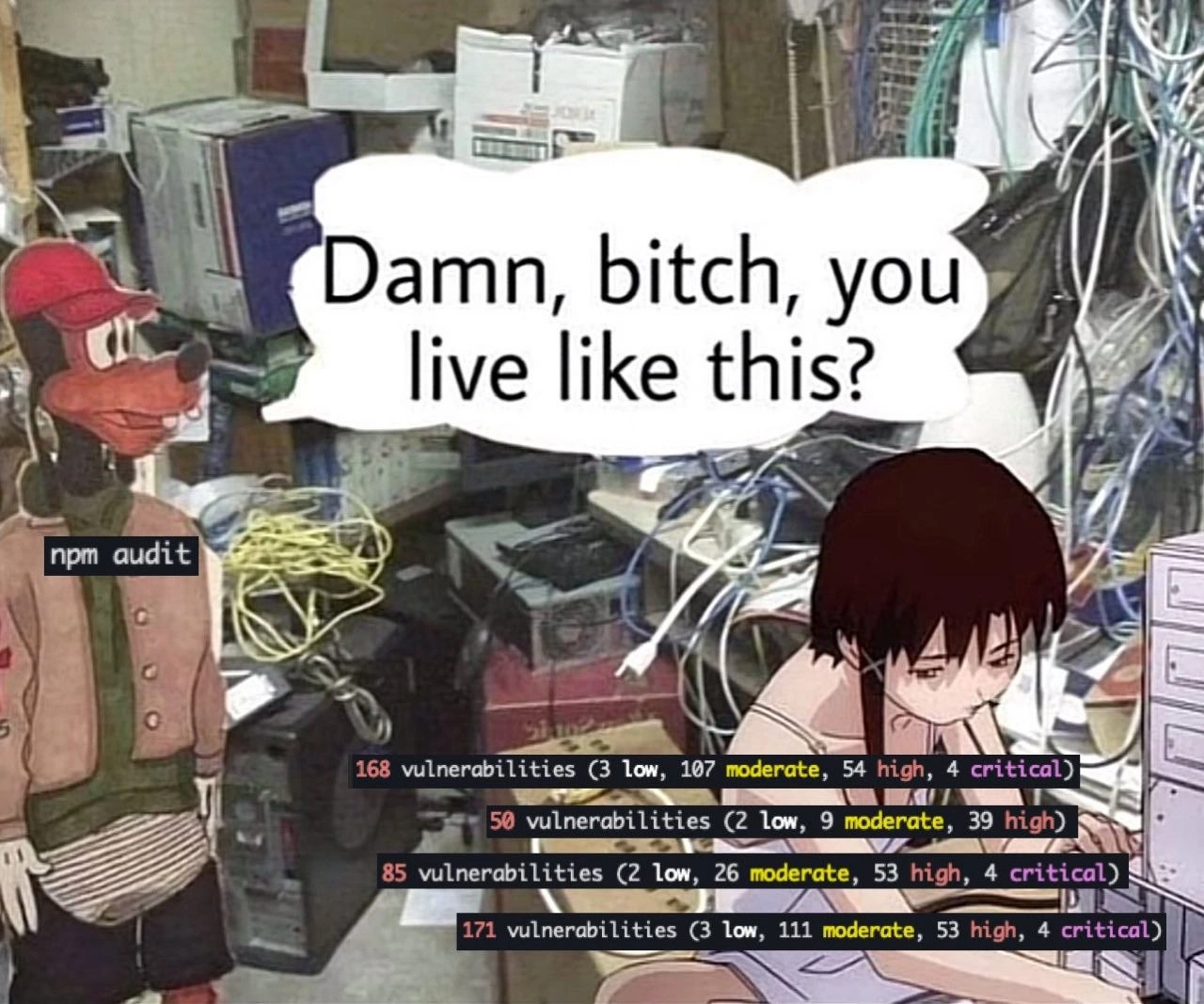
In the image, the Disney character Goofy has been cast as the npm audit tool. He’s wearing an npm audit label, looking puzzled and a bit horrified. His speech bubble, “Damn, bitch, you live like this?”, is a popular internet saying used when someone walks into an extremely messy room or house. Here it’s used as an analogy: the “messy room” is the project’s cluttered node_modules folder full of vulnerable packages. On the right, the tired anime girl is Lain from Serial Experiments Lain, an old-school tech-centric anime. She represents the developer or codebase owner. Lain is surrounded by a chaotic tangle of Ethernet cables and outdated computer gear – visually echoing how messy and tangled the project’s dependency list is. She looks exhausted and embarrassed, much like a developer who sees the audit report but feels too overwhelmed to fix it all. The meme’s text and visuals together poke fun at DependencyManagement gone wrong: it’s basically saying, “Hey developer, your project’s dependencies are a total mess – even the auditing tool can’t believe you let it get this bad!” It highlights supply_chain_risk in a funny way: having too many third-party packages (especially if they’re not kept updated) is like hoarding junk that could be dangerous. The term Dependency Hell often describes this scenario – where managing and updating all those libraries (and their conflicts and vulnerabilities) becomes a nightmare. The humor also carries an implicit lesson for junior devs: ignoring that long list of vulnerabilities from npm audit is as bad an idea as ignoring a moldy pile of dishes in your room. Eventually, someone (or something) is going to call you out on the mess.
Level 3: Hoarders: Node Modules Edition
On a deep technical level, this meme lands because it dramatizes dependency sprawl in a Node.js project as a scene from a hoarder's nightmare. In the NodeJS ecosystem, it's shockingly easy to accumulate hundreds of npm packages — each library dragging in dozens of other libraries (transitive dependencies) until your node_modules folder looks like a digital junkyard. Here, npm audit (personified by Goofy in a red cap) walks into that junkyard and bluntly asks, "Damn, bitch, you live like this?" This phrase, ripped from internet meme culture, perfectly captures the auditor's shock at the Dependency Hell it has discovered. The cluttered basement full of old computers, cardboard boxes, and tangled cables is a visual metaphor for a bloated dependency tree loaded with outdated and risky packages. Each floating terminal overlay showing lines like 168 vulnerabilities (3 low, 107 moderate, 54 high, 4 critical) is painfully familiar to experienced developers who’ve run npm audit on an aging project. It’s a callout: the tool is effectively shaming the codebase owner (represented by Lain from Serial Experiments Lain) for neglecting basic package management and leaving a trove of known security vulnerabilities unaddressed.
From a senior developer’s perspective, the humor cuts deep. We’ve all seen projects where package.json dependencies multiply like rabbits – often for convenience or quick fixes – until no one truly knows what’s inside. The meme highlights a common industry pattern: dependency hoarding. Much like a hoarder stacking useless old modems in a basement, developers might keep adding new NPM libraries without ever pruning or updating the old ones. The result? A messy dependency tree that’s rife with warnings when scanned. The counts of moderate, high, critical issues here aren’t even exaggerated – run npm audit on a large enterprise app and you might genuinely get three-digit vulnerability reports. The anthropomorphic “npm audit” is essentially performing an intervention, like an expert on the TV show Hoarders walking into a cluttered house and exclaiming in disbelief. The dev (Lain, slumped and exhausted) embodies the overwhelmed maintainer who’s been ignoring those audit warnings for far too long. In reality, tackling such a report can be daunting: updating or removing packages can break functionality, so teams procrastinate the vulnerability management process. This meme slyly jabs at the collective guilt in developer culture – we preach about Security and supply-chain risk, but when faced with 171 vulnerabilities (with 4 marked critical!), too often the pragmatic response is a tired sigh and a decision to “deal with it later.” It’s funny because it’s true: in the world of software DependencyManagement, we sometimes live like code hoarders, and even our tools are starting to judge us for it.
Description
This is a multi-layered meme using the 'Damn, bitch, you live like this?' format. The background is a photograph of an extremely cluttered and messy room, filled with tangled wires, old computer equipment, and boxes, symbolizing a chaotic and poorly maintained project. On the right, the anime character Lain Iwakura from 'Serial Experiments Lain' sits hunched over her computer, looking weary, representing the developer working in this environment. On the left stands a cartoon character resembling Goofy, who is labeled 'npm audit' on his jacket. A large speech bubble from him contains the text 'Damn, bitch, you live like this?'. To the right, several lines of text are overlaid, simulating the output of a security scan, listing hundreds of vulnerabilities (e.g., '168 vulnerabilities (3 low, 107 moderate, 54 high, 4 critical)'). The meme humorously personifies the 'npm audit' command as a judgmental outsider, shocked at the overwhelming number of security vulnerabilities found in a developer's project dependencies. It's a deeply relatable scenario for web developers who often face a deluge of warnings from dependency scanners, reflecting the chaos of 'dependency hell' in modern JavaScript development
Comments
13Comment deleted
Running 'npm audit' is my favorite ritual. It's like reading a horror story where you're the main character and every chapter ends with a new critical vulnerability in a left-pad dependency
npm audit: “This isn’t a package.json, it’s a geological core sample - every caret version pin marks another epoch of tech debt we’ll need both archaeologists and a SOC to excavate.”
After 15 years in the industry, you realize 'npm audit fix --force' is just the JavaScript ecosystem's version of 'have you tried turning it off and on again?' - except each reboot adds 47 new vulnerabilities from yesterday's breaking changes in left-pad v2.0.0
When npm audit roasts your dependency tree harder than your code reviewer ever could - turns out your node_modules folder has more critical vulnerabilities than that server room has properly managed cables. At least the physical infrastructure chaos is contained to one room; your transitive dependencies are shipping to production
Transitive deps: turning 'npm install' into a vuln lottery where criticals are the jackpot you pray to ignore
npm audit is a CVSS-powered anxiety linter: four “critical” CVEs buried in a dev-only transitive dependency block the release while the real threat model is that wiring closet
npm audit walks into the server closet that is your dependency graph, flags 171 advisories in transitive devDeps, recommends “audit fix” that rewrites half the lockfile, breaks CI, and still leaves four criticals - security theater at scale
theres no budget to fix it so Comment deleted
This truth should be illegal Comment deleted
It's kinda low btw. Comment deleted
LAIN MENTIONED Comment deleted
O. Watching right now) Comment deleted
plot twist: 95% of them are garbage irrelevant issues happening only in development tools in a scenario that will never happen with the way you're using them the rest are genuine vulnerabilities that you'll never handle properly because bad tooling made you complacent to their existence Comment deleted