Skip to content
DevMeme
956 of 7435
The Heroism of 'npm audit fix'
PackageManagement Post #1079, on Mar 1, 2020 in TG

The Heroism of 'npm audit fix'

Why is this PackageManagement meme funny?

Level 1: No Need to Thank Me (But I Did Nothing)

Imagine you ask your friend to help clean up a messy room with four big piles of junk. Your friend runs into the room, spends literally one second moving things around, then comes back out, smiles proudly, and says, "All done, no need to thank me!". But when you look inside the room, the same four messy piles are still there, untouched. You'd probably roll your eyes and chuckle at how silly that is, right?

That's exactly the joke here. In this meme, a computer tool (NPM) was asked to fix 4 problems in a project. It came back almost immediately, saying "everything is up to date," and acted like a hero, even though it actually fixed 0 out of the 4 problems. The picture of the cartoon character with a smug face saying "No need to thank me." is just like that friend who wants credit without doing any work. It's funny in a goofy way – we don't really get mad, we mostly just shake our heads and laugh because the tool is being as overly proud (and unhelpful) as that silly friend.

Level 2: Auto-Fix vs Reality

So, what’s happening here? Let’s break it down in simpler terms. NPM stands for Node Package Manager – it's the tool Node.js developers use to manage and install libraries (called packages) that their projects depend on. When you build a JavaScript application, you often rely on lots of these packages (this app had 194 of them!). These packages make development faster, but they can also introduce known security vulnerabilities if one of them (or one of their sub-dependencies) has a flaw. To help developers, NPM provides a command-line tool to perform a package security scan: when you run npm audit, it checks all your dependencies against a database of known vulnerabilities. It then reports how many issues it found and how serious they are. Think of it as a security scanner for your project’s ingredients.

Now, npm audit fix is an even more proactive command. It says: “NPM, not only find the vulnerabilities, but also try to fix them automatically.” When you run this, NPM will go through the list of vulnerable packages and see if there are safer versions available that don’t have those issues. If so, it will attempt to update those packages for you (essentially modifying your package-lock.json and installing the newer versions). This is supposed to save you the hassle of manually editing version numbers or running separate install commands.

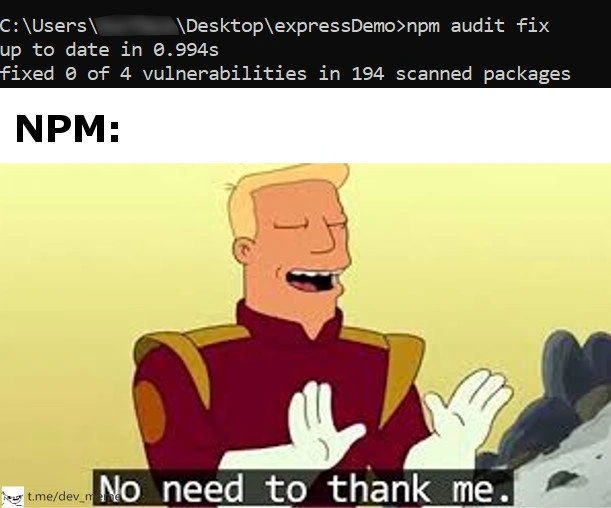
In the meme’s scenario, after running the fix command, the console output is:

C:\Users\YourName\Desktop\expressDemo> npm audit fix
up to date in 0.994s

fixed 0 of 4 vulnerabilities in 194 scanned packages

What does that mean? It tells us NPM scanned all 194 packages in the project, found 4 vulnerabilities, and then... didn’t fix any of them. The line "up to date in 0.994s" is basically NPM saying “I’ve finished checking/updating everything, and it only took about a second.” The kicker is the next line: "fixed 0 of 4 vulnerabilities". That means out of the 4 issues found, zero were resolved by this automatic process. In other words, NPM couldn’t find any safe updates it was allowed to apply, so nothing changed. The project was already "up to date" as far as minor version updates go.

For a newer developer, this can be a bit confusing or disappointing. You run a fix command expecting it to fix things, but it comes back saying it fixed nothing. Why would that happen? There are a few common reasons:

  • No Patch Available: The vulnerability might be in a package that hasn’t been fixed yet. If the maintainers of that package haven’t released a new version without the bug, npm audit fix has nothing to upgrade to.
  • Major Upgrade Required: There might be a fixed version, but it’s a new major version that could introduce breaking changes (for example, going from version 2.x to 3.x). By default, NPM won’t jump to a new major version because it could break your app. The auto-fix is conservative and avoids changes that might be incompatible.
  • Dev Dependency or False Alarm: Sometimes the vulnerabilities are in tools you only use during development (not in the production code), or in code paths your app doesn’t actually use. NPM still lists them, but fixing them might not be urgent or might require manual steps. In some cases, these are like false positives for your particular situation – the scanner flags it, but it might not truly affect you.

The meme highlights the irony of this situation. The top part (the text from the terminal) looks like a routine developer task: scanning for issues and applying fixes. But the outcome is basically "we found problems but did nothing," which is a bit absurd. It’s even somewhat comical that NPM prints "up to date" in bold letters, as if everything is fine. Imagine a doctor giving you test results saying, "We found 4 issues with your health, but good news: you're all up to date!" – it doesn’t make much sense, right? That’s why developers chuckle at this. The tool’s messaging is upbeat and almost braggy (printing the time taken, saying no need to update anything), yet the core message is that the vulnerabilities are still there.

The bottom part of the meme uses a character from a popular cartoon to drive the point home. That character is Zapp Brannigan from Futurama. He’s known for being overly confident and congratulating himself for negligible accomplishments (or even failures). By showing Zapp saying "No need to thank me.", the meme is comparing him to the npm audit fix tool. It’s like NPM is boasting “You're welcome, I fixed everything!” when in reality it fixed nothing. This exaggeration makes the situation humorous. Developers often feel a mix of amusement and exasperation seeing that output — "Gee, thanks NPM... great job."

In summary, the meme is playing on a common developer humor scenario: our tools give us these bureaucratic, almost silly responses at times. Everyone who has dealt with NPM packages and security audits can relate to running a command and not getting the result they hoped for. It’s a relatable dev experience because it highlights the gap between what we expect (a clean, secure project after one command) and what we get (a report telling us there are still problems). The humor comes from that gap and from the tool acting like it deserves praise regardless. After you encounter this a few times, you learn that npm audit fix is helpful but not magical – and that sometimes, just like Zapp Brannigan, it can claim victory a bit too early.

Level 3: Victory Lap with Zero Wins

At first glance, this meme shows a Windows CLI screenshot of the command npm audit fix proudly reporting "up to date in 0.994s" and "fixed 0 of 4 vulnerabilities in 194 scanned packages". To any seasoned developer, this is hilariously frustrating and relatable. It's a snapshot of modern Node.js package management in a nutshell: the tool identifies multiple security issues in your dependencies, then essentially shrugs and says everything is "up to date" without actually resolving a thing. The punchline lands when the meme immediately cuts to Futurama’s smug starship captain Zapp Brannigan raising his hands, subtitled "No need to thank me." NPM, like Zapp, is patting itself on the back for accomplishing absolutely nothing.

This scenario is a prime example of terminal humor in developer culture. The Command Line Interface output is technically correct yet comically misleading. NPM (Node Package Manager) has a built-in security scan (npm audit) that checks for known security vulnerabilities in your project’s NPMPackages. When you run npm audit fix, NPM attempts to automatically upgrade packages to fix those issues. But here's the irony: if none of the vulnerable packages can be safely updated (for example, if fixes require breaking changes or no patched version exists), the tool does nothing – and still declares victory. It’s like a security guard checking 194 doors, finding 4 unlocked, and then proudly announcing "All secure!" without locking any of them. This security_scan_irony is both funny and painful: the package security scan gave an all-clear sound bite (up to date) that creates an illusion of safety, even though the four vulnerabilities remain. Experienced devs recognize this comedic pattern: the tools meant to save us from Dependency Hell often just report the hell back to us and call it a day.

Why is this so on-the-nose for senior developers? Because we've all been there. We know the DependencyHell of modern JavaScript: even a simple "expressDemo" app can drag in nearly 200 transitive packages. Inevitably, some of those will have reported flaws. Perhaps it's a vulnerability in a deep dependency that hasn’t been patched yet, or an upgrade that would break our app if applied. So npm audit fix does the responsible thing and refuses to auto-update (to avoid chaos), leaving you with "fixed 0 of 4 vulnerabilities". The result: NPM essentially says “I checked, there are issues, but I won’t fix them for you” – and then has the audacity to act smug about it. This meme nails that absurdity by pairing the terse audit output with Zapp Brannigan’s overconfident grin. Zapp is the perfect avatar for npm audit fix here: overconfident, self-congratulatory, and utterly oblivious to the fact that nothing was actually accomplished.

Under the hood, there are valid reasons for this non-fix. NPM’s audit system uses a database of known flaws (like an index of reported CVEs for packages). When you run an audit, it flags issues and suggests versions where they're resolved. But npm audit fix will only apply non-breaking fixes automatically (patch or minor version bumps that won’t break your code). If the only available fixes are major version upgrades (or no fix is available yet), the tool opts to do nothing. This conservative approach prevents it from wreaking havoc in your project – but it also means you get results like "0 of 4 vulnerabilities fixed." In practice, a dev then has to either address these manually (painstakingly updating or finding workarounds), use npm audit fix --force (which risks breaking changes), or live with the warnings for a while. So from a senior perspective, the humor is bittersweet: we want our tools to help with security, but often they just expose how messy our dependencies are and leave the hardest problems unsolved.

The meme is also hinting at false positives and noise in automated auditing. Not every vulnerability flagged is truly critical or even reachable in your app – sometimes it’s in a dev-only package or a part of the code you don’t use. Yet the audit treats them all the same, and you get a scary list of “4 vulnerabilities” that makes it sound like your app is a ticking time bomb. Then the auto-fix swoops in and... fixes nothing. It’s both hilariously anticlimactic and a bit of a facepalm moment. The relatable dev experience here is the mix of relief and annoyance: relief that nothing broke (since no changes were made), and annoyance that you still have vulnerabilities to deal with. As a wise, battle-scarred engineer, you learn to take these audit results with a grain of salt – checking each vulnerability to see if it truly matters, and not expecting magic from one command.

In summary (without actually concluding formally), the meme blends DeveloperHumor with a touch of truth. The top half is pure tech reality – a CLI output screenshot of a tool doing exactly what it says (and not what we hoped) – and the bottom half is the comedic interpretation of that reality. Every experienced Node.js dev can chuckle at this: npm_audit_fix appearing to save the day while actually leaving you with the same problems. It's a gentle roast of our tools: sometimes they’re as incompetent and boastful as a cartoon spaceship captain. And as Zapp (npm) confidently proclaims "No need to thank me", every developer who’s seen that "0 of 4 vulnerabilities fixed" message just rolls their eyes.

Description

A two-part meme that satirizes the frequent ineffectiveness of the 'npm audit fix' command. The top half shows a screenshot of a command line terminal. The command 'npm audit fix' has been run, and the output clearly states, 'fixed 0 of 4 vulnerabilities in 194 scanned packages'. Below this, the meme has a large label, 'NPM:', followed by an image of the character Zapp Brannigan from the animated show 'Futurama'. Brannigan, known for his incompetence and unearned confidence, is shown with a smug expression, gesturing dismissively with the subtitle, 'No need to thank me.' The humor arises from personifying NPM as this character, ironically taking credit for doing absolutely nothing to solve the security issues it identified, a scenario all too familiar to JavaScript developers
Comments

7
Anonymous ★ Top Pick `npm audit fix` is the thoughts and prayers of the JavaScript ecosystem
  1. Anonymous ★ Top Pick

    `npm audit fix` is the thoughts and prayers of the JavaScript ecosystem

  2. Anonymous

    npm audit fix throws a victory party while four CVEs keep renting space in node_modules/left-pad - DevSecOps theater at its finest

  3. Anonymous

    After 15 years in the industry, I've learned that 'npm audit fix' is like having a security consultant who charges $500/hour to tell you about problems they won't actually solve - but at least the consultant doesn't add 47 new transitive dependencies while failing to help

  4. Anonymous

    NPM audit fix is the Zapp Brannigan of security tools - supremely confident in its abilities while accomplishing absolutely nothing, yet still expecting gratitude for its 'heroic' efforts. It's the perfect embodiment of security theater: scanning 194 packages, finding 4 vulnerabilities, fixing exactly zero, and somehow still managing to take a victory lap in under a second

  5. Anonymous

    npm audit fix: proudly rewriting your lockfile and suggesting --force while fixing 0/4 - JavaScript’s finest security theater

  6. Anonymous

    npm audit fix: 0/4 resolved, yet smugly “up to date”; choose between chasing abandoned transitive deps or --force and a midnight rollback

  7. Anonymous

    NPM audit fix: Because nothing secures job stability like 194 transitive deps demanding manual overrides

Use J and K for navigation