How an Engineer Names Every Computer
Why is this DevCommunities meme funny?
Level 1: One Name Fits All
Imagine your friend dares you to do something impossible, like "Hey, if you're so smart, name every star in the sky." Obviously, you can’t list every star’s real name – there are too many! So instead, you do something cheeky: you point at each star and say, "This one is named 'Star', this one is also 'Star', and that one, 'Star'...". In the end, you’ve technically given a name to every star (you called all of them "Star"), but you totally ignored the real intent of the challenge (which was to see if you know all the different names or could come up with unique names). It’s a silly, literal way to “follow the instructions” without actually doing the hard thing asked.
That’s exactly what happened in this meme, but with computers and code. Someone asked an engineer to “name every computer ever” – basically an undoable task. The engineer jokingly responded by saying, “Alright, I’ll name them all… I’ll name them all ‘ever’.” He wrote a tiny recipe (in a computer language) that would go through a list of computers and give each one the name "ever." It’s like saying every computer’s name is now Ever. It’s funny because the engineer did exactly what the words said, but in a ridiculously literal way. Instead of doing the real expected thing (which was impossible anyway), he found a loophole: just use the same name for everything! It’s playful and unexpected, and that surprise – doing something so literal and absurd – is what makes people laugh.
Level 2: Looping Through Every Computer
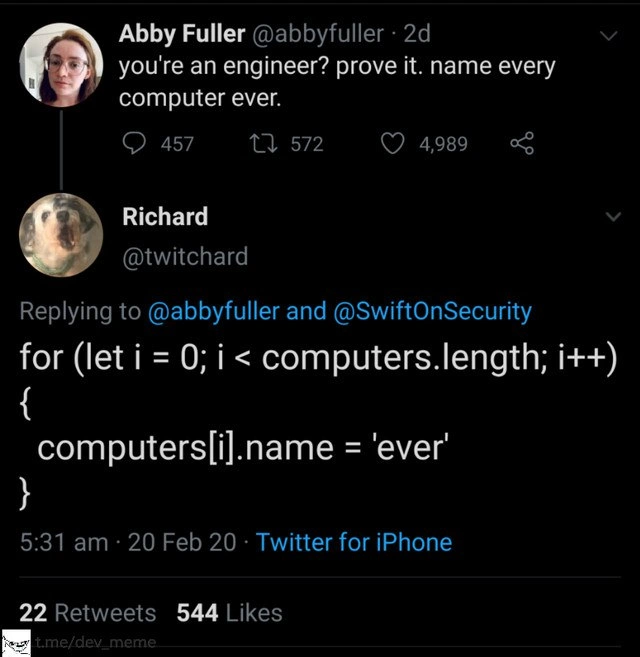
Let’s break down what’s happening in this meme. It comes from a Twitter joke. In the screenshot, someone on Twitter says:
“you're an engineer? prove it. name every computer ever.”
This is like a playful challenge. Normally, “name every computer ever” means “list the name of every computer that exists or has ever existed” – which is an absurd request (there are millions of computers!). Instead of admitting it’s impossible, the engineer replies with a short piece of code in JavaScript as the “proof.” The code they wrote is:
for (let i = 0; i < computers.length; i++) {
computers[i].name = 'ever';
}
Let’s explain this code step by step:
computers– Think of this as a list (an array) of computers. Maybe each item in the list is an object representing a computer, with properties likename. We don’t see the list defined here (it’s hypothetical), but the code assumes it exists. For example, it could be something likecomputers = [ {name: "MacBook"}, {name: "ENIAC"}, {name: "HAL 9000"}, ... ].for (let i = 0; i < computers.length; i++)– This is a for-loop. It will repeat the block of code inside the curly braces{ ... }for each computer in the array. Here’s how it works:- It starts by setting
let i = 0. That means it begins withi(an index) at 0, which refers to the first element in the array (since array indices start at 0 in most programming languages). - The loop runs as long as
i < computers.length.computers.lengthis the number of items in thecomputersarray. So if there are 100 computers in the list,computers.lengthis 100, and the loop will run whileiis less than 100 (i.e., last index will be 99, the 100th item). i++means that at the end of each loop iteration, the value ofiincreases by 1. Soiwill go 0, 1, 2, 3, … up to one less than the total number of computers. This ensures every index is covered exactly once.
- It starts by setting
- Loop body: Inside the braces, we have
computers[i].name = 'ever';. This line is executed for eachi. It takes the i-th computer in the list (computers[i]) and sets itsnameproperty to'ever'. In many programming contexts, “naming a computer” could mean giving it anamevalue like this. For example, ifcomputers[0]was the first computer object, we just changed its name to"ever". We do this for each computer in the array in turn.
What does this achieve? By the end of the loop, every computer in that list has its name set to "ever". In other words, the engineer literally named every computer “ever.” The joke is a play on the wording. The original tweet meant “prove you’re an engineer by listing every computer (implying you have encyclopedic knowledge).” But the engineer interpreted “name every computer” as an instruction to assign the name “ever” to each computer object. It’s a goofy, literal-minded solution that only a programmer might come up with.
This kind of humor is very common in developer communities (especially on Twitter or other social platforms where devs hang out). We take a normal-sounding request and imagine it as if a computer or a strict program had to follow it. Computers are very literal: they do exactly what you tell them to do, no more, no less. Here, the words “name every computer ever” were followed to the letter in code. It shows the engineer’s mindset: when confronted with a problem or challenge, write a script to solve it (even if the “solution” is a bit tongue-in-cheek).
A JavaScript one-liner usually refers to solving a problem in a single line of code. In the tweet, the code is formatted on multiple lines for readability, but it could be written in one line as well (just by removing the newline and spaces). JavaScript is known for letting you do things concisely if you want. For example, the same loop could be condensed to:
for(let i=0;i<computers.length;i++){computers[i].name='ever';}
That fits in one line. It’s still the same logic, just without line breaks. Developers often enjoy these little challenges of doing something in as few characters or lines as possible — it’s like a tiny coding puzzle or flex.
Now, why is this funny to people in the tech community? A few reasons:
- It’s an unexpected answer: The question sounded like it was asking for a list or proof of knowledge, but the answer was code. It’s like answering a riddle in a completely offbeat way.
- Literal interpretation: The humor comes from interpreting a human request as if it were a computer instruction. Non-engineers might say “That’s not what I meant at all!” but the engineer can shrug and say “Well, you said to name every computer… so I did, see?”
- Inside joke about naming: As mentioned, there’s a long-running joke among programmers that “naming things” (like variables, servers, or products) is a tough problem. Here the developer gives every item the same silly name, which is a mock “easy way out.” It’s funny because it’s clearly not a real solution in practice, but in a joking context it fits perfectly.
Also, consider the social context: Abby Fuller (the person who tweeted the challenge) is a well-known engineer in cloud computing circles, and @SwiftOnSecurity (tagged in the reply) is a popular tech parody account. These are people many tech folks follow. The fact that Richard replied with code and included those personalities means he knew the right audience would see the joke. It’s a form of DevCommunity humor, where showing off a bit of coding wit gets you nods and laughs from fellow devs. The engagement numbers (hundreds of retweets and likes) show that many people got the joke and found it amusing. In developer in-jokes, being clever with code is kind of the point, and this meme nails it: it’s simple code, but it cleverly flips the script on a challenge.
To sum it up, at this level: the meme is a screenshot of a Twitter exchange where an impossible request (“name every computer ever”) is answered not with an actual list of computer names, but with a programming trick. It’s funny to developers because it demonstrates coding know-how and a very literal-minded approach to language. Even if you’re just starting out in programming, you can appreciate the basic code here (a loop that changes a bunch of names) and see the humor in how it “misunderstood” the task on purpose.
Level 3: Loop to Name Them All
This meme highlights a classic developer humor twist: taking an absurd request literally and solving it with code. On TechTwitter, Abby Fuller’s tongue-in-cheek prompt “you’re an engineer? prove it. name every computer ever.” is basically an impossible task — nobody can list every computer model or name off the top of their head. But an engineer’s brain doesn’t hear impossible; it hears an unbounded loop. 😄 Instead of rattling off thousands of computer names, the developer answers with a sly JavaScript snippet that technically fulfills the request:
for (let i = 0; i < computers.length; i++) {
computers[i].name = 'ever'; // giving each computer the name "ever"
}
In one compact loop, they’ve “named” every computer in the (hypothetical) computers array by assigning each a name of "ever". This is a brilliant example of literal requirement interpretation – a well-known trope in programming jokes and real-life specs. The original tweet expected an engineer to prove their expertise, perhaps by listing out computer models or witty names, but the engineer proved it by writing a correct piece of code that does exactly what the words say: it names every computer “ever.” It’s an elegant bit of wordplay converted into code.
Experienced developers find this hilarious because it plays on multiple inside jokes at once. First, there’s the infamous saying: “There are only two hard things in Computer Science: cache invalidation and naming things.” Here, the engineer cheekily “solves” the naming problem by giving all computers the same name, sidestepping uniqueness entirely. It’s a satirical nod to how we sometimes handle naming in code (using generic names like foo or temp everywhere, which we know is bad practice, but it’s easy). Second, it’s technically correct – and as any grizzled coder will tell you with a grin, being technically correct is the best kind of correct. The code meets the literal challenge even though it obviously defies the spirit of the request. This kind of clever misinterpretation is a common source of humor among developers who deal with convoluted specs and communication gaps regularly.
The tweet format itself is a nod to developer community culture. Abby Fuller (a real engineer with a big following) jokingly issues a “prove it” challenge that sounds like gatekeeping (“Oh, you’re an engineer? Then enumerate every computer ever made!”). That’s a familiar internet meme structure. The reply from Richard flips it on its head by leaning into his coding skills instead of playing along normally. Tagging another popular tech persona (@SwiftOnSecurity) suggests this was meant to be shared and enjoyed by the wider dev audience. And judging by the likes and retweets, it hit its mark – many devs saw this and thought, “Haha, classic engineer move!”
From a senior developer perspective, there’s also an underlying truth in this humor: engineers often look for algorithmic solutions to problems that might not even need solving (or can’t truly be solved). We’re trained to break down tasks systematically. So when faced with an impossible question, the instinct is to reframe it: “What if I had an array of every computer? I could loop through and name them…” It’s absurd, but it demonstrates the problem-solving mindset. The loop for (let i = 0; i < computers.length; i++) is instantly recognizable to any programmer as a straightforward iteration from 0 up to the number of items. It’s basic, un-fancy, and universally understood – which makes the joke accessible. The choice of JavaScript is key, too: it’s a language nearly all devs are familiar with (even if they love to hate it), and it’s often used for quick one-liners on forums and Twitter due to its terse syntax.
In essence, this meme is funny to seasoned devs because it perfectly captures that mix of pedantic literalism and coding creativity. It satirizes the kind of “trick solution” you might jokingly provide when someone asks an impossible or ill-defined thing. It reminds us of countless real scenarios where requirements were ambiguous and the “solution” got misconstrued. Here, no project is on the line – just our sides from laughing. The engineer proved they can code (indeed, who else would respond with a for-loop?), and they did so by creatively interpreting a challenge in the nerdiest way possible. One loop to name them all, one loop to bind them. Mission accomplished, sort of. 🎉
Description
A screenshot of a Twitter interaction. The first tweet, from a user named Abby Fuller, poses a challenge: 'you're an engineer? prove it. name every computer ever.' Below it is a reply from a user named Richard, who, instead of listing computer models, provides a snippet of code. The code is a 'for' loop written in a language like JavaScript, which iterates through an array called 'computers' and assigns the string 'ever' to the 'name' property of each element: 'for (let i = 0; i < computers.length; i++) { computers[i].name = 'ever' }'. The humor lies in the literal, programmatic interpretation of the ambiguous phrase 'name every computer ever.' Instead of reciting a list, the engineer provides an algorithm to perform the action of naming, perfectly encapsulating the logical and often pedantic mindset of a software developer
Comments
7Comment deleted
The product manager said, 'I want you to touch every record in the database.' So I ran `UPDATE records SET modified_at = NOW()`. I don't see why she's upset
Spec said “name every computer ever,” so the junior did a for-loop that set hostname='ever' across the fleet - now Prometheus thinks we’re running one giant existential monolith
This is the same mutation bug that caused our entire Kubernetes cluster to be named "production" last quarter, except the junior who wrote it used forEach and we couldn't even blame the off-by-one error
When asked to 'name every computer,' a true engineer doesn't waste time on enumeration - they just mutate the array in O(n) time. Bonus points for avoiding the classic 'computers.forEach(c => c.name = "ever")' because apparently we're still writing for loops in 2020. Though honestly, the real engineering flex would've been 'computers.fill({name: "ever"})' or just returning early with 'throw new Error("Insufficient memory to enumerate all computers")'. But hey, at least they didn't use 'var' and pollute the global scope
Classic requirements literalism: the O(n) mutating rename technically passes UAT, until the CMDB reports 30,000 identical hosts called 'ever' and SRE files a P1 for loss of identity
When 'name every computer ever' hits, engineers don't enumerate - they mutate the array in O(n) bliss
Proof of engineering: I named every computer “ever” - O(n) rename, O(1) creativity, and O(∞) tickets when DNS, AD, and the CMDB all insist we only have one very overworked host