Non-native apologizes, writes perfect Python; native replies with buggy comprehension
Why is this Languages meme funny?
Level 1: Actions vs Words
Imagine two friends trying to do a task. One friend is a bit shy and says, “Sorry if I don’t speak your language well,” but then they solve a tricky puzzle perfectly. The other friend, who speaks the language just fine, says loudly, “LOL it’s okay!” but then when they try the puzzle, they make a big mess of it. This is funny because you’d think the confident friend would do better, but it’s the humble friend who actually does the job right. In the meme, the “puzzle” is writing code in Python. The first friend apologizes for their English words but writes excellent code, and the second friend has good English words but writes mixed-up, buggy code. It’s like saying: don’t judge how good someone is by how perfectly they speak – look at what they can do. The quiet, careful person ends up being the real expert, and that surprise makes us smile.
Level 2: Comprehending Comprehensions
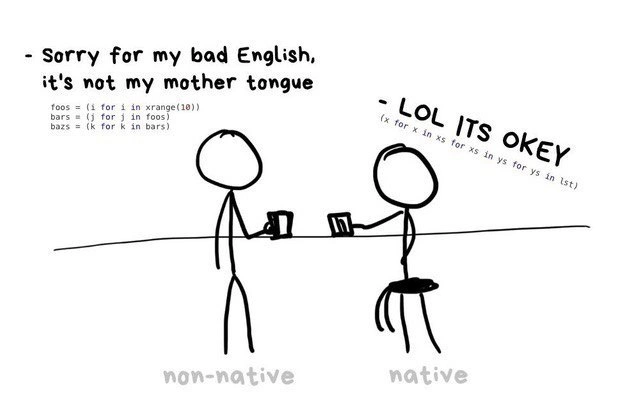
Let’s break down what’s happening in simpler terms. This comic panel compares two developers at a bar. The first (labeled "non-native") says “Sorry for my bad English, it’s not my mother tongue”, and yet writes three lines of perfect Python code. The second (labeled "native") says “LOL ITS OKEY” (notice they even misspelled "okay" as OKEY 😅) and then tries to write a one-line Python expression that turns out completely wrong. The joke comes from comparing their code quality and language use side by side. The non-native English speaker’s code is spot-on, while the native speaker’s code is full of mistakes. It’s a role reversal of expectations that’s both funny and telling.
What is a Python comprehension? It’s a quick way to create a list, set, or other collection by comprehending (looping over) another sequence. For example, a list comprehension might look like:
squares = [n*n for n in numbers] # makes a list of squares of each number in 'numbers'
This single line does the same work as a few lines of a normal for loop appending to a list. Python also has set comprehensions (using { } braces) and generator expressions (using ( ) parentheses). They all allow writing loops and conditionals in one compact line, which is considered very idiomatic Python (a common Python style).
Now, the non-native dev’s code uses these comprehensions correctly:
foos = (i for i in xrange(10))– This is a generator expression. It creates a generator that will produce numbers from 0 to 9. (In Python 3,xrangeis replaced byrange, but the idea is the same: it generates numbers on the fly.)bars = {j for j in foos}– This is a set comprehension. It takes whateverfoosyields (the numbers 0–9) and puts them into a set calledbars. After this line,barswould be a set containing{0, 1, 2, 3, 4, 5, 6, 7, 8, 9}.bazs = {k for k in bars}– Another set comprehension, now looping over thebarsset to make a new setbazs. Sincebarsalready had 0–9,bazswill end up the same. This last step is a bit redundant in terms of result, but it’s written correctly. It shows the non-native dev knows they can loop over a set just as easily as anything else.
Each line is syntactically correct and follows Python’s rules. The non-native coder even chose different loop variable names (i, j, k) for each comprehension, which is a good practice to avoid confusion. This code is pretty advanced if you think about it – it means the person knows about sets and generators, not just basic loops. Many juniors take a while to learn comprehensions, but this dev nailed it. So even though they apologized for their English, their “Pythonese” is excellent!
Now, the native speaker’s turn: They write {k for x in xs for xs in ys for ys in lst} all in one go. This is supposed to be a set comprehension with multiple loops, but it’s wrong in structure. In Python, you can have multiple for parts in a comprehension (to loop over multiple things, similar to nested loops). However, you must use different variables for each loop, and the order matters. For example, a correct nested comprehension might look like:
# Flatten a list of lists into a single list (correct nested comprehension example)
flat_list = [item for sublist in list_of_lists for item in sublist]
In that correct example, we first loop for sublist in list_of_lists, then inside that, for item in sublist. Each for introduces a new variable (sublist, then item). The native speaker’s code didn’t do that. They reused xs and ys in a very confusing way:
- First
for x in xssuggestsxsis some collection, andxwill be each element. - Then
for xs in yssuddenly reuses the namexsas a loop variable, likely clobbering the originalxs. Nowxsis being treated as each element inys(whateverysis). - Then
for ys in lstagain reusesysas a loop variable, iterating overlst.
By the end, xs and ys have been reassigned in ways that make no sense relative to the beginning of the comprehension. The result is that this comprehension is nonsense to Python and to developers. If you actually tried to run it, Python would likely complain about using the variables in the wrong order (NameError or UnboundLocalError), or if by chance xs and ys were defined outside, it would still do the wrong thing. The native dev’s code is basically a bug. It’s as if they tried to condense a complex nested loop into one line without understanding how the comprehension syntax works. In code review terms, this would be read as “unreadable and probably incorrect”.
Let’s compare the two characters in simpler terms:
| Character | English Usage | Code Usage |
|---|---|---|
| Non-native | Polite apology for their English: “Sorry for my bad English…” (even though it’s understandable) | Writes clean, correct Python using generator and set comprehensions properly. This shows strong grasp of coding. |
| Native | Casual, with a spelling mistake: “LOL ITS OKEY” (misspells "okay", very informal) | Writes messy, buggy Python by misusing a set comprehension. The code is incorrect and hard to read, showing lack of understanding. |
The table highlights the crux of the joke: great code can come from someone with imperfect English, and sloppy code can come from a native English speaker. In developer communities (like Stack Overflow, GitHub, etc.), it’s common to see a non-native English speaker humbly apologizing for their language, yet providing an excellent solution or answer. Meanwhile, now and then a native speaker might be overly casual (typos like "okey" happen in informal chat) and might not put as much care into their code or explanation. This comic exaggerates it to make us laugh and reflect.
For a junior developer, the lesson here is two-fold. First, don’t underestimate someone’s coding ability just because they aren’t super confident in English. Programming itself is a language – and someone can be very fluent in Python or Java or C++ even if their English has a few errors. Second, when writing Python comprehensions or any code, clarity and correctness matter more than cramming everything in one line. It’s better to write code in simple, correct steps (like the three lines the first person used) than to mash it into a single line that ends up wrong. Remember, in Python we often say code should be readable. The non-native’s code, though doing multiple steps, is easy to follow. The native’s code is trying to be one-liner clever but ends up confusing. As a new developer, aim for the approach on the left: write code that others (and you) can understand, and only condense it if you’re sure it still stays correct and clear. And maybe, double-check your spelling if you’re writing comments or messages – but as we see, a small English mistake is far less problematic than a code mistake! 😉
Level 3: Lost in Comprehension
The meme delivers a clever fluency paradox that seasoned developers instantly recognize. On the left, the "non-native" character humbly says “Sorry for my bad English” and then proceeds to write flawlessly Pythonic code. This code isn’t just correct – it’s elegant, using a generator and set comprehensions in three tidy lines. In contrast, the "native" character casually responds “LOL ITS OKEY” (ironically misspelling “okay”) and scribbles a single-line comprehension that is utterly broken. The humor emerges from this role reversal: the apologetic non-native English speaker writes clean, idiomatic Python, while the native speaker, supposedly at ease with language, produces a jumbled set comprehension that would make any Python senior engineer cringe. It’s a classic case of judging technical skill by communication skill – and getting it completely backwards.
From an experienced Pythonista’s perspective, the left side code is immediately satisfying. It leverages Python’s powerful comprehension syntax correctly:
foos = (i for i in xrange(10)) # generator expression yielding 0..9 (Python2's xrange, like range in Py3)
bars = {j for j in foos} # set comprehension collecting those numbers into a set
bazs = {k for k in bars} # another set comprehension (redundant here, but syntactically fine)
Every part of this is by the book: using a generator expression (... for i in xrange(10)) to lazily produce numbers 0 through 9, then a set comprehension {j for j in foos} to gather them into a set. The variable names i, j, k change at each step, showing the coder knows each comprehension has its own scope. This is clean, readable, and idiomatic Python (a.k.a. “Pythonic”). In fact, it hints the developer understands concepts like lazy evaluation (with the generator) and is comfortable with comprehension syntax introduced in PEP 202 (back in the early 2000s). An experienced dev might chuckle because the “non-native” coder is clearly native in Python! They even used xrange, which was the optimal choice for large ranges in Python 2.x – a tiny detail that signals deep familiarity (or at least that the comic is set in a Python 2 context).
Now look at the right side code:
bad = {k for x in xs for xs in ys for ys in lst} # ❌ incorrect and confusing comprehension!
This is a buggy comprehension that would likely throw a SyntaxError or at least behave in unintended ways. The native speaker’s code tries to cram multiple for loops into one set literal, but misuses loop variables horribly. In a proper nested comprehension, each for introduces a new variable, like {result for a in A for b in B for c in C}. Here, they reuse xs and ys in a way that shadows the outer loops, which is not how the Python parser or any sane programmer expects it to work. It’s as if they wrote three nested loops with variables clobbering each other’s values. An experienced reader immediately recognizes this as nonsense – the kind of line that makes you exclaim, “What does that even mean?” It violates multiple principles of good code. Remember the Zen of Python? “Readability counts.” and “Flat is better than nested.” The non-native’s code, while using three comprehensions, keeps each comprehension flat and readable. The native’s one-liner is an over-nested, unreadable tangle (and ironically incorrect to boot). It’s the sort of anti-pattern that might emerge when someone tries to show off with a fancy one-liner without truly understanding it. Seasoned devs have seen this before: an overconfident coder writing a complex expression to look smart, but creating a maintenance nightmare or a straight-up bug.
The juxtaposition is rich with developer humor. It pokes fun at a common scenario in global software teams and online communities: a contributor apologizes for their English, yet their technical contribution (code, explanation, algorithm) is excellent — often better than the native English speakers’. Here that idea is exaggerated to hilarious effect. The “native” character’s response “LOL ITS OKEY” not only contains a spelling mistake (OKEY), but their code is practically gibberish. This highlights an industry truth: communicating in English is one skill, and writing good code is another, and they don’t always come in the same package. Many veteran developers from international teams will smile at this, recalling code reviews where a quiet colleague with accented English produces brilliant code, while a more fluent speaker might introduce the odd silly bug. The meme also taps into the stereotype reversal: usually we might assume the native speaker would mentor the non-native, but here the roles could easily be switched — the careful coder might have to gently correct the native speaker’s sloppy code (and maybe their spelling, too!).
There’s a subtle nod to code quality vs. communication skills. As experienced devs know, good code speaks for itself. The left dev’s code, even if written by someone insecure about English, is clean enough that it communicates its intent clearly (in the universal language of Python). The right dev’s code, despite presumably being a native English speaker, fails to communicate logic; it’s a mess that would confuse any team member regardless of language background. In a real code review, no amount of “LOL it’s okay” charm would save that second snippet from a thorough teardown. 🤭 The scenario is both funny and a gentle reminder: don’t judge a coder’s skill by their spoken language fluency. In software, correct syntax > correct spelling of “okay.”
Description
Black-and-white stick-figure comic: two figures sit at a bar, each holding a mug. Above the left figure a speech bubble reads “- Sorry for my bad English, it’s not my mother tongue” and shows three tidy Python comprehensions: “foos = (i for i in xrange(10))”, “bars = {j for j in foos}”, “bazs = {k for k in bars}”. The word “non-native” is written under this character. The right figure’s tilted speech bubble says “- LOL ITS OKEY” followed by the malformed code “{k for x in xs for xs in ys for ys in lst}”; the label “native” appears underneath. Visually simple lines highlight the contrast: the apologetic non-native speaker uses syntactically correct, idiomatic Python while the native speaker’s English spelling and set-comprehension order are both wrong, poking fun at assumptions about language proficiency and code quality

Comments
16Comment deleted
I’ll take “sorry for my bad English” and an O(n) generator any day over “LOL ITS OKEY” and a comprehension that’s both O(n³) and a NameError factory
The real bug in production isn't the non-native speaker's English - it's the native speaker who approved that nested generator expression without a code review comment about readability
The real plot twist: the 'non-native' developer writes production-ready Python with proper generator expressions and set comprehensions, while the 'native' speaker delivers a nested comprehension crime scene that would make any code reviewer reach for the reject button. Turns out fluency in English doesn't correlate with fluency in Pythonic idioms - though both will confidently ship to prod on a Friday
The ESL dev writes three clean generators; the native replies with a triple‑nested, shadowing comprehension - proof that PEP 20 is advisory and code reviews are NP‑hard
'foos := for in foos[]': the one syntax every senior dev reads fluently, no matter the passport
Code review takeaway: the non‑native’s English was fine; the native’s Python wasn’t - {x for x in xs for xs in ys for ys in lst} violates more of the Zen of Python than “OKEY” violates grammar
once upon a time in a gay bar Comment deleted
Being gay is a bit gay you know Comment deleted
Ugly mfs Comment deleted
the left one can be substituted with just "xrange(10)" and it'll have the same effect, tho why would you use python 2 in 2021... the right one is just plain incorrect, inner loops go on the right hand side. should be (x for ys in lst for xs in ys for x in xs) Comment deleted
shouldn't it be ordered the other way round? Comment deleted
(in native) Comment deleted
nesting inline fors has to be done in reverse Comment deleted
nesting inline fors should be illegal too Comment deleted
aye Comment deleted
If inline fors were the way they are in the pic, they would be intuitive and useful Comment deleted