When your code hits 'spanishInquisition' and the compiler didn't expect that
Why is this Compilers meme funny?
Level 1: Surprise Party 🎉
Imagine you’re reading a very serious rule book, and it suddenly says, “I didn’t expect a surprise party to show up.” And right at that moment, a bunch of friends in party hats jump into the room yelling “Surprise!” It would be silly and funny, right? That’s basically what’s happening in this meme.
In our story here, the strict rule book is like the computer’s code checker (the compiler). It got confused by something in the code and essentially said, “Hey, I wasn’t expecting Spanish Inquisition to appear!” That’s like saying “I didn’t expect this crazy surprise guest.” In a famous comedy sketch, whenever someone says they didn’t expect the Spanish Inquisition, a group of surprise guests (dressed in old-fashioned red costumes) bursts in shouting “Nobody expects the Spanish Inquisition!” They’re basically saying, “Ha! Of course you didn’t expect us – that’s the joke!”
So the meme is funny because the computer unknowingly set up the same joke. The computer was just trying to say “I found something in the code that shouldn’t be there,” but the way it said it sounded like the start of that famous punchline. It’s like the computer accidentally made a joke and the comedians popped up to finish it. In simple terms: the programmer made a tiny mistake, the computer got surprised by it, and that surprise perfectly matches a well-known silly surprise from a comedy show. It’s the contrast of something very strict (computer code rules) with something very silly (unexpected surprise visitors) that makes people laugh.
Level 2: Unexpected Token
Let’s break down why this is funny in simpler technical terms. First, what’s going on in the code? We have Go code here. Go (often called GoLang) is a programming language that must be compiled – meaning a special program (the compiler) checks your code and translates it into machine language. When the compiler checks your code, it has a very strict idea of what’s allowed to appear where (these rules are the language’s syntax). If you violate those rules, you get a syntax error, often phrased as “unexpected X” or “expected Y but found Z”. That’s the compiler’s way of saying “I got confused – I saw something I didn’t expect at this point in the code.”
In the snippet, the developer wrote a line defining a variable:
var buffer = make([][]byte, 0)
This line is valid: it creates a variable named buffer which is a slice of slice of bytes ([][]byte in Go is like a two-dimensional byte array). The next line in the code is:
spanishInquisition := Canali[]{
and that’s where the trouble starts. In Go, := is a shorthand to declare and initialize a new variable. So spanishInquisition := ... means “create a new variable called spanishInquisition and set it to ... something.” The “something” after the := must be a valid expression or value. Here, the developer wrote Canali[]{. This looks wrong to the compiler. Likely, they were trying to initialize some complex value (maybe a composite literal like a slice or struct of type Canali), but the syntax is incomplete or incorrect.
Because of this, when the compiler tried to make sense of spanishInquisition := Canali[]{, it choked at the very start of the line. It saw the word spanishInquisition in a place it wasn’t allowed (possibly because at the top level of a Go file you can’t use := like that, or because Canali[]{ isn’t a proper expression). So the compiler emits an error. The error reads:
'spanishInquisition' unexpected
This means the compiler encountered the identifier spanishInquisition and said “Huh? I didn’t expect to see a name (identifier) here.” The key humor is that the compiler literally uses the word “unexpected” next to “spanishInquisition.” Now, normally “unexpected identifier” errors are boring. But here it accidentally created a famous phrase!
The bottom panel shows a scene from Monty Python’s Flying Circus (a British comedy show). In that sketch, whenever someone says “I didn’t expect a sort of Spanish Inquisition,” a group of eccentric, red-robed men (the Spanish Inquisition) burst into the room and shout:
“Nobody expects the Spanish Inquisition!” 📣
It’s a very famous quote in comedy. People often reference it whenever something surprising happens, especially in nerdy or internet culture. So, connecting the dots: the compiler said it found spanishInquisition “unexpected” (i.e., it didn’t expect it). That’s exactly the cue for the Monty Python joke. In other words, the compiler’s error unintentionally set up the “Nobody expects the Spanish Inquisition!” punchline.
For a newcomer: think of an identifier as just a fancy word for a name in your code (like variable names or function names). And a compiler error is essentially the computer telling you “I don’t understand what you wrote; it doesn’t follow the rules of the language.” Here the identifier that broke the rules was literally named “spanishInquisition”, which is unusual and funny on its own – most people don’t use such long or quirky names. The developer probably chose that name on purpose to create this joke, or they noticed the coincidence after the fact. It’s common in coding humor to use references from movies or comedy in your examples. Monty Python, being classic geek humor, gets referenced a lot (for instance, the word “spam” for junk email comes from a Monty Python skit about canned Spam!). This meme falls under both CompilerErrors and SyntaxErrors humor – it’s making light of the kind of message you get when code won’t compile, by linking it to a pop culture reference.
So, summing up the context:
- The Go compiler threw a syntax error because of a code mistake (
spanishInquisition := Canali[]{is not valid Go syntax). - The error message included the phrase “
spanishInquisitionunexpected,” unintentionally echoing the famous Monty Python line. - The bottom picture is literally the Monty Python characters who say that line, emphasizing the joke: Nobody expects the Spanish Inquisition! The compiler sure didn’t expect it!
This creates a perfect nerdy joke. To someone who knows Monty Python, it’s instantly recognizable and hilarious that a compiler error would read like that. Even if you don’t know Monty Python, you can appreciate that the code had an “unexpected Spanish Inquisition”, which is a pretty odd (and thus funny) thing for a computer to complain about. It’s the mix of a dry technical message with a random dramatic phrase that makes it comedy. Developers often share these moments because it lightens the mood when dealing with frustrating errors. After all, debugging can be stressful, so why not enjoy a laugh when your tool spits out something ridiculous?
Level 3: Compile-Time Comedy
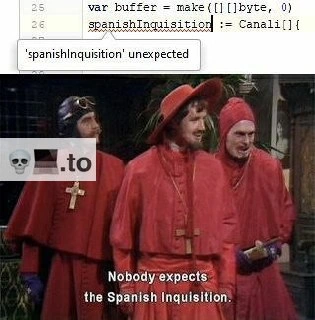
For seasoned developers, this meme hits on two levels: our shared battle with perplexing compiler errors, and our shared love of Monty Python’s absurd humor. The top panel shows a Go code snippet that throws a syntax error. The message '<spanishInquisition>' unexpected is the Go compiler complaining about an unexpected identifier during compilation. Many of us have seen errors like “unexpected token X” or “expected Y, got Z” when we mess up syntax. They’re usually dry, sometimes frustrating messages. But every so often, they accidentally align with something funny. In this case, a simple variable name “spanishInquisition” combined with a small syntax mistake yields a compiler error that reads like the setup to a joke.
It’s poking fun at how compilers are extremely literal. They don’t understand jokes or context — they just report “I found something I didn’t expect.” Here the developer chose a variable name (or perhaps a dummy type name) that makes the error message say it didn’t expect the Spanish Inquisition. It’s a classic coding humor Easter egg: you see the stern compiler error echo a line from a Monty Python sketch. Seasoned devs have a knack for recognizing such coincidences and references. We’ve all been in the trenches of debugging when suddenly an error message inadvertently lightens the mood. In a world of monotonous “SyntaxError” and “NullPointerException” messages, seeing a quote from a comedy sketch pop up in your build output is pure gold. It’s like the compiler cracked a joke, intentionally or not.
The bottom panel delivers the punchline: the infamous Monty Python trio in their red robes, shouting “Nobody expects the Spanish Inquisition!” This is one of those cultural touchstones in geek circles. Monty Python references are beloved in programming culture — from Spam (junk email) to the many inside jokes we slip into code comments. Any developer who’s been around internet culture or older colleagues has likely heard “Nobody expects the Spanish Inquisition!” as a catchphrase. It’s absurdist humor: in the original sketch, characters mention the Spanish Inquisition as a metaphorical surprise, and then the Inquisition literally bursts into the room as a ridiculous, over-the-top surprise.
In the meme, the compiler becomes the straight man delivering the setup: it “didn’t expect spanishInquisition”. The bottom panel is the comedic payoff, as if the Monty Python inquisitors took offense to the compiler’s statement and barged in right on cue. For a senior developer, this touches on the shared experience of making tiny mistakes that yield big, strange errors. Maybe you left out a curly brace or bracket, and suddenly the compiler starts complaining that an unrelated word is “unexpected.” The classic phrase “It compiles on my machine” or “works on my machine” comes to mind — except here it definitely doesn’t compile, and it fails in a theatrically humorous way.
We also appreciate that this error is in GoLang, a language known for relatively clear error messages. Go’s compiler is usually pretty straightforward, but it can’t resist following its rulebook. The developer humor here is mixing a strict technical message with irreverent British comedy. It’s the incongruity that makes it funny: a rigid compiler error unintentionally quoting a comedy troupe. For anyone who’s spent time reading compiler or interpreter errors, the phrase “unexpected X” is all too familiar. We usually groan when we see CompilerErrors like that, but this time it delivers a laugh. It’s a reminder that programming can have delightful moments where our work and our humor intersect.
On an industry note, this also underlines how developers often cope with frustration by finding humor in it. A silly variable name like spanishInquisition causing a funny error is a lighthearted way to deal with the annoyance of a SyntaxError. Instead of getting mad at the missing bracket or wrong syntax, we screenshot it and share a laugh. It’s DeveloperHumor in its purest form – turning a mistake into a Monty Python reference. Seasoned devs have likely done similar things (like naming a test “HolyHandGrenade” or a server “BiggusDickus” just to amuse themselves). In teams, someone might intentionally trigger humorous log messages or error text to break the tension.
Ultimately, this meme is a 2-for-1 special for experienced devs: it lampoons the strictness of compilers and celebrates classic geek humor. It’s funny because it’s true – compilers really don’t expect your left-field variable names – and because it quotes something we love. Nobody expects a mundane compile error to make them chuckle, but here we are, chuckling at it. Compile-time comedy like this is a little reward for all those hours spent wrestling with code.
Level 4: Syntactic Surprise
At the deepest technical level, this joke hinges on how a compiler processes code through lexical analysis and parsing. In Go (and most languages), source code is converted into a stream of tokens (identifiers, keywords, punctuation, etc.) which must conform to a strict grammar. The snippet shown is:
var buffer = make([][]byte, 0)
spanishInquisition := Canali[]{
The Go compiler’s parser sees spanishInquisition and := and expects a valid expression on the right-hand side. Here, it encounters Canali[]{ – a sequence that doesn’t fit any known rule in Go’s syntax. In Go, a slice literal should be written as []Type{ elements }, not Type[]{ ... }. The parser gets confused because after the :=, it might interpret Canali as a type name, but []{ immediately after is not valid. Internally, the compiler likely enters a state (according to Go’s grammar rules) where an expression or composite literal was expected, but what it got (spanishInquisition used as a new statement or a malformed type literal) wasn’t permissible. This results in a parse error.
The error message '<spanishInquisition>' unexpected is essentially the compiler saying “I found an identifier token spanishInquisition where it made no sense in the grammar.” Compiler frontends often perform predictive parsing (like an LL(1) parser) or use a parsing table (LALR). When they hit something that doesn’t align with any production rule, they throw an error, often naming the offending token. Here the offending token happens to be literally spanishInquisition. It’s a normal compiler error (“unexpected identifier”) but with a hilarious twist: that identifier forms a famous phrase. This is a collision of formal language theory and pop culture — the compiler is utterly oblivious to Monty Python, yet its deterministic grammar enforcement inadvertently produced a classic comedic punchline.
Deep down, this highlights the rigid nature of language syntax definitions. Syntax errors like this occur due to the language’s formal grammar rules (specified in Go’s specification using BNF). The compiler’s job is to enforce those rules strictly. So, even though to a human the code’s intention might be guessable (perhaps they meant []Canali{} or some proper literal), the compiler cannot proceed. It throws an error at the first point of confusion – in this case, right when it stumbles on the token spanishInquisition in an invalid spot. The phrase “unexpected <token>” is a generic template used by many compilers (not just Go) to report that something appeared where the parser had no valid transition.
Ironically, that generic phrasing produces a perfect setup for a Monty Python reference. It’s as if the compiler unwittingly delivered a comedic line. This deep technical interplay between language parsing and the resulting error message is a beautiful example of how literal computers are. They don’t appreciate humor — the humor emerges from our human pattern-matching on that error string. Under the hood, the compiler’s abstract syntax tree construction was interrupted by a token it couldn’t place, leading to an error object that includes the offending token text for debugging. Here, that mechanism made the compiler look like it’s commenting on a historical Spanish Inquisition – but of course, it’s not. It’s just enforcing context-free grammar rules. Nobody (and no compiler) truly expects the Spanish Inquisition in code, because it’s not part of the grammar! The result is a perfect storm of Compilers meet Languages meet classic comedy — a Syntactic Surprise born from the intersection of code and culture.
Description
The meme is split into two panels. Top panel: a light-themed code editor shows line numbers 25-26 of Go code. Line 25 reads "var buffer = make([][]byte, 0)" and line 26 starts "spanishInquisition := Canali[]{". An error tooltip below states "'spanishInquisition' unexpected" indicating a compile-time syntax error. Bottom panel: a well-known Monty Python scene shows three crimson-robed inquisitors barging in, subtitle reading "Nobody expects the Spanish Inquisition." The juxtaposition humorously links the compiler's "unexpected" token message with the sketch's famous catchphrase, poking fun at how compilers flag unanticipated identifiers and how developers often stumble over small syntax mistakes in Go
Comments
9Comment deleted
We architect for Byzantine failures and GC pauses, yet the post-mortem still reads: “Parser panic - nobody expected spanishInquisition.”
After 20 years in the industry, I've learned there are only three certainties: death, taxes, and that one junior dev who will somehow access index[0] on an empty collection in production despite passing all code reviews, unit tests, and integration tests
When your linter throws 'spanishInquisition' unexpected, you know someone on the team has been watching too much Monty Python during code reviews. The real crime here isn't the error - it's mixing Go's buffer syntax with JavaScript and expecting the interpreter to just roll with it. At least the error message is honest: nobody expects type coercion to save you from cross-language syntax salad
Compiler: “spanishInquisition” unexpected - of course; nobody models the unknown unknowns in their grammar. Architect for surprises or they’ll storm prod at 3am
Go channels promise safe concurrency, but botch 'chan' as 'canal1' and summon a syntax inquisition fiercer than Monty Python's cardinals
In Go, ':=' outside a function is heresy - at package scope only 'var' is canonical, so of course the parser flags the Spanish Inquisition as unexpected
Why watermark is free domain Comment deleted
Ooo, this is pascal or Delphi Comment deleted
Or mb Golang Comment deleted