Skip to content
DevMeme
1285 of 7435
Pointers Doing What Pointers Do
CS Fundamentals Post #1438, on Apr 29, 2020 in TG

Pointers Doing What Pointers Do

Why is this CS Fundamentals meme funny?

Level 1: Opening Every Door

Imagine you have a friend who is very curious and a little impulsive. You walk with them down a long hallway of an apartment building, and for every door they see, they immediately try to open it without asking. Most doors are locked or not theirs to open, so what happens? Sooner or later, they set off an alarm or walk in on something they shouldn’t, and you both get in trouble. In this analogy, the hallway is like the computer’s memory, each door is like a specific address (a spot where something is stored), and that overly curious friend is like a pointer in a program.

The meme is joking that a pointer will act like that friend who tries to open every door. In a normal situation, you’d only open the door you have a key for – similarly, a pointer is supposed to point to a specific, valid place in memory. But if the pointer isn’t given the right “key” (i.e., a correct address), it’s as if it grabs random keys and starts poking into any door it finds. So the humor is that pointers can be overenthusiastic and a bit reckless if left unsupervised. This is funny to programmers because they know a wild pointer can crash a program, much like our friend can crash an outing by causing a security incident. Essentially, the meme is a playful way to say: “Be careful with pointers, or they’ll go pointing everywhere and cause chaos!” It’s using a simple pointing gesture (Leonardo DiCaprio pointing in a movie scene) to represent that idea. Even if you don’t know the technical details, you can laugh at the notion of something that just can’t resist pointing at everything. It’s like a joke about a misbehaving pet or friend, but in the world of computers.

Level 2: Memory Addresses Demystified

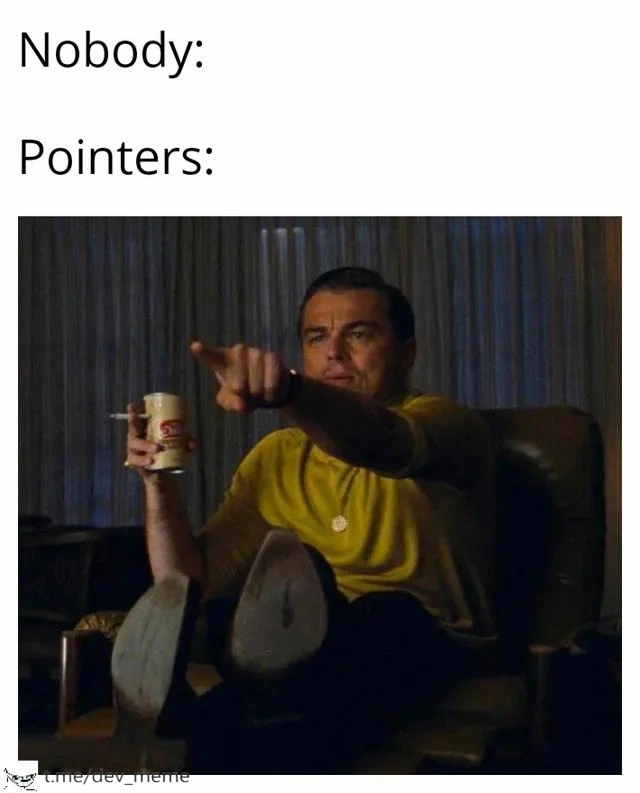
Let’s break down what this meme is talking about in simpler terms. In programming (especially in languages like C and C++), a pointer is a special kind of variable that doesn’t hold a regular value like 5 or "Hello" – instead, it holds a memory address. Think of a memory address as a specific slot number in the computer’s memory where data is stored. If normal variables are like boxes containing values, then a pointer is like a piece of paper with the location of a box written on it. Using that pointer, the program can find the actual value by going to the memory slot (address) it references. This is what we mean by a pointer "pointing" to data. The joke here is literal: the meme shows a man pointing his finger (Leonardo DiCaprio from a well-known movie scene) as a visual pun on pointers pointing to things. The text "Pointers:" above him indicates that he’s acting like a program pointer, eagerly pointing at something on the screen – which represents a memory address.

Now, why would a pointer "immediately point at every memory address it encounters"? This is poking fun at how pointers can be dangerous or unpredictable if used incorrectly. In C/C++, when you create a pointer but don’t initialize it (meaning you don’t give it an actual address to point to), it doesn’t just sit there harmlessly. Instead, it contains some garbage address by default – essentially random. That’s like having a piece of paper with a random house address scribbled on it; if you go there, who knows where you’ll end up! If a program tries to use such a stray pointer to access memory, it’s likely to either read gibberish or crash the program. That crash is what we call a Segmentation Fault (or segfault for short). A segmentation fault happens when your program tries to touch memory that it’s not allowed to touch – imagine trying to open a locked door in someone else’s house; the operating system is like security that stops you and kicks you out (the program ends with an error). This meme exaggerates that by saying the pointer will point at "every memory address" it sees – obviously in reality it’s not every address, but it can feel that way when debugging because an uninitialized pointer could be pointing anywhere in memory.

Let’s look at a tiny code example to see this in action:

#include <stdio.h>

int main() {
    int x = 42;
    int *p = &x;               // p holds the address of x (it "points to" x)
    printf("%d\n", *p);        // OK: prints 42, *p goes to that address and gets the value

    int *q;                    // q is declared but NOT initialized (wild pointer)
    *q = 100;                  // ERROR: trying to use q without a valid address
    return 0;
}

In this snippet, p is a pointer that we set to &x (the address of variable x). So p knows exactly where x lives in memory, and *p accesses that spot, giving us the value 42. That’s a proper use of a pointer. In contrast, q is another pointer we declared without initializing it, so q could have any random address in it. The line *q = 100; means "go to whatever address q currently holds, and put the value 100 there." This is obviously trouble, because q isn’t set to a meaningful place – it’s like blindly throwing the number 100 into a random location in memory. When you run this, most likely the program will crash with a segmentation fault because q’s random address was not a part of memory the program is allowed to write to. It’s the equivalent of our pointer character from the meme pointing at something completely out-of-bounds. In a sense, q tried to point at "every memory address" – or at least one it shouldn’t have – and the operating system said "No way!" and stopped the program.

The meme uses the "Nobody: ... Pointers: ..." format, which is a popular internet meme template. "Nobody:" followed by silence (nothing underneath) implies that no one prompted this behavior. Then "Pointers:" suggests that pointers just jump into action on their own. It’s a humorous way to say pointers can cause trouble even when you think nothing is happening. This format makes it sound like pointers have a personality: eager and a bit reckless. Of course, in reality, pointers do exactly what the code tells them – but if the programmer forgets to control them (for instance, forgetting to initialize them or check boundaries), it feels like the pointer just went rogue spontaneously.

The image of Leonardo DiCaprio pointing is a nod to how we often illustrate pointers in programming discussions. A pointer "points to" a memory location, and here we have an actual person physically pointing for emphasis. The living-room scene with him leaning forward excitedly captures how a pointer might "excitedly" reference any address. For developers learning this, it’s a memorable visual: you’ll recall that pointers = pointing to addresses. But the joke part is remembering that if you don’t tell a pointer exactly where to point, it might as well be that guy pointing at random things on the TV – essentially meaningless and potentially problematic. In summary, the meme is explaining in a funny way that pointers are variables storing memory addresses, and if they’re not handled carefully, they’ll end up referencing (pointing at) invalid or unexpected memory addresses during runtime (when the program is running). That’s when crashes like segmentation faults happen. It resonates especially with those who have tried pointer arithmetic (moving pointers around in memory) or manual memory management in C/C++ and learned how easily things can go wrong.

Level 3: Pointers Gone Rogue

This meme strikes a chord with every programmer who has wrestled with C or C++ pointers. The format itself – "Nobody: [...] Pointers: [...]" – sets up the joke: nobody asked for this chaos, yet pointers are off doing their own wild thing. It lampoons the way pointers can behave almost mischievously if you’re not constantly vigilant. Essentially, it's saying "no one in particular is doing anything, but pointers are out here pointing at everything in sight." This is a playful exaggeration of how an uninitialized or misused pointer in code seems to have a mind of its own, eagerly referencing memory addresses with reckless abandon. If you’ve ever forgotten to initialize a pointer, you know this feeling: that pointer wasn’t set to point to anything valid, so it just contains some random address from whatever bits were in that stack memory slot. The moment you try to use it… BOOM! 💥 You either crash with a SegmentationFault, or worse, you don’t crash and instead overwrite some random part of memory. Both scenarios are the stuff of nightmares for any developer in LowLevelProgramming. The meme’s humor is that it anthropomorphizes the pointer as Leonardo DiCaprio’s character in that famous pointing scene – like a pointer excitedly shouting "there’s another address, let’s go point at it!" at every opportunity. It’s funny because, as developers, we know a pointer is just a piece of data following orders, but it feels like dealing with a capricious entity that will gleefully run amok given the slightest chance.

Why is this so relatable? In real projects, especially systems programming, pointers are indispensable but notoriously error-prone. The shared experience this meme taps into is the fragility of manual MemoryManagement. Seasoned C/C++ devs have a sort of collective PTSD from debugging pointer bugs. For instance, a common scenario: you allocate an array and get a pointer to its start. Forget to check your bounds, and that pointer will happily march past the array’s end, start iterating through whatever memory comes next, possibly clobbering important data or causing a crash. Another classic: the dangling pointer. You free some memory but keep a pointer to it; that pointer now "immediately points" at an address holding garbage or belonging to something else. If you accidentally use it, you’ve essentially unleashed a tiny gremlin in your code that might corrupt unrelated data or crash unpredictably. It’s almost like the pointer didn’t get the memo that the memory moved on – it’s still pointing at that old address, now potentially part of some new allocation or off-limits. The meme exaggerates this by implying pointers indiscriminately latch onto every address in runtime, which is a tongue-in-cheek reference to how a stray pointer seems to randomly crash your program in places that have no obvious connection to the bug. Experienced devs chuckle at this because they recall maddening debug sessions tracing a memory stomp that originated from a wild pointer elsewhere in the code.

The image chosen – Leonardo DiCaprio leaning forward excitedly pointing at a TV screen (from Once Upon a Time in Hollywood) – adds an extra layer of nerdy humor. In internet meme culture, this DiCaprio scene is used to signify “I recognize that!” or “Look at that, there it is!”. Applying it to “Pointers” is perfect: it’s like the pointer variable in your program is eagerly identifying every single memory address going by, just as Leo’s character eagerly points out something familiar on the screen. We imagine the pointer going, “Oh look, address 0x7ffeef4a, let me point there! And there’s 0x7ffeef4b, gotta point there too!” – much like someone pointing out every little detail on the TV. This relentless pointing is precisely how a badly-managed pointer behaves: it doesn’t discriminate or hesitate; if you increment it in a loop or misuse it, it will traverse into memory regions it has no business being in. The "Nobody: (nothing) … Pointers: (point everywhere)*" construction highlights that this behavior comes out of nowhere unless the programmer explicitly reins it in. In a properly written program, pointers don’t randomly roam – but the joke is that if you neglect them for even a second (nobody supervising them), they’ll end up pointing at something crazy.

There’s also an implied nod to the classic "segfault and memory woes" every C/C++ dev deals with. The meme text mentions "every memory address they encounter in runtime," hinting at runtime bugs where a pointer iterates or jumps into unexpected memory. The result of that in real life is often a segmentation fault with the infamous "core dumped" message, or if you’re unlucky, subtle memory corruption (which might not crash immediately but cause weird behavior later). Both outcomes can be exasperating. Thus, the humor carries a slight grimace of truth: working with pointers is powerful but can feel like handling a loaded foot-gun. You can shoot yourself in the foot with one mis-aimed pointer. An experienced developer reads this meme and laughs, perhaps thinking of that one time a missing & (address-of operator) caused them to pass an uninitialized pointer into a function, which then promptly derailed the program. Or the time they spent hours debugging only to find a *ptr = value; line was writing to an unintended location because ptr had been incremented or offset incorrectly.

Importantly, the meme resonates in the context of pointer humor and memory_address_joke – it’s practically a rite of passage in computer science fundamentals courses to screw up a pointer and face the consequences. Ask anyone who learned C in school: almost every student’s code at some point raised a segfault due to a bad pointer. The joke’s over-the-top portrayal (“pointers point at every address”) is like an instructor joking, "This is what it feels like when you mess up – the pointer just went on a world tour of memory." It’s hyperbole that conveys the constant vigilance needed when dealing with manual memory management. These days, languages and frameworks try to save us from ourselves – we have smart pointers (std::unique_ptr, std::shared_ptr) in modern C++ to automatically handle deallocation, we have tools like AddressSanitizer to catch out-of-bounds access, and entire languages like Rust that prevent data races and null references at compile time. The existence of those tools and languages is itself an acknowledgment of the problem: raw pointers will "point at everything they encounter" unless carefully controlled. So the meme is both a joke and a gentle reminder of a hard truth in low-level programming: if you don't explicitly manage your pointers, chaos ensues. That shared understanding is what makes the meme amusing – it’s funny because it’s true enough to spark recognition, and painful enough to invoke a laugh that says, "Yep, been there."

Level 4: Address Space Odyssey

In the low-level world of C/C++ pointers, memory is a vast coordinate system. A pointer holds a number – essentially an address in the process's virtual address space – telling it where to look for data. Under the hood, this address is a numeric offset into the program’s memory. On a 64-bit system, a pointer is a 64-bit value (8 bytes) that could theoretically reference 2^64 distinct memory locations (an almost astronomical range). When the meme quips that pointers "immediately point at every memory address they encounter", it humorously exaggerates how pointers treat memory addresses freely as data. In a way, a pointer will happily treat any bit pattern as an address if you cast it or assign it – there’s no built-in safety check at the hardware level beyond some alignment concerns. This design is by intention: C was created to be a portable high-level assembly, giving developers direct LowLevelProgramming capabilities with minimal runtime overhead. A pointer is literally a raw address because anything else (like automatic bounds checking) would incur performance penalties. So by design, pointers are powerful and unforgiving – much like the physics of space travel in an odyssey, one calculation error and you might end up in the wrong galaxy (or in programming terms, reading the wrong memory).

The phrase "point at every memory address they encounter" also hints at pointer arithmetic and traversal. In C/C++, adding 1 to a pointer makes it point to the next item in memory for that pointer’s data type. For example, if p is an int* at address 0x1000, p++ will point at 0x1004 (assuming 4-byte ints). Pointers are essentially memory address iterators. You can iterate through an array by moving a pointer from one address to the next. But here's where the danger lies: nothing inherently prevents p++ from advancing past the end of an array. The pointer has no awareness of memory boundaries – it will keep marching forward into whatever memory comes next. If that memory belongs to something else (or to no valid allocation at all), we venture into undefined behavior territory. The program might still run reading garbage values, or it might segfault immediately – it’s Schrödinger’s pointer until observed! This memory-agnostic nature of pointers is both their greatest strength and the source of countless bugs. Seasoned systems programmers have a dark joke: "Walking through memory with a pointer is fine until suddenly it isn't." One moment you’re stepping through an array, the next you’ve strolled right off a cliff.

From an operating system perspective, a SegmentationFault (SIGSEGV) is a mechanism to halt a program that tries to access memory it shouldn’t. Modern OSes use virtual memory so each process thinks it has a contiguous block of addresses starting from 0. The OS and hardware MMU (Memory Management Unit) ensure that only certain ranges of those addresses are mapped to actual physical memory your process owns. If a pointer goes rogue and points to an address outside those allowed ranges – say, address 0x1BADB002 that your program hasn’t mapped – the CPU will raise an exception. This is like the hardware saying, "Whoa there, you don’t own this address – program, you shall not pass!". The runtime then kills the program with a segmentation fault. Historically, the term comes from older architectures where memory was divided into segments (like code, data, stack segments) and accessing an address with the wrong segment register or an out-of-range offset would trigger a "segment violation". The meme’s joke plays on this process: a pointer eagerly pointing at “every memory address” would inevitably hit forbidden regions and invoke the OS’s watchdogs, resulting in a crash. In other words, if pointers literally point everywhere, you'll constantly be tripping the alarm systems of memory protection. The comedic image of a person frantically pointing in all directions maps to the chaotic outcome of a pointer wildly flinging addresses at the CPU.

Deep down, pointer misbehavior is constrained by fundamental design and physics. Computers don't (and can't) automatically know the intent of an address in a raw pointer. The hardware simply attempts to fetch or store data at the provided address, trusting the program. This trust is why pointers are so efficient – there's zero overhead – but it’s also why a wrong pointer can corrupt data or crash. It’s a classic trade-off in CS_Fundamentals between safety and performance/control. High-level languages like Python or Java chose safety: they don’t let you arbitrarily manipulate addresses, and they throw exceptions if you go out of bounds. C and C++ chose control: giving you raw access to memory with the expectation you know what you’re doing (and if not, well, here be dragons 🐉). The humor here is that no one (nobody) in the program is explicitly telling the pointer to misbehave, yet if not properly handled, a pointer variable might still go on a rampage through memory just because it can. This condition has led to countless nights of debugging through core dumps and spawned tools like Valgrind and sanitizers to catch these wild pointers in action. In the academic realm, the very problem of unchecked memory access inspired advancements like formal verification of memory safety and languages like Rust that use a borrow checker to prevent exactly the kind of runaway addressing this meme jokes about. In short, the meme humorously underscores a deep truth: a raw pointer in runtime is like an unsupervised adventurer in a colossal address space – bold, naive, and perilously free.

Description

This meme uses the popular 'Leonardo DiCaprio Pointing' format from the movie 'Once Upon a Time in Hollywood'. The image features actor Leonardo DiCaprio in a yellow shirt, sitting in a chair, pointing at something off-screen while holding a drink and a cigarette. The text overlay reads 'Nobody:' followed by 'Pointers:'. This is a classic visual pun in the programming world. The humor comes from the literal interpretation of the word 'pointer'. In computer science, particularly in languages like C and C++, a pointer is a variable that stores the memory address of another variable, so it figuratively 'points' to a location in memory. The meme hilariously personifies this abstract concept by showing someone literally pointing, creating a simple but effective joke that resonates with anyone who has studied computer science fundamentals

Comments

7
Anonymous ★ Top Pick A pointer is just an address. The real fun begins when you add arithmetic to it and suddenly you're pointing at the kernel's private key or just a segfault. It's the programming equivalent of 'I'm not touching you!'
  1. Anonymous ★ Top Pick

    A pointer is just an address. The real fun begins when you add arithmetic to it and suddenly you're pointing at the kernel's private key or just a segfault. It's the programming equivalent of 'I'm not touching you!'

  2. Anonymous

    Dangling pointer scrolling a heap dump: spots 0xDEADBEEF, does the DiCaprio point, and insists, “See? Totally still a valid object.”

  3. Anonymous

    After 20 years in this industry, I've learned that pointers don't segfault your program - they just reveal the segfault that was always there, waiting patiently at address 0x0

  4. Anonymous

    Pointers are like that senior architect who shows up uninvited to your code review, points at your perfectly good garbage-collected code, and insists you need to manually track every byte allocation while explaining why your segfault at 0x00000000 is actually a feature that builds character. They're technically correct that you have more control, but nobody asked to spend their Friday debugging why `ptr->next->next->data` occasionally points to the heat death of the universe

  5. Anonymous

    Pointers: masters of pointing blame right back at your 3AM pager

  6. Anonymous

    Pointers: confidently pointing to an address that belonged to a different struct two mallocs ago

  7. Anonymous

    Raw pointers are that coworker who confidently points directions without owning the result - follow them and you end up reading past your address space at 0xDEADBEEF

Use J and K for navigation