The Unregulated World of Performance Enhancement in Agile Development
Why is this Agile meme funny?
Level 1: Candy for Chores
Imagine you have a bunch of chores or homework to finish and you’re really tired. Normally, you might take a break or do it slowly. But let’s say you want to get it done super fast – so you secretly eat a big handful of candy to get a burst of energy. Now, in a kids’ running race, doing something like that (but with a special grown-up “energy pill”) would be considered cheating, and there are strict rules against it. But in everyday life, if you’re a grown-up, there’s no one watching over you like a referee. This meme jokes that when adults have a lot of work (for example, writing computer code tasks in a tool called Jira – basically a big to-do list app for programmers), they could just drink a huge coffee or take some “energy boost” to work faster. It’s funny because it’s like a kid saying, “Hey, nobody can stop me from eating all the candy so I can clean my room really fast!” In real life, being an adult means you actually can do silly or unhealthy things to get your work done – and there’s no “candy police” or “doping police” to tell you it’s not allowed, even if it might not be the smartest thing to do.
Level 2: Caffeine-Powered Sprints
Let’s break down the references for those newer to the software game. Jira is a popular project tracking tool (made by Atlassian) that teams use to manage work. In Agile methodology (such as Scrum), work is divided into sprints – short, focused time periods (often 1-2 weeks) where a team commits to completing a set of tasks or user stories. Each task is estimated in story points, which are a rough measure of effort. At the end of a sprint, ideally all those tasks are “Done,” and the team’s completed story points count is their velocity. Teams and managers watch velocity as a key measure of a team’s output (basically a marker of developer productivity over time). It can feel a bit like a race to keep that velocity number high.
Now, think about actual races: in a 100m sprint on a track, some athletes might be tempted to use performance enhancing drugs (like steroids or other stimulants) to run faster – but sports have strict rules and testing to prevent this cheating. There are official agencies that check athletes for illegal boosts because it’s dangerous and unfair. SwiftOnSecurity’s tweet basically says, hey, “you’re an adult, you can just take performance enhancing drugs” – meaning in the grown-up work world of coding, there’s no authority figure to stop you from doing something extreme to go faster. In other words, for software teams there’s no “international doping agency” equivalent watching over your Jira sprints. There’s obviously no official drug test when you grab your fourth cup of coffee or pound an energy drink to get through a long coding session.
Why joke about this? It’s pointing out the workplace performance pressure developers often feel. In tech jobs, people sometimes push themselves very hard to finish projects or meet deadlines. It’s common (almost a cliché) to see programmers drinking a lot of coffee or energy drinks to stay alert – basically a legal way of “boosting” their performance. This meme takes that to an absurd level by calling it “performance enhancing drugs” as if writing code were an Olympic sport. It’s Agile humor with a grain of truth: nobody’s going to penalize you for working late fueled by caffeine. Being an adult in tech (adulting_in_tech) means you have the freedom – and temptation – to use whatever pick-me-up you want when you’re crunching on a project. There’s no boss or referee saying “Hey, too many energy shots, you’re disqualified.” The tweet is a tongue-in-cheek way to highlight how developer fatigue and burnout can creep in. It reminds us that unlike in sports, in a coding sprint the only real limits are our own health and sanity. The bottom line: in software development, unlike in professional sports, anything goes in the quest to meet those tough deadlines — and that’s why this joke hits home for so many people in sprint-based teams.
Level 3: Steroids for Story Points
Behind the humor is a darkly familiar truth: Agile workflows like Jira sprints often feel like competitive sports without referees. In professional athletics, taking performance enhancing drugs triggers investigations by organizations like the International Olympic Committee or WADA (World Anti-Doping Agency). But in the world of software development, there’s no authority testing your bloodstream during stand-ups or code reviews. The tweet jokes that as a developer you can pop a stimulant or chug another double espresso to crank out more story points, and nobody’s going to pull a red card. For all Jira cares, you could resolve half the backlog in one caffeine-fueled night – it won’t flash a “cheater” alert or demand a drug test. It’s agile humor rubbed with cynicism: the sprint metaphor isn’t just figurative here – we’re talking about sprinting on caffeine.
This resonates with senior engineers because it satirizes real developer productivity pressures. We’ve all seen those agile sprint plans that demand a heroic velocity increase every iteration. Management treats the team’s velocity (how many story points completed per sprint) like a high score that must keep climbing. Developer folk wisdom says “coffee is the unofficial programming fuel,” and this tweet wryly suggests: why stop at coffee? If there’s no sprint doping agency, why not bring on the full medley of stimulants? Developer humor like this arises from shared pain: when the backlog is overflowing and the deadline was “yesterday,” devs jokingly wonder if downing energy drinks or pulling all-nighters is the only way to “boost performance.” The absurdity hits home because tech culture often incentivizes overwork despite cautionary principles. The Agile Manifesto might preach sustainable pace, but in practice many teams stumble into crunch mode. A cynical veteran will tell you about those 2 AM coding marathons fueled by Red Bull, when Jira tickets are flying off the board like an athlete on steroids. The phrase “no international doping agency for Jira sprints” highlights that workplace performance pressure is unchecked: as long as tasks move to “Done,” nobody asks how you got there. Did you write that feature with a clear mind, or while jittery on your third Adderall of the week? From a developer fatigue perspective, it’s scary-hilarious. The only “penalty” for productivity doping is your own burnout or a massive caffeine crash the next day.
In essence, the meme jabs at a harsh agile reality – one of those fundamental agile pain points: modern development can feel like an Olympic event with all-night coding sprints, except athletes get referees and rest days, whereas developers get Jira and JQL queries at 3 AM. It’s a laugh-through-the-pain situation. Seasoned engineers chuckle, then sigh, recognizing the joke wouldn’t be funny if it weren’t at least a little true. In fact, if there really were a doping agency for coding, half the industry might be benched for excessive caffeine levels – and maybe that’s the point. In tech, we rigorously enforce code style and test coverage, but we turn a blind eye to the personal toll of keeping up the pace.
Description
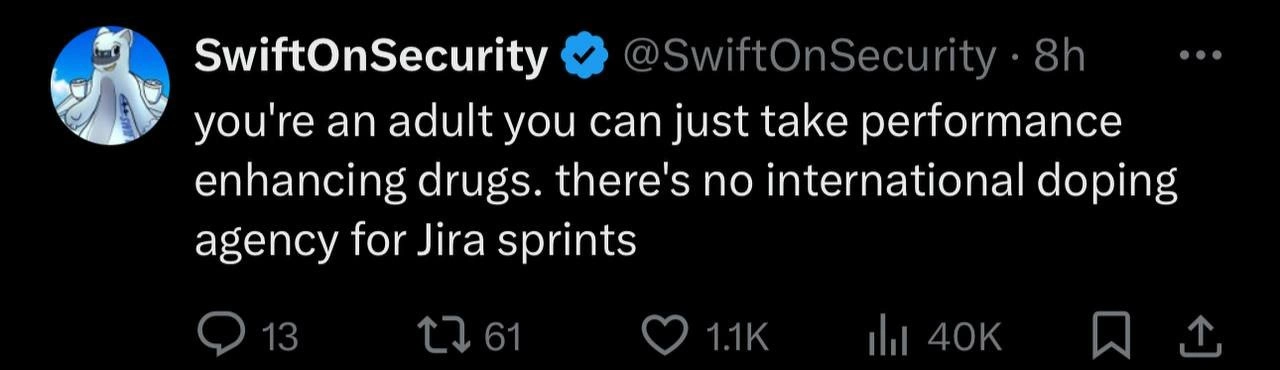
A screenshot of a tweet from the popular tech/security account SwiftOnSecurity. The tweet, against a black background, reads: 'you're an adult you can just take performance enhancing drugs. there's no international doping agency for Jira sprints'. The humor stems from the absurd and cynical comparison of professional athletic doping to the high-pressure environment of corporate software development, specifically within the Agile framework. It highlights the intense demands for productivity and the lack of oversight on how developers cope with the stress of meeting sprint goals. For senior engineers, this is a darkly humorous and relatable commentary on crunch culture, burnout, and the sometimes-extreme measures taken to maintain high performance in a demanding job

Comments
11Comment deleted
They don't drug test for Jira sprints, but they probably should start screening for dangerously high levels of caffeine and existential dread
Our sprint velocity shot up 300% - not from espresso, just Fibonacci doping: re-estimating every 3-pointer as a “13-point legacy refactor” is still WADA-compliant in Jira
After 15 years of sprint retrospectives, you realize the only 'continuous improvement' that actually works is upgrading from coffee to espresso to whatever the SRE team is microdosing to stay awake during their third consecutive incident response
The real performance-enhancing drug for Jira sprints is learning to say 'no' to scope creep mid-sprint - but most teams haven't discovered that particular supplement yet. Unlike Olympic athletes, we're all just self-medicating with caffeine and optimistic story point estimates while pretending our velocity charts represent sustainable engineering practices rather than a slow march toward technical bankruptcy
Since there’s no WADA for Agile, leadership’s favorite PED is rebaselining the story‑point scale and calling it process improvement
No anti-doping for Jira because velocity is the easiest thing to juice - switch to “modified Fibonacci,” inflate story points, and the burndown looks ripped while your pager keeps ringing
Because sprint velocity scales linearly with caffeine dosage, but exponentially with the good stuff - no distributed consensus required
yet* Comment deleted
I thought Jira is a performance reducing drug. Comment deleted
And then Comment deleted
That's why everyone is taking amphetamine these days smh Comment deleted