Deceptive Discounts: Comparing App Size Optimization to Odometer Fraud
Why is this MobileDev meme funny?
Level 1: Fake Sale Tag
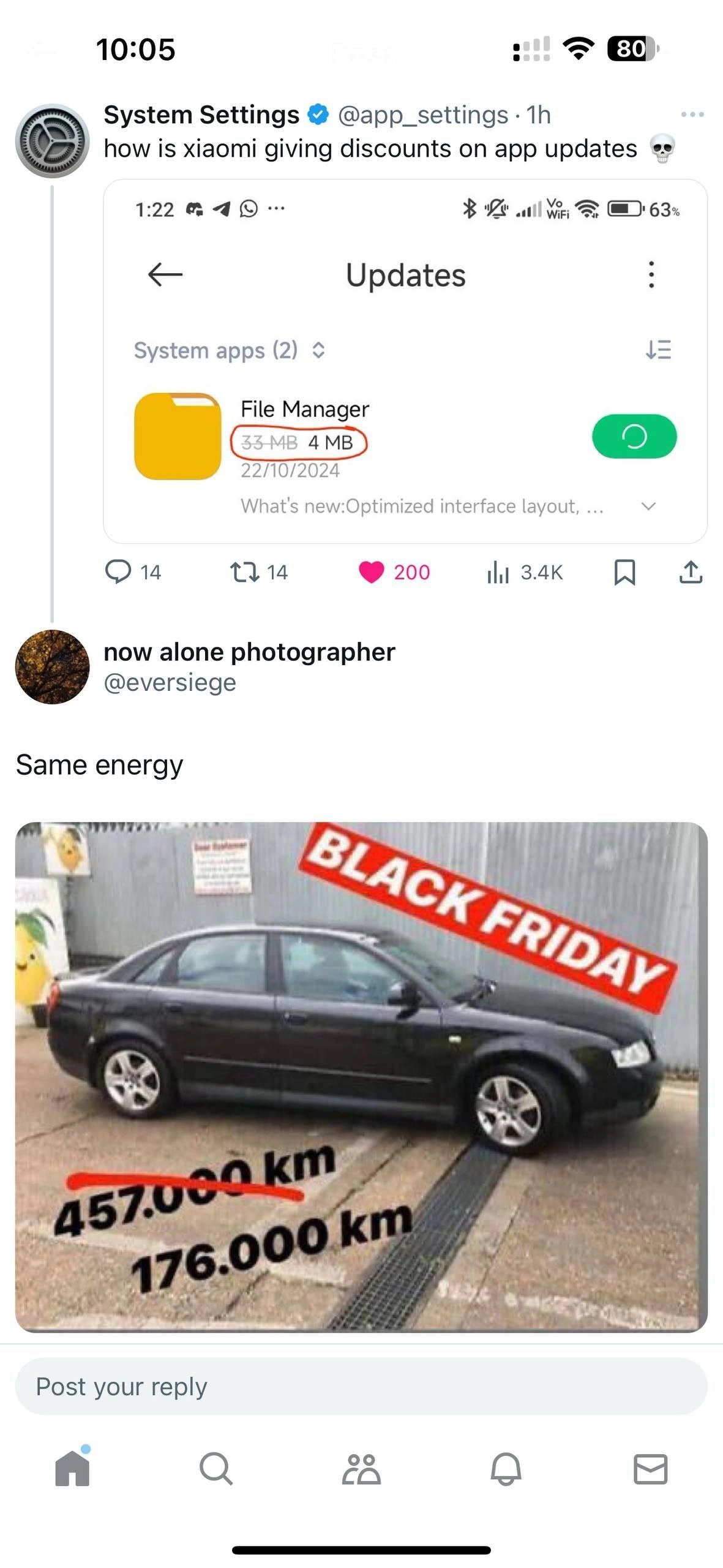
So, picture this: your teacher tells the class you have to do 33 math problems for homework tonight. Ugh, 33 problems! Later, she changes her mind and says, “Actually, good news, you only need to do 4 problems.” Then she even crosses out the 33 on the board and writes 4 in big red letters, like it’s a special sale at a store. You’d be happy (less work!), but you’d also think, “Why is the teacher acting like homework is on sale?” It’s pretty silly to treat homework like a Black Friday deal, right?
Now imagine your phone doing something similar. Your phone wants to update an app. Originally, updating that app might have meant downloading a lot of data (say 33 MB, which is a big chunk), but instead it only needs a tiny bit (4 MB). To show this, the phone’s update screen crosses out the big number 33 and puts 4 next to it, almost like a price tag that’s been marked down. It’s as if your phone is proudly announcing, “Sale on data! This download is much smaller now!” Phones don’t usually talk to us like they’re shopkeepers, so it looks funny.
Then there’s that car picture. Think about a car’s mileage (how far it’s been driven) like the car’s “age.” This car had 457,000 km on it — that’s very high, meaning it’s been driven a ton. Some sneaky seller crosses that out and writes 176,000 km, trying to pretend the car hasn’t been driven nearly as much, and they stick a big “BLACK FRIDAY” sale banner on it. We all know you can’t actually put a car’s wear and tear on discount by just changing the number on the dashboard. That’s just a goofy trick.
The whole joke here is that something normal and boring (updating an app, or a car’s mileage) is being presented in an over-the-top, “look, it’s on sale!” way. It feels out of place and absurd. We laugh because it’s like seeing a serious thing wearing a clown costume – a phone update dressed up with a sale tag, or a well-used car pretending to be a Black Friday deal. It’s such a ridiculous way to show those numbers that you can’t help but find it funny.
Level 2: Updates on Sale
Let’s break down what’s happening in that screenshot for those newer to Android or app development. On Xiaomi smartphones (which run a customized Android interface called MIUI), there’s a built-in app updater in the settings. In the image, it shows an available update for the “File Manager” app (one of the system apps). Normally, you’d just see something like “Update size: 4 MB” along with a brief “What’s new” description. But Xiaomi’s interface did something eye-catching: it showed 33 MB 4 MB right under the app name. They actually crossed out “33 MB” and put “4 MB” next to it in bold, almost like a price tag that’s been marked down.
The tweet above that image says, “how is xiaomi giving discounts on app updates” and includes a skull emoji (💀). In internet slang, the skull emoji means “dead from laughter” (as in, “I’m dying, this is so funny”). The person tweeting couldn’t believe what they were seeing – it’s as if Xiaomi is advertising an app update like it’s a product on Black Friday sale! The phrasing “giving discounts on app updates” is them jokingly saying Xiaomi is acting like downloading data is something you pay for at a store, with a sale coupon. Of course, in reality, app updates are free (in money terms), but here it looks like they’re on sale in terms of download size.
So what does 33 MB → 4 MB really signify? Essentially, Xiaomi is showing off that this update won’t require as much data as the full app. SoftwareUpdates for apps can be done in a smart way: instead of downloading the entire 33 MB app again, your phone can download just the differences (maybe 4 MB worth of changed parts) and patch the app. That’s called a delta update (delta means “difference”). This way, you save data and time. Xiaomi’s updater is highlighting that savings very dramatically. It’s like the phone is proudly saying: “Look, we optimized this update! It would have been 33 MB, but now it’s only 4 MB for you.” Usually, app stores just mention the final download size quietly, but Xiaomi literally compared the before and after right on the screen. For users, it’s actually helpful to know it’s a small download, but presenting it with a strikethrough makes it look like a sale sticker, which is unusual and funny.
Now, the meme’s reply image takes this joke further. The second tweet says “Same energy” and shows a car with a big red “BLACK FRIDAY” banner. In that photo, the car’s odometer reading (how many kilometers it’s been driven) originally shows 457,000 km, which is a huge number (that car is well-traveled!). That number is crossed out in red, and underneath it, they wrote 176,000 km as the “new” reading. This is mimicking a very shady trick known in real life as odometer rollback – where a used car seller illegally rolls back the mileage to make it look like the car has been driven less than it actually has. It’s basically lying about the car’s history to sell it for a higher price. By slapping a “Black Friday” sale banner on it, the image jokes that the car’s mileage has been “discounted” the same way Xiaomi “discounted” the app update size.
When the reply says “Same energy,” it means “these two situations feel very similar.” Both the Xiaomi update and the used car scenario involve a big number getting replaced by a much smaller number, presented with flashy sale-like graphics. Of course, the contexts are different: one is a legit software improvement, the other is a sketchy car dealer trick. But visually and conceptually, they match, which is why seeing them side by side is comical. It’s a way of saying, “Xiaomi doing that with app MB is as goofy (or borderline sketchy) as someone doing that with a car’s kilometers.” It’s exaggerated for effect, and that contrast is what makes it funny to those of us in the developer community.
For someone new to these terms: PackageManagement is basically how a system installs and updates software. If you’ve ever seen your phone or computer say “updating...”, there’s a package manager under the hood figuring out what bits to download and replace. A good package manager tries to download as little as needed. In mobile apps, the technique used is often “download only what’s changed” to avoid wasting bandwidth. That’s why Xiaomi could show 4 MB instead of 33 MB – most of that 33 MB was already on your phone from the old version, so no need to grab it again. It’s like if a teacher hands out an update to a textbook: instead of giving you a whole new book, they just give you a few new pages that you stick into your copy. Only 4 pages instead of 33 – much easier! Xiaomi basically turned to us and said, “See? We only gave you the 4 pages.”
Now, MobileDevelopment teams care a lot about app size and performance. A term you’ll hear is app bloat, which is when an app gets unwieldy and large over time. Developers try to prevent that by optimizing images, removing unused code, and using tools (like Android App Bundles) to shrink download sizes. When they succeed in cutting down size, they often mention it in the release notes. For example, an update note might say “We reduced the app size from 100 MB to 80 MB” or “Added features and fixed bugs (app is now smaller too!).” It’s usually a line in the text, though – not a giant crossed-out graphic in the UI! That’s why this Xiaomi thing stood out. It’s like the software team was so proud of saving 29 MB that they turned it into a visual celebration. Useful? Arguably yes, because users with limited data will be happy. But it also made everyone chuckle because it’s just not what you expect to see on your settings screen.
Finally, let’s touch on Black Friday: it’s an annual shopping event famous for big discounts and bold marketing. Stores put up signs like “Was $100, now $50!” to show huge savings. Seeing that kind of presentation in a tech context (like an app update) is inherently humorous. It’s mixing a very consumer-sales idea with a nerdy software update. The meme capitalizes on that contrast. So, to recap in plain terms: Xiaomi’s phone showed an update from 33 MB down to 4 MB like it was a store sale, and someone on Twitter joked about it. Another person compared that to a car dealer faking a mileage reduction with a Black Friday sign. Both are doing the “big number -> slashed -> small number” thing. It’s funny to us because it’s such a mash-up of worlds: software updates aren’t usually advertised like cheap TVs on Black Friday! Don’t worry, Xiaomi isn’t actually charging money or doing anything nefarious here – it’s just a quirky way of displaying info. And the developer community found it silly enough to make this meme and share a good laugh over it.
Level 3: Black Friday Bytes
Zooming out to the humor: why are developers cracking up at this? It’s the absurd collision of mobile app updates with retail-style showmanship. Xiaomi’s updater literally presents an app patch like a product on sale – “Was 33 MB, now only 4 MB!” complete with the old value struck through. To seasoned engineers, this is hilarious because we usually think about SoftwareUpdates in terms of version numbers and changelogs, not clearance-rack discounts. It’s as if the phone’s update system had a meeting with the marketing department.
A senior developer immediately recognizes the vibe: it’s reminiscent of those overly enthusiastic release notes or product pitches that try to spin any improvement as a huge deal. “Reduced app size by 15%!”, “Launch speed doubled!”, “Now uses 30 MB less memory!” – we see these claims all the time in update logs. This scenario takes that to an extreme by literally formatting the size change as a bargain deal. It’s poking fun at how tech teams sometimes celebrate shaving off some megabytes as if they’d cured cancer. We’re smiling because we’ve either written or read those hyperbolic changelogs. Xiaomi’s update screen is basically a meme of itself: the kind of thing you’d joke about (“ha, imagine if we put a Black Friday tag on our patch notes”), except they actually did it on a phone UI!
The “Same energy” reply with the used car odometer is the perfect punchline. In the car world, a shady second-hand dealer might roll back an odometer from 457,000 km to 176,000 km to pretend the car is less used than it really is. They might even slap a BLACK FRIDAY sale banner on the windshield to lure buyers. Of course, that’s blatantly dishonest (and illegal), but visually it matches what Xiaomi’s updater did: a big number knocked down to a much smaller number, presented like a sweet deal. It triggers the same kind of skepticism and dark humor. As engineers, we know the Xiaomi case is actually legit (just a smaller download), but the presentation feels like one of those too-good-to-be-true offers. We have a bit of a cynical streak; many of us have witnessed metrics being massaged or performance numbers cherry-picked to impress management. So we laugh at this UI because it humorously echoes that kind of number-fudging vibe, even if unintentionally.
There’s also an undercurrent here about versioning math that “never seems to add up.” Every other app update seems to claim “-5 MB here” or “-10% memory there,” yet somehow our apps keep getting bigger overall. It’s like software’s own version of retail pricing games. If you took all those claims at face value, by the 10th update the app should be zero bytes and use negative RAM! We all know that’s not how it really works — often an update that reduces size in one area might add new features (and megabytes) elsewhere. The meme is winking at that reality. The car analogy drives it home: rolling back the odometer doesn’t make the car new, just like boasting about size reduction doesn't guarantee the app isn’t gaining weight later. A senior dev finds that comparison chef’s kiss because it’s humor wrapped around a truth: marketing can spin numbers whichever way, but reality might differ.
In practice, Xiaomi’s strikethrough UI was probably well-intended, even user-friendly. It highlights a MobileDevelopment achievement: implementing delta updates to save user bandwidth and storage. In markets where Xiaomi phones are popular, data caps and limited storage are real concerns, so visibly showing “Hey, this update won’t eat 33 MB, only 4 MB!” could be a selling point for users. It’s actually a thoughtful feature – just presented in a comically over-the-top way. One can imagine the meeting behind it: “We reduced the update size by 29 MB – let’s make sure users see that difference. People love feeling like they’re saving data!” It’s both adorable and a tad cringey, which is exactly why it became meme-worthy. (Fun fact: this screenshot was from late October 2024, with Black Friday looming in November, so maybe the team was already in the holiday sale spirit 😉.)
Also, consider the meme format itself: a tweet and a “same energy” image reply. This format is common in DeveloperHumor circles. We love to take a real tech quirk (like that Xiaomi update screen) and then find a real-world parallel image that exaggerates it. Here both images use a bold red strike-through of a big number to a smaller number. It’s universally the sign of a deal. By saying “Same energy,” the second tweet is effectively captioning: “This phone update and this used-car scam give off the same vibes.” That juxtaposition is what makes it so funny. Both are technically about reducing numbers, one legitimately and one fraudulently, but presented in the exact same style. As experienced devs (and consumers), we appreciate the irony. It’s a gentle roast of Xiaomi’s UX choice, and at the same time a nod to how ridiculously far the “selling it” mentality can go in tech.
So from a senior perspective, the humor comes from recognizing the truth behind the exaggeration. We’ve all been in situations where engineering improvements had to be “sold” to users or bosses in flashy terms. Xiaomi literally slapped a virtual “SALE!” label on an update, and that cracks us up. It makes us joke, what’s next, coupon codes for firmware upgrades (enter PATCHSAVE50 at checkout to halve your download)? In the end, we’re laughing both at and with the absurdity. It’s funny because it’s kind of true: tech improvements are often marketed like products. Here that idea was taken quite literally, and DeveloperHumor loves nothing more than calling out that absurdity with a wink and a meme.
Level 4: Struck-out Size Sorcery
Under the hood, this Xiaomi updater trick is powered by some serious MobileDev wizardry: an incremental update, a.k.a. a delta patch. Instead of shipping the entire 33 MB app again, the update server provides a tiny patch (only 4 MB) containing just the bytes that changed from the previous version. This technique is a staple of efficient Package Management systems. It’s similar to how version control sends only diffs – here the phone applies a binary diff to reconstruct the new app. Xiaomi’s interface literally shows 33 MB 4 MB next to the app, as if it's an “87% off” deal on data. And indeed, by the numbers it is – roughly an 88% reduction in download size.
In technical terms, there’s a delta update algorithm at work. Android apps (APKs) can be diffed: the update service computes the difference between File Manager v1 and File Manager v2. Only the changed binary chunks (plus a bit of metadata) get packed into the update file. For example, Google Play employs a tool called bsdiff for APK updates, achieving huge size cuts by compressing the diff. If only a few small assets or sections of code change, the patch can be an order of magnitude smaller than the full app. This explains that dramatic “33 MB → 4 MB” change. It’s not that the app magically shrank to 4 MB overall – it’s that you only need a 4 MB download to transform your existing 33 MB app into the new version.
Essentially, the updater behaves like a specialized patch system. The patch file likely contains instructions like “replace these bytes at offset X with this new sequence” along with any new resources. When your phone downloads that patch, the installer merges it with the old app already on your device. Think of it like sending you only the edited pages of a book rather than the whole book again – way less to carry over the network. The math behind it is straightforward: sending just differences can save enormous bandwidth. In this case, $(33 - 4) / 33 \approx 0.879$, so about 87.9% fewer bytes needed – essentially an “88% off” sale in terms of data usage!
For context, Android and other platforms have been refining this method for years. Early app stores often made you pull the full package for each update, but modern updaters got smarter. Google introduced file-by-file patching in 2016 which, like Xiaomi’s approach here, often yields 50–90% smaller downloads. It’s a combination of binary diffing and compression. Interestingly, some diff tools (like Google’s earlier Courgette for Chrome) go so far as disassembling the program into an intermediate form before diffing, to maximize similarity and shrink the patch even further. It’s practically binary voodoo: rearranging bytes and applying compression so that the patch file comes out as small as possible.
Now, Xiaomi’s updater UI turning this into a “sale tag” is just a UX flourish on top of this tech. Underneath, it’s a rigorous algorithm ensuring that ~33 MB of app data can be updated with only 4 MB downloaded. The new version isn’t defying physics – it’s leveraging the fact that most of the app is unchanged and already on your phone. It’s a clever real-world example of the principle “don’t send what you already have” (similar to caching strategies in networking). So while it might look like a shady mileage rollback at first glance, it’s actually coming from a completely legitimate optimization — just delta patching algorithms doing their job exceptionally well, dressed up in a cheesy Black Friday-style sticker.
Description
A two-part meme presented as a Twitter thread. The top image is a tweet showing a Xiaomi system update screen for a 'File Manager' app. The update size is humorously displayed as a 'discount,' with the original size '33 MB' struck through and replaced by '4 MB.' The tweet's author asks, 'how is xiaomi giving discounts on app updates'. The bottom image is a reply tweet with the caption 'Same energy.' It shows a used black car with a 'BLACK FRIDAY' banner. The car's mileage has been 'discounted' from '457.000 km' (struck through) to '176.000 km.' The meme creates a hilarious parallel between a legitimate, though oddly framed, technical improvement (app size reduction through optimization) and blatant fraud (odometer tampering). For experienced engineers, the joke lies in the absurdity of marketing a positive engineering outcome - like reducing binary size by removing bloat or refactoring - as a consumer 'discount,' equating it with a deceptive sales tactic
Comments
23Comment deleted
We finally removed the legacy libraries and cut our app size by 80%. Marketing is now running a campaign advertising 'more free space on your phone, on us.'
That 33 MB → 4 MB “discount” APK is storage-odometer fraud; open it once and it streams 200 MB of assets - same dev energy as calling a 1.5 GB container image a “thin microservice.”
After 20 years in tech, I've seen compression algorithms improve dramatically, but Xiaomi's achieved the holy grail: retroactive file size optimization through strikethrough markdown. Next they'll be offering negative latency by crossing out ping times
When your OEM claims they've optimized the File Manager from 33MB to 4MB, it's giving the same energy as 'we removed all the features you actually used' or 'we now fetch everything from the cloud.' At this point, I'm half expecting the next update to be negative bytes - they'll start removing files from your phone to save space. Classic case of either brilliant delta patching or someone accidentally shipped the APK stub instead of the full binary
We shaved the update with split APKs and bsdiff; marketing called it “88% off,” legal called it odometer rollback for binaries
Xiaomi’s 33MB→4MB update isn’t a sale, it’s App Bundle splits and delta patches - odometer rollback for APKs
Xiaomi's 'optimized' File Manager: accrued 457k km of bloatware tech debt, then stripped to a responsive skeleton for that Black Friday perf gain
wtf Comment deleted
iirc they optimized their build process and removed arm32 libs which drastically reduced app sizes Comment deleted
Still tho, 33MiB to 4MiB is p insane That, or building 29MiB of useless junk into your app, that's also p insane Comment deleted
to non-android devs: it's called "delta update" where only the diff patch between apks gets downloaded ref: https://stackoverflow.com/a/38157682 Comment deleted
same as what git does Comment deleted
Isn't there already ABB or whatever the new 'optimized' package is called? Comment deleted
i was just thinking about this, and did a quick search and refreshed my memories about Android App Bundle publishing format .aab, and its output APK set archive (this part is very new to me) .apks https://developer.android.com/tools/bundletool I think AAB/package splitting is already applied and differential patches make the download size even smaller Comment deleted
Yeah even xbox does this with appxbundle and eappxbundle and whatever xbox games come in. But its so stupid if you skip 30 updates you will need to doenload each patch🗿 somebody forgot to check if the total new package would be smaller than all missing patches🗿 Comment deleted
Giga corp Comment deleted
Wow, Android devs invented their counterpart for drpm and debdelta. 🙃 Pretty spectacular for people who usually bundle hunderds of megabytes for a simple hello world application. Comment deleted
Did debdelta ever reach production? Comment deleted
We used to have that on Fedora Comment deleted
xiaomi use diff update in its app store Comment deleted
keep in mind, there are some people who seriously believe that their mobile data goes as a payment to them Comment deleted
https://fedoraproject.org/wiki/Changes/Drop_Delta_RPMs Comment deleted
Feels a bit taken with tweezers Comment deleted