The First Audio Log in a Sci-Fi Horror Game or Just a Tech Update?
Why is this AI ML meme funny?
Level 1: Spooky Lab Note
Imagine you’re reading a diary entry in a spooky science story that says, “Great news, the experiment is working perfectly!” You just know that in the next chapter something big is going to go wrong. This meme is joking that a famous inventor’s real upbeat news about putting a chip in someone’s brain feels just like that kind of ominous diary entry. It’s funny and a bit scary at the same time: the update sounds cheerful and optimistic, but because we’ve seen so many sci-fi thrillers, we can’t help feeling it’s actually a warning sign. In simple terms, it’s like a friend casually saying “What could possibly go wrong?” — and you get a nervous little laugh, because you know the story might turn dark right after.
Level 2: Black Mirror Vibes
Let’s break down why this tweet feels eerie yet funny in simpler terms. Neuralink is a company (co-founded by Elon Musk) working on a brain–machine interface – basically a high-tech chip that can be implanted in a person’s skull to connect their brain signals to a computer. In late January 2024, Elon Musk announced that for the first time a human received one of these brain implants. The person is “recovering well,” and importantly, the device is picking up signals – those “neuron spikes” – from the person’s brain. A neuron spike is just a tiny electrical pulse that a brain cell makes when it’s active (think of it like a little flash or click inside your head when a thought happens). So, Musk is saying: we put a chip in someone’s brain, and we can see the little electric pops from their neurons. That’s exciting news in neuroscience! It means the implant is working so far and the patient is okay.
Now, here’s where the humor and creepiness come in. Michael Irving (the guy making the meme) looked at Musk’s very upbeat, clinical update and immediately thought of a sci-fi horror story. He wrote, “The audio log you find in a trashed office in a sci-fi horror game,” as if Musk’s tweet were a line spoken by some doomed scientist in a video game. Why? In many sci-fi horror games and movies, the plot is revealed through audio logs or journal entries left behind by characters. A common trope is a scientist’s log that starts optimistic — “Experiment is going well, everything is under control…” — and you, the player, already know things must have gone terribly wrong because you’re literally finding this log in a wrecked, abandoned lab after the fact. Musk’s tweet has exactly that same optimistic scientist tone, except here it’s real life. It’s easy to imagine Elon’s words being played back in a game like System Shock or an episode of Black Mirror, right before the brave experiment spawns a monster or an AI goes rogue.
The term “Black Mirror vibes” fits perfectly. Black Mirror is a TV series that tells cautionary tales about futuristic technology misused or going awry. When people say something has “Black Mirror vibes,” they mean it feels like a scenario from that show — a tech idea that starts out cool but might end up scary. A brain implant that posts cheerful updates on social media? That definitely has that vibe. It’s not that Neuralink is evil or doomed, but our collective memory is full of stories where messing with the human brain leads to trouble. So we can’t help but chuckle and feel a tad uneasy.
For a newer developer or tech fan, there are a couple of layers to why this hits home:
- Hype vs. reality: This tweet is part of the huge excitement around AI and futuristic tech. Elon Musk is known for hyping big ideas (self-driving cars, rockets to Mars, and now mind-computer links). The update sounds super positive, but old hands in tech have a rule: don’t celebrate until it’s proven to work safely in the real world. In plain terms, they’ll believe the brain chip is truly great after it’s been working for a long time without issues. Until then, saying “promising results” is like tempting fate. It reminds experienced folks of all the times something looked good in a demo but failed later.
- Sev-0 (ultimate emergency): You might notice the term
Sev-0 incidentpop up. In developer jargon, “Sev-0” means a severity level 0 problem – basically the worst kind of emergency, when everything is on fire. If a website goes down for everyone, that’s a Sev-0. The joke here is that a brain implant messing up would be an extreme Sev-0. It’s a way tech folks express, “If this fails, it fails really badly.” It’s dark humor – we joke about it because it’s a scary possibility. Kind of how doctors might make a grim joke to cope with a risky surgery. - Patch notes feel: The meme’s title mentions System Shock patch notes. “Patch notes” are the little updates you read whenever a game or app gets updated – they list changes in a dry, matter-of-fact way. Musk’s tweet (with lines about the implant and neuron detection) reads a bit like patch notes for reality. It’s like humanity just got a software update: Brain Implant v1.0 installed – initial tests look good. That sounds both cool and a tiny bit spooky. Seeing world-changing technology described so casually is surreal, and that’s why it matches a video game vibe.
So, the takeaway at this level: the meme is funny-peculiar because it turns a real cutting-edge tech announcement into a scene from a science fiction thriller. It highlights the contrast between industry excitement (“Wow, we have a person with a computer in their brain now!”) and that little warning voice in our heads (“This is exactly how the plot of a horror game would start…”). In plain terms, we’re all impressed by the science, but we’re also half-joking, “Uh oh, this sounds like the part in the movie where they say ‘everything is fine’ right before it isn’t.” It’s a mix of geeky excitement and a tongue-in-cheek warning.
Level 3: Pre-Sev0 Incident Log
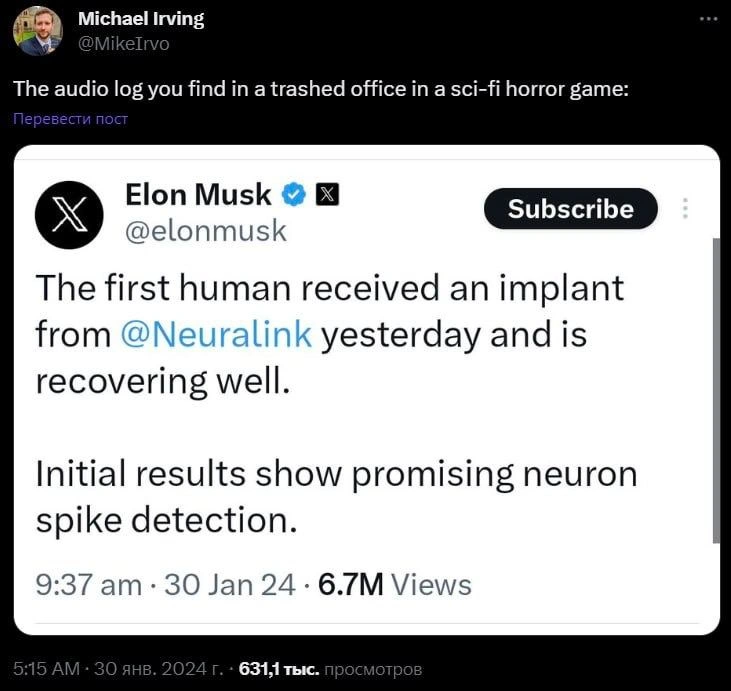
The meme sets up Elon Musk’s Neuralink announcement as if it were a found footage cassette from a doomed space station. Michael Irving jokes, “The audio log you find in a trashed office in a sci-fi horror game:” with Musk’s tweet screenshotted below, making it seem like exactly such an in-game message. Below that, Elon’s real tweet reads:
The first human received an implant from Neuralink yesterday and is recovering well.
Initial results show promising neuron spike detection.
To any gamer or sci-fi savvy developer, this optimistic progress report screams foreshadowing. It’s hilariously spot-on: in games like System Shock, BioShock, or Dead Space, you constantly stumble upon cheery lab notes and audio diaries written right before experiments go off the rails. Musk’s tweet has exactly that tone of “Great news, nothing could possibly go wrong!” You read it and practically hear the ominous music sting. It’s the kind of log entry where you’d immediately mash the quick-save button because you know a boss fight (or worse) is around the corner.
Seasoned developers find this meme funny because we’ve lived through the real-life tech equivalent of those horror story beats. We’ve seen upbeat status reports turn into all-hands firefights. “Recovering well, promising results” are famous last words in our world. It’s like a deployment note that says “All tests passed in staging!” right before the entire system crashes in production. That little phrase “promising neuron spike detection” gives us flashbacks to project updates where someone bragged “the new feature is 99% stable” — translation: a colossal bug is lurking in the 1% they didn’t test. The meme expertly mixes TechHumor with that gut feeling of impending doom that every on-call engineer knows too well.
There’s also a broader satire here of hype-fueled tech culture. Neuralink is a high-profile project riding on big IndustryTrends_Hype. The tweet is meant as a triumphant update in the AI/tech saga — the kind of thing investors and fanboys cheer about. But the meme calls out the Black Mirror energy behind such milestones. These are ethical and safety worries made meme: we’re literally plugging computers into brains and doing a victory lap on social media about it. Experienced devs can’t help but smirk and think, “Have we learned nothing from sci-fi warnings?” It’s highlighting the gap between what tech marketing says (“This will change the world for the better!”) and the dark what-ifs we all secretly harbor (“Please tell me this brain chip has a really good firewall…”).
By dubbing it a “pre-Sev-0 incident log,” the post cleverly mixes space-horror tropes with developer lingo. A Sev-0 incident is the worst-case scenario at work — system down, hair-on-fire emergency. The joke here is that Elon’s tweet would be the entry you read in a retrospective after everything goes haywire: the cheery note right before the meltdown. It resonates because big, ambitious tech often has that one optimistic memo before reality hits. Think of rocket launches where an internal report said “all systems green” minutes before an explosion, or software releases where the final email proudly said “no showstoppers” just before a major outage. This meme is winking at us, saying: this tweet might age like milk if Neuralink’s next update reads like patch notes from a zombie outbreak.
In essence, at the senior-dev level we appreciate how perfectly this real update fits a long-running narrative pattern. It’s TechSatire that hits home. The meme pokes fun at the hubris of tech pioneers who talk about risky milestones as casually as reading changelogs. The humor lands because it’s grounded in truth: whether it’s a server cluster or a secret lab, overconfidence before all results are in is a recipe for ironic disaster. We laugh, a bit nervously, because we hope Neuralink doesn’t turn into the next cautionary tale… but we’ve been in tech long enough to know that when someone says “What’s the worst that could happen?”, the universe (or Murphy’s Law) loves to answer.
Level 4: Shock to the System
In a deep tech sense, this meme touches on the cutting-edge of brain–machine interface technology and echoes classic sci-fi cautionary tales like System Shock. On one side we have the raw science of a Neuralink implant detecting real human neuron signals; on the other, the eerie narrative parallel of a pre-disaster log entry. The tweet’s content — “Initial results show promising neuron spike detection” — is a dry, technical status update that could easily be an excerpt from a dystopian game’s patch notes.
Under the hood, Neuralink’s implant essentially adds a new hardware interface to the human brain. Think of inserting a custom PCIe card or USB device into your brain’s operating system — a radical form of hardware plug-in. The device uses ultra-fine electrode threads to listen in on neural activity. Each electrode aims to pick up tiny action potentials (the electrical spikes neurons fire to communicate). Detecting a single neuron spike reliably is a serious technical achievement. Neurons fire in millivolt pulses lasting mere milliseconds, so the implant’s electronics must sample thousands of times per second, amplify microvolt-level signals, and filter out a sea of background noise. It’s like attaching a logic analyzer to a living, squishy CPU: you get a flood of analog signals and need advanced signal processing (and likely some machine learning) to discern meaningful events. “Promising spike detection” basically means “the device is online and we’re successfully logging neuron signals” — a fundamental milestone, akin to getting a debug log from a new kind of sensor.
Now, the phrase “promising results” in a lab log has a certain ominous ring to veterans. We’ve seen too many projects where everything looked fine… until it wasn’t. In fact, Elon’s tweet reads almost verbatim like a System Shock audio log you’d find just before all hell breaks loose.
“Subject received neural implant. Vital signs nominal. Initial results… promising.”
It’s that calm-before-the-storm tone. In those games, an optimistic experiment update like this is always followed by an experiment gone horribly wrong. Here in reality, we have a real human with a chip in their brain and a cheery report that sounds straight out of sci-fi horror. The meme’s creators immediately picked up this vibe, hearing “ominous foreshadowing” beneath the corporate optimism.
From a systems perspective, hooking a computer directly into a brain is the ultimate production deployment – and you can’t exactly roll back if there’s a bug. The meme’s talk of a coming Sev-0 incident is dark humor: in DevOps, a Sev-0 is an all-hands-on-deck catastrophe, the highest severity. If something glitches in a brain implant (say a firmware bug causing neuron misfires), that’s a literal life-or-death outage. A veteran engineer reads “recovering well, initial results promising” and reflexively raises an eyebrow — we’ve all seen flawless test results hide lurking faults. It’s like the infamous last commit message “looks good to me” right before a production crash.
There’s a historical echo here too. For decades, researchers have tested BCIs (Brain–Computer Interfaces) in labs: from patients moving cursors with implanted electrodes to monkeys controlling robot arms. Those trials taught us that reading the brain is possible but fraught with challenges (signal drift, tissue inflammation, enormous data streams to interpret). Neuralink’s innovation is scaling up the channel count (thousands of electrodes) and going wireless, pushing the envelope of what’s physically possible. But as any distributed-systems old-timer would note, more data streams = more to go wrong. The System Shock-like phrasing tickles that part of our brain that remembers how many “revolutionary” tech demos eventually hit a terrifying snag.
The fact there’s a Subscribe button next to this profound medical update is the cherry on top. It’s science fiction bleeding into real life: groundbreaking neurosurgery announced with social-media flair. Seasoned developers and sci-fi fans alike get uneasy Black Mirror vibes from this juxtaposition. It’s the classic AIHypeCycle rhythm — momentous breakthroughs touted in upbeat language, while the deeper implications (and potential AIEthicsConcerns) loom in the background. Fundamentally, Level 4 highlights how this meme riffs on the collision of advanced technology and cautionary narrative: bridging brain biology with silicon is both an exhilarating and precarious engineering feat, the kind that in fiction tends to either save humanity or accidentally unleash the monsters.
Description
A screenshot of a tweet from user Michael Irving (@MikeIrvo) which provides a humorous framing for a real-world tech event. Irving's tweet reads, 'The audio log you find in a trashed office in a sci-fi horror game:'. Below this caption is an embedded screenshot of a tweet from Elon Musk (@elonmusk). Musk's tweet announces, 'The first human received an implant from @Neuralink yesterday and is recovering well. Initial results show promising neuron spike detection.' The humor is generated by the juxtaposition of Musk's clinical, optimistic, and very real announcement with the well-known video game trope of 'found audio logs.' In sci-fi horror games like 'Dead Space' or 'BioShock,' these logs start with scientists describing a breakthrough, only to chronicle a descent into chaos and disaster in subsequent entries. The meme cleverly reframes a major technological milestone as the ominous first chapter of a dystopian horror story, a sentiment that resonates with the tech community's mix of excitement and skepticism towards world-altering technologies

Comments
12Comment deleted
That's the 'everything is fine' log entry. The one after this usually mentions a minor, unexpected 'side effect,' and the one after *that* is just screaming and static
Great, we’ve finally merged `neural-interface-v1` to prod without a rollback plan - what could possibly go wrong besides a live-site incident inside the user’s skull?
The real horror isn't finding these logs in abandoned facilities anymore - it's watching them get posted as press releases while we debug the same CORS error for the third day straight
Every senior engineer knows that production announcements reading 'initial results show promising' are just the opening cutscene before the incident postmortem. This tweet has the exact energy of finding a cheerful corporate memo in System Shock 2 right before discovering what happened to the crew - except this time, the neural network isn't just in the game engine, it's literally in someone's neurons. At least when our ML models hallucinate, we can just roll back the deployment
Promising 'neuron spike detection' is basically Prometheus for wetware - on-call without rollback, staging, or a privacy policy for thoughts
“Promising neuron spike detection” is exactly the release note you find right before the facility goes dark - was the health check just still_sentient=true and who owns the rollback?
Neuralink's prod deploy to human cluster: Promising spikes, but one faulty synapse and it's game over - no hotfixes past the blood-brain barrier
Fucking SOMA or some shit Comment deleted
Nice, you know that game too ^w^ Comment deleted
Periodic reminder that companies don't care about keeping your implants working unless it makes them enough money: https://spectrum.ieee.org/bionic-eye-obsolete Comment deleted
https://gshowitt.itch.io/system-shutdown Comment deleted
Deus ex in real life Comment deleted