Skip to content
DevMeme
2986 of 7435
A Poetic Blame Game Between Dev and Ops
DevOps SRE Post #3298, on Jun 21, 2021 in TG

A Poetic Blame Game Between Dev and Ops

Why is this DevOps SRE meme funny?

Level 1: Whose Fault Is It?

Imagine you and your friend are building a giant LEGO castle together, and one morning it collapses into a pile of bricks. You both stare at the mess and immediately start pointing fingers. You say, “My bricks were stacked fine, so it must be your side that fell apart!” and your friend says, “No way, my part was perfect – it’s your side that’s shaky!” Now picture that argument happening as a little rhyming poem: “The castle is down, I’m feeling so blue, I know it’s not me… so it must be you!” It sounds silly, right? But it also makes you smile. This meme is just like that. Two groups of grown-up engineers had something break on them (a computer service went down), and each group initially blames the other in a playful way. Instead of getting truly angry, they turned their frustration into a short nursery rhyme-style joke. The funny part is seeing a serious “Whose fault is it?” argument presented like a children’s poem. It reminds us of two kids squabbling, but in a lighthearted, creative way. The whole point is to laugh at how people often rush to blame someone else when things go wrong – and to appreciate that even in a stressful situation, these tech folks kept their sense of humor.

Level 2: Network vs App Showdown

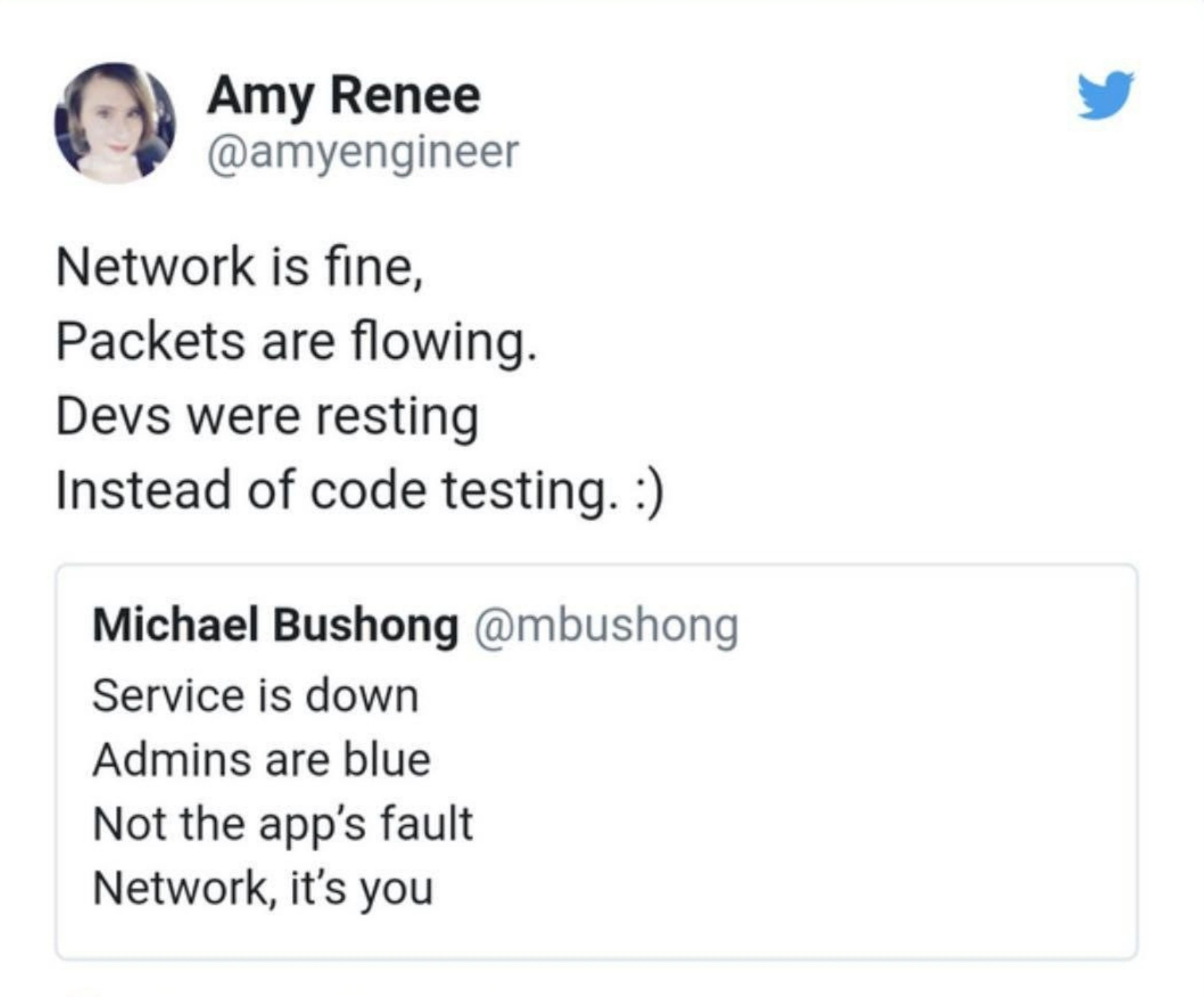
Let’s break down what’s happening in this meme in simpler terms. We have an outage – meaning something in production (the live system) broke, and users are probably seeing errors. Two people on Twitter are dramatizing the situation using a playful poem. The first person (Amy, the network engineer) basically says: “Hey, the network is working fine. Data packets are moving through as they should. The developers must have been relaxing instead of testing their code, so the bug is in the application.” The second person (Michael, representing the admins or developers) replies in the same rhyming style: “The service is down (not working), and the ops team is feeling sad (blue). It’s not the application’s fault; it’s actually the network’s fault.”

In plain English, this is a friendly techie blame game. One side (network/infrastructure folks) is saying, “Our wires, switches, and internet plumbing are all good – so the problem must be in the software.” The other side (developers/operations on the software side) is countering, “Our code and servers are fine – so the problem must be in the network.” This is a common tug-of-war in IT departments, especially during on-call incidents. On-call means someone is responsible for responding to problems whenever they happen (even late at night). If you’re the unlucky engineer on-call during a major outage, you might get pulled into a chat or call to troubleshoot. Often, multiple teams join in – network engineers, system administrators, developers – each checking their part of the system. And let’s be honest, under stress, people sometimes point fingers at each other initially. It’s human nature: “It’s not my stuff that broke; it must be yours.”

The meme is funny because it shows this serious scenario in a very non-serious way – through a nursery-rhyme style poem on Twitter. The format mimics the classic “Roses are red, violets are blue” rhyme scheme, which people often use online to make jokes. Here, instead of a love poem or a random joke, they’re using it to sass each other about a technical failure. It’s like two coworkers having a rap battle about whose fault the outage is, but in a super short, cutesy poem form. This kind of Twitter meme format (stacked tweets with one reply dunking on the other) is common in tech humor circles. Engineers often share snarky one-liners or even haiku-like error messages on Twitter to bond over shared experiences. In this case, crafting the blame as poetry makes it clear they’re being tongue-in-cheek – it’s a form of inside joke for anyone who has been through such late-night dramas.

Let’s clarify some of the technical bits mentioned:

  • Network is fine, packets are flowing: The “network is fine” means the hardware and connections (routers, switches, cables, and all that) don’t show obvious problems. Packets are the small chunks of data that travel across networks. When you load a website or call an API, your computer sends and receives data packets. If packets are flowing, data is getting through the network. For example, a network engineer might have run a quick test like ping (which sends test packets to see if a destination responds) and saw replies coming back. That suggests the basic network path is okay. It’s basically saying, “Our part (the network) is doing its job, see, the messages are getting from point A to B without getting lost.”

  • Devs were resting / Instead of code testing: This line playfully accuses developers of perhaps being lazy or complacent – maybe not writing enough tests or not verifying their code thoroughly before deploying. It’s a gentle jab: if the network isn’t at fault, the outage must be due to a bug that better testing might have caught. It implies the developers pushed code and then relaxed, but oops, maybe they missed something.

  • Service is down: This means the application (the service users interact with) is not working. “Down” is the universal word for “not up/running.” If you try to use the website or app and it fails, the service is considered down.

  • Admins are blue: “Admins” here refers to system administrators or ops people – the folks who keep the servers and services running. Saying they are “blue” means they’re sad or upset. They might be frantically trying to fix the issue, and they’re feeling the stress (and maybe the blues) of the outage. It’s a cute way to keep the rhyme (blue with you) while indicating the ops team is unhappy.

  • Not the app’s fault, network, it’s you: This is the punchline of the second tweet. It flat-out says the application (app) isn’t to blame for this failure. Instead, it calls out the network as the guilty party. Essentially, the second person is replying, “Hold on, we checked our code and servers, and everything was correct on our side. So the network must be the cause of this downtime.” This could refer to anything in the network infrastructure: maybe a misconfigured router, a broken switch, a failing DNS server (which translates URLs to IP addresses), or any number of networking gremlins that can take down a service even when the code is perfectly fine.

This back-and-forth reflects a real troubleshooting process, albeit dramatized. In a real outage call, the conversation might go like:

  • Dev Team: “Our latest deployment was last night and passed all tests. The service was stable for 12 hours. Now suddenly it’s unreachable. Maybe something in the network changed?”
  • Network Team: “We haven’t touched the network. All the monitors show the circuits are up, and we can ping the servers. Maybe something in the application crashed or got overwhelmed?”
  • Dev Team: “The app logs show no errors until it couldn’t reach the database. Is the DB network segment okay?”
  • Network Team: “Oh, the database? Wait, we see high latency there… could be a congested network link or a failing switch… hmm.”

And so on. Eventually, everyone pieces together clues to find the actual root cause. It might turn out to be something like a DNS misconfiguration (a very common cause of “network” issues where services can’t find each other) or a sudden spike in traffic that overwhelmed a component. The key is that at first each team often suspects the other – as a kind of knee-jerk reaction.

Now, modern IT practices encourage something called “blameless culture.” This means that instead of wasting time accusing each other, teams are encouraged to work together to fix the problem and then later analyze it without blaming individuals. The idea is to focus on what went wrong (process, tools, miscommunication, etc.) rather than who screwed up, because the goal is to learn and prevent it in the future, not shame someone. In fact, many companies do blameless post-mortems, which are meetings after an incident to discuss how to improve things without finger-pointing. But as you can see in this meme, in the heat of an outage at 3 AM, the instinct to say “It’s not me, it’s you!” is still very much alive. Old habits die hard. This meme is basically poking fun at that habit.

Finally, it’s worth noting the tone: this blame war is done in a jokey, poetic way, which suggests these two aren’t seriously angry at each other. It reads more like colleagues or friends teasing each other. In real incident chats, especially among good teams, you’ll often see this kind of light-hearted banter to keep morale up. (It’s way better than yelling in panic.) They all know the priority is to restore the service, but cracking a little on-call humor like “Roses are red, the server is dead…” can defuse stress. It’s a tradition in tech communities to handle tragedy with a bit of comedy. That’s why we have entire threads of Ops humor and memes – it’s a shared coping mechanism.

So, in summary for a junior developer: this meme shows a familiar scenario where two sides of the tech team (network vs software) blame each other for a crash, but they’re doing it with a silly Twitter poem. It teaches a subtle lesson: during outages people might play the blame game, but it’s more productive to collaborate. And if you must vent or blame, at least doing it in rhyme shows you haven’t lost your sense of humor! After all, in tech, if you can laugh at a problem, it means you’re not far from solving it.

Level 3: Ops vs Dev Poetry Slam

This meme captures a production outage blame game elevated to performance art. It’s 3 AM in an on-call war room, and instead of the usual heated emails, the teams are lobbing rhyming couplets on Twitter. The humor hits home for seasoned engineers because it satirizes that classic network vs application finger-pointing in a format as unexpected as a Shakespearean roast. The first tweet, from a network engineer’s perspective, insists “Network is fine, packets are flowing”, implying the internet plumbing (routers, switches, etc.) shows no faults – so hey, it must be the developers’ bug. The reply, channeling the app team (or sysadmins), claps back: “Service is down, admins are blue / Not the app’s fault, network, it’s you.” In other words: Nope, our code is innocent; the infrastructure gremlins are to blame. It’s a Roses-are-red parody thread, turning a high-stress blame war into a geeky poetry slam. Seasoned Ops folks recognize this blame ping-pong in verse as dark humor born of real 3 AM pain. After all, when you’ve been awake for 20 hours fighting an outage, sometimes the only sane response is to get a little insane – like composing a troubleshooting sonnet on social media.

From a senior perspective, the meme is funny because it’s too real. We’ve all seen critical services go down and immediately the devs and ops (operations) start eyeing each other. The network team swears packets are reaching their destination (maybe they ran ping and got replies, proving basic connectivity). The developers swear nothing changed in the code (often proclaimed via the famous “Works on my machine!” mantra). Each side is armed with their monitoring data and logs, ready to prove the culprit lies elsewhere. It’s essentially a technical whodunit, and everyone’s trying to avoid being the prime suspect. The meme exaggerates this by having each side literally craft blame in rhyme, like a pair of feuding bards in a NOC (Network Operations Center). The result reads like an outage-themed poetry slam that any battle-scarred engineer can chuckle (or cringe) at.

Why does this scenario even happen? Experienced devs know that modern systems are complex tangles of applications, networks, databases, and services. When something breaks, finding the root cause is hard – there are so many layers where the fault could hide. The network engineer sees all switches green and says, “Not our problem, the network is reliable.” The app team sees their logs are clean and the last deploy was a day ago, so “Not our fault either.” In truth, both these claims can be true and yet the service is undeniably down. Veteran engineers recognize this paradox: maybe a third factor is at play (cue the classic joke: “It’s always DNS” – the Domain Name System – whenever an outage defies easy explanation). In practice, debugging an outage often means peeling through the OSI model layers:

  • Is Layer 3 (Network) passing packets? Yes? (Packets arrived, “packets are flowing” 🌊)
  • Is Layer 4 (Transport) connecting? Perhaps the TCP handshake is failing or a firewall is silently dropping traffic.
  • Is Layer 7 (Application) responding? The web server or microservice might have crashed or hung even if the network delivered the request.

Each team tends to check their layer first. If their layer looks OK, they instinctively point to another layer. This meme’s poetic duel is basically a Layer 3 vs Layer 7 blame standoff. A grizzled network admin might be running traceroute and saying, “No packet loss between services A and B, so it’s not the network.” Meanwhile, a weary developer is hitting the service’s health check URL and seeing it hang, “The server isn’t responding – must be the network or something in between.”

To illustrate, here’s a snippet of how each side gathers ammo in the blame war:

# Network engineer verifies that basic connectivity is fine:
$ ping service.internal
4 packets transmitted, 4 received, 0% packet loss, time 3002ms

Packets flying back with 0% loss? Network is fine (they swear). But the dev or admin digs deeper:

# Developer checks if the application is responding on its port:
$ curl -I https://service.internal/api/health
curl: (7) Failed to connect to service.internal port 443: Connection timed out

The app isn’t replying on port 443. Timeout. Hmm. Could be the app crashed (“Service is down”) or maybe a network firewall is blocking that port. Each side interprets this differently: Ops might mutter “Your app is dead, not responding,” and Dev might retort “Our service would respond if your network wasn’t choking it.” In short, both have evidence to point fingers, yet users are still getting errors.

Seasoned engineers find humor here because they’ve lived this exact stalemate. The meme also pokes fun at how engineers sometimes communicate during incidents. When tension runs high, you’d think people would be yelling, but often the opposite happens – the truly experienced folks get almost too calm, dropping dry one-liners and sardonic jokes to ease the tension. Turning the incident into a poem is an extreme (and hilarious) example of that coping mechanism. It’s a form of Ops humor: finding a sliver of comedy in the chaos of on-call firefighting. As any on-call veteran knows, laughter is literally a survival strategy when the pager is blowing up at midnight. You might hear someone in the war room crack an “it’s not a bug, it’s a feature” joke or ironically recite one of the blameless blameful post-mortem haikus” floating around on Twitter.

There’s also an element of industry commentary here. Modern DevOps culture preaches “blameless post-mortems” – after an outage, teams are supposed to analyze issues without accusing individuals, focusing on system improvements rather than personal fault. Yet, in the heat of an incident, that ideal often goes out the window. Silos re-emerge: network engineers vs software engineers, each convinced the other group messed up. This Twitter exchange reads like a satire of those old turf wars. It’s basically Dev vs Ops, Act I, Scene I – a theatrical throwback to pre-DevOps days when these teams were separate kingdoms. The veteran chuckles because we’re supposed to have moved past this “us vs them” mentality (DevOps, SRE, and all that jazz encourage shared responsibility). And yet, here we are – even our poems are throwing shade across the aisle.

In reality, the best outage resolutions happen when everyone stops finger-pointing and starts collaborating. But the meme wryly acknowledges what really goes down at 3 AM before that spirit of cooperation kicks in. It’s cathartic: we see our own on-call struggles and petty blame exchanges cleverly condensed into four rhyming lines. Instead of gritting our teeth, we get to smirk and think, “Yep, been there, done that, wrote the poem.”

In Theory (Blameless Culture) In Practice (Blame Game)
“Let’s focus on the root cause together.” “😇 Not my code, it must be the network.”
“We succeed or fail as one team.” “🚨 Who pushed that last commit?!”
“What did the logs and metrics show?” “📣 Everything on my end looks fine!”
“We’ll write a blameless post-mortem.” “📝 Who broke it? I’m naming names in rhyme.”

The table above contrasts the ideal vs the reality. The meme lives squarely in that right-hand column – a playful take on our worst instincts during a crisis. It resonates with senior devs and ops alike because it’s a mirror of our shared war stories: those late nights where frustration briefly triumphs over training, and someone mutters “I told you it wasn’t our side…” just as the real issue (often something completely unexpected like an expired certificate or yes, a misconfigured DNS record) comes to light.

In summary, “When production breaks, the blame war becomes poetry on Twitter” is both a joke and a gentle critique of tech culture. It highlights the absurdity of turf wars via a medium as absurd as a rose-themed Twitter poem. Seasoned engineers laugh, perhaps a bit ruefully, because they know that under the rhymes lies a very real truth: in the trenches of debugging and troubleshooting, blame can fly faster than packets – until wisdom (or exhaustion) prevails and teamwork begins. It’s a humorous reminder that even in the age of blameless culture, old habits die hard, especially when pagers and adrenaline are involved.

Description

A screenshot of a Twitter exchange presenting the classic 'Dev vs. Ops' blame game in a poetic format. The first tweet, from user Amy Renee (@amyengineer), is a four-line poem suggesting a service issue is due to developers not testing their code. The full text is: 'Network is fine, Packets are flowing. Devs were resting Instead of code testing. :)'. The second tweet, a reply from Michael Bushong (@mbushong), is a haiku-like poem that shifts the blame to the infrastructure: 'Service is down Admins are blue Not the app's fault Network, it's you'. This exchange humorously captures the perennial finger-pointing that occurs between software development and IT operations teams during a production incident, where each side is quick to assume the other is at fault. It's a relatable scenario for anyone who has been involved in on-call rotations or incident response

Comments

11
Anonymous ★ Top Pick This is the SRE version of a rap battle. The winner is whoever has the most convincing Grafana dashboard
  1. Anonymous ★ Top Pick

    This is the SRE version of a rap battle. The winner is whoever has the most convincing Grafana dashboard

  2. Anonymous

    After the Slack haiku blaming the network finishes, Jaeger quietly reminds us the outage was one feature-flag service doing a “SELECT *” health-check across prod - true poetry in packet loss

  3. Anonymous

    After 20 years in the industry, I've learned that the network is always fine until you check the metrics, and the code always works perfectly until it meets actual packets. The real bug is believing either team when they say 'it's definitely not on our side.'

  4. Anonymous

    Ah yes, the eternal dance of distributed systems troubleshooting: Layer 8 insists the packets are flowing beautifully while Layer 3 is having an existential crisis. The real tragedy here isn't the outage - it's that both teams are technically correct. The network IS passing packets... just not the ones the application expected after that untested deployment. Classic CAP theorem in action: you can have Consistency, Availability, or Pointing fingers at the network team, but never all three

  5. Anonymous

    War room update: TCP clean, BGP stable, SLO burning - turns out the only dropped packets were accountability at Layer 8

  6. Anonymous

    Network was innocent; the API was the one RESTing - an autoscaled retry storm reciting 503s to a misconfigured health check while everyone blamed BGP

  7. Anonymous

    Packets flow fine, devs test rests not code - until SRE traces it to that unmerged YAML hotfix no one owns

  8. @Johnny_bit 5y

    It’s not DNS There is a no way it’s DNS It was DNS

  9. @feskow 5y

    Devs were RESTing

  10. @DetOfVice 5y

    It's sound like Depeche Mode's stripped

    1. @chupasaurus 5y

      The OP is definitely Roses a red, while reply is underdeilvered. Packets were ACKed, Network is good, While devs wear their grins Tests are long overdue Licensed under Creative Commons Attribution-ShareAlike 4.0 International License

Use J and K for navigation