Skip to content
DevMeme
2985 of 7435
When a Bit Flip Literally Makes You Feel Off
Hardware Post #3295, on Jun 20, 2021 in TG

When a Bit Flip Literally Makes You Feel Off

Why is this Hardware meme funny?

Level 1: One Light Off

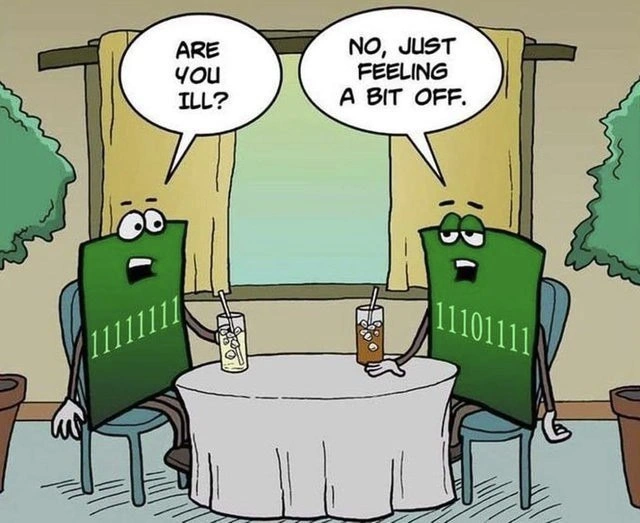
Imagine you have a row of 8 little lamps that can either be on or off. Normally all 8 lamps are turned on, shining bright – that’s like the left chip, who’s completely healthy with all its little switches on. But today, one of the lamps is off on the right-side friend. The pattern of lights isn’t perfect anymore; there’s a tiny dark spot. The left friend notices and asks, “Are you sick?” The right one, looking a bit droopy, replies, “No, I just feel a bit off.”

In everyday language, if someone says they feel “a bit off,” they mean they’re not feeling quite right. The joke here is that for these computer-chip buddies, one of the tiny switches in the right-hand chip’s body is turned off when it should be on. It’s as if one Christmas light in a string went out, making the whole string look a little dim. So the poor chip feels a little off his game because one of his eight “life lights” isn’t shining. This play on words makes us giggle because even a small thing like one lamp (or one binary bit) being out of place can make the whole picture seem odd. Just like you’d notice if one sock is inside out or one puzzle piece is wrong in a puzzle, the left chip notices his friend isn’t fully lit and checks on him. The meme makes us smile because it turns a geeky idea (one tiny bit of data being wrong) into a simple, silly scene of a friend feeling slightly under the weather when a little part of him isn’t working.

Level 2: Bit Flip Basics

Let’s break down the scene and concepts for newer developers or the curious:

  • Bit and Byte: A bit is the smallest unit of information in computing, representing a binary value of either 0 or 1 (off or on, false or true). Eight bits together make a byte, which is a common chunk of data (enough to encode one ASCII character or a small number). In the cartoon, the two green characters are like living bytes – each displaying eight binary digits on their body.

  • Binary Values (255 vs 239): The left chip’s binary 11111111 corresponds to the maximum 8-bit value 255 in decimal (all bits are 1s). The right chip’s binary 11101111 is 239 in decimal. It’s just a little smaller because one of the middle bits is 0 instead of 1. In fact, if we compare them bit by bit, they differ in exactly one position:

    11111111  
    11101111  
       ^  
    

    The caret (^) above points to the flipped bit (changed from 1 to 0). That one tiny change (it happens to represent a difference of 16 in value) makes the whole byte slightly different. It’s similar to how changing one letter in a word can make the word look or sound wrong.

  • Bit Flip Error: A bit flip is when a single bit unintentionally changes state (from 0 to 1 or vice versa). This might happen due to hardware issues like electrical interference, a random cosmic ray (yes, cosmic energy can sometimes flip a memory bit!), or a software bug that writes a wrong value. Even though a one-bit change is small, it can corrupt data – for example, turning a valid piece of information into something gibberish or incorrect. Developers take these seriously because one tiny binary change can break an algorithm or produce a wrong result, especially in low-level software where data isn’t double-checked.

  • Error Detection (Parity): Because a single-bit error can cause mischief, computers have simple safeguards. One classic method is a parity check. Imagine adding an extra bit to every byte that doesn’t carry data but instead says “I’m 0 if the number of 1s in this byte is even, or 1 if it’s odd.” This way, if one bit flips, the count of 1s will change from even to odd or vice versa, and the parity bit won’t match the expected value anymore. It’s like a built-in alarm that says “something’s wrong!” In the cartoon, the left chip asking “Are you ill?” mimics that alarm — as if it noticed the other chip’s pattern of bits isn’t what it’s supposed to be. More advanced systems use stronger error detection and correction (like Hamming codes or CRC checksums), but parity is the basic idea in its simplest form.

  • Hamming Distance: This term denotes how many positions two binary sequences differ in. If two bytes differ in only one bit, their Hamming distance is 1 (as with 11111111 vs 11101111). If they differed in two bits, the distance would be 2, and so on. Engineers use this concept when designing error-correcting codes: you want valid data patterns to be far apart in terms of Hamming distance. That way, if a bit (or even multiple bits) accidentally flip, it’s easier to detect that something changed, or even reconstruct the original data. For instance, a simple parity scheme can detect any single-bit error because flipping one bit creates a Hamming distance-1 change that the parity check notices. More complex codes with larger minimum Hamming distances can not only detect but also correct one-bit errors by figuring out which bit must have flipped.

  • Off-by-One Error vs “Bit Off”: An off-by-one error in programming is a very common bug where a loop or index is off by one. For example, you meant to loop 10 times but accidentally loop 9 or 11 times, or you miscalculate an array’s last index by 1. It’s a small counting mistake that can cause big problems (like missing an item or going out of bounds). The meme’s joke phrase “a bit off” sounds similar, but here it’s literally about a bit being off (set to 0 when it should be 1). Both ideas play on being just one small step away from correct. It’s funny to us because such a tiny difference – whether it’s one index in code or one binary digit in data – can throw things off kilter.

  • Relatable Scenario: Even if you’re new to low-level programming, you might have encountered a situation where a tiny mistake had noticeable effects. Maybe you had a piece of text where one character was wrong, making the whole sentence read oddly. Or you wrote some code and forgot a minor detail, causing a bug that was hard to find. A single-bit error is the binary-level equivalent: everything can be perfect except one little 0/1, and that makes the output wrong or the program act strange. The meme exaggerates this with the idea of the byte “feeling sick” because one bit flipped. We imagine the data itself as a character who knows something is not quite right internally – a cute way to personify a bug.

In summary, the picture shows a clever binary pun: one memory chip has all its bits = 1 (a healthy, full-value byte), and the other has a one-bit error. “Feeling a bit off” is a play on words – at once meaning he feels slightly unwell and literally that one of his bits is off (0). It’s a lighthearted illustration of a core concept in computer science: small binary differences can have noticeable effects, and we have to account for them to keep data correct.

Level 3: One Bit Short

For seasoned developers, this comic triggers knowing chuckles and maybe a few war stories. It highlights how one tiny bit flip can lead to disproportionate headaches in real systems. The anthropomorphic chips are essentially bytes personified, and a single-bit error has left one of them with a slightly “corrupted” value. Anyone who’s debugged gnarly memory corruption issues knows the horror: a single stray bit or a one-bit mis-set flag can cause data to be off in subtle ways – just as the right-hand chip’s value 0xEF is almost correct but not quite the 0xFF it should be.

In practice, single-bit errors are rare but insidious. Imagine a scenario where a configuration file has one wrong bit: maybe a true (1) changed to false (0) in a boolean flag, or a bit in a pointer address flipped – suddenly the program behaves bizarrely. These “bit flip bugs” can be nightmare to diagnose because they aren’t systematic logic errors; they’re often transient hardware faults or side-effects of other issues (like writing past an array boundary and flipping an adjacent value’s bit). Many a senior engineer has a tale of chasing a heisenbug that turned out to be caused by something as absurd as a cosmic ray flipping a single bit in memory. It’s the kind of bug where you ruefully say, “It was literally a bit off,” once you finally catch it.

The meme’s dialogue also nods to the classic off-by-one error. While an off-by-one error usually refers to a programmer mistakenly iterating one time too many or too few (like indexing beyond an array by 1), the spirit is similar: being off by one (whether one index or one bit) can throw the whole system out of whack. Here, the byte on the right is essentially one bit short of a full byte – geeks sometimes joke that a person who’s acting odd is “one bit short of a byte,” meaning not all there. In this case it’s literally true: the chip is missing one bit compared to the full 0xFF, and he plays it off as feeling a little under the weather.

In a real development environment, we have safeguards for this kind of subtle corruption. For example, data transmissions include checksums or CRCs (cyclic redundancy checks) which can detect if a single bit (or even a few bits) got flipped in transit. Memory modules in serious servers use ECC so that if one bit spontaneously changes, the hardware corrects it on the fly and logs a warning (so the system doesn’t just silently use bad data). But not every system has these protections – your average laptop RAM or a non-critical IoT gadget might experience a rogue bit flip and have no idea it happened. The result? Possibly nothing noticeable... or maybe some weird glitch that leaves you scratching your head.

The humor here is that developers personify and empathize with these bytes. We’ve all had days where we feel “off” and can’t quite function 100%. Similarly, we’ve seen perfectly good programs act strangely because of one tiny error. The left chip asking “Are you ill?” is exactly how an alert system or a vigilant code review might catch an obvious anomaly (“uh oh, something’s not right with this data; it fails a parity check!”). The right chip saying “No, just feeling a bit off” captures that classic underplaying of a problem – like when a server reports a minor error that belies the fact that some data just got mangled. It’s a tongue-in-cheek reassurance that “hey, it’s only a bit that’s off, no biggie,” even though we know that even a one-bit bug can sometimes lead to big problems.

Ultimately, the meme resonates with experienced devs because it’s a perfect geeky pun: it mixes the binary literal truth (one bit is set to 0 instead of 1) with the everyday idiom “a bit off” meaning slightly not right. It’s a reminder that in low-level programming and computer hardware, tiny details matter – sometimes that one missing bit is the difference between a smooth run and a frustrating bug hunt. And after you’ve been through a few all-night debugging sessions caused by something as small as a flipped bit, you learn to both respect the seriousness of data integrity and laugh at the absurdity of it.

Level 4: Hamming Distance One

At the deepest technical level, this meme alludes to error-correcting codes and fundamental data integrity concepts. The two binary strings on the characters – 11111111 and 11101111 – differ by exactly one bit. In coding theory, the number of bit positions in which two codewords differ is called the Hamming distance. Here the Hamming distance is 1, meaning a one-bit error has transformed the left chip’s value into the right chip’s value. This seemingly trivial alteration (changing a single 1 to a 0) can carry serious implications in computing: a one-bit flip can turn the number 255 (0xFF in hex) into 239 (0xEF), altering the data’s meaning entirely.

Real-world computer systems guard against such single-bit errors using parity bits and more advanced error-correcting codes like Hamming codes and ECC (Error-Correcting Code) memory. A parity bit is an extra bit added to a byte (or larger word) that indicates whether the total number of 1s in the data is even or odd. If one bit flips during storage or transmission, the parity (even vs odd count of 1s) will no longer match, signaling that the data is corrupted. In our cartoon, the left chip asking “Are you ill?” humorously echoes a parity check flagging an anomaly – it’s as if the left chip’s internal error-check noticed the other chip’s bits don’t add up as expected.

However, simple parity can only detect an error, not fix it. That’s where Hamming codes come in. Richard Hamming’s pioneering work in the late 1940s introduced algorithms that not only detect but also automatically correct single-bit errors by carefully arranging data and check bits. These codes ensure that any two valid data + check-bit patterns have a Hamming distance of at least 3. So if a single bit error (Hamming distance 1) occurs, the system can pinpoint which bit went bad (since the erroneous pattern is still closer to the original than to any other valid pattern) and flip it back. This forms the basis of modern ECC memory in servers and spacecraft: if one memory bit randomly flips due to cosmic radiation or hardware glitches, the system can heal itself by correcting that bit, preventing the whole “byte” (or larger data word) from feeling “off.”

Cosmic rays flipping bits might sound like science fiction, but it’s a well-documented phenomenon known as a single-event upset (SEU). In space electronics and even high-altitude flights, energetic particles can sporadically invert a bit in memory. On Earth, background radiation can do it too, albeit rarely – but in billions of gigabytes of RAM across the world, “rarely” still means it happens. That’s why ECC memory is prevalent in mission-critical systems: a flipped bit in a user’s gaming PC might cause a subtle graphics glitch or a crash, but a flipped bit in a bank’s transaction record or an aircraft’s control system is unacceptable. Error-correcting codes shield us from these one-bit gremlins. In fact, the mere one-bit difference highlighted in the meme is precisely the kind of error ECC is designed to handle gracefully.

The humor of the meme comes from applying these serious low-level concepts to two personified memory chips chatting over drinks. The phrase “feeling a bit off” is a pun rooted in this theory: in everyday language it means feeling slightly unwell, but in technical terms a “bit off” describes a binary digit turned from its correct state. Behind this lighthearted joke lies the elegant principle that computing is a world of absolute precision – even a single bit’s deviation, a Hamming distance of 1, can make all the difference. The meme gives a nod to the brilliant yet invisible machinery of error detection and correction that keeps our digital lives on track, one bit flip away from chaos.

Description

This is a single-panel cartoon depicting two anthropomorphic, rectangular green computer chips sitting at a round table with drinks. The chip on the left looks concerned, with wide eyes, and asks in a speech bubble, 'ARE YOU ILL?'. On its body is the binary number '11111111'. The chip on the right appears tired and unwell, with droopy eyelids, and replies, 'NO, JUST FEELING A BIT OFF.' This chip has the binary number '11101111' on its body. The humor is a clever pun that plays on the double meaning of 'a bit off.' While it's a common phrase for feeling unwell, in the context of computing, the second chip literally has one 'bit' flipped from a 1 to a 0 compared to its healthy companion. This is a visual representation of a single-bit error, a fundamental concept in hardware and low-level computing where data gets corrupted, making the joke particularly resonant for hardware engineers, systems programmers, and anyone familiar with data integrity issues

Comments

12
Anonymous ★ Top Pick That's what you get for not using ECC memory. One stray cosmic ray and suddenly your byte is having an existential crisis
  1. Anonymous ★ Top Pick

    That's what you get for not using ECC memory. One stray cosmic ray and suddenly your byte is having an existential crisis

  2. Anonymous

    Prod lesson of the week: a single cosmic-ray bit flip turned our 0xFF “all features ON” flag into 0xEF - nothing like discovering half the platform is A/B testing entropy

  3. Anonymous

    When you've spent 20 years debugging production issues, you realize the real cosmic ray bit flip was the friends we corrupted along the way

  4. Anonymous

    This is the kind of bug that makes you appreciate ECC memory - when a single flipped bit can turn a perfectly healthy process into one that's 'feeling a bit off.' In production, this would be the moment before your monitoring alerts start screaming about data integrity issues, but at least the chip has the self-awareness to recognize something's wrong. Unlike that time we spent three days debugging a Heisenbug that turned out to be a cosmic ray flipping a bit in DRAM at 35,000 feet

  5. Anonymous

    Reminder: the Hamming distance between “works” and “postmortem” is one bit - pay for ECC

  6. Anonymous

    A single bit off: the gap between 0xFF and 0x7F - and between “auth required” and “public S3 bucket,” while the health check cheerfully returns 200

  7. Anonymous

    Classic bit flip: turns all-ones health into 'a bit off' - no ECC, no mercy from cosmic rays

  8. Deleted Account 5y

    oh no the parity is wrong

  9. @Dobreposhka 5y

    oh, memes from Azer

    1. @slnt_opp 5y

      Think they spread pretty well over TG

  10. @KP2020 5y

    If it had a bit off it will be 00010000

  11. @azizhakberdiev 5y

    Conversation between 1000...00 and 000...000 in ieee 754: Yes, we are different, but we are the same

Use J and K for navigation