The Network Administrator's Cable Hammock
Why is this Networking meme funny?
Level 1: Sleep Anywhere
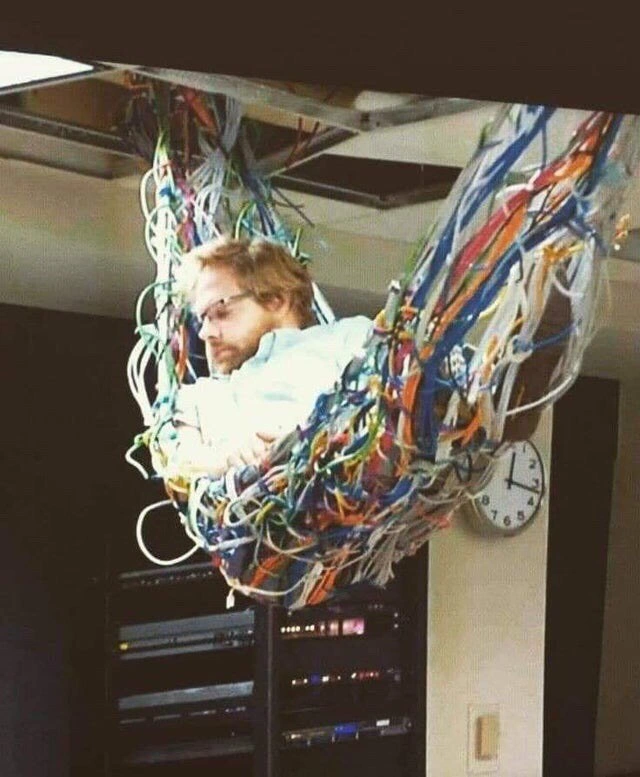
Imagine you stayed up all night fixing your toys or doing a big project, and you got so tired that you fell asleep right in the middle of your mess. That’s basically what’s going on in this picture – except the “toys” are a bunch of long computer wires, and the person is an IT worker who fixes computers and networks. He was working so late that he decided to take a nap right there using the pile of wires like a hammock bed!
Have you seen a hammock before? It’s like a comfy net or cloth that you tie between two trees or poles and lie in to relax. In this case, the man made a hammock out of wires hanging from the ceiling. It looks really silly, right? There are dozens of colorful cables all tangled together, and he’s lying on them as if it’s the most normal thing. He’s up near the ceiling because those wires come through a space above the room (usually ceilings in offices have a little empty space where wires and pipes go). He even moved a ceiling tile out of the way to climb into his new “wire bed.”
The funny part is that nobody would ever think wires make a good bed – they’re usually hard and thin and all over the place like cooked spaghetti. But when you’re super tired, you might feel like “I could sleep anywhere, I don’t care!” This IT guy must have been that tired. Maybe he was working all night to make sure the company’s network or website kept running. By 4 AM (really early in the morning), he probably just couldn’t keep his eyes open. So, he got creative and said, “Well, these cables are here... maybe I can just lie on them for a few minutes.” It’s a goofy example of being too tired to be picky about where you sleep.
This picture makes people laugh because it’s so absurd – it’s like something from a cartoon, using a bunch of wires as a resting spot. It also makes folks who work in IT nod their heads, because it captures a truth: those jobs can be exhausting, and people sometimes end up sleeping at work or in weird places. It’s a mix of “Haha, that’s so ridiculous!” and “Aww, I hope he gets a real bed soon.” The message “Wish you rest properly on these weekends!” basically means, “Hopefully you can sleep in a normal bed this weekend instead of resorting to a crazy wire hammock!”
In simple terms: the man in the photo is so worn out from a long night of work that he made a bed out of messy cables. It’s funny and a little sad at the same time. But mostly, it shows that when you’re extremely tired, you can fall asleep anywhere – even on a bundle of tangled wires hanging from the ceiling!
Level 2: Cable Management 101
Let’s break down what’s happening here in simpler terms. We’re looking at a small server room or network closet where a ton of network cables are hanging down from an open ceiling. Those cables – the colorful blue, yellow, orange, and green wires – are most likely Ethernet patch cables. In a normal setup, these connect servers and networking gear (like switches and routers) to each other through a structured layout. Typically, cables run up through the ceiling or under the floor, all nicely bundled and labeled, and terminate into a patch panel or directly into the equipment. Good cable management means keeping those wires tidy: you use cable ties or Velcro straps, route cables along proper paths, and avoid having excess slack dangling around. It’s important for both troubleshooting (so you know which cable is which) and safety (no tripping, no accidentally unplugging things).
Now, what we see in the photo is the opposite of tidy: it’s often jokingly called “cable spaghetti.” Just like a bowl of spaghetti noodles, these cables are tangled every which way. This happens in real life when many cables accumulate and nobody has time to organize them properly. Each time someone added a new connection or fixed something quickly, they might have just run a new cable through the ceiling and left the old ones as-is. Over months or years, you end up with a chaotic bundle of old and new cables twisted together – a nightmare for any organized tech person. It’s both funny and cringe-inducing for IT folks because it means if something goes wrong or a cable fails, finding the right one amid that mess is going to be a huge headache. (Imagine trying to pull one specific noodle from a spaghetti bowl without moving the others!)
In the image, a sysadmin (system administrator – basically an IT professional who keeps servers and networks running) is literally lying in those cables as if they were a hammock. A hammock is usually a fabric or net bed hung between two points. Here the “net” is made of network cables strung across the open ceiling. The ceiling itself has removable tiles (common in offices and server rooms) so you can run cables or access pipes and wires above. Someone has removed a tile, revealing that hidden cable jungle. The sysadmin has somehow climbed up and is using the slack of all those cables to support his body weight. His arms are folded and he’s reclining, so he’s definitely posing or taking a real quick nap in there. (Hopefully it’s just a staged funny photo and not an actual exhausted person, but given IT culture it could be a bit of both!)
Why would anyone do this? The clock on the wall reads around 4:15 (likely in the morning). In IT, a lot of major work – like upgrading network equipment or doing maintenance – is scheduled during off-hours (late night, early morning, weekends). That’s because you don’t want to knock people offline during the workday. So sysadmins often have to work overnight when everyone else is asleep. It looks like this guy had an all-nighter working on the network (the clue is “networking all-nighter” in the title). By the wee hours, he’s extremely tired. There’s no bed in a server room, and maybe not even a chair up there, so he improvised with what he had: a ton of cables that kind of resemble a net. It’s a tongue-in-cheek demonstration of how SysadminLife sometimes means sleeping at work in the strangest places.
This image is popular in SysadminHumor circles because it highlights two things at once: the chaotic state of the infrastructure (all those unruly cables) and the tough working conditions (overnight hours leading to exhaustion). People in IT share pictures like this to laugh, but also to say “yeah… been there.” The comment “Wish you rest properly on these weekends!” suggests that instead of doing crazy overnight work and ending up napping in cables, we hope our hardworking admins get a real rest on the weekend. It’s a light-hearted poke at a serious reality: maintaining servers and networks is not a 9-to-5 job, and sometimes the infrastructure isn’t just hard to manage – it’s literally uncomfortable.
A few terms for clarity:
- Networking – This refers to connecting computers and devices so they can communicate (share data). It often involves hardware like switches/routers and lots of cables if wired, or signals if wireless. Here it’s obviously a wired network scenario.
- Infrastructure – In IT, this means the foundational hardware, software, and facilities that support an organization’s technology. Cables, servers, racks, power supply – all that is infrastructure.
- Cable Management – The practice of organizing and labeling cables so that everything is neat and easy to service. There are even rack accessories and cable trays to help with this. When you ignore cable management, you get what’s in the picture: confusion and clutter, aka “cable spaghetti.”
- Occupational hazard – A risk or drawback that comes with a job. In context, jokingly, having to sleep in weird places or dealing with cable messes are “occupational hazards” for sysadmins. (Usually that term is used for things like construction or medical jobs, but IT has its own quirky hazards – like tripping over cables or pulling an all-nighter in a freezing server room.)
In short, this meme shows a tech person who was so tired from working on the network all night that he turned a chaotic tangle of network cables into a makeshift bed. It’s funny in a goofy way, but it’s also a little piece of a story about the hard work that happens behind the scenes to keep our digital world running – messy cables and all.
Level 3: Cradled by Cable Chaos
Every seasoned sysadmin who sees this image will likely cringe and chuckle at the same time. It’s the ultimate ServerRoomStories snapshot: an exhausted admin literally cradled by the very cable spaghetti that’s been driving them crazy. The humor hits home because it’s a hyperbolic reflection of reality. In the real world, cable management often falls prey to deadline pressure and “just-get-it-working” urgencies. Over years, what starts as a few tidy Ethernet runs can become a multicolored rat’s nest hanging from racks and ceiling voids. We all swear we’ll tidy up “next time,” but next time rarely comes. Technical debt isn’t just in code – it lives in infrastructure too. Here, that physical tech debt has accumulated into a veritable hammock.
The scene tells a whole story. It’s around 4:15 AM (judging by the wall clock), deep into an overnight maintenance window. Perhaps this sysadmin spent the night swapping switches, tracing cables, or fighting an outage. The blinking LEDs on the racks below suggest live equipment – maybe a core router or switch that just got configured at ungodly hours. By this point, he’s dead tired. And in a locked building at 4 AM, you don’t exactly have a plush couch handy. So what’s a resourceful (or delirious) sysadmin to do? Improvise. Pop open a ceiling tile, notice the absurd abundance of slack in the cabling, and think “that looks like a hammock… I could totally lie in that.” It’s the kind of slap-happy decision you make after too much coffee and too little sleep. SysadminHumor often involves this sort of MacGyver moment – using whatever’s on hand to solve a problem or catch a break. In this case, the cabling chaos became a bed.
Why is this so funny (and a tad painful)? Because it’s relatable. Not that most of us have actually napped in a ceiling, but we’ve all hit that exhaustion point during a long deployment or outage where even the harsh carpet of the server room starts looking comfy. Many IT veterans have stories of sleeping under a desk, atop a rack (dangerous but happens), or curled up with a jacket on a data center floor. This image just takes it up a notch: sleeping in the network itself. It’s a perfect metaphor for SysadminLife – being so entwined in your work that you quite literally entangle yourself in it. There’s a saying that the only time users notice the sysadmin is when things go wrong. Well, here things might have gone so wrong (or so prolonged) that the sysadmin became part of the infrastructure overnight!
From an infrastructure perspective, this also highlights the dark side of CableManagement neglect. That dense weave of cables didn’t happen in one night. It’s the result of many quick fixes and “temporary” solutions layered over time. Perhaps every new server or switch install meant running a fresh patch cord because nobody dared untangle the old ones. Eventually, you get this decorative spaghetti nightmare hanging out of the ceiling. (Hey, at least it’s colorful – a full rainbow of poor planning.) The fact it can support a person’s weight hints that there’s way too much excess cabling up there, likely coiled and knotted instead of neatly routed on a tray. It’s a comedy of compounding errors. And of course, touching it now is perilous: disturb this rats’ nest and you risk unplugging something critical accidentally. You can bet that even breathing on such a setup might cause the network to hiccup. So ironically, the smart move (in a very unsmart environment) is to not touch the wires. The sysadmin found a use for them without re-routing a single cable: a nap time hammock that doesn’t break anything (hopefully!).
The meme caption wryly says, “Wish you rest properly on these weekends!” That’s a nod to how sysadmins often spend weekends or late nights doing maintenance, then try to recover from the sleep deprivation. Proper rest is a luxury in crunch time. Sometimes, as shown here, you take what you can get – even if it means a 20-minute catnap (or should we say a Cat5 nap?) suspended above the server racks. It’s a bittersweet image: hilarious in its absurdity, but also a tiny bit sad knowing that someone really was that tired on the job. The shared understanding among IT folks is clear: been there, done that (though maybe not exactly this). The next time someone jokes about “network spaghetti,” this picture is the ultimate literal punchline. It’s a reminder that behind the stable internet connections and internal tools we take for granted, there are humans in chilly server rooms at 4 AM, fighting chaos with caffeine – and occasionally embracing the chaos as a place to crash for a moment.
(Pro tip: If you ever feel like making a cable hammock, maybe take it as a sign to schedule a cable cleanup project… and get some rest.)
Level 4: Cat5 Chaos Theory
At the Physical Layer of networking (OSI Layer 1), everything boils down to signals traveling over actual wires. Under ideal conditions, those wires are meticulously organized into structured pathways. But in practice, entropy reigns: given enough time (and enough urgent fixes), network cabling tends toward maximum disorder. This meme is a perfect case study in cable entropy. The ceiling is spilling over with a tangled mass of twisted-pair Ethernet cables (likely Cat5e/Cat6). Each of those cables consists of twisted wire pairs designed to reduce electromagnetic interference and crosstalk – a bit of elegant physics that keeps our data transmissions clean. Yet, no amount of twist engineering can save you from the chaos of cable spaghetti. Over years of neglect (or frantic patch-work), what was once a neat bundle obeying TIA/EIA-568 structured cabling standards can devolve into a snarled web.
From a theoretical standpoint, you can liken this mess to problems in knot theory or graph complexity. Untangling such a cable knot might not literally require solving NP-hard problems, but in the moment it feels like trying to invert a cryptographic hash by hand. Each cable is like an edge in a graph of connectivity, crossing over others unpredictably. With hundreds of cables, the possible tangle configurations explode combinatorially – a sort of chaos theory for cable management. In fact, physicists have studied how any long string tends to knot itself given random motion; a server room undergoing constant minor changes is basically a random string agitator. The result? A cable hammock that could practically hold a human.
Speaking of which, the poor soul lounging up there is performing an unsanctioned stress test on both cabling and gravity. Ethernet cables and RJ45 connectors aren’t rated for human loads – they have specific bend radii and tensile limits to preserve signal integrity. By draping himself in the cables, the sysadmin is inadvertently testing the durability of the network’s physical infrastructure. It’s a darkly humorous inversion of roles: normally the sysadmin supports the network, but here the network literally supports the sysadmin. If this were an academic exercise, we’d note how excessive cable slack and lack of strain relief can turn a neatly engineered network topology into a makeshift suspension bridge. Every patch cord in that hammock is sharing the load (unevenly, no doubt), turning the cable bundle into a distributed hammock system – arguably the least efficient use of a high-speed network.
There's also irony in how “spaghetti cabling” mirrors spaghetti code in software: both arise from iterative quick fixes piled on over time without refactoring. In software, spaghetti code defies logical structure; in hardware, spaghetti cabling defies physical order. The fundamental lesson from this Level 4 view is that complex systems naturally drift into chaos without continuous discipline – whether it’s network wires or code modules. This meme takes that concept to an absurd extreme: the cabling chaos has become so advanced that it’s now a structural feature (a hammock), not just a bug. In theory, good engineering practices and regular maintenance should prevent such nightmares. But as systems grow, the second law of thermodynamics might as well apply to server rooms: energy (effort) must be expended to maintain order, or the system will slide into disorder. Here, clearly, order lost the battle. The result is equal parts hilarious and horrifying to any network engineer: a Cat5 cat’s cradle that embodies chaotic comfort after an all-nighter.
Description
A classic, grainy photograph from inside a server room or data center showing a man with glasses and light brown hair peacefully sleeping. He is curled up inside a makeshift hammock that is impressively, and chaotically, woven from a massive spaghetti-like tangle of multi-colored ethernet cables (blue, yellow, orange, white, and grey). The cable hammock hangs down from an open section of a drop ceiling. Below the sleeping man are black server racks filled with networking equipment. To the right, on a beige wall, a simple analog clock is visible. The image is a powerful and humorous visual metaphor for the life of a systems or network administrator. It simultaneously mocks terrible cable management ('cable gore') while also celebrating the ingenuity and exhaustion of IT professionals who spend long hours maintaining critical infrastructure, finding rest and comfort wherever they can, literally cradled by the very systems they manage
Comments
7Comment deleted
This isn't technical debt; it's structural debt. He's not sleeping on the job, he's load testing the patch panel's tensile strength
After the 4 AM change window, I finally embraced a single point of failure: a Layer-1 hammock woven from all the “temporary” patch cables - certified for 10 Gbps straight into REM
After 15 years of preaching about proper cable management and DCIM best practices, you realize the real CAP theorem is: Cables, Accessibility, and Patience - you can only have two, and usually you're left with just the cables while suspended above a hot aisle wondering if kubernetes was invented just to avoid physical infrastructure altogether
This is what happens when your infrastructure follows the same architectural pattern as your legacy codebase: 15 years of 'temporary' solutions, zero documentation, and everyone's too afraid to touch anything because nobody knows which cable keeps the production database alive. The person in this image is the senior engineer who finally volunteered to 'just trace one connection' - last seen three sprints ago
Spaghetti code has nothing on spaghetti infrastructure - at least this debt bears your weight
When “structured cabling” means the SRE can nap in it - every swing triggers a link flap, STP reconverges, and the NOC calls it load testing
If the patch cables can hold a person, the network's spaghetti layer has become load-bearing technical debt - update the architecture diagram and the risk register accordingly