DigitalOcean Enters the Managed Kubernetes Arena
Why is this Containerization meme funny?
Level 1: No Assembly Required
Imagine you have a really complicated Lego set – let’s say a giant spaceship with thousands of tiny pieces. You’re excited to have a cool spaceship, but when you open the box and see the huge instruction book and all those pieces, you feel overwhelmed. Kubernetes is kind of like that giant Lego spaceship kit for running apps: super powerful and cool, but also really complicated to put together correctly. Now, what DigitalOcean is offering with DOKS is like having a master builder friend who says, “Hey, I’ve built the hard part of the spaceship for you! It’s mostly done – you can just do the fun part of adding your own little tweaks and then start playing with it.” In other words, instead of you spending hours or days trying to assemble this complex thing by yourself, they hand it to you mostly assembled, so you can enjoy it right away.
It’s similar to if you wanted a fancy cake for your birthday. You could try to bake it yourself following a complex recipe with lots of steps (which is hard and might not turn out well if you’re not experienced). Or you could just go to a bakery and get a beautiful cake. DigitalOcean’s managed Kubernetes service is like the bakery: they deliver you the finished cake (the working Kubernetes cluster) so you don’t have to worry about the baking process (all the setup and technical details). You can just start decorating the cake or, even better, eating it.
The funny part of this situation – and why developers shared that email with a wink – is that everyone was talking about Kubernetes (the cool spaceship) but also whispering, “yeah, it’s a pain to build it.” DigitalOcean basically said, “We know it’s a pain, so let us build it for you.” For developers, that feels a bit like a lifesaver. It’s both a relief (“Phew, I don’t have to figure all that out alone!”) and a little ironic because this super modern technology (which was supposed to make life easier) ended up so complicated that we needed another service to simplify it again.
But at the simplest level: this is about making a hard thing easy so you can focus on what you actually want to do. It’s like getting a toy that says “No assembly required” on the box – you can start playing with it immediately instead of spending all day setting it up. That’s what DigitalOcean is promising for Kubernetes: just click the “Get Started” button, and in a short time, you’ll have what you need, without the usual frustration. And that idea – turning a long, difficult task into a quick and easy one – is something anyone can smile about. You get the fun without the tedious work, which is why this caught people’s attention and brought out some grins in the developer community.
Level 2: One-Click Kubernetes
Let’s break down what this DigitalOcean Kubernetes (DOKS) email is saying in simpler terms, and why it matters to developers (especially those newer to Kubernetes or container orchestration in general). Kubernetes, often abbreviated as “K8s” (because there are 8 letters between the “K” and the “s”), is a system that helps run and manage containers across many machines. Containers are like lightweight mini-computers (or packages) that bundle an app with everything it needs to run. Kubernetes is super powerful: it can deploy many copies of your app, move them around if a machine fails, and help them talk to each other. But it’s also notorious for having a steep learning curve and a lot of moving parts. Think of Kubernetes as a very sophisticated traffic control system for your apps – it can direct and redirect traffic expertly, but only if you set up the control system correctly in the first place.
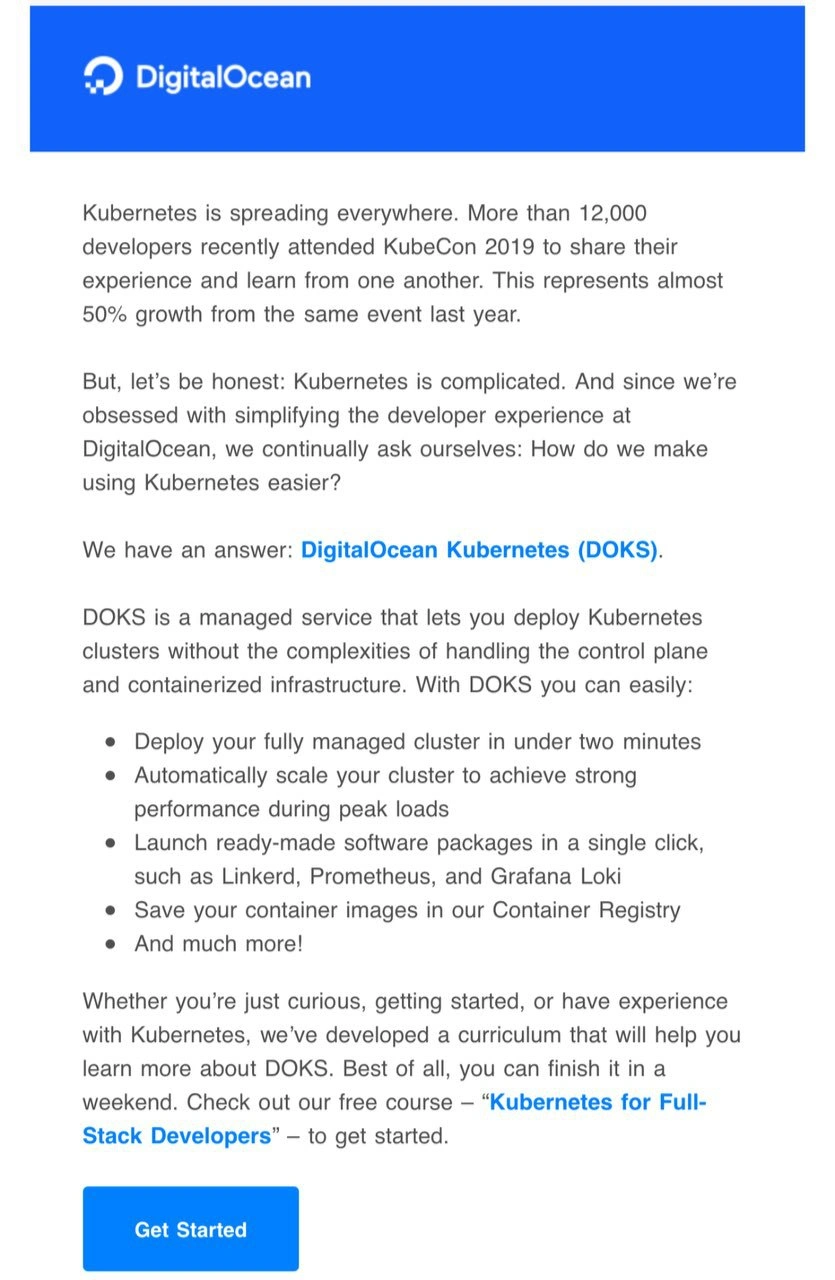
DigitalOcean’s email starts by hyping how widespread Kubernetes has become (“spreading everywhere” with thousands attending KubeCon 2019, a big conference for Kubernetes enthusiasts). This sets the stage: lots of developers are interested in Kubernetes. Then, they candidly admit “Kubernetes is complicated.” For a newbie or junior dev, this line might actually be comforting – even the cloud provider says it’s not just you, K8s can be hard! Running Kubernetes yourself normally means you have to configure a cluster: that’s a group of servers (or virtual machines) that act together. You’d have to set up a control plane (which are like the master servers coordinating everything), install Kubernetes components on them, secure them, and then add worker nodes where your actual apps (in containers) run. It involves dealing with command-line tools, configuration files (often large YAML files which are infamously finicky), networking details (so all your containers can communicate), and so on. It’s a bit like configuring an entire data center’s worth of software by hand.
Now DigitalOcean Kubernetes (DOKS) is introduced as an answer: it’s a managed Kubernetes service. “Managed” is the key word here. That means DigitalOcean is offering to do the hard behind-the-scenes setup and maintenance for you. With DOKS, you don’t have to install or manage the Kubernetes control plane yourself. DigitalOcean runs those master components – the Kubernetes API servers, the etcd database that store cluster state, the scheduler that decides who runs what – all that is handled by them. You get to use Kubernetes without seeing its internal plumbing. In practical terms, using DOKS might be as simple as clicking a “Create Cluster” button on the DigitalOcean web dashboard or running a single doctl command (DigitalOcean’s command-line tool). According to the email, you can “deploy your fully managed cluster in under two minutes.” That implies they’ve automated the setup so well that from the moment you say “go,” it only takes a couple minutes for a fresh Kubernetes cluster to be ready for you. (Behind the scenes, DigitalOcean’s systems are quickly allocating some Virtual Machines – known as Droplets in DO’s terminology – installing Kubernetes on them, and handing you access. They likely have a stock image or snapshot to speed this up, so it’s not literally doing everything from scratch in those two minutes, but the user experience feels instantaneous.)
So what does DOKS let you easily do? The bullet points give a snapshot:
Deploy a fully managed cluster quickly – We’ve covered this: speed and ease instead of manual setup that could take hours if you’re doing it yourself the first time.
Automatically scale your cluster during peak loads – This refers to autoscaling. Imagine your web application gets a sudden surge of users (say your online store has a Black Friday sale). Autoscaling means the system will notice the increased load and can automatically add more power: in Kubernetes terms, it could add more containers of your app or even add more server nodes to the cluster to handle the traffic. Without autoscaling, you’d have to manually add those and it might be too late or too slow. DigitalOcean’s service promises to handle that scaling for you. For a new developer, this means you’re less likely to have your app crash just because you didn’t anticipate a spike in usage – the platform has your back (to an extent).
One-click launch of software packages like Linkerd, Prometheus, and Grafana Loki – These are popular tools in the Kubernetes ecosystem.
- Linkerd is what’s called a service mesh. It helps manage and monitor network communication between parts of your application (especially if your app is broken into microservices). It can add features like encryption, retries, and telemetry without you having to build those into each app.
- Prometheus is a monitoring system. It collects metrics (numbers that tell you how your app and servers are doing, like CPU usage, requests per second, error rates) from your containers and nodes.
- Grafana Loki is a log aggregation system – basically a tool to collect and index logs (text output from applications) from all your containers so you can search and analyze them in one place. It’s part of the Grafana suite (Grafana mostly does dashboards for metrics, Loki does logs).
Normally, setting each of these up on Kubernetes could be a project of its own. Each has its own installation steps, configurations, and gotchas. The fact that DigitalOcean offers them in “one click” suggests they integrated these tools probably via something like Operator or Helm charts. For a junior dev, the takeaway is: you can get advanced monitoring, logging, and networking tools working on your cluster without being an expert in each one. It’s like having a toolbox of best practices readily available.
Save your container images in our Container Registry – When you deploy to Kubernetes, you need to have your application packaged into a container image (like a Docker image). A Container Registry is a storage for those images (Docker Hub is a famous public one, for example). DigitalOcean saying “our Container Registry” means they also are providing a place for you to keep your container images, likely tightly integrated so that your DOKS cluster can pull images from there quickly and securely. This is about convenience: you don’t have to use a third-party registry or worry about network issues pulling images – hosting it in the same cloud can make things simpler and possibly faster.
And much more! – Classic marketing speak to imply there are other features (maybe things like built-in security, easy upgrades for Kubernetes versions, integration with DigitalOcean’s storage or load balancers, etc.) without listing every single one.
The email then addresses everyone, from the curious to the experienced, and mentions a curriculum: “Kubernetes for Full-Stack Developers” (a free course). This indicates DigitalOcean recognizes a lot of devs might be starting to learn Kubernetes. They’re providing educational material, which doubles as a way to get you comfortable with their platform. For a junior dev, it’s an invite: “Even if you don’t know Kubernetes, we have resources to get you started (and by the end of the weekend, you might even have your first cluster running on DOKS!).” The message is that Kubernetes doesn’t have to be scary or only for specialists; DigitalOcean wants to democratize it to the average developer.
In simpler terms, DigitalOcean is saying: “We know you keep hearing about Kubernetes and how it’s taking over the world, but also that it’s really complex. We’ve built a service to take away that complexity. Click here, and we’ll give you a Kubernetes cluster that just works, plus tools that help run it well. You won’t have to worry about the gritty details like control plane setup, etcd databases, or manual scaling. And if you’re not sure how to even use Kubernetes, we’ve got a beginner-friendly course for you.”
From a developer’s point of view, especially if you’re early in your career or new to cloud stuff, this is appealing. It’s like being handed the keys to a race car after hearing how hard it is to build a race car. DigitalOcean’s brand has often been about simplicity and community – they have lots of tutorials, a reputation for clear documentation – so them doing Kubernetes in a “simple” way is on-brand.
The context tags and the forum post indicate that this email was shared almost as news/humor: “DigitalOcean joined the race of managers for k8s.” That phrasing suggests a bit of a joke – by 2019 it felt like everyone had a managed Kubernetes offering (Google, Amazon, Microsoft, VMware, even smaller players). DigitalOcean was basically confirming it’s not going to be left out. It’s news, but also a little funny, because it underscores how Kubernetes had become a must-have service. It’s like the tech industry’s version of a trend – “oh, you’re doing Kubernetes now too? Welcome to the club.”
So, to sum up for a newer developer: this meme is highlighting a marketing email where DigitalOcean says “Kubernetes is everywhere and awesome, but tricky – we made an easy mode for it.” The humor or interesting bit behind it is that Kubernetes’ popularity forced cloud providers to compete on who can make it simplest. It reflects a real shift in developer experience: from manually managing servers and container orchestration, to having it all taken care of with a few clicks. If you’ve ever tried setting up something complex and then discovered a tool that does it for you automatically, you know that mix of relief and slight skepticism – is it really that easy? This email is basically offering that kind of shortcut for Kubernetes.
Level 3: Managed K8s Gold Rush
For those of us who have been around the block (or cluster) a few times, this DigitalOcean email hits on a very real trend circa 2018-2019: the managed Kubernetes gold rush. Kubernetes had quickly become the de facto standard for container orchestration – practically every engineering team felt the pressure to adopt it (12,000 developers at KubeCon 2019, up 50% from last year!). That explosive interest was both exciting and terrifying. Exciting because of the possibilities (automated deployments, scaling, resilience!), but terrifying because Kubernetes is complicated – not just a little complicated, but wrangle-an-octopus-while-solving-a-Rubik’s-cube complicated. Enterprises and startups alike were struggling to hire or train people who could deploy and maintain clusters reliably. DevOps/SRE folks were in high demand specifically to tame this beast. And where there’s widespread pain, the industry smells opportunity. Every cloud provider and infrastructure company scrambled to offer a managed Kubernetes service to capture developers who were thinking, “We want the cool new tech, but we don’t want to spend all our time babysitting it.”
DigitalOcean joining this race might have felt slightly late (AWS had EKS, Google had GKE – which, to be fair, Google essentially created Kubernetes – and Azure had AKS, all already out or in the works by 2018). But DigitalOcean has always positioned itself as the developer-friendly underdog: simpler UX, straightforward pricing (remember the fabled $5 droplet?), and catering to those who find AWS overly complex. So their pitch here is in character: “Kubernetes is great but a headache. Let us, the simplicity-obsessed DigitalOcean, handle the hard parts for you.” It’s a clear appeal to developers and small teams who want the deployment power of containers without needing a PhD in clusterology.
Notice how the email’s tone and content hit all the buzzwords and pain points: “Kubernetes is complicated” – check, we all agree and appreciate the honesty. “Deploy your fully managed cluster in under two minutes” – check, because we’ve all spent far longer than that just debugging a single misconfigured kubeadm step. (Seasoned devs might smirk at in under two minutes: sure, the API server will come up quickly on pre-configured VMs, but we know those two minutes gloss over hours of engineering work that DigitalOcean did beforehand to make it possible. Still, two minutes sounds magical if you’ve ever waited for a cluster API to initialize or fought with certificates.) “Automatically scale during peak loads” – check, because everyone fears the day their app goes viral and their cluster falls over. They’re implicitly referencing cluster autoscalers and pod autoscalers, but marketing wisely avoids those jargons and just calls it strong performance during peak loads. To an experienced dev, this translates to: “we’ll run a Cluster Autoscaler so you don’t have to set up metrics and node provisioning logic yourself.” Been there, configured that – so hearing it’s handled is appealing (though we might raise an eyebrow and think: I wonder how smoothly their autoscaler works under the hood?).
Then “one-click install Linkerd, Prometheus, Grafana Loki” – ah, they’re hitting the CloudNative ecosystem checkboxes. Service mesh? Observability stack? Logging? All the add-ons that are practically required to run a serious Kubernetes environment, but which themselves can be a week-long adventure to deploy correctly. If you’ve ever manually installed Prometheus and Grafana on a cluster, you’ll recall juggling YAML files, setting up persistent volumes, scraping configs, and so on. DigitalOcean is basically saying, “we did the homework for you – just click this.” It’s simultaneously enticing (even to experienced engineers, because who doesn’t love saving time on boilerplate setup?) and a bit amusing. Amusing because it underscores that a “simple” Kubernetes setup isn’t just Kubernetes – it’s Kubernetes plus a constellation of other components. The meme-worthy aspect is that we started with “Kubernetes will make deploying apps easy,” and a couple of years later we’re at “Don’t worry, we’ll make deploying Kubernetes (and all its necessary sidekicks) easy.” We’ve abstracted the abstraction.
The DigitalOcean Container Registry mention is a strategic cross-sell – DevOps veterans recognize this pattern. You lure developers in with a shiny managed K8s, then conveniently offer them a place to store their Docker images, so they never have to leave your platform. It’s convenience with a side of vendor lock-in: the classic cloud play. The seasoned folks might chuckle at “And much more!” in the email – it’s such a marketing afterthought, like “trust us, there are other cool things too, we just don’t have space to list them.” We can almost hear the product manager in the background going, “Wait, mention that we also have firewall integration, and logging!” But the email opts for brevity.
Let’s talk about the Kubernetes for Full-Stack Developers free course offer. This is DigitalOcean acknowledging that a lot of developers are still new to Kubernetes. Full-stack devs (who historically could ignore infrastructure to some extent) are now expected to deploy on Kubernetes, so DO is buttering them up with free education. The meme’s original poster wryly notes, “Looks like development was started about 5 months ago and was planned as open source initially.” This hints at some git archaeology: apparently, DigitalOcean had a GitHub repo for the DOKS project, implying they considered building it in the open – perhaps to entice community contributions or transparency. A hardened engineer might note that many companies flirt with open-sourcing their cloud tooling (it’s great PR), but often the reality of running a hosted service means the true sauce (integration with billing, proprietary infra code) stays closed. Still, it shows how much interest Kubernetes commanded: even DigitalOcean’s open source street cred was tied to having a Kubernetes offering.
From an industry vantage, the email is almost a time capsule of the cloud native era’s peak hype. Kubernetes became such a dominant force that not having a managed K8s service by 2019 meant a cloud provider was behind the curve. (It’d be like a bank not offering a mobile app – unthinkable if you want to compete.) So DO’s announcement is them keeping up with the Joneses. The humor that makes this a “DevMeme” is the familiarity of it all. Developers had seen a parade of these announcements: “X company now has managed Kubernetes!” It was becoming a meme in itself – Kubernetes was the cool kid every platform wanted to hang out with. There’s a subtle “me too” satire: DigitalOcean saying “we’re obsessed with simplifying the developer experience” might be entirely genuine (they do have that reputation), but to a jaded engineer, it reads like, “Marketing has entered the chat.” That line is basically product marketing bingo – everyone claims they simplify dev experience. The veteran dev knows that in reality, running anything in production – even managed K8s – will still have its rough nights. It’s funny because it’s true: Kubernetes is complicated, and the solution offered is to let someone else handle the complicated bits. We’ve gone full circle from “we manage our own servers” to “we let cloud manage VMs” to “we even let cloud manage Kubernetes which manages containers on VMs.” It’s turtles (or Droplets) all the way down, as far as the cynic is concerned.
To really appreciate the difference a managed service makes, recall what spinning up Kubernetes was like before this era. An experienced dev might have used kubeadm or kops or Terraform scripts to create a cluster on raw VMs. It was error-prone and time-consuming. For example, on your own you might:
# Without a managed service: many manual steps to create a Kubernetes cluster
$ kubeadm init --pod-network-cidr=10.244.0.0/16 # Initialize the master (control plane)
... output ...
$ kubectl apply -f https://raw.githubusercontent.com/coreos/flannel/master/Documentation/kube-flannel.yml
# ^ Install a pod network add-on (like flannel) so pods can talk across nodes
$ kubeadm join --token ABCDEF 1.2.3.4:6443 --discovery-token-ca-cert-hash sha256:XXXX
# ^ Join each worker node to the cluster using the token and master address
# (Plus set up storage classes, ingress controllers, etc., by hand!)
Compare that to DigitalOcean’s way:
# With DigitalOcean's managed Kubernetes (DOKS): a single CLI command
$ doctl kubernetes cluster create my-cluster --region nyc1 --count 3
One command and you’re done (in theory)! The doctl tool tells DO’s backend “give me a cluster named my-cluster in region NYC with 3 nodes,” and their automation handles all those kubeadm and configuration steps invisibly. The difference is stark. Seasoned devs will note that someone still executes all the steps – it just isn’t you anymore, it’s the cloud provider’s automation scripts. The humor lies in how we’ve abstracted away the toil: we went from dozens of commands (and inevitable troubleshooting of them) to one command (and trusting DigitalOcean to troubleshoot if things go wrong). It’s both a relief and a surrender – relief that we avoid known pain, surrender of control to the cloud ops team.
So, DigitalOcean Kubernetes (DOKS) entering the scene is both a genuinely useful development and a meme-able moment. It encapsulates the industry’s trajectory: embrace a powerful but complex technology (Kubernetes), then immediately build layers on top to tame that complexity. The meme’s poster quips “Sorry if you heard before, I missed this somehow” – a light self-own that even well-informed devs can barely keep up with all the Kubernetes-related news. It feels like every week there was a new “We do Kubernetes so you don’t have to” announcement. By late 2019, being a cloud provider without a Kubernetes offering was like being a shoe store that didn’t stock sneakers – unthinkable given the demand.
In sum, the seasoned perspective sees this email as both a helpful heads-up and a comedic sign of the times. Kubernetes became such a sprawling ecosystem that even cloud providers market themselves on making it easier. The email is truthful (K8s is complicated) yet also kind of humorous in its implied “Don’t worry, we know it’s a lot – just click our big blue Get Started button and relax.” Experienced devs know that clicking “Get Started” is just the beginning of a different journey (learning how DOKS integrates with your workflow, dealing with any black-box issues, etc.), but at least it’s a more comfortable journey than bare-metal Kubernetes. The meme resonates because we’ve all felt that mix of overwhelm at K8s hype and the guilty relief of having it managed for us. It’s like the industry collectively said, “We created a monster, now let’s domesticate it and sell tickets to the petting zoo.”
Level 4: Control Plane Conundrum
At the deepest technical layer, Kubernetes is essentially a distributed operating system for containers, and managing it introduces all the classic hard problems of distributed systems. A Kubernetes cluster has a control plane (the brains of the operation) coordinating multiple worker nodes (the muscle running your container workloads). Under the hood, the control plane relies on components like an API server, scheduler, controller manager, and an etcd database to maintain cluster state. Etcd isn’t just any datastore – it uses the Raft consensus algorithm to ensure a consistent view of cluster configuration across the master nodes. This is a non-trivial feat: it’s dealing with the CAP theorem trade-offs (it chooses consistency over availability during network splits to avoid brain-split scenarios). That fundamental complexity is unavoidable – whether you or DigitalOcean runs it, the cluster’s “source of truth” has to juggle network latency, partial failures, and data replication fidelity.
Now consider autoscaling. When DigitalOcean promises you can “automatically scale your cluster to achieve strong performance during peak loads,” behind that friendly claim lies a web of metrics collection, decision algorithms, and orchestration. Kubernetes itself provides a Horizontal Pod Autoscaler (to add more container instances based on metrics like CPU) and a Cluster Autoscaler (to add more VM nodes when pods don’t have room to run). These components must react to signals (e.g., surging web traffic) and then make distributed changes – scheduling new pods or provisioning new VMs – without collapsing under the very load they are trying to handle. The control plane must constantly reconcile the desired state (what should be running) with the current state (what is actually running) in the cluster. This reconciliation loop is continuous and eventually-consistent. Making it look easy (“just check a box to turn on autoscale”) doesn’t remove the sophisticated algorithms and careful tuning required. It just means DigitalOcean’s SREs and software have pre-built those decisions for common use cases.
Even the simple promise of “Launch ready-made software packages in a single click, such as Linkerd, Prometheus, and Grafana Loki” involves a lot of orchestration under the hood. In Kubernetes terms, launching Prometheus or Grafana means applying a bunch of YAML definitions – deployments, services, configmaps, potentially using Helm charts – to set up those apps inside the cluster. Tools like Linkerd (a service mesh) inject sidecar proxies into every service instance, modifying network traffic flow for advanced routing and telemetry. Doing that manually involves understanding Kubernetes admission controllers or using a CLI to mesh each service. DigitalOcean’s one-click solution likely leverages operators or predefined Helm charts to automate these installs. That’s an abstraction on top of an abstraction: you click a button in a web UI (or call a simple API), which triggers a whole sequence of Kubernetes API calls to deploy a complex stack correctly. It’s like orchestrating an orchestra – a meta-orchestration – where DOKS (DigitalOcean Kubernetes Service) conducts Kubernetes itself which in turn orchestrates containers. The humor that seasoned engineers see here is that Kubernetes – which was supposed to simplify deploying software – became so complex that now we need cloud services to simplify the simplifier. It’s layers of abstraction solving the problems introduced by the previous layers of abstraction. Each layer (distributed consensus, service meshes, autoscalers, etc.) is marvelously engineered, but they each add to the complexity budget.
In short, DigitalOcean’s managed service (DOKS) is hiding a conundrum of control and coordination. By taking over the control plane, DigitalOcean is assuming responsibility for etcd cluster health, API server uptime, scheduling algorithms, network add-ons, and the upgrade lifecycle of Kubernetes itself. They likely have automated systems to roll out Kubernetes version upgrades across your cluster without downtime, to monitor and replace unhealthy master nodes, and to ensure your cluster’s state doesn’t drift into chaos. These are tasks an expert DevOps team would have to do if running Kubernetes on their own. The deep irony (and beauty) is that to make Kubernetes – a tool known for automating infrastructure – easy for end developers, you need even more automation and infrastructure behind the scenes. It’s turtles all the way down, or rather, containers all the way down. The cloud-native promise is that you don’t see the turtles – you just see one friendly face (a GUI or simple CLI) and trust that there’s a lot of math and machinery quietly making it all work. The meme humor emerges from that reality: we laugh at the fact that an orchestration system so advanced and complex has spawned an entire industry of “managing the manager” services.
Description
A screenshot of a product announcement webpage from DigitalOcean. The top of the image has a prominent blue header with the white DigitalOcean logo. The body of the page is on a clean white background with black text. The headline text reads 'Kubernetes is spreading everywhere,' followed by paragraphs explaining the complexity of Kubernetes and introducing DigitalOcean's solution: 'DigitalOcean Kubernetes (DOKS).' The announcement lists key features in a bulleted list, such as deploying a cluster in under two minutes, automatic scaling, and launching ready-made software packages like Linkerd, Prometheus, and Grafana Loki. The page ends with a call to action, mentioning a free course and a large blue 'Get Started' button. This image is a typical corporate product launch announcement, designed to be informative and persuasive. It addresses a common industry pain point - Kubernetes's complexity - and positions DOKS as the user-friendly alternative, consistent with DigitalOcean's brand identity of simplicity for developers
Comments
7Comment deleted
DigitalOcean promises to make Kubernetes simple. So instead of needing a Ph.D. in YAML engineering, you only need a master's degree and a very optimistic SRE
“DigitalOcean: ‘Spin up a k8s cluster in two minutes.’ Perfect - leaves me the rest of the weekend to broker peace between Calico, Prometheus, and 73 CRDs before etcd files for Chapter 11.”
Ah yes, the classic 'Kubernetes is complicated' understatement - like saying assembly is 'a bit verbose' or that regex is 'somewhat cryptic.' After 15 years of watching managed services promise to abstract away complexity, we've learned they just relocate it to the vendor lock-in and billing departments
Ah yes, Kubernetes made 'easy' - because nothing says 'simplified developer experience' quite like abstracting away the control plane complexity you'll inevitably need to understand when debugging why your pod is stuck in CrashLoopBackOff at 3 AM. At least they're honest about K8s being complicated; most vendors just gaslight you into thinking you're the problem when their 'simple' YAML somehow spawns 47 resources you didn't ask for
Every cloud pitch: Kubernetes is hard, so we made it easy - same YAML, no control plane, and a fresh billing line called managed etcd
DOKS: Managed K8s in two minutes - leaving plenty of time to debug why your pods still hate each other
Two-minute clusters are real; the other six months are RBAC, NetworkPolicy, Prometheus, and convincing Finance that autoscaling isn’t an open bar