Skip to content
DevMeme
671 of 7435
The NetBeans Irritation Method for Pearl Farming
IDEs Editors Post #759, on Oct 29, 2019 in TG

The NetBeans Irritation Method for Pearl Farming

Why is this IDEs Editors meme funny?

Level 1: Pearls from Irritation

Imagine you learned that when an oyster gets annoyed, it makes a pearl. That’s a pretty cool nature fact, right? Now, think of a friend who really, really loves a certain video game or a favorite toy. If you wanted to play a silly prank on them, you might say something totally opposite of what they think – like telling a group of Nintendo fans, “I think the old Game Boy is way more fun than the Switch!” just to see their faces. You know they’ll get irritated and start exclaiming “No way, that’s not true!” In a funny way, they’ll start giving you all these reasons and get a bit dramatic.

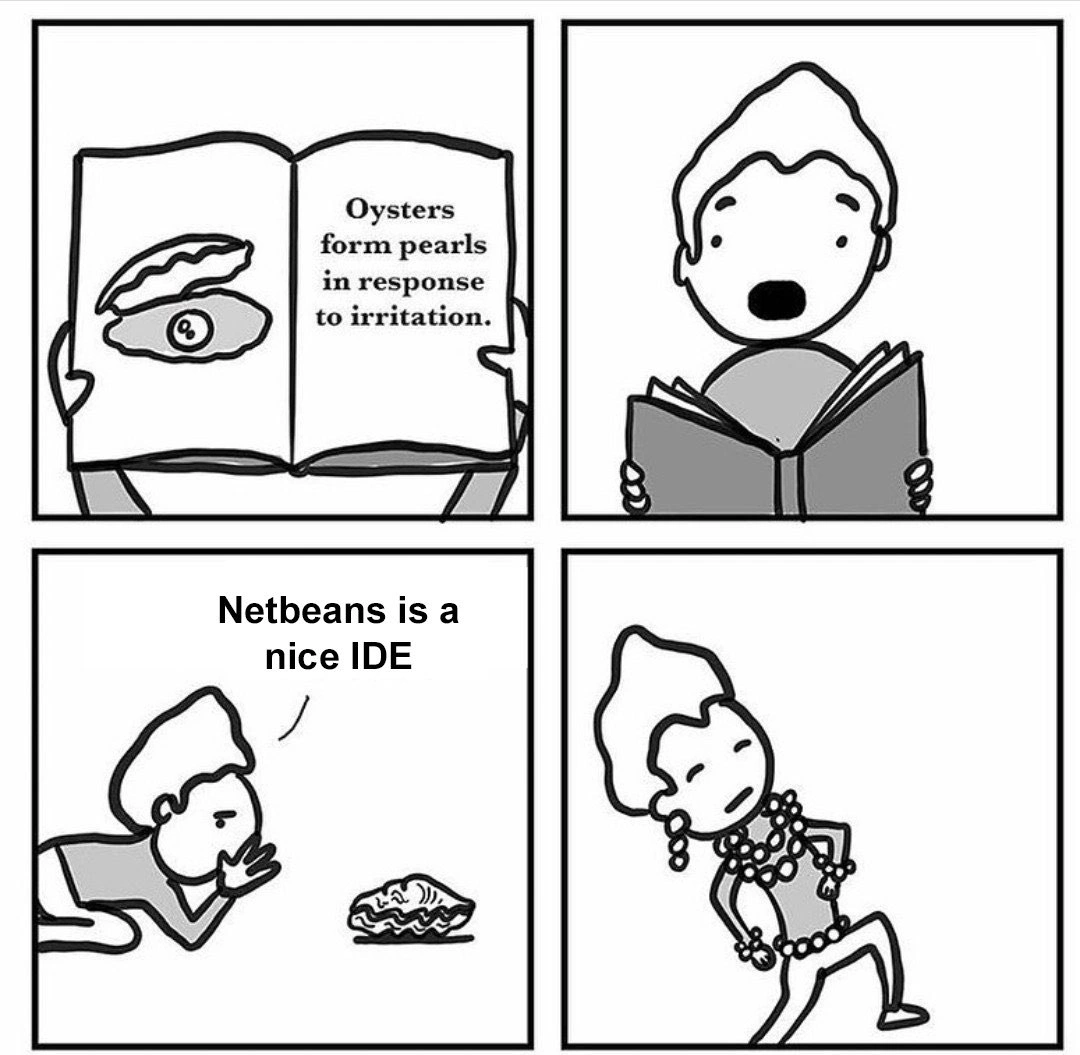
This meme does the same thing with programmers and their tools. One character whispers a teasing comment – “NetBeans is a nice IDE” – which is basically praising something that a lot of coders find annoying. It’s like telling your sibling their least favorite vegetable is actually the best dessert ever, just to bug them. The oyster in the picture hears this and gets so annoyed that it makes a ton of pearls! In the last panel, the oyster is covered in pearls, almost dancing in anger. It’s an over-the-top, goofy result.

The simple idea: doing something irritating on purpose can cause a big reaction. We find it funny because the reaction is exaggerated – the oyster doesn’t just make one pearl, but dozens, because it’s that offended. It’s poking fun at how people (or oysters!) sometimes respond when you poke them in just the right way. In real life, annoying someone usually isn’t productive, but in this cartoon world, annoying the oyster created a pile of treasures. The humor comes from that crazy contrast – a tiny joke leads to a huge, silly outcome. Even if you don’t know anything about NetBeans or IDEs, you can laugh at the fact that the oyster got so upset by a little remark that it went wild making pearls. It’s a playful take on “teasing to get a reaction”, showing that even an oyster can go overboard when provoked in just the right way.

Level 2: Sparking Editor Wars

Let’s break this down in simpler terms. The comic starts by stating a real-world fact: oysters form pearls in response to irritation. If a tiny grain of sand slips inside an oyster’s shell, it’s like a tickle or itch the oyster doesn’t like. The oyster’s natural reaction is to coat that irritant in smooth layers (a substance called nacre) until, over time, it becomes a shiny pearl. In short, a little annoyance can make an oyster produce something new and valuable – a pearl.

Now, the meme takes that idea and applies it to software developers and their coding tools. In the programming world, an IDE (Integrated Development Environment) is a software application that provides a bunch of features to help you write code more easily. For example, an IDE usually includes a code editor, a debugger, tools for building/running your code, and other helpful integrations – all in one package. NetBeans is one such IDE. It’s been around for a long time (it was a big deal for Java programmers in the 2000s) and is now open-source under Apache.

Here’s the catch: NetBeans isn’t exactly the coolest kid on the block anymore. Over the years, many programmers found NetBeans to be slow or cumbersome compared to rival IDEs. A common complaint was its indexing slowness – when you opened a project, NetBeans would spend a while scanning all your files (building an index) to provide autocomplete suggestions and refactoring tools. This process could take a while, especially on large projects, which could be pretty irritating if you just wanted to jump in and start coding. Modern developers often prefer other editors/IDEs that feel faster or more lightweight. For instance, JetBrains (a company known for IDEs like IntelliJ IDEA, PyCharm, etc.) has a huge fan base because their tools are powerful and intelligent (though they can be heavy too!). There’s also VS Code (Visual Studio Code), which is a newer editor that is super popular for being snappy and extensible. The point is, NetBeans has a bit of a dated reputation in the coding community, and not many people go around actively praising it these days.

So when the character in the comic kneels by the oyster and whispers, “NetBeans is a nice IDE,” it’s a very tongue-in-cheek moment. Why? Because saying “NetBeans is nice” in a group of developers can trigger a debate. It’s a bit like walking into a room of gamers and casually saying, “My old Nintendo Wii is the best console ever.” You’re likely to get some strong reactions! In developer circles, there are longstanding arguments about tools – often called “editor wars” or “IDE wars.” People can get surprisingly passionate (and stubborn) about which code editor or IDE is the best. It might seem silly, but remember, programmers spend all day in these tools, so they develop strong preferences. The comic is playing on that culture: praising NetBeans (a tool many have left behind) is portrayed as a legendary way to provoke those passions.

This relates to something called developer experience (DX) – which basically means how enjoyable and efficient it is to use a given tool as a developer. If a tool has good ergonomics (is comfortable and efficient to use), developers tend to love it. If it has quirks that slow you down or frustrate you (like long loading times, confusing interfaces, or lack of features), developers might hate it. NetBeans, for some, represents the latter: it had quirks that annoyed users. So other devs moved to alternatives that improved the DX. Many Java devs, for example, switched to IntelliJ IDEA (a JetBrains IDE) which generally offers smarter coding assistance and, for them, felt worth the trade-off of using a heavier program. Others might opt for lighter editors like Sublime Text or VS Code that start up faster and feel snappier, even if they rely more on plug-ins.

Because of these experiences, saying something positive about NetBeans in front of seasoned developers can be controversial. It’s not that NetBeans is truly awful – it still works and some people do like it – but it’s like praising an older, slow car in front of racecar enthusiasts. It sounds a bit provoking or out-of-touch. That’s exactly what the person in the meme is doing: they’re intentionally offering this mild praise to “irritate” the oyster. The oyster in the comic represents those developers who are easily annoyed by the mention of NetBeans being good. In the final panel, the oyster has produced an absurd amount of pearls – it’s completely decked out in necklaces of pearls and even dancing. This visual gag means the oyster was so irritated by that comment that it over-reacted and made way more pearls than normal. Translating that back to developer terms: a tiny comment about NetBeans led to an explosion of reactions (imagine an online forum thread where developers go overboard arguing or bashing the tool in response).

The phrase “irritation-driven development” is a humorous twist on real software development philosophies like test-driven development. In test-driven development, you write tests for your code first, then write code to pass those tests – the tests “drive” your design. In irritation-driven development, the joke is that you spark progress (or at least, spark a lot of activity) by annoying someone or something. Here, by irritating the oyster with that NetBeans compliment, the person “drives” the oyster to produce pearls. It’s an absurd idea, of course – we don’t actually want to annoy developers on purpose as a way to get work done! – but it highlights a truth: often, when developers find something irritating in their tools, they either speak up loudly about it or even go and create a better tool. A lot of innovation in developer tooling comes from someone saying “I can’t stand this anymore, I’m going to fix it.” So in a meta way, the meme is nodding to how complaints and irritations in the developer world sometimes lead to improvements or new “pearls” (like better software, or at least a funny discussion).

Finally, the punchline includes the text “JetBrains gang in da house.” This is the poster’s way of acknowledging that fans of JetBrains IDEs (IntelliJ IDEA, etc.) are likely present and watching. In other words, the moment someone mentions NetBeans positively, the devotees of the rival tool (JetBrains’ products) tend to swoop in and respond, much like the oyster pumping out pearls. It’s a playful way of saying, “I know this topic is going to get the big reactions from the crowd that loves the more modern tools.” It’s similar to how if you mention a preference for one operating system (say, Linux) on a forum, you might immediately get responses from die-hard Windows or Mac fans. The comic, and that caption, are both embracing the humor in this predictable fan reaction.

So, to sum up in plain terms: This meme shows someone learning that oysters make pearls when irritated. They then jokingly “apply” that fact by saying something bound to irritate developers (“NetBeans is a nice IDE”) to an oyster. The oyster reacts in an exaggerated way, making tons of pearls – symbolizing the way developers might overreact or produce a lot of “response” when you mention a touchy subject like praising an unpopular coding tool. It’s funny to programmers because it’s a mix of a true nature fact, a familiar programmer argument, and an absurd visual payoff. Essentially, it’s laughing at the idea that sometimes upsetting a developer (or an oyster) can lead to an outpouring of gems – whether those are actual pearls or just a flood of passionate comments!

Level 3: Trolling for Pearls

At the highest level, this meme mashes up biology and EditorWars culture with wicked humor. In nature, an oyster encases an irritant (like a grain of sand) in layers of nacre, forming a pearl. In developer life, a tiny provocation can likewise trigger an oversized reaction. Here, the provocation is the innocuous-looking statement: “NetBeans is a nice IDE.” To seasoned engineers, that line is practically incendiary – the kind of classic flamebait that can spawn a 100-comment thread in minutes. It’s like typing :(){ :|:& };: into a Linux shell: a small input that causes an explosive fork bomb of reactions. By whispering praise for beloved beleaguered NetBeans, the character in the comic knowingly trolls the oyster (standing in for the developer community), expecting an explosive pearl-producing offense. And predictably, the oyster overreacts, bedecking itself in pearls – a spot-on visual metaphor for the overflow of “pearls” (strong opinions) developers unleash when their tool preferences are challenged.

Why is calling NetBeans “nice” such a legendary irritant? It taps into a rich vein of developer tribalism. NetBeans is an IDE (Integrated Development Environment) with a long history, especially in Java programming. Years ago, it was a big deal – one of the official Sun Microsystems IDEs – but over time it gained a reputation for being slow, clunky, and dated compared to sleeker alternatives. Complimenting it today, even mildly (“nice”), can feel like praising a rusty old car in a showroom of Teslas. Many experienced devs have painful memories of waiting for NetBeans to wake up index an entire project (cue jokes about “indexing the universe”), or dealing with its less-than-snappy performance. So when someone chirps that it’s a “nice IDE,” it rubs salt (or sand) in old wounds – hence the oyster’s pearl overdose from sheer offense. The choice of the word “nice” is the cherry on top: it’s such a bland, lukewarm compliment for a tool known to cause frustration that it comes off as either naïve or slyly sarcastic. It’s precisely the kind of backhanded positivity that makes loyal fans of other tools raise an eyebrow and ex-Sun veterans mutter “Them’s fightin’ words.”

This hits on a broader pattern in tech culture: developers form strong loyalties to their tools, and minor praise or criticism can feel personal. The comic is essentially depicting an episode of the eternal IDE/editor holy wars. These battles have raged for decades, and every generation of programmers has their own cause célèbre. A few infamous fronts in this war include:

  • Emacs vs Vim – the OG text editor holy war, spanning 40+ years of keystroke combat.
  • Tabs vs Spaces – a battle of indentation that even made it into HBO’s Silicon Valley.
  • Eclipse vs IntelliJ vs NetBeans – the Java IDE triple threat match of the 2000s (each camp swears theirs is best).
  • Dark Mode vs Light Mode – because apparently theme preference is serious business.

Praising NetBeans in 2019 is like waving a flag for an older IDE faction in the modern era of IntelliJ IDEA and VS Code. It dredges up the DeveloperPainPoints of the past (slow startup times, memory-hungry processes, less refined UX) that many thought were long buried by newer tools. And of course, the mention of NetBeans summons the other side: the “JetBrains gang” (fans of JetBrains’ popular IDEs like IntelliJ) who will eagerly jump in to defend their favorite and dismiss NetBeans as a relic. The post’s caption “JetBrains gang in da house” wryly acknowledges this: say the magic words “NetBeans is good” and - poof! - passionate IntelliJ users materialize out of thin air, ready to debate. It’s virtually an API call to rally the troops of the IDE wars.

Underneath the joke is a nod to how DeveloperExperience (DX) and ergonomics of tools can deeply affect emotions. Developers spend all day in these environments – writing code, debugging, exploring large codebases. A tool’s comfort and efficiency (or lack thereof) really matters. If an IDE saves you keystrokes and headaches, you’ll sing its praises; if it constantly freezes or lags, it becomes the butt of jokes and the source of resentment. NetBeans, for many, was a mix of both: powerful (with things like a GUI builder and robust refactorings) yet frustratingly heavy. Over years, those frustrations turned into strong opinions. That’s why a simple positive comment about a “nemesis” tool can light the fuse. It’s developer humor drawing from real experience – an inside joke about how even a polite compliment can sound outrageous if it contradicts people’s lived tech pain.

There’s also an ironic truth in the term “irritation-driven development.” This parody phrase riffs on real methodologies like test-driven development (TDD), but here suggests that annoyance and provocation are what drive progress (or at least drive people to react). In one sense, it’s poking fun: instead of writing tests to drive code design, we’re annoying oysters to drive pearl production. But in another sense, it winks at a real phenomenon in tech: many improvements and new tools are born because developers got irritated with the status quo. Think about it – how do we get “pearls” of new technology? Often because someone was fed up with an existing tool and said “I can do better.” NetBeans itself emerged as an open-source improvement project years ago; IntelliJ IDEA rose to prominence because developers were irritated with the limitations of Eclipse/NetBeans and craved a smoother experience. It’s the grit in the oyster effect: a little pain or annoyance can spur creativity, leading to something valuable. So the meme exaggerates this idea: by deliberately causing irritation (saying the unsayable praise), you get a comically over-productive oyster. If only every developer’s annoyance resulted in literal gems!

To a seasoned programmer, the final panel of the oyster dancing with excessive pearl bling is laugh-out-loud because it’s so relatable and absurd at once. We’ve all seen someone overreact in a forum or chat when a contentious tool opinion drops – paragraphs of rebuttal, benchmark links, maybe even a spicy meme response (these rants are the “pearls” being spewed). The oyster decked out in pearls is basically a caricature of an outraged developer drowning in their own over-the-top rebuttals. In other words, the community’s “pearls of wisdom” start flying when they’re provoked. The meme cleverly turns that into a visual gag: the oyster doesn’t just make one pearl – it goes overboard, just like how dev discussions can escalate dramatically from one small comment. It’s a satirical take on our tendency to overproduce output when provoked, whether that output is jewels or jabs.

Finally, this meme tickles the insider knowledge of senior devs. It assumes you know that praising NetBeans is an easy way to get an eye-roll or a heated comeback from certain folks. It’s humor at the expense of our own hypersensitivity about tools. We laugh because it’s true – we’ve seen “IDE bias” cause comical levels of drama. Yet, at the heart of it, there’s almost a fondness: we only get riled up about tools because we care so much about our craft and workflow. As sarcastic as it is, the joke is a tiny ode to the passion behind DeveloperTooling debates. The next time you see an oyster…I mean, a coder…spontaneously spawn pearls (long posts, new plugins, or fiery arguments) from a tiny irritant like this, you’ll remember this comic. It’s a reminder that in tech, even a one-line opinion can have shell-shocking consequences – and a lot of shiny pearls of commentary left on the floor.

if ("NetBeans is a nice IDE".equals(comment)) {
    // Summon the JetBrains gang in da house
    throw new EditorWarException("Pearls of irritation everywhere!");
}

Description

A four-panel, black-and-white comic strip illustrating a humorous take on developer tool preferences. In the first panel, a character reads from a book that shows an oyster, with the text: 'Oysters form pearls in response to irritation.' The second panel shows the character having a moment of realization. In the third panel, the character kneels before an oyster on the ground and says, 'Netbeans is a nice IDE'. The final panel depicts the character standing triumphantly, adorned with multiple strings of pearls. The meme's humor is rooted in the 'IDE wars,' a long-standing debate within the developer community over which Integrated Development Environment is superior. The joke implies that the statement 'Netbeans is a nice IDE' is so fundamentally irritating that it can cause an oyster to spontaneously produce a wealth of pearls, a sentiment often shared by developers who prefer other IDEs like those from JetBrains, as hinted at by the post's caption 'JetBrains gang in da house'


Comments

7
Anonymous ★ Top Pick Some say the hardest part of software is naming things. I say it's convincing a senior dev to use an IDE that isn't hardcoded into their muscle memory since their first internship
  1. Anonymous ★ Top Pick

    Some say the hardest part of software is naming things. I say it's convincing a senior dev to use an IDE that isn't hardcoded into their muscle memory since their first internship

  2. Anonymous

    If oysters add a pearl every time someone calls NetBeans “lightweight,” we’ll hit petabyte-scale jewelry long before the IDE finishes indexing your 500-module monorepo

  3. Anonymous

    NetBeans: the only IDE where waiting for autocomplete to load gives you enough time to implement the feature manually, debug it, and question your career choices

  4. Anonymous

    The beautiful thing about NetBeans is that it teaches you the true meaning of 'eventual consistency' - eventually, after enough irritation and workarounds, you'll be consistent in your desire to switch IDEs. It's like technical debt, but for your sanity: every small annoyance compounds until you're wearing enough pearl necklaces to make a jewelry store jealous

  5. Anonymous

    NetBeans: the IDE where praising it aloud is grit enough to birth pearls - even Oracle couldn't kill it

  6. Anonymous

    Irritation-driven development: whisper 'NetBeans is a nice IDE' to a shell and it generates enough pearls to pay for a JetBrains All-Products Pack before Maven finishes 'Scanning for projects'

  7. Anonymous

    Whisper “NetBeans is a nice IDE” in a room of IntelliJ subscribers and you’ll trigger a spontaneous tooling migration debate - distributed consensus without quorum, but plenty of pearls

Use J and K for navigation