Going Full Navajo: Leaving Bugs As Spirit Pathways In My Code
Why is this Bugs meme funny?
Level 1: Leaving the Door Open
Imagine you build a perfect sandcastle and secretly worry that because you worked so hard on it, a part of you might be stuck inside. So you decide to leave a tiny door in one wall of the castle — a way out for your “spirit” just in case. Sounds silly, right? That’s exactly the joke here. A programmer made a computer program and found some mistakes in it (we call those mistakes “bugs”). Normally you’d fix those mistakes, like repairing a wall in a castle. But this person jokes that he’s leaving the bugs in on purpose so his spirit doesn’t get locked inside the perfect program. It’s like saying, “My work isn’t perfect, but that’s a good thing because now I won’t be trapped in it!” Of course, nobody’s soul really gets trapped in a program or a sandcastle. The joke just makes us laugh because it’s a fun, make-believe excuse for not cleaning up your mess — like a kid saying they meant to color outside the lines so their crayon can find its way home. It’s playful and a little absurd, which is why it’s funny!
Level 2: Intentional Imperfections
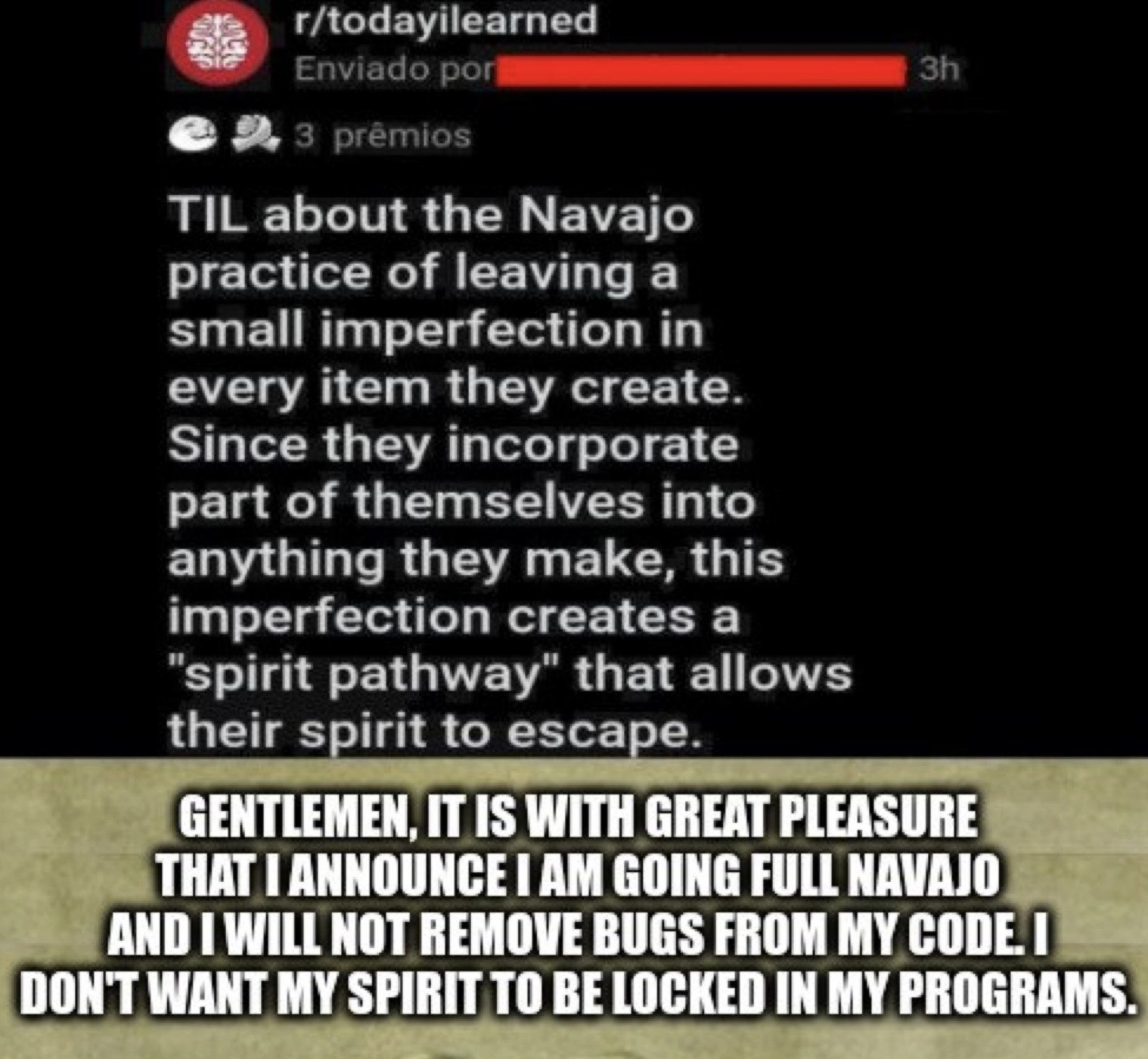
At its core, this meme blends a programming problem with a piece of cultural trivia. The top half is a screenshot from Reddit’s TIL (Today I Learned) where someone shares the fact that Navajo artisans intentionally leave a small flaw in every creation. In Navajo weaving traditions, this flaw – often called a “spirit line” or spirit pathway – is there so the weaver’s soul, which they believe is woven into the work, can exit. It’s a sign of humility and spiritual belief: nothing man-made should be absolutely perfect.
The bottom half applies that concept to software development in a comically literal way. The developer proudly states he’s “going full Navajo” by not removing bugs from his code. In programming, a bug is any mistake or flaw in the code that causes a program to behave in unintended ways (for example, a calculator app that crashes when you try a certain formula has a bug). Normally, programmers try to eliminate bugs to improve their CodeQuality – which means making the code cleaner, more reliable, and easier to maintain. Leaving bugs in on purpose is definitely not a best practice; it leads to technical debt, which is like taking shortcuts that you’ll have to pay for later when the problems inevitably need fixing.
That’s why this meme is funny: no sane developer or manager would formally endorse leaving errors in a program as “intentional.” Yet every coder knows the sneaky relief of not fixing a pesky minor issue when a deadline looms or when touching the code could break something else. We usually address it later (or comment // TODO: fix this and hope for the best). Here the author has concocted a flamboyant justification for this procrastination. By invoking the Navajo intentional imperfection concept, he’s basically saying, “I’m not fixing that bug because I want it there – for spiritual reasons!” It satirizes the excuses developers make when code isn’t perfect. It’s a playful twist on the classic joke “It’s not a bug, it’s a feature.” Instead of claiming the flaw is a software feature, he claims it’s a feature for his soul.
The phrasing “Gentlemen, it is with great pleasure…” mimics a formal announcement, as if the programmer is addressing colleagues in some grand engineering meeting. This overly serious tone adds to the humor. It suggests the developer is almost proud of his bug-laden code. In a real workplace, announcing “I will not remove bugs from my code” would earn you some confused stares (and probably a stern talk with your team lead!). In truth, developers are expected to fix bugs to prevent crashes, security issues, or poor user experience. But in this joke, he treats bug-fixing like a threat to his very soul!
For a junior developer or someone new to coding, it helps to know that blame culture and creative excuses are part of tech humor. “Blame culture” means people try to deflect responsibility for problems – e.g., “That bug isn’t my fault, it’s because of the last guy’s code” or “The server environment messed it up.” This meme cranks the blame game up to mythical levels, shifting it to “I can’t fix that bug or my spirit will be trapped.” It’s an obvious parody – nobody truly believes their soul is literally in their code. But it riffs on the feeling that a piece of you does go into everything you create, and it jokingly warns: make sure to leave yourself a way out! The til_reddit_format setup (fun fact on top, punchline on bottom) is a common meme style, especially in developer circles, to frame a dry tech joke with something quirky and unexpected. By learning about a genuine Navajo practice, then seeing it misapplied to bugs in software, the absurdity becomes clear and laughable. It’s a gentle reminder that striving for perfection in code is great, but if you fall short, you can always humorously pretend it was on purpose. 😇
Level 3: Not a Bug, a Pathway
The meme’s punchline gives a software bug a mystical rebranding. Instead of admitting to sloppy code or unfinished fixes, the developer grandly declares every bug is an intentional imperfection – a “spirit pathway” for his soul. This is a veteran coder’s dark humor at work: we’ve heard every excuse in the book for not cleaning up code, from “Works on my machine!” to “It’s not a bug, it’s a feature.” Now, with tongue firmly in cheek, we get “It’s not a bug, it’s a spirit escape hatch.” It’s a brilliant parody of blame culture on dev teams – rather than owning up to technical debt, the coder blames higher spiritual necessity!
In real development, leaving known bugs in a program is usually a recipe for TechDebt nightmares. Seasoned engineers cringe at the idea of intentionally lowering CodeQuality, because today’s minor glitch can become tomorrow’s 3 AM PagerDuty call. Yet, under crushing deadlines or fragile legacy systems, even battle-scarred pros sometimes knowingly ship code with an “acceptable” bug. They just don’t normally announce it like a proud Navajo artisan. The meme’s formal tone (“Gentlemen, it is with great pleasure…”) mocks the absurdity of treating a dirty hack as a noble tradition. It’s the kind of sarcastic relief only a tired developer could come up with after debugging for days – “I’m not lazy, I’m just safeguarding my spirit, okay?”
This joke lands because it’s painfully relatable. Every senior dev has faced that one nasty bug that’s safer to leave alone. We jokingly call these haunted corners of the codebase – fix one thing, and four new bugs scurry out. Here, that frustration is flipped into faux pride: the coder portrays neglecting bug fixes as if it were an enlightened design pattern. It’s a satire of the “bugs as features” justification we’ve all heard. Just compare a few classic bug excuses to this new “Full Navajo” spin:
| Common Bug Excuse | “Full Navajo” Variant |
|---|---|
| “It’s not a bug, it’s a feature.” | “It’s not a bug, it’s a spirit pathway.” |
| “We’ll fix that in the next sprint.” | “We must preserve this sacred imperfection.” |
| “That crash only happens on my PC.” | “Removing it might trap my soul in the code.” |
Under the hood, this meme is poking fun at our tendency to bond with our code (sometimes a bit too much). We pour so much of ourselves into programming that a piece of our identity lives in the projects we build. The Navajo-inspired joke exaggerates that feeling to the extreme: if part of my spirit lives in my app, I’d better leave a bug as an escape route! It’s a hilariously supernatural twist on the very real phenomenon of developers being emotionally invested in their work. And hey, after years of on-call nightmares, maybe the idea of a “spirit pathway” for our sanity doesn’t sound so crazy after all – a little intentional imperfection to keep the coding gods appeased might be the only thing keeping us from becoming ghosts in the machine. 👻
Description
The meme is split into two sections. The top half is a mobile screenshot of a Reddit r/todayilearned post that reads: "TIL about the Navajo practice of leaving a small imperfection in every item they create. Since they incorporate part of themselves into anything they make, this imperfection creates a 'spirit pathway' that allows their spirit to escape." The bottom half, on a textured beige background, shows bold white all-caps text: "GENTLEMEN, IT IS WITH GREAT PLEASURE THAT I ANNOUNCE I AM GOING FULL NAVAJO AND I WILL NOT REMOVE BUGS FROM MY CODE. I DON'T WANT MY SPIRIT TO BE LOCKED IN MY PROGRAMS." The joke reframes un-fixed software defects as intentional imperfections, lampooning common developer excuses, code-quality trade-offs, and the ever-present burden of technical debt
Comments
6Comment deleted
Relax, that null-pointer in prod isn’t a Sev-1 - it's a carefully architected spirit egress path; I’m just future-proofing my soul for post-mortems
After 20 years in enterprise architecture, I've realized my legacy systems aren't technical debt - they're ancestral wisdom preserved in COBOL spirit pathways that prevent vendor lock-in of my soul
Ah yes, the 'Navajo methodology' - finally, a legitimate Agile framework for explaining why that race condition in production is actually a feature. I've been practicing this for years, except I call mine 'technical debt pathways' and they allow my spirit to escape during 3 AM oncall incidents. The real genius is that unlike the Navajo who intentionally place one small imperfection, we've democratized the practice by distributing hundreds of spirit pathways throughout the codebase - truly embracing the microservices philosophy at the bug level
We now label known defects as “spirit egress ports” - they glide through code review as “by design,” neatly explain our perpetually overdrawn error budget, and keep the monolith haunting prod
Legacy systems' bugs aren't oversights - they're architected escape hatches ensuring our souls don't get version-locked forever
We keep one deliberate bug in prod as the spirit pathway - if the dashboards ever go all green, a VP will think we’re idle and announce a Q3 rewrite to event-driven microservices