The Developer Specimen: A Medical Anomaly
Why is this MentalHealth meme funny?
Level 1: All Work, No Rest
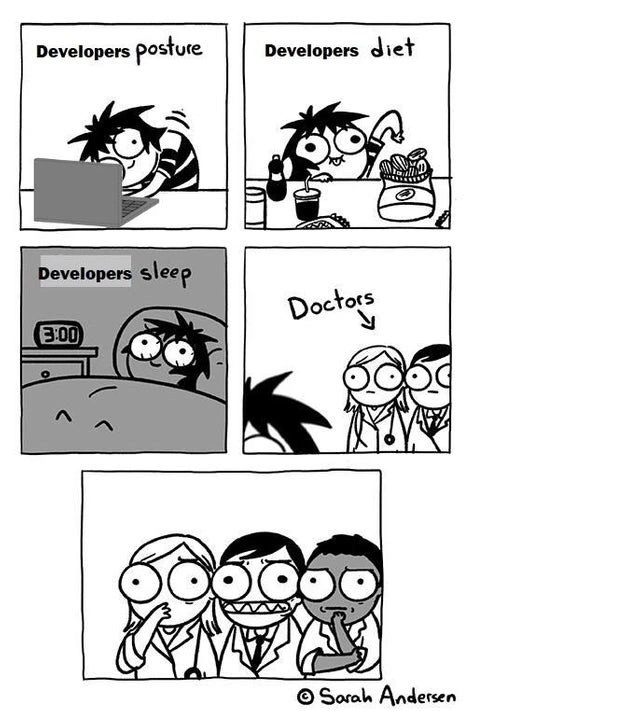
Imagine you have a big school project or an online game that you really want to keep going all the time. You decide you’re never going to take a break so that it can be perfect. You sit bent over your desk for hours and hours without stretching (your back starts to hurt, like when you’ve been coloring or gaming too long). Instead of eating a real dinner, you just munch on candy and chips because they’re quick (and hey, they taste good). You even stay awake all night, afraid to go to sleep in case something goes wrong with your project or game. By 3:00 in the morning, your eyes are wide open in the dark – you’re super tired but too worried to sleep. Now imagine the next day, you go to the doctor for a check-up. The doctor looks at you and then at what you’ve been doing and goes 😱. They’re shocked, right? Because no one should skip sleep, meals, and sit in a twisted position all day – that’s really unhealthy and will make you feel terrible.
This comic is joking that some programmers work so hard to keep a computer system running (99.9% uptime means it’s almost never off) that they start living in a super unhealthy way. It’s funny because it’s drawn in a silly way – the character has huge surprised eyes and the situations are exaggerated – but it also has a truthful lesson: working all the time with no rest, no good food, and no sleep will make you unhealthy, no matter how “heroic” it seems. Just like a kid staying up all night would turn into a cranky zombie the next day, an engineer who never takes care of himself becomes exhausted. So the joke is showing a very tired, snack-fueled programmer, and the shocked doctors are like parents or teachers saying, “Oh no, look at what you’re doing to yourself!” In simple terms: if you never take a break and act like you have to keep things running 24/7, you’ll end up feeling and looking pretty rough – and that’s why this picture is both funny and a little bit oops, relatable.
Level 2: Spine, Snacks, Sleep
Let’s break down the panels and tech terms for a newer developer (or anyone curious):
99.9% uptime – This means the service or website is up almost all the time (downtime of only 0.1%). It’s an industry way to express reliability. For example, 99.9% uptime allows barely ~8 hours of downtime per year. To achieve this, teams often have on-call duty: someone must be available at odd hours to fix issues immediately so the system doesn’t stay down. It’s a key part of Service Level Agreements (SLAs) with users.
Developer’s posture (Panel 1) – The comic shows the dev hunched over like a shrimp. Long coding hours can lead to poor_posture: you crane your neck toward the screen and curve your spine into a C-shape. This can cause back and neck pain (“tech neck” or worse). New developers often don’t realize how important a good chair and stretching are. In reality, proper ergonomics (monitor at eye level, chair with back support) help avoid turning into Quasimodo over your keyboard. The meme exaggerates it for effect – our coder’s eyes are bulging and he’s practically glued to the screen – but it’s poking fun at a real issue.
Developer’s diet (Panel 2) – Here the dev’s “meal” is sodas, fries, chips, and some kind of mystery sauce bottle – basically junk food. When crunching to meet a deadline or stuck in the office late, healthy meals often get replaced by quick fixes like fast food, candy, or the classic energy drinks. It’s common in developer lifestyle jokes: the stereotypical programmer desk has empty cola cans and pizza boxes. This panel labeled “Developers diet” highlights how balanced nutrition goes out the window during heavy workloads. The humor is that the dev is treating sugary caffeine and greasy fries as if they’re a normal dinner. (Many of us have attended marathon coding sessions where dinner was vending machine snacks 😅.) It’s funny until you remember a diet like that will make any doctor facepalm – as we see in the final panel.
Developer’s sleep (Panel 3) – The clock reads 3:00 AM and our dev character is wide-eyed in bed, clearly not sleeping. This reflects SleepDeprivation and LateNightCoding/support. Maybe he’s anxious about a production server, or he got a phone alert that something’s broken (common if you’re “on-call”, meaning you have to respond to outages anytime). New engineers learn that if you promise high uptime, you might get woken up by pager alerts when the site goes down at crazy hours. Even without emergencies, insomnia can happen if your brain is buzzing from coding all day. The comic captures that 3 AM stare – you know you should sleep, but you just can’t. Consistently missing sleep wreaks havoc on mental and physical MentalHealth, reducing your focus and eventually your DeveloperProductivity. In the short term, though, devs often push through with coffee and code, a decision that seems heroic at night but feels terrible in the morning.
Doctors’ reaction (Panel 5) – The last panel shows three doctors looking shocked and concerned (one even covering her mouth in horror) as they gaze at the scenes of the developer’s life. The panel before it simply says “Doctors →” with an arrow, implying these medical professionals are now examining the situation. This is a punchline: it’s comparing the dev’s lifestyle to a patient’s horrific test results. The doctors are basically saying, “This is really unhealthy!” Their faces mirror what any responsible adult or health expert would think upon seeing a person live on soda, no sleep, and twisted posture. It’s a funny outsider-perspective on developer self_neglect. We in tech laugh because we recognize ourselves, and the absurdity that we ignore common-sense health advice just to keep coding or keep systems running. The health_professionals_reaction here is an exaggerated version of what your own doctor might do if you bragged about an all-nighter: 😱.
The entire comic uses a Sarah_Scribbles_style art (simple black-and-white, big round eyes, spiky hair). Sarah Andersen’s comics often humorously depict struggles like poor self-care or anxiety, which makes that style perfect for this joke. Each panel is labeled (“Developers posture,” “Developers diet,” “Developers sleep”) like a mini case study, and then the doctors’ panel delivers the verdict. For a junior dev, the lesson is clear: this is a parody of what not to do. It’s common in our field to go heads-down on a project and forget to stand up or eat well, especially under pressure to keep things running. But over time, this leads to DeveloperBurnout – exhaustion, health issues, and diminished enthusiasm for work. The tags like WorkLifeBalanceTips and MentalHealth are a hint: take care of yourself even when the job gets intense. The comic resonates because so many of us have done these things at least once (stayed up all night fixing code, subsisted on caffeine, etc.), but seeing it from a doctor’s viewpoint reminds us it’s unsustainable (and a little absurd). In short, the meme is a funny wake-up call about self-care in tech.
Level 3: High Availability, Low Vitality
This meme skewers the high uptime culture in tech with dark humor that seasoned engineers know all too well. Achieving 99.9% uptime (so-called "three-nines availability") sounds great on an SLA, but the comic highlights the unseen cost: the developer’s own health and sanity. In the first three panels we see a programmer physically deteriorating – shrimp-like poor_posture over the laptop, subsisting on a junk_food_diet of soda and fries, and suffering 3am_insomnia. It’s a caricature of the on-call hero lifestyle: the developer contorts like a pretzel in a ergonomic chair cheap swivel chair, chugs caffeine instead of eating real meals, and skips sleep to babysit servers through the night. The final panels show health_professionals_reaction – a trio of horrified doctors – driving home the joke: any outsider (or doctor) would be appalled at what tech folks accept as “normal” for the sake of uptime.
Under the humor, there’s painful truth familiar to anyone who’s been paged at 3 AM: maintaining high availability can feel like a war of attrition on your body. This is classic DeveloperHumor rooted in DeveloperBurnout and the relentless grind of LateNightCoding. The comic’s style (a nod to Sarah’s Scribbles with the wide-eyed, frazzled character) makes it funny, but the scenario is very real. There’s an industry trope that “it’s always DNS” or some production bug that blows up during off-hours, and the poor developer on call must crawl out of bed to fix it. Veteran engineers have war stories of marathon debugging sessions fueled by potato chips and energy drinks, resulting in aching backs and bloodshot eyes. It’s humor as commiseration: Yep, been there, done that, got the wrist braces.
The juxtaposition of 99.9% uptime against a 0% healthy lifestyle is a commentary on skewed priorities in some tech workplaces. Companies boast about near-zero downtime as a DeveloperProductivity win, but behind the scenes that often means someone sacrificed Work-Life Balance (and maybe a vertebra or two). It satirizes the unsustainable “crunch mode” culture where heroic effort is expected to meet absurd reliability targets. Everyone touts WorkLifeBalanceTips in all-hands meetings, yet the on-call rotation still wrecks your sleep schedule. The meme resonates because it’s tragically relatable: a system’s uptime comes at the expense of the engineer’s personal downtime. In a just world, we’d invest in better automation, on-call schedules, and system design to avoid human sacrifice for uptime. But as the cynical veteran knows, until that glorious day, many devs will keep slouching at their desks at 3 AM, keeping the lights on while their own light flickers. The doctors’ aghast faces in the final panel say it all: “This level of self-neglect is nuts!” – and every engineer laughing at this comic knows deep down that DeveloperLifestyle like this isn’t healthy, even if it’s often reality.
Description
A five-panel comic strip by Sarah Andersen, in her signature black-and-white, whimsical art style. The first three panels depict the unhealthy habits of a developer: 'Developers posture' shows the character hunched over a laptop; 'Developers diet' shows them eating junk food at their desk; 'Developers sleep' shows them wide awake in bed with a clock reading 3:00. The fourth panel, labeled 'Doctors', shows three doctors in lab coats looking with concern towards the developer, who is just out of frame. The final panel is a close-up of the doctors, their expressions having turned to sheer horror and disbelief, with one forcing a pained, toothy grin. The comic humorously critiques the stereotypical and often damaging lifestyle associated with intense software development. It highlights the physical toll of poor ergonomics, unhealthy eating habits, and sleep deprivation that can result from long hours, tight deadlines, or high-pressure work environments. The punchline, delivered through the doctors' horrified reaction, underscores how alarming these normalized behaviors would seem from a medical perspective, making it highly relatable to developers who have experienced burnout or the physical consequences of their profession

Comments
7Comment deleted
We treat our bodies like a legacy monolith: we know it's a mess, we're afraid to touch anything, and we're just hoping it doesn't crash during the next deploy
We’ve refactored the monolith, containerised prod, and now the only thing left not horizontally scalable is our lumbar spine
The doctors are horrified until they see our salaries, then they prescribe themselves the same lifestyle to pay off their med school loans
The real reason doctors look horrified isn't the posture or diet - it's realizing developers treat their bodies with less care than their production servers, yet somehow both still manage to crash at 3 AM
If posture, diet, and sleep were microservices, we left them as single-node cron jobs; SLOs violated since 2009 and now the doctors are running the blameless postmortem
We instrument every microservice with SLOs, but run our own runtime in best‑effort mode on caffeine - doctors filed a SEV‑1 for a 03:00 circadian outage
Doctors gawking like we've achieved 99.99% uptime on a stack of Mountain Dew, ramen, and 'git push --force' at 3AM