The Modern 'Full Stack' JavaScript Developer Stereotype
Why is this Frontend meme funny?
Level 1: All Gear, No Idea
Imagine a person who wears a chef’s hat and has the most expensive kitchen gear, but they only know how to heat up frozen dinners in the microwave. They call themselves a master chef because they plate the food nicely, but they can’t actually cook a meal from scratch. People who really know how to cook would find that pretty funny (and a bit silly). This meme is joking about a similar idea, but with a programmer: someone who has all the cool new tech tools and a fancy computer, yet hasn’t learned the basic skills needed to do the whole job. It’s a funny way to say that just having shiny equipment or big titles doesn’t automatically make you an expert — you need to know how to use the tools properly, too.
Level 2: Where's the Back End?
In simpler terms, this meme is saying: here’s a developer who calls themselves a full-stack developer, but actually they’re only working with the front-end part of the technology stack. Let's break down the joke and the terms to see why it's funny to developers:
Full-stack developer – Usually, this means a programmer who works on both the front-end and the back-end of web development. The front-end is everything you see in a web application (the user interface in the browser: buttons, text, images, the part built with HTML/CSS/JavaScript that runs on your computer). The back-end is what runs on the server (the behind-the-scenes logic, databases, server-side code that you don’t directly see). A full-stack dev is comfortable with both – they can build the web pages and also handle the server/database that powers those pages. In the meme, the term "full-stack" is in quotes because the person isn’t really doing both – they mostly stick to the front-end, but they claim to be full-stack.
Next.js on Vercel – Next.js is a popular web framework built on top of React (React is a JavaScript library for building user interfaces). Next.js makes it easy to create a web application with React because it provides structure and features like server-side rendering and routing out of the box. It also allows some back-end functionality through API routes, but many people primarily use it to create the front-end of their app. Vercel is a hosting platform (from the creators of Next.js) that makes deploying web apps very simple – especially Next.js apps. If you have a Next.js project, you can deploy it to Vercel with minimal effort (often just by linking your code repository, and Vercel takes care of building and serving it). Now, saying the dev is "only Next.js deployed on Vercel" means the entire project is basically a React front-end that they've put online via Vercel. There’s likely no custom server code they've written beyond what Next.js provides, and no separate database server they maintain. It’s a very streamlined setup (front-end code + a platform that handles hosting). This is great for getting started quickly, but it’s mostly covering the front-end and deployment. So, a person who only knows this might not actually know how to, say, set up their own web server or work with a database, which are typical back-end tasks.
Doesn't know what a database is – A database is where applications store information so it can be retrieved later. For example, if you have a web app like Twitter, the list of tweets and user profiles is stored in databases. Knowing about databases is crucial for back-end development. When the meme says this person "doesn't know what a database is," it's an exaggeration (most likely they have some idea) that emphasizes how little back-end experience they have. It suggests they’ve never had to directly interact with a database – maybe they built projects that didn’t require saving data, or they always used a service that handled data storage for them (like Firebase, which is a cloud service that stores data so you don't have to manage the database server yourself). In a typical full-stack project, you have to design how data will be stored, write queries or use an API to save and retrieve data, and understand concepts like tables or collections. If someone never learned that, they’re missing a big piece of the "stack."
$6000 MacBook Pro – This is referring to the developer’s computer. A MacBook Pro is a high-end laptop made by Apple, and a fully specced-out one can be very expensive (the meme says $6000, which is an exaggerated price for a top-tier model). In the tech world, a lot of developers use MacBook Pros for coding (because macOS is good for development and the hardware is strong). The joke here is that this person has an extremely expensive laptop – more than what most developers actually need – and it’s implied they got it for the prestige or the belief that it makes them a better developer. It's poking fun at the stereotype that some newcomers splurge on fancy gear thinking it’s essential. In reality, you can code on almost any decent computer; a pricey MacBook is nice to have, but it doesn't automatically grant skill. So, the meme is highlighting that this "full-stack" dev has all the high-end equipment (the $6k laptop) as if that makes them professional, but still lacks fundamental knowledge (like databases). It's like having a top-of-the-line toolkit but not knowing how to fix a basic problem.
Exclusively uses VSCode terminal – VS Code (Visual Studio Code) is a very popular, beginner-friendly code editor that many developers use. It has an integrated terminal (a command-line window) inside of it. When the meme says this person only uses the VSCode terminal, it implies they might not use the regular operating system terminal at all. For context, developers often use terminals (like the Windows Command Prompt, macOS Terminal, or Linux shell) to run commands – for example, to use Git, to start their servers, or to install libraries. If someone only uses the terminal inside VSCode, maybe they learned all their command-line skills within that safe environment and have never opened the stand-alone Terminal app or used advanced command-line tools outside VSCode. This hints at a level of inexperience or a very narrow way of working. It's a bit like saying, "I only drive in the parking lot of my driving school, never on a real road." It’s not inherently bad to use VSCode’s terminal (it’s the same shell, just embedded in the editor), but experienced developers often switch between tools and are comfortable opening a terminal anywhere. The meme is subtly teasing that our "full-stack" dev might be intimidated by anything outside their familiar VSCode setup – again emphasizing a limited skill set behind the fancy title.
Doesn't know about HTML forms, exclusively event listeners and fetch – Here the meme contrasts two ways of sending data from a web page to a server. An HTML form is the traditional way: you create a
<form>in HTML with some<input>fields and a<button type="submit">. When the user fills it out and hits submit, the browser will package that data and send it to the server (to a URL you specify in the form'saction) all by itself, then typically reload or redirect to a new page with the server’s response. This is how things worked in the early days of the web and still works now (for example, a simple contact form or login page can be a plain form). On the other hand, an event listener withfetchis a more modern, JavaScript-centric way: instead of letting the browser handle the form, the developer writes a script that listens for the form submission (or a button click) event, then uses thefetch()function (which is a way to make web requests via JavaScript) to send the data to the server in the background. This approach is common in single-page applications where you want to update the page dynamically without reloading it. The meme jokes that this dev only knows the JavaScript way and not the simple HTML way. That implies they possibly jumped straight into learning a framework like React where you often control form submission manually. Not knowing about basic HTML forms is like skipping a fundamental chapter in "Web Development 101." It’s certainly possible – if all your learning material was about React and modern JS, forms might have been abstracted away – but it’s a funny thing to admit because HTML forms are very basic. To developers, hearing "doesn't know about forms" is crazy because it's such a core web concept, hence it’s played for laughs. It underscores that the person’s knowledge is very one-sided (only what modern JS taught them)."one more SaaS this one will work for sure" – SaaS stands for "Software as a Service." In practice, a SaaS is typically a web-based application or service that people pay to use, usually via subscriptions. For example, if you create an online tool and charge users monthly, you’ve created a SaaS product. Many developers are interested in building their own SaaS as a startup or side project. The meme suggests that this particular developer has tried to build multiple SaaS projects (perhaps hoping to strike it rich or become the next big thing) and is always optimistic that the next one will succeed. The phrase "one more SaaS, this one will work for sure" is almost the developer’s motto. It's making fun of a kind of loop: imagine someone building project after project, each time thinking, "Okay, the last app I made didn't become the next Facebook, but this new idea I have, built with this new tech, will definitely take off!" It's a bit of a techie inside joke about being overly optimistic. Many of us have side projects and we know that feeling of optimism (and often disappointment). So this line adds to the caricature of the developer: not only do they use fancy tools without deep knowledge, they also jump from idea to idea, confident each new web app (SaaS) they make will be "the one" – which experienced folks know is rarely how it works out.
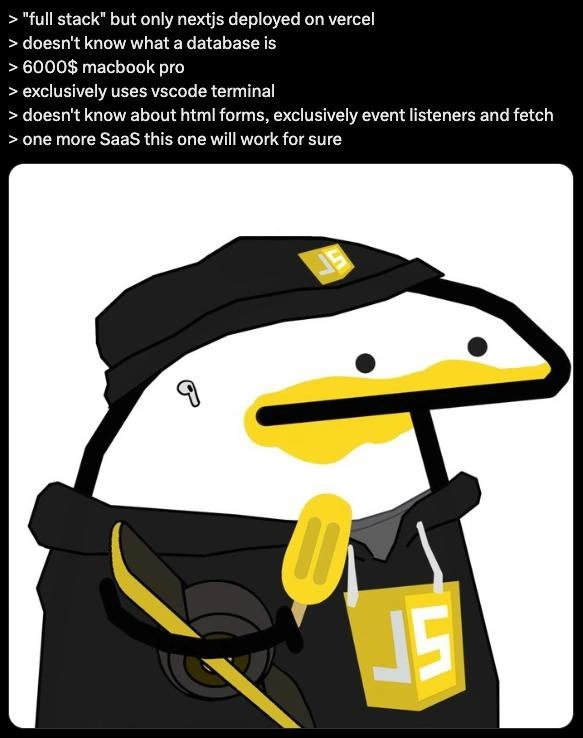
All together, the meme paints a picture of a person who is mostly a front-end developer (focused on the UI and using JavaScript frameworks) but presents themselves as if they're an expert in everything (full-stack). The cartoon duck dressed in JavaScript-themed attire is a funny visual representation of that. The duck has a hoodie and beanie with the JS logo, meaning this character is basically a walking JavaScript advertisement. It’s poking fun at those who are perhaps a bit too proud of being JavaScript developers while neglecting other skills. The AirPods, fancy laptop (implied), and even the stylus as a prop add to the stereotype: they have the look of a cutting-edge developer.
For a junior developer or someone new to this, the meme’s message is: don’t be that person who only knows one slice of the technology but claims to know it all. It’s okay to use great tools like Next.js and Vercel – they exist to make our work easier – but it's also good to understand the basics (like what forms do, or how data is stored). The humor is in the exaggeration. The dev described is an extreme case to make people smirk. It resonates with developers because it captures real tendencies (leaning heavily on high-level tools, hype from new frameworks, the "startup hustle" mentality) in a funny, self-aware way. In short, the meme is a gentle reminder wrapped in humor: being truly "full-stack" means having some depth in all parts of development, not just using a single framework and calling it a day. And you don’t become an expert just by buying a fancy Mac or sticking JS logos on everything — you gotta learn the fundamentals too!
Level 3: All Front, No Back
This meme is a tongue-in-cheek roast of the modern "full-stack" developer whose entire tech stack begins and ends with a Next.js app deployed on Vercel. It highlights the shallow breadth sometimes masked by buzzwords on résumés. For seasoned devs, each greentext line hits a nerve:
"full stack" but only Next.js deployed on Vercel – The quotes around "full stack" say it all: this dev claims to do it all, but their entire "back-end" is basically a Next.js app hosted on Vercel. In reality, Vercel abstracts away much of the server side: connect your repo and push, and your React app is live with zero knowledge of servers, networking, or OS needed. It's a convenient setup (great Developer Experience), but calling it "full stack" is a stretch – there's no custom server, no devops, no database unless one magically appears as a service. Seasoned engineers chuckle at how self-contained this "stack" is. It’s like bragging you built a house, but really you just decorated one room in a prefab and let the factory handle the assembly.
doesn't know what a database is – This jabs at devs who never venture beyond the front-end state or maybe a bit of browser storage. A true Full-Stack project involves persistence – storing data in a database (SQL, NoSQL, etc.). If our Next.js-on-Vercel hero hasn't touched a database, any data in their app is either ephemeral or stored via third-party SaaS APIs. Perhaps they use something like Firebase, or they just have no user accounts or saved data at all. In real teams, this is the developer who says "We'll just use this SaaS for user data, it'll be fine," until things go wrong and they have no clue how to optimize a query or debug a slow lookup. It's funny until you realize that in production, "doesn't know database" means "someone else has to deal with our data storage and queries." The meme exaggerates, but it’s poking at a real gap: building flashy front-ends without understanding the back-end that makes apps truly functional.
$6000 MacBook Pro – Ah yes, the stereotypical high-end gear flex. Many web developers love the latest MacBook Pro – not just for the sleek macOS experience and UNIX underpinnings, but also as a status symbol. Mentioning a "$6000" model exaggerates that this person bought the absolute top-of-the-line laptop (maxed-out specs: think 64GB RAM, crazy GPU, the works). It's humorously implied that they equate having expensive gear with being a pro developer. Our "full-stack" impostor is rocking a powerhouse machine that could compile Linux kernels or render Pixar animations, yet they’re mostly using it to run
npm installand refresh localhost. 😅 It’s a classic all flash, no substance scenario. Seasoned devs have seen this trope: a junior dev with a decked-out Mac who writes code that could run on a five-year-old PC. The expensive laptop is basically overkill for a Next.js app, but it sure looks cool at the café.exclusively uses VSCode terminal – This highlights a comfort-zone habit. VS Code (Visual Studio Code) has an integrated terminal window, and if someone exclusively uses that, it hints they've rarely touched a stand-alone terminal or shell outside their editor. They live inside their IDE: clicking GUI buttons for Git, using the built-in terminal for any shell commands, and possibly feeling lost if faced with a raw command prompt. A supposed "full-stack" dev should be comfortable running commands and scripts in various environments (setting up servers, using CLI tools, etc.), but this person might not even know how to open iTerm or Terminal.app on their $6000 Mac. The joke is gentle: it's not wrong to use VSCode’s terminal, but doing so exclusively suggests our dev has never
ssh-ed into a server or deployed outside of Vercel’s one-click pipeline. The DeveloperExperience_DX of VSCode is fantastic – it makes many tasks easier – but if you rely on it entirely, you might never develop broader sysadmin skills. Picture a senior engineer asking, "Could you tail the logs on the server?", and our dev responds with a blank stare because there's no VSCode extension for that.doesn't know about HTML forms, exclusively event listeners and fetch – This line makes old-school web devs either laugh or facepalm. It implies our friend skipped some HTML fundamentals and went straight to doing everything with JavaScript. Instead of using a simple
<form>element to submit data to a server in the traditional way, they attach JS event listeners to button clicks and use thefetch()API to send data manually. In modern single-page apps (with frameworks like React/Next), it's common to handle form submissions via JavaScript for more control. But the meme suggests this dev isn't even aware that HTML forms can submit on their own. They're effectively reinventing what the browser could do automatically, because that's all they've ever known. It's like someone who builds a custom car but doesn't realize you can turn the key to start it, so they hot-wire it every time. To illustrate the difference in approaches:<!-- Classic HTML form (no JS needed for basic submission) --> <form action="/api/submit" method="POST"> <input name="data" value="Hello!" /> <button type="submit">Send</button> </form>// Our "full-stack" dev's approach: manual JS handling document.getElementById('sendBtn').addEventListener('click', () => { const data = { value: document.getElementById('inputField').value }; fetch('/api/submit', { method: 'POST', headers: { 'Content-Type': 'application/json' }, body: JSON.stringify(data) }); });In the first snippet, the browser would handle sending the form data to the server; in the second, the developer is doing it all via JavaScript. Neither method is wrong – modern apps often need the JS approach – but the meme implies our Next.js dev only knows the JS way because that's what their framework and tutorials taught. They skipped learning how a basic form works. Experienced folks find this amusing because it shows a narrow educational path: the dev can wield
fetchand event handlers, but doesn't know the underlying web fundamentals that browsers have had since the '90s. It's a playful reminder that frameworks are great, but you should still know what's under the hood."one more SaaS this one will work for sure" – This final line drips with startup satire. SaaS (Software as a Service) refers to online software products usually sold via subscription (think Slack, Notion, etc.). The meme suggests our dev keeps chasing the next big app idea – they’ve built multiple small SaaS projects and each time believe "this one will be the hit!" It's poking fun at the optimistic cycle many devs go through: spinning up a new project with the latest tech stack, deploying it, and hoping it takes off, only to watch it fizzle and then promptly starting another. You can almost hear them say, "This time I used Next.js and a bunch of new APIs, it's definitely going to succeed". The humor lies in that boundless confidence meeting reality. It also ties into FrameworkFatigue: each "one more SaaS" might use a new framework or service (Next.js today, maybe a different shiny tool tomorrow) under the assumption that the tool will make the project successful. Those of us who've been around know that success is more about solving real problems and execution, not just the framework used. So we grin at that line because we've either been that person or mentored that person: always excited about the next project while quietly ignoring the hard lessons from the last one.
All these points combine to caricature a frontend_poser_stereotype in the meme's image: a duck decked out in a black hoodie and beanie emblazoned with the JavaScript logo, sporting AirPods and a flashy stylus. It’s the ultimate JS fanboy uniform, symbolizing someone who has made JavaScript and its ecosystem their entire identity. The duck looks smug and "cool," much like our described dev who has all the swagger of a full-stack pro – expensive gear, hipster coder vibe – but only a slice of the knowledge. The humor works because each detail is recognizable: the JavaScript-logo apparel screams "I only do JS!", the AirPods and expensive accessories scream "tech bro aesthetic," and the stylus is just absurd enough (who codes with a stylus?) to underscore the point that it's more about image than substance.
For veteran engineers, this meme elicits a mix of amusement and a knowing sigh. We laugh because we've met folks like this – enthusiastic, up-to-date with the latest trend (be it Next.js, React, etc.), but shockingly unaware of anything that isn't in their JavaScript world. We also sigh because the industry sometimes encourages this: there are bootcamps and tutorials that promise you'll be a "full-stack web developer" by only teaching you React and some cloud deployment, glossing over the deeper stuff like databases, algorithms, or networking. The result is well-intentioned devs who can get pretty far with modern tools (which is a testament to how far frameworks have come!), but when something goes off the happy path – say a production outage that requires digging into logs, or a need to optimize a slow database query – they’re out of their depth.
In essence, When the "full-stack" dev is really just Next.js on Vercel is a humorous reality check. It reminds us that true FullStackDevelopment isn’t just about using a framework that covers front and back in theory, but about understanding the pieces at play (front-end, back-end, database, ops). The meme exaggerates to make us laugh – the dev literally doesn't know what a database is in the joke – but the core message resonates: Having the fanciest tools and titles means little if you haven't learned the fundamentals behind them. And for those of us who have been around, it’s a gentle poke at times we’ve all seen someone (or been someone) who was a bit too proud of a shallow achievement. We laugh, we nod, and maybe we double-check that we haven’t neglected learning something basic in our own rush to embrace the new and shiny.
Description
The image features a 'Flork of Cows' meme character, a simple sock puppet-like figure, styled as a JavaScript enthusiast. The character wears a black hoodie and beanie, both adorned with a yellow 'JS' logo, and holds a yellow popsicle. A list of 'greentext' statements above the image satirizes a specific developer persona: '> \"full stack\" but only nextjs deployed on vercel', '> doesn't know what a database is', '> 6000$ macbook pro', '> exclusively uses vscode terminal', '> doesn't know about html forms, exclusively event listeners and fetch', '> one more SaaS this one will work for sure'. The humor critiques the modern web developer who claims 'full stack' expertise but possesses a narrow, frontend-heavy skillset centered on specific frameworks like Next.js and platforms like Vercel. It highlights a potential ignorance of fundamental backend concepts (databases) and basic web technologies (HTML forms) in favor of expensive tools and a constant chase for the next SaaS solution, a trend that experienced engineers often view with skepticism

Comments
7Comment deleted
Their definition of 'full stack' is knowing both the light and dark themes for VS Code
Thinks he’s full-stack because Next.js renders the JSON, Vercel hosts it, and git history is the database - “look, it even supports time-series queries via blame!”
The same developer who insists they need Kubernetes for their todo app but still hasn't figured out why their useState hook causes infinite re-renders
Ah yes, the 'full stack' developer whose stack is exactly one layer deep: Next.js on Vercel. They've mastered the art of `onClick={() => fetch()}` but ask them about database normalization and you'll get a blank stare that costs $6000 in MacBook Pro. They're convinced their 47th SaaS idea will finally work - right after they figure out why their form doesn't submit without JavaScript. The tactical gear is fitting though; they're fully equipped for the modern web development battlefield where the enemy is HTML fundamentals and the mission is to avoid ever touching a backend
Full‑stack in 2025: Next.js on Vercel, everything is fetch, Stripe is the database - consistency handled by their SLA, migrations by their pricing tier
Modern full‑stack: Next.js on Vercel, event listeners for forms, and the database scheduled for v2 - scales perfectly until someone asks for a JOIN
Fullstack mastery: Vercel deploys at lightspeed, but HTML forms trigger 'useEffect' PTSD