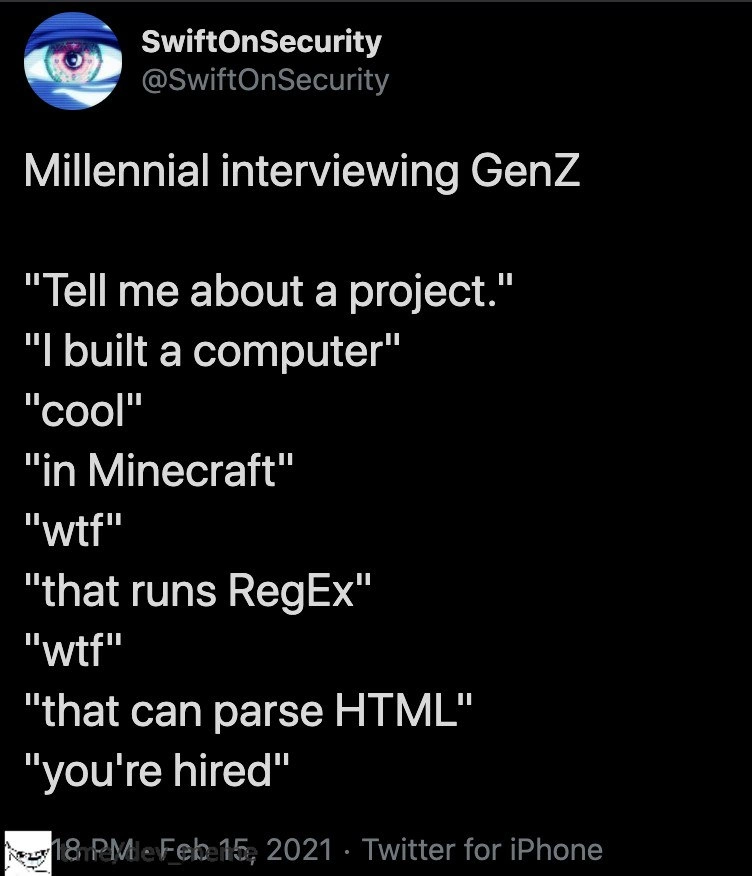
Millennial interviewer blown away by Gen Z’s Minecraft computer that parses HTML
Why is this Interviews meme funny?
Level 1: Not Just Child’s Play
Imagine a kid who loves to play with building blocks – like LEGO, but in a video game. Let’s say this kid spends hours in a virtual playground stacking blocks and creating gadgets. Now, picture an adult asking them in an interview, “So, what cool thing have you made?” The adult expects something simple, maybe the kid built a little model or a basic robot. But the kid starts describing their project, and with each detail the adult’s eyes widen a bit more:
First, the kid says, “I made a working computer.” That alone is surprising – it’s like a child saying they built a tiny version of a computer that can actually do calculations. Many adults would already be impressed by that! But then the kid adds, “...and I made it inside a video game I play.” This is completely unexpected. It’s as if a child told you they built a real radio using parts from a toy set. The adult is thinking, “Wait, you built a computer within a game world? How is that even possible?” The game in question (Minecraft) is kind of like a big digital sandbox where instead of sand, you have blocks and switches that you can use to create machines. So the kid basically used a game as their engineering kit.
Now the kid doesn’t stop there. They continue, “This computer I made can search through text using patterns.” In simpler terms, the kid taught their handmade computer how to look for specific words or combinations of letters in a bunch of text – kind of like pressing Ctrl+F on a document, but much more powerful and complex. This concept (using patterns to find things in text) is advanced even for many grown-up programmers, so the adult is now going “Huh?! You got your game-built machine to do that?”
Finally, the kid says, “...and it can even read web page code and make sense of it.” That is like saying this homemade computer can read an entire book written in a very complicated language and understand the structure of it. Web page code (HTML) is essentially instructions browsers use to show content, and it’s not something easy to read without special programs. So the kid basically built a device in their game that can digest something really messy that normally only professional software deals with. This would be like a child building a toy robot that can read a whole instruction manual and organize it correctly – it’s kind of unbelievable!
At this point in the story, the adult interviewer is so astonished that they basically blurt out, “You’re hired!” It’s a jokey way of saying: “I’m so impressed, I want you on my team immediately.” In reality, job offers don’t usually happen in one second, but this exaggeration drives home how extraordinary the kid’s project is.
The reason it’s funny is that it plays on our expectations. We usually think of video games as just child’s play – something fun and not serious. Likewise, we expect an interview with a young person to involve fairly straightforward projects (like a school assignment or a small app they made). But here the “play” turned out to be very serious engineering in disguise. The kid used what’s essentially a toy world to build something highly sophisticated, the kind of thing even adults find hard. The generational twist is part of the joke too: the younger person (Gen Z) is teaching the older person (Millennial) that the new ways of playing and learning (like using Minecraft) can lead to real, impressive skills. It’s as if a student in a science fair rolled out a huge, working time machine made out of cardboard and duct tape – the judge can’t help but be amazed and a little bewildered.
In simple terms, this meme tells a funny story: a young tech whiz turns a game into a genius project, leaving the grown-up interviewer stunned. It reminds us that sometimes the line between playing and inventing is very thin for creative people. What looks like “just a game” can actually be a platform for doing incredible things. And when that happens, even the ones doing the hiring are so blown away that the usual rules (like long interviews or doubting the candidate) fly out the window. The adult basically says, “I don’t need to hear more – if you can do that, you’re amazing. Welcome aboard!” It’s a heartwarming and humorous nod to youthful innovation, and it makes us smile because we love to see expectations turned upside down in such a clever way.
Level 2: Blocks to Bytes
Let’s break down the meme in more straightforward terms. The setting is a job interview, a scenario from the Interviews category that many of us recognize. The interviewer (a millennial – someone maybe in their late 20s or 30s) asks a common question: “Tell me about a project you’ve worked on.” This is a typical part of the TechnicalInterviewProcess, where candidates, often younger or less experienced, are expected to describe something cool or challenging they built to show their skills. The candidate in this meme is from Gen Z (born in the late 1990s or 2000s, so maybe early 20s). The humor kicks in with the project they choose to describe: “I built a computer… in Minecraft… that runs RegEx… that can parse HTML.”
To understand why that answer is both impressive and funny, let’s explain each part:
Minecraft: a popular sandbox video game where players explore a blocky 3D world, mine resources, and build structures. Importantly, Minecraft has a feature called Redstone, which is essentially a material in the game that can carry power signals. Redstone dust laid out on the ground acts like electrical wire, and there are components like Redstone torches, repeaters, and comparators that function a bit like electronic parts (switches, delays, logic gates). Players have figured out how to use these to create all sorts of contraptions in-game, from simple automatic doors to calculators and pixel art displays. Think of Redstone builds as a form of in-game programming or digital engineering using the game’s physics. It’s like virtual LEGO with electric circuitry capabilities. So when someone says they “built a computer in Minecraft,” they mean they arranged Redstone components in such a way that, just like the circuits in a real computer, they can perform calculations or run simple programs. This is part of CS_Fundamentals because it involves understanding how a real computer’s logic might work (with bits, logic gates like AND/OR, memory, etc.), and reproducing that with Minecraft blocks. It’s a well-known geeky challenge: for example, people have built 8-bit adders or even a basic CPU that adds and multiplies numbers, entirely out of Minecraft Redstone. It’s slow and huge (imagine a giant room-sized circuit made of blocks), but it works. So, this Gen Z candidate claims to have done that – which already is “cool!” in the interviewer’s response.
Built a computer… in Minecraft: At first, the interviewer just hears “I built a computer” and says “cool,” probably expecting a regular hardware project (maybe the candidate assembled a PC from parts or did a Raspberry Pi homebrew project). But then the candidate adds “in Minecraft,” which is unexpected. Building a physical computer is one thing, but doing it inside a video game is unconventional. It shows creativity and a deep level of engagement; you’re not using standard tools, you’re using a game to simulate the tools. The interviewer’s “wtf” at this stage (informal shorthand for “what the heck?!” with a more shocked tone) means they’re astonished. It’s the first sign that this project is way outside the norm. It also hints at a GenerationalGap: perhaps the millennial interviewer did play games like Minecraft casually, but wouldn’t have considered doing a serious project within it. For Gen Z, who grew up with Minecraft (which was released in 2011, so many Gen Z played it through childhood), using it as a platform for creativity – even technical projects – is more natural. This line gets a laugh because it’s a bit absurd but true: people really do complex builds in Minecraft, so it’s believable in a wild way.
That runs RegEx: Now it gets very technical. RegEx stands for Regular Expression, which is a sequence of symbols and characters that forms a search pattern. Developers use regex patterns to find or manipulate text. For example, you could write a regex to validate if a string is in the format of an email address, or to find all occurrences of a word in a document. Under the hood, using a regex involves an engine that checks the text against that pattern, often using a state machine or backtracking through possibilities. Regex is considered a mini-language in itself – terse and full of symbols like
^,$,\d,[A-Za-z]+– and it’s known to be confusing at first. Many junior devs learn about regex and find it both powerful and headache-inducing. So, when the candidate says their Minecraft computer runs regex, they’re implying that the computer isn’t just doing basic math; it can perform text pattern matching tasks. This means the candidate must have implemented a rudimentary regex engine on top of their Minecraft-made computer. Think about that: first you create a working computer out of blocks and wires in-game, then you program it to understand and execute a regular expression. Implementing regex requires knowledge of automata theory or at least how to traverse through text with a pattern. It’s definitely not a beginner task even on a normal computer, let alone on one you built from scratch in Minecraft! That’s why the interviewer goes “wtf” again – this is a second layer of “you did what?!” The shock is both at the complexity and the audacity: regex is famously tricky, so doing it in such a homemade environment is kind of mind-blowing. It’s a bit like a student saying, “I built a toy car” and then, “it runs on a custom rocket fuel I formulated.” Each step ups the wow factor.That can parse HTML: Finally, the kicker. HTML stands for HyperText Markup Language, which is the standard language for creating web pages. HTML uses tags in angle brackets (like
<div>,<p>,<a>) to structure content: headings, paragraphs, links, images, etc. Parsing HTML means reading an HTML document (which is just text with these tags) and understanding its structure — basically, identifying where the tags open and close, what’s nested inside what, and constructing a tree of elements. Web browsers do this parsing to know how to display a page. But here’s the rub: HTML, especially as used in the wild, can be quite messy (tags might not be properly closed, or might be deeply nested). It’s a known challenge in programming to write an HTML parser; usually we rely on well-tested libraries or the browser’s engine for that. Now, one of the first cautionary lessons in many programming circles is “don’t try to parse HTML with regex.” Regex is great for patterns with predictable structure, but HTML’s nesting and recursive nature makes it hard to craft a single regex that can handle every case (for example,<div><span>Hello</span></div>is fine, but nesting or missing a closing tag can confuse a regex quickly). The fact that the meme specifically says the Minecraft computer’s regex can parse HTML is a direct reference to this classic tech joke. It suggests the candidate tackled a problem that’s almost proverbially the wrong way to do it, and made it work through sheer brute force ingenuity. This is where the interviewer just gives up on being shocked and says “you’re hired.” The humor is that parsing HTML is such a complex task that if someone truly managed to do it with a regex on a self-built machine, they must be exceptionally skilled (or crazy, or both!). It’s the ultimate “I can do anything” flex from the candidate.
So why is this funny, especially in an InterviewHumor and GenerationalHumor sense? For one, it exaggerates the abilities of a younger candidate in a way that parodies real generational differences. Millennials might joke that Gen Z grew up with smartphones in hand and learned to code before they could drive. Here, that notion is blown up to a cartoonish degree: the Gen Z interviewee not only coded, but invented a whole computer system within a game to solve a problem. It plays on the stereotype that young folks have incredible tech savvy, doing things for fun that older folks find astounding. The millennial interviewer’s progressively stunned reactions (“wtf” repeated) represent the older generation being floored by what the new generation considers a ‘project’. There’s also an underlying camaraderie in the joke: both generations share a love of tech. The interviewer isn’t dismissive; instead, they’re impressed to the point of immediate job offer, meaning in this fictional interview, the common ground is their understanding of how crazy the project is.
Another aspect is how it highlights gaming as a legitimate venue for learning and demonstrating skill. Minecraft here isn’t just a game; it’s essentially a programming and engineering platform. Many junior devs or students have learned logic and programming concepts from manipulating Redstone or writing Minecraft mods. What used to be a circuit diagram on paper in a textbook can now be a hands-on, visual experience in a virtual world. This meme celebrates that by saying: look, a “gamer kid” might actually have done something more hardcore than what an EE student does in a lab. It’s funny and a bit inspiring — Games as a category can intersect with CS Fundamentals in surprising ways.
Finally, let’s touch on the format: it’s a screenshot of a tweet by SwiftOnSecurity (a popular tech parody account on Twitter). The black background, the profile pic, and the quoted dialogue format might be familiar to anyone who uses Twitter or sees tweets embedded in articles. This format has become common for sharing humorous anecdotes or jokes; people often screenshot a witty tweet and share it as an image (which is exactly what we have in the meme). SwiftOnSecurity often posts tongue-in-cheek tech commentary, and this one went viral because it resonated with a lot of tech folks. The use of casual internet slang like “wtf” and the quick back-and-forth makes it immediately relatable and easy to read.
In summary, at this level we understand that: a young candidate used Minecraft’s Redstone to build an actual working virtual computer. They then used that computer to run a regular expression (a tool for finding patterns in text) to accomplish something crazy hard: parsing HTML (reading the structure of a web page’s code). Each of those tasks alone is notable; together it’s an outrageous achievement. The interviewer’s shock and instant decision to hire the person is the punchline. It highlights how an unorthodox project in a game demonstrated such deep technical skill that it blew away the interviewer’s expectations. This teaches us that innovation can come from anywhere – even from playing around in a game – and what one generation views as “just playing” might actually be serious skill-building. And of course, it’s just plain funny to imagine that conversation happening in real life!
Level 3: Kids These Days
For experienced developers, this meme lands as a perfect storm of InterviewHumor and deep-cut technical inside jokes. The scenario: a millennial interviewer asks the classic TechnicalInterviewProcess question, “Tell me about a project you’ve worked on.” The Gen Z candidate’s answer escalates quickly from impressive to downright insane, in a tongue-in-cheek way that seasoned devs find hilarious (and a bit intimidating). The dialogue in the tweet unfolds like a slow revelation of madness:
- Candidate: “I built a computer.” – Okay, great, many of us have built our own PCs or maybe a simple breadboard CPU in college. That alone is a solid project.
- Candidate: “...in Minecraft.” – WTF. Suddenly this isn’t a typical computer engineering project; it’s in-game programming. The interviewer’s mental jaw drops: you built a working computer inside a video game? That’s a huge leap in complexity (and nerd cred).
- Candidate: “...that runs RegEx.” – WTF x2. Now the in-game computer isn’t just adding 2 + 2 or blinking lights; it’s executing text pattern matching. Implementing a regex engine means this Minecraft contraption can handle state machines or even a mini interpreter. Many senior devs have sweated over regex behavior in real applications, so hearing it runs on a Minecraft machine is mind-blowing.
- Candidate: “...that can parse HTML.” – WTF x3, mind blown. Parsing HTML is a notorious task; even on a modern server with high-level languages it’s non-trivial. HTML parsing involves handling nested tags, cases like unclosed tags, and other pitfalls that often require robust libraries. The candidate is effectively saying, “Yeah, I solved one of the trickiest text-processing problems on a computer I made out of Minecraft blocks.” At this point, the interviewer’s disbelief turns into sheer awe.
- Interviewer: “You’re hired.” – The punchline: skip all remaining formalities; this display of skill and creativity has won the job on the spot. It’s an exaggeration, of course – real interviews don’t usually end with an immediate offer after one exchange – but it humorously underscores just how impressed the interviewer is.
The humor here plays on the generational gap and our industry’s evolving nature. Millennials (born in the ’80s and ’90s) might reminisce about projects like building simple robots with kits or coding a website as a teenager. But here comes Gen Z, who grew up with open-world sandbox games and unlimited access to technology, doing projects that sound like sci-fi. A millennial interviewer hears “built a computer” and might assume a Raspberry Pi project or assembling PC parts – impressive but familiar. When the candidate specifies “in Minecraft,” the older dev’s mental model flips: this is a GamingReference to a platform most of us considered just a fun pastime. Turning it into a working computer is an ultimate geek flex, something many have watched YouTube videos about but few have patience to actually do. It’s a bit like a tech talent show moment – unexpected medium, astonishing result. Kids these days!
What really makes seasoned engineers cackle is the RegEx and HTML one-two punch. These are everyday tools in programming, but with a lot of baggage and lore. Regular expressions are powerful but often overused in hilarious ways; there’s the classic joke: “Some people, when confronted with a problem, think ‘I know, I’ll use regular expressions.’ Now they have two problems.” In practice, regex can indeed turn a simple task into a complex debugging nightmare if you’re not careful. And one of the canonical examples of regex misuse is trying to parse HTML or XML with it. The phrase “You can’t parse HTML with regex” is practically memetic in developer communities – it’s been the punchline of countless Stack Overflow threads and comic strips because of how HTML’s nested structure confounds regular expressions. So when the Gen Z interviewee proudly says their Minecraft computer can parse HTML using regex, it’s layering two infamous tech challenges together. It’s absurdly funny: it’s as if the candidate deliberately chose the most overkill, convoluted approach possible – and pulled it off. This is the kind of story an experienced developer might half-jokingly share over coffee: “You won’t believe it, but I interviewed a kid who parsed HTML with a Minecraft-built regex machine!” Cue the stunned expressions.
Beyond the absurdity, there’s genuine admiration. This mythical Gen Z project demonstrates a mastery of CS fundamentals (digital logic design, automata theory) wrapped in an unconventional format. It’s the ultimate answer to “What’s the coolest thing you’ve done?” It shows creativity, problem-solving, and borderline masochistic dedication. Any senior engineer knows that building a stable parser or writing a regex engine from scratch is non-trivial – doing it on custom hardware made of virtual blocks is jaw-dropping. It highlights that the next generation of programmers might approach problems very differently. They aren’t limited by traditional thinking; they tinker in sandbox games, learn programming concepts by modding or redstone circuits, and think outside the conventional “write code in Python on a PC” box. The meme, posted as a tweet by the popular account SwiftOnSecurity (a source known for infosec and tech satire), captures this zeitgeist with a dash of viral Twitter humor. The black background and tweet format have become a common meme vehicle for relatable tech anecdotes, and here it delivers a perfect blend of GenerationalHumor and TechnicalInterviewProcess parody.
To an experienced dev, there’s also an ironic subtext: interviews often focus on leetcode problems or system design whiteboarding, yet here a candidate blows the process away by presenting a wildly practical-but-impractical personal project. It pokes fun at hiring practices – the interviewer’s script (“Tell me about a project”) gets totally derailed by an answer no one could anticipate. And honestly, many of us would love to hire someone with that kind of passion and skill! It’s a wish-fulfillment scenario for both sides: the interviewee gets to showcase something truly unique they’re proud of, and the interviewer immediately recognizes a kindred tech genius and says “you’re hired” without bureaucracy. The comedy works because it taps into our shared experiences and aspirations in tech:
- We’ve struggled with regexes and HTML parsing, so we appreciate the ridiculousness of doing it in Minecraft.
- We remember or participate in generational shifts – each new cohort of developers has new toys and talents that surprise the previous generation.
- We’ve sat in interviews (on one side or the other) and secretly wished for a mind-blowing project story instead of the usual drab answers.
In short, this meme is “too real” and fantastical at the same time. It exaggerates reality to highlight truths: passion projects can be incredibly advanced, and the ways people learn and impress in tech are always evolving. Seasoned devs laugh because they imagine themselves as that interviewer, saying “WTF” repeatedly — half incredulous, half impressed — until they, too, would give in and say “you’re hired.” It’s a delightful celebration of both the absurd complexity we often wrangle in tech and the brilliant creativity that new blood brings to the field.
Level 4: Turing-Complete Toybox
At the most abstract level, this meme spotlights a Turing-complete sandbox inside a video game and the stacking of formal language complexities on top of it. Minecraft’s Redstone system essentially allows players to build logic gates and memory circuits using in-game components (think of Redstone dust as wiring and torches as transistors tiny power sources). With enough Redstone contraptions, one can simulate a primitive CPU inside the game. This is not just a toy – it’s a digital logic laboratory. In theoretical computer science terms, Minecraft’s Redstone world is Turing-complete: given enough space and time, it can perform any computation that a real computer can. Enthusiasts have proven this by constructing in-game adders, ALUs, and even entire 8-bit computers block by block. It’s like building a working Von Neumann architecture out of virtual LEGO bricks – immensely slow and impractical, but fundamentally universal in computing power.
Now, what does it mean to “run RegEx” or “parse HTML” on such a contraption? Here we venture into the realm of formal languages. Regular expressions correspond to regular languages in the Chomsky hierarchy – patterns that can be recognized by a finite state automaton. HTML, however, isn’t a regular language in the general case; it’s a semi-structured markup often requiring a context-free grammar (or beyond) to parse correctly, because tags can nest arbitrarily deep. There’s a famous adage in programming: “You can’t parse HTML with regex.” It humorously underlines that HTML’s structure is too complex and recursive for a single regex pattern to handle in all cases. In computational theory, to parse nested structures like HTML, you typically need a pushdown automaton (theory-speak for something like a stack or a more powerful machine than a regex engine). A regex engine alone (based on an NFA/DFA or backtracking algorithm) will inevitably choke on fully general HTML.
So when the Gen Z candidate claims they built a computer in Minecraft that “runs RegEx” and “can parse HTML,” it implies they’ve essentially created a complete computing system with at least the power of a pushdown automaton inside the game. In other words, they used Minecraft’s Turing-complete substrate to implement a regex-powered HTML parser. This is a wild stacking of computational abstractions: a real physical computer (your PC) runs Minecraft (software) which simulates a virtual computer (Redstone circuit) which runs a regex-driven parser (software again) to analyze HTML (a complex language). It’s computing inception, and it tickles the fancy of any CS theory enthusiast. Each layer — from Redstone logic gates up to pattern matching and language parsing — echoes core CS concepts: digital design, automata theory, and language grammars. The meme humorously implies the candidate conquered all these layers in a feat of recreational computer science.
From a theoretical perspective, it’s an absurdly beautiful achievement. It’s as if someone proved a point by brute force: yes, you can parse HTML with regex… if you first design a whole computing machine to carry it out! This evokes the notion of a “Turing tar-pit” – a system where everything is possible in principle, but doing anything practical is ridiculously hard. Minecraft is the tar-pit here: it lets you simulate anything, but building an HTML parser out of torches and pistons is the opposite of efficient. Yet, it’s possible, and that possibility is the punchline’s foundation. The older interviewer (a millennial) is effectively encountering the reality that the younger generation took a playful, Turing-complete toy and pushed it to academic extremes. It’s a testament to fundamental CS knowledge packaged in the most unexpected wrapper. Any senior engineer or CS grad can appreciate the layers of irony: Redstone computing demonstrating theoretical principles, a regex engine implemented for fun (when in practice we often warn newbies not to reinvent those), and tackling HTML parsing — a task even seasoned programmers approach with caution — all done in a game. It’s an intellectual flex of the highest order, couched in generational humor.
Description
Screenshot of a tweet from the account “SwiftOnSecurity” on a black Twitter UI background. Header shows a circular profile image, the display name “SwiftOnSecurity,” and handle “@SwiftOnSecurity.” The tweet reads: “Millennial interviewing GenZ” followed by a back-and-forth dialogue in quotation marks: “Tell me about a project.” / “I built a computer” / “cool” / “in Minecraft” / “wtf” / “that runs RegEx” / “wtf” / “that can parse HTML” / “you’re hired.” Small footer text shows the posting time and “Twitter for iPhone.” The humor hinges on generational culture clash in technical interviews: a Gen Z candidate describes constructing a functioning computer inside Minecraft using Redstone, capable of executing regular expressions and parsing HTML - an absurd yet technically remarkable feat. Seasoned engineers will recognize references to regex complexity, HTML parsing pitfalls, and the novelty of building Turing-complete machines within a game, highlighting interview expectations versus modern DIY hacking ingenuity
Comments
13Comment deleted
If you can simultaneously break “never parse HTML with regex” and “Minecraft isn’t prod” and still ship, you’re exactly the person we need to untangle our ‘distributed monolith’ that insists SOAP messages are just XML loot boxes
The real horror isn't parsing HTML with regex - it's explaining to the board why your critical infrastructure now requires a Minecraft server with a 64-chunk render distance and dedicated GPU for redstone tick optimization
The real genius here isn't building a Minecraft computer that runs regex to parse HTML - it's convincing the interviewer you did it before they remember the legendary Stack Overflow answer about summoning eldritch horrors. Any architect who's maintained a legacy codebase knows that parsing HTML with regex is the technical equivalent of 'hold my beer' moments that haunt production for decades. But a GenZ candidate casually dropping 'I built it in Minecraft' is the ultimate power move: either they're a redstone savant who understands computational theory at a hardware level, or they're brilliantly calling out how absurd technical interviews have become. Either way, in a market where FizzBuzz still filters out candidates, someone who can discuss Turing completeness through the lens of block-based gaming while trolling fundamental CS anti-patterns deserves the offer letter - if only to see what they'd do with Kubernetes
Parsing HTML with regex in Minecraft? You’re hired - our prod is the same concept: Turing‑complete configs, optimistic specs, and redstone that’s just called YAML
In hiring, a Minecraft regex that parses HTML beats a decade of fizzbuzzes and system design whiteboard marathons
A redstone CPU is believable; a regex that parses HTML is the fantasy - one is Turing-complete, the other is interview-filter complete
Never hire anyone who uses regex to parse html. Comment deleted
You are not funny, right? Comment deleted
If I was funny, why would I be reading a developer memes channel? Comment deleted
*Sad trombone* Comment deleted
https://stackoverflow.com/questions/1732348/regex-match-open-tags-except-xhtml-self-contained-tags#1732454 Comment deleted
Absolute classic Comment deleted
Purrfect Comment deleted