When editing the web server config feels like bomb disposal duty
Why is this Configuration meme funny?
Level 1: Handle with Care
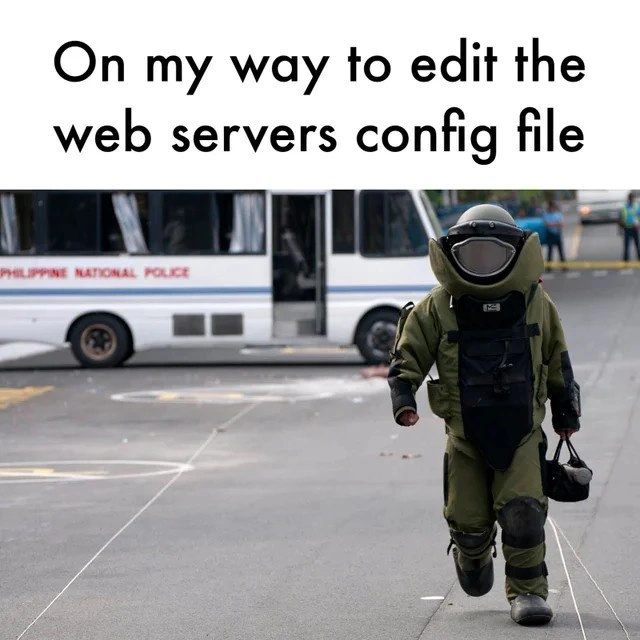
Imagine you have a very delicate machine that runs your favorite game or website. Changing the settings on that machine is like stacking a tower of blocks super high – if you move one block wrong, the whole tower might fall down. The meme is saying that changing a server’s settings feels as careful as defusing a pretend bomb. In the picture, a bomb expert in a big protective suit is walking slowly and carefully, just like an engineer would be very careful about adjusting important computer settings. In simple terms: touching an important part of a running website is a bit scary, because a tiny mistake could make the whole thing stop working. So you do it very slowly and carefully – like carrying a full glass of juice across a white carpet. One slip, and there’s a big mess! The joke is that something as simple as editing a file on the server can feel as nerve-wracking as cutting the right wire on a bomb. Basically, be super careful or… boom!
Level 2: Proceed with Caution
For newer developers or junior ops folks, let’s break down why editing a web server’s config file is compared to a bomb squad scenario. A configuration file is basically a set of instructions that tells your software (here, a web server) how to behave – which port to listen on, what files to serve, how to handle security, etc. Popular web servers like Apache (with its httpd.conf or .htaccess files) and Nginx (with its nginx.conf and site config files) rely heavily on these configurations. Changing those instructions, especially on a running production server (the real website that users are visiting), can be very sensitive. It’s like adjusting the engine of a car while it’s speeding down a highway – not the ideal time for mistakes. This is why the meme shows a bomb expert: it humorously suggests that editing a config requires utmost caution and nerves of steel.
Why so cautious? Because even a simple typo or error in the config file can cause big problems (deployment risks). For example, if you add a new rule or change a setting in the config and there’s a mistake, the web server software might not understand it and could refuse to start or load that config. If the server software doesn’t start up properly, your website could go offline – that’s a production incident, meaning users see errors or can’t reach your site. To someone in operations (Ops), that scenario is about as scary as a “boom” – not literally explosive, but it could blow up your uptime and pager alerts. This is why it feels like a risky hotfix: you’re making a quick change to fix something (a hotfix) on the live system, and if you slip up, things get worse fast.
In DevOps and sysadmin culture, there are lots of jokes (sysadmin humor, Ops humor) about these situations because they happen a lot. People might say “One does not simply edit the production config” – implying you should be very, very careful. There are best practices to avoid feeling like a bomb defuser, such as using configuration management tools (like Ansible, Puppet, or Chef) which let you plan and test config changes, or doing the change in a staging environment (a copy of production) first. But sometimes, in the real world, you have to log in to the server and edit a config by hand. Maybe an urgent bug or outage is happening and the fastest way to recover is to tweak a setting right on the server. In those moments, even a junior engineer learns quickly why this meme exists: your heart races a bit, and you double-check every character in that file before you hit save.
To illustrate, consider a web_server_config example: say you run an Apache web server and your site is down because it’s not allowing users to connect. You realize a setting in the config is too strict (perhaps an access rule). To fix it, you open the Apache config file to change Require all denied to Require all granted (so that visitors are allowed in). This sounds simple, but you’re keenly aware that if you mess up the syntax or put that line in the wrong place, Apache might not restart. That would keep your site down – oops! So you carefully make the change, maybe run apachectl configtest (a command to test the config for errors, much like a bomb squad using a tool to see if the device is armed), and only then restart Apache. When it comes back online and the site works, phew! – you feel as relieved as diffusing a bomb with 00:01 seconds left on the timer.
This meme also resonates with anyone who’s dealt with production servers because it captures the fear_of_outage – the worry that a simple action could inadvertently break something huge. The bomb_squad_meme image is a lighthearted exaggeration: obviously editing a text file isn’t physically dangerous, but the emotional pressure and focus needed can feel like a life-or-death mission when your company’s website (or your job’s on the line) is at stake. Even differences like Apache vs Nginx (two different web servers) don’t matter here; both have config files that must be correct. Seasoned developers might playfully argue about which server is better, but they’ll all agree that messing up either one’s config will ruin your day. So, especially if you’re new: proceed with caution, test your changes in a safe environment if you can, and remember that even pros get the cold sweats editing configs on live systems. The meme is a funny reminder of that shared anxiety.
Level 3: Config Roulette
The meme hits experienced DevOps/SRE nerves by equating a simple config edit with bomb disposal. It's funny because it's true in a dark way. A senior engineer knows that a tiny tweak to a web server config can blow up a production environment. One stray character in nginx.conf or a mis-indented Apache directive, and BOOM – your site is down, alarms are blaring, and you’re in the blast radius of a production incident. The image of a bomb-squad technician in full gear perfectly captures that feeling: you suit up with extreme caution (maybe not a literal Kevlar suit, but definitely a cautious mindset) before touching a critical configuration file on a live server.
Why so dramatic? Because editing a web server’s config is often a high-stakes game of “Config Roulette.” The deployment risks are real: one wrong move and the web server might fail to restart, cutting off user traffic as effectively as an explosion. No pressure, right? Seasoned ops folks have learned (the hard way) that config changes require the same steady hands and nerves of steel as defusing a bomb:
- Precision or Disaster: Web servers like Apache and Nginx are unforgiving. A missing semicolon in Nginx or a wrong order of directives in Apache is like cutting the wrong wire – the whole service might not come back up. For instance, in Nginx: forgetting a
;at the end of a line can prevent the server from loading any of your site configuration. It’s the digital equivalent of a detonator: small character, big boom. - Downtime Blast Radius: A misconfiguration can take down the entire site or expose security holes. Change the wrong setting and suddenly your homepage is a 503 error or, worse, you’ve enabled directory listings and leaked sensitive files. A veteran sysadmin double- and triple-checks changes because they know the blast radius of a config mistake can range from minor glitch to full-on outage.
- No Immediate Undo: Unlike code deployments where you might do a quick rollback, a config change often goes live immediately (especially if you’re editing directly on the server – a cowboy move, but we’ve all been there at 3 AM). If that change was bad, the server could refuse to reload. You can’t exactly “step away from the bomb” once you’ve snipped the wire; you’re in it and must fix it under pressure.
The humor is also in the DevOps culture it references. This is classic Ops humor born from real anxiety: everyone standing back (like the police bus and caution tape in the photo) while the lone “bomb tech” – the on-call engineer – approaches the terminal with sweaty palms. It’s funny because it’s a coping mechanism; you joke that editing config is bomb-defusal to acknowledge how ridiculous and intense it feels. If you’ve ever been that person, decked out in metaphorical armor, about to sudo vi /etc/nginx/nginx.conf in production, you understand the meme viscerally.
This meme also hints at the gap between ideal and reality. In theory, we should have configuration management tools, version-controlled config files, infrastructure as code – all safety measures so no single edit feels life-threatening. In practice, especially in legacy systems or lean teams, you still find yourself manually tweaking a config while praying to the uptime gods. The missing apostrophe in “web servers config” even suggests the hasty, jittery state you’re in – grammar be damned when you’re on a bomb squad mission to fix prod. It’s a bit of sysadmin dark humor: we laugh, but only to hide the tears of those 2 AM emergencies.
Whether you’re Team Apache or Team Nginx, the fear of outage doesn’t discriminate. Apache’s .htaccess quirks or Nginx’s strict syntax – either one can ruin your night if you’re careless. Smart ops folks mitigate where they can: using apachectl configtest or nginx -t (like a bomb squad X-ray) before applying changes, scheduling maintenance windows, keeping backups of last known-good configs, etc. But even with all that, when you “go on your way to edit the web server’s config file,” you can’t help feeling like you should be hearing the Mission: Impossible theme in the background. 😅 In short, the meme nails a universal DevOps experience: touching a production config triggers the same adrenaline as diffusing a live bomb, a task only the brave (or foolish) take on willingly.
Description
The meme has two parts. At the top, large black text on a white background reads: "On my way to edit the web servers config file" (missing apostrophe in "servers"). Below the text, a photo shows a lone bomb-squad technician in a full green explosive-ordnance suit, visor down, slowly walking across an empty street while carrying a small tool bag; a police bus and yellow caution tape are blurred in the background. The contrast between the caption and the image jokes that touching a production web-server configuration file is as dangerous and high-stakes as defusing a bomb, a feeling many ops and backend engineers know all too well given the potential for downtime, misconfiguration, or security regressions
Comments
8Comment deleted
Blue-green deploys sounded elegant until I’m in /etc/nginx/conf.d at 2 AM, staring at include *.conf and trying to decide which “wire” to cut before the pager detonates
The only difference between editing nginx.conf in production and actual bomb disposal is that with the bomb, at least the blast radius is limited to one city block instead of your entire user base
The protective suit is necessary because one misplaced semicolon in nginx.conf can take down the entire production environment faster than you can type 'sudo systemctl restart' - and unlike bomb disposal, there's no 'cut the red wire or blue wire' decision tree, just a config file where whitespace matters and the blast radius is measured in angry Slack messages per second
One misplaced 'location /' block in nginx.conf, and your entire empire's a 502 crater - no red wire needed
Change request said 'config only' (aka cluster-wide runtime code with no compiler); one misordered include and you’ve invented a global kill switch
Editing nginx.conf in prod is defusing a bomb - SIGHUP is the blue wire, restart is the red, and one missing semicolon takes 443 down across twelve regions
? Comment deleted
Nginx isn't use wrong config Comment deleted