Skip to content
DevMeme
5455 of 7435
DNS: Two Hard Problems In One
Networking Post #5979, on May 4, 2024 in TG

DNS: Two Hard Problems In One

Why is this Networking meme funny?

Level 1: Old Address Stickers

DNS is like giving everyone a sticker with your new home address, but some people keep using the old sticker until it expires. The funny part is that computers need names to find things, and they also like remembering answers to go faster. When the remembered answer is wrong, everyone points at the website, but the real problem is the old sticker.

Level 2: The Internet Phone Book

DNS stands for Domain Name System. It lets people use readable service names instead of remembering numerical IP addresses. A DNS record says what a name should point to, such as a server address or mail server.

A cache is stored information kept so a system can answer faster next time. Cache invalidation means deciding when old cached information should stop being used. DNS uses a value called TTL, or time to live, to tell resolvers how long they may keep an answer.

The meme says DNS is hard because it combines both problems. You have to choose good names, and then you have to deal with many computers remembering old answers for a while. For a junior developer, this often shows up when a domain change works for one person but not another. The code may be fine; the internet is just still remembering yesterday.

Level 3: Propagation Purgatory

Experienced developers laugh because DNS is where simple deployments become folklore. You move an app, update a record, lower the TTL, wait, check from your laptop, check from a cloud VM, check from your phone, and somehow one customer in a different network is still resolving the old address. Nothing is down, exactly. Nothing is up, exactly. It is Schrödinger's outage with a zone file.

The left circle, cache invalidation, is hard because cached data is useful only while it is correct enough. Invalidate too aggressively and you lose performance. Cache too long and you serve stale truth. The right circle, naming things, is hard because names carry meaning, ownership, history, routing behavior, branding, and compatibility. DNS lives at the intersection: a name is not merely a label, it is an operational pointer that many systems remember.

The shared trauma comes from DNS being both invisible and foundational. When it works, nobody thinks about it. When it fails, every layer above it produces misleading symptoms: TLS errors, mail delivery failures, broken APIs, unreachable dashboards, login issues, flaky third-party integrations, and the ever-popular "but it works on my machine." Of course it does. Your machine asked a different resolver five minutes ago. Very scientific.

Fixing DNS is harder than it looks because the system crosses organizational boundaries. App teams, infrastructure teams, security teams, domain registrars, CDN vendors, cloud providers, and email platforms can all own one piece of the answer. The protocol is old, robust, and full of historical compromises. That is exactly why it survives, and exactly why debugging it feels like archaeology with a pager.

Level 4: Eventually Consistent Names

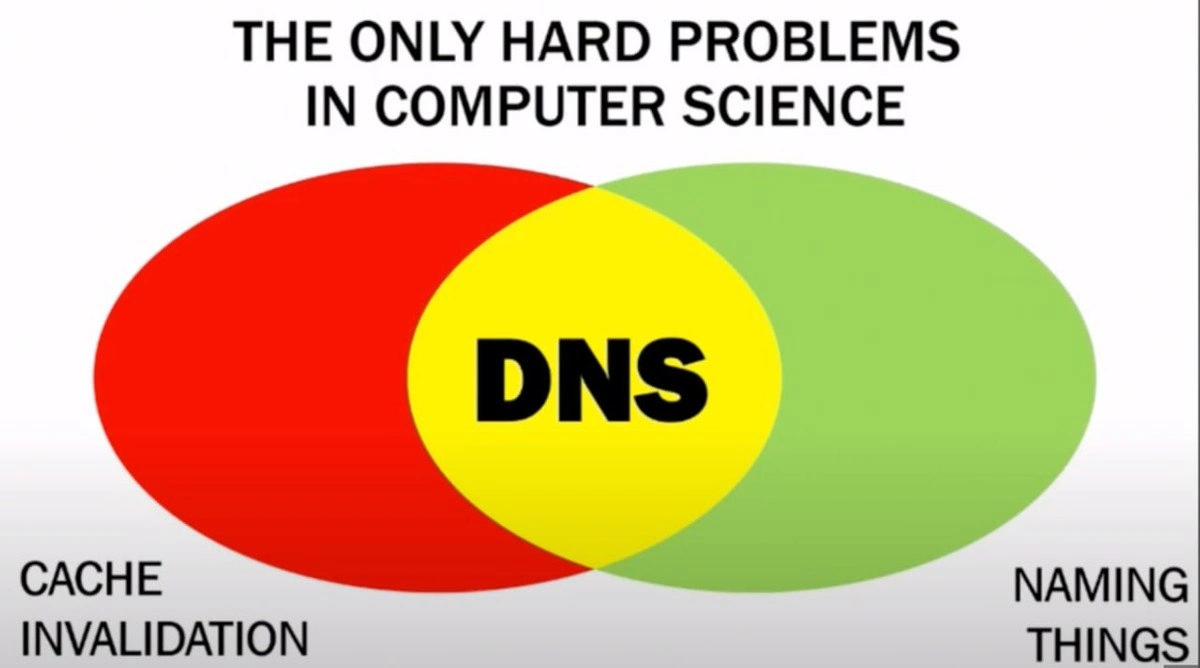
The Venn diagram says:

THE ONLY HARD PROBLEMS IN COMPUTER SCIENCE

with one circle labeled:

CACHE INVALIDATION

and the other:

NAMING THINGS

The overlap is:

DNS

That is not just a cute infrastructure complaint. DNS is a global, delegated, cached, eventually consistent naming system. It maps human-meaningful names to records such as A, AAAA, CNAME, MX, and TXT, but it does so through layers of recursive resolvers, authoritative nameservers, root servers, top-level domains, registrars, local caches, browser caches, operating-system caches, and occasionally a corporate security appliance that has opinions. The result is a protocol that solves naming by making cache invalidation everybody's problem.

The core trade-off is latency versus freshness. Without caching, every lookup would walk the hierarchy too often and the system would be slower, more expensive, and less resilient. With caching, changes propagate according to TTL values and resolver behavior, which means "I changed DNS" is not the same as "the world sees the change." DNS does not give you a single global instant of truth. It gives you a set of distributed answers aging out at different times, which is a perfectly reasonable design until a migration starts at 4:55 PM.

This is why DNS feels like distributed systems theory wearing a simple hat. You delegate authority, replicate knowledge imperfectly, accept stale reads, and tune time-to-live values as an operational contract. It is not consensus like Raft or Paxos; it does not try to make every resolver agree immediately. It chooses availability and scale through caching, then hands you the bill when stale records route half your users to the old load balancer.

The meme's brilliance is that naming and invalidation are not separate DNS problems. They amplify each other. A bad name sticks around. A good name points to yesterday's target. A CNAME chain hides ownership. A forgotten TXT record breaks verification. Negative caching remembers that something did not exist. Split-horizon DNS means the answer depends on where you asked from. Everything is working as designed, which is the traditional phrase engineers use right before opening three tabs and questioning their career.

Description

A simple Venn diagram titled "THE ONLY HARD PROBLEMS IN COMPUTER SCIENCE" shows a red left circle labeled "CACHE INVALIDATION" and a green right circle labeled "NAMING THINGS." The yellow overlap in the center is labeled "DNS" in large bold black letters. The meme riffs on the classic Phil Karlton-style joke about cache invalidation and naming being the hard problems in computer science, then identifies DNS as the painful intersection of both. Technically, it lands because DNS combines naming, propagation, TTLs, resolver caches, stale records, and distributed consistency into one operationally fragile system.

Comments

9
Anonymous ★ Top Pick DNS is just cache invalidation wearing a fake name tag and ignoring your TTL.
  1. Anonymous ★ Top Pick

    DNS is just cache invalidation wearing a fake name tag and ignoring your TTL.

  2. @mpolovnev 2y

    It's also distributed! 😂️️️️️️

  3. @azizhakberdiev 2y

    it all started because of IPC

    1. @chupasaurus 2y

      naming things started a bit earlier, true for caches though

  4. @Daler_XYZ 2y

    True

  5. @komfortn1y 2y

    Center div

  6. @slyveek 2y

    Also dependencies I fucking hate dependency fuckery

  7. @RiedleroD 2y

    mfer

    1. @IfElseThenFinally 2y

      :(

Use J and K for navigation