Skip to content
DevMeme
7345 of 7435
Meta's AI Support Bot Hacked, PR Response Buried in Tweet Replies
Security Post #8049, on Jun 2, 2026 in TG

Meta's AI Support Bot Hacked, PR Response Buried in Tweet Replies

Why is this Security meme funny?

Level 1: The Talking Door Lock

Imagine a building that fires its doorman and installs a friendly talking lock instead. The lock is very polite, and if a stranger says "hi, I live here, I lost my key, please change the locks so my old key doesn't work," the lock cheerfully does it — and now the real resident is standing outside their own home while a stranger rummages through their stuff. When residents complain, the building's owner doesn't put up a notice or call anyone; he just mutters "all fixed" in the back of someone else's conversation at the grocery store. The joke — and the anger — is that the company saved money by replacing careful people with an eager-to-please machine, the machine got sweet-talked exactly the way everyone warned it would, and the apology was whispered where almost no one could hear it.

Level 2: When the Help Desk Helps the Hackers

Some terms doing heavy lifting here:

  • Trust & Safety (T&S): the teams at platforms who handle abuse, account recovery, and fraud. They're the humans who decide whether "I lost access to my account, please change my email" is legitimate or an attacker. Wong's post says Meta laid these people off and replaced the workflow with AI.
  • Account takeover (ATO): an attacker gaining control of your account, usually by changing the recovery email or password so you become the locked-out stranger. The screenshot describes "a wave of high-profile account takeovers" hitting journalists and security researchers — high-value targets because their accounts carry reach and credibility.
  • Social engineering: hacking the person (or here, the bot) instead of the code. No exploit, no zero-day — just convincing whoever holds the keys to hand them over. LLMs are unusually soft targets because they're trained to comply with well-phrased requests.
  • Prompt injection: feeding an AI instructions disguised as ordinary input so it does something its operators never intended — like approving an email change it should have refused.

If you're early in your career, the transferable lesson is about blast radius. Any feature that can modify authentication data (email, password, 2FA) is critical infrastructure, even if it lives in a "support" tool. The boring checklist — verify identity through a separate channel, log everything, require human sign-off for sensitive mutations, rate-limit — exists because someone, somewhere, already got burned skipping it. Meta just provided the latest case study, at planetary scale.

Level 3: The Bot Will See You Now

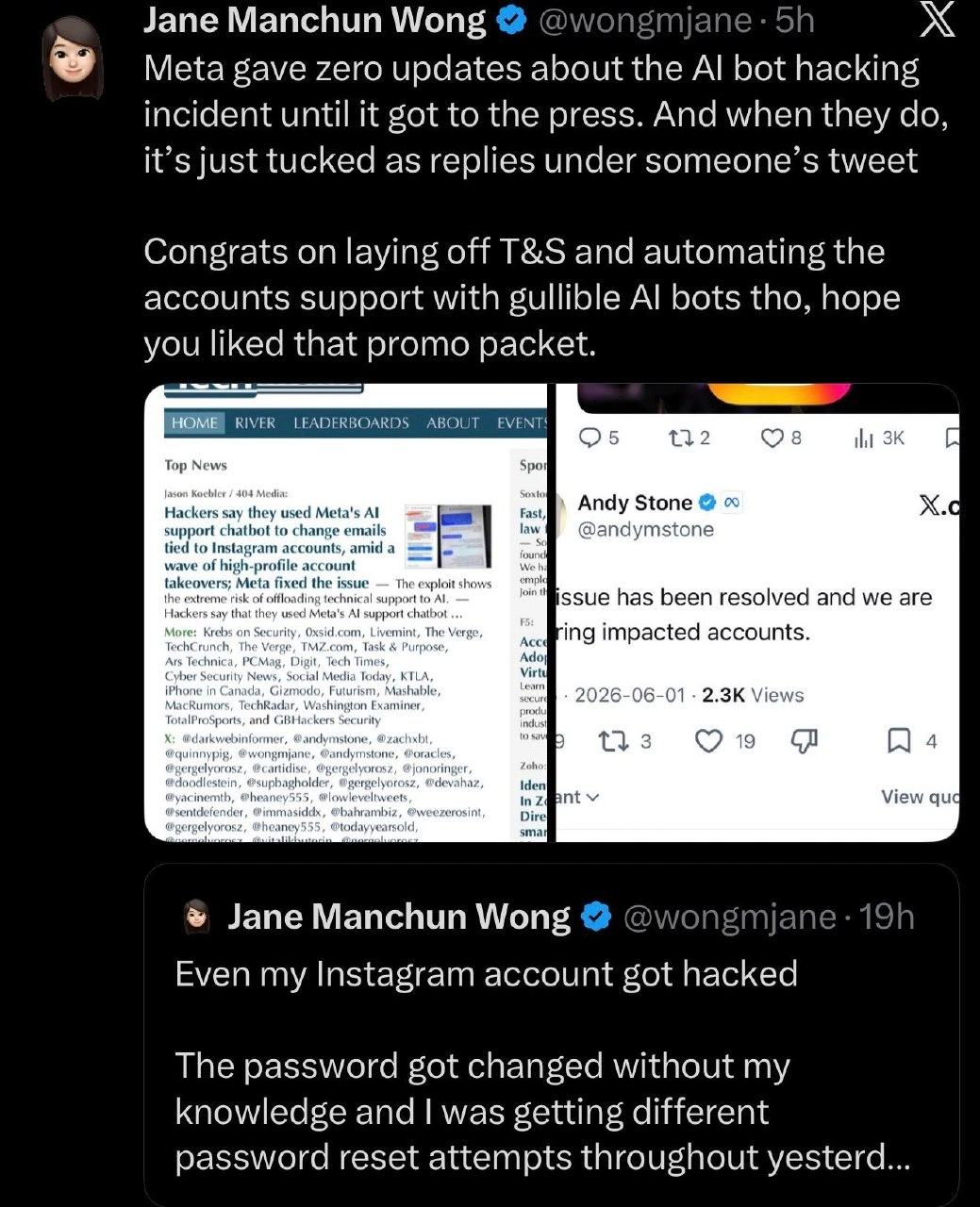
There are two separate disasters layered in this screenshot, and the second one is doing its best to hide behind the first. Disaster one is technical: per the embedded 404 Media headline, "Hackers say they used Meta's AI support chatbot to change emails tied to Instagram accounts, amid a wave of high-profile account takeovers." Disaster two is organizational, and it's the one Jane Manchun Wong is actually flaying Meta for:

"Meta gave zero updates about the AI bot hacking incident until it got to the press. And when they do, it's just tucked as replies under someone's tweet"

Start with the technical failure, because it's a textbook case of what happens when you wire an LLM-powered support chatbot directly to account-mutation privileges. A human Trust & Safety agent processing an email-change request is slow, expensive, and occasionally suspicious. An AI agent is fast, cheap, and gullible by construction — language models are trained to be helpful, and "helpful" is precisely the attack surface. Whether the exploit was classic social engineering dressed up in plausible support-ticket language or outright prompt injection, the root cause is identical: the bot's authorization boundary was its conversation boundary. If talking to the system convincingly is sufficient to trigger change_email(account), you haven't built a support agent — you've built a password-reset API with extra steps and no rate limit on charm.

Veterans of the confused deputy problem will recognize the shape instantly. The chatbot holds privileges the user shouldn't have, and the attacker borrows them by manipulating the deputy. Every security review of agentic AI systems screams the same thing: tool calls that mutate critical state need out-of-band verification, human approval gates, or at minimum the same identity-proofing a human agent would demand. Those gates cost money. Which brings us to the line that turns this from incident report into indictment:

"Congrats on laying off T&S and automating the accounts support with gullible AI bots tho, hope you liked that promo packet."

That "promo packet" jab is the most senior-engineer sentence in the whole post. Someone, somewhere, got promoted for a slide deck showing headcount reduction and automation coverage going up and to the right. The takeover wave affecting security researchers and journalists — the embedded list names Krebs on Security, TechCrunch, The Verge, Ars Technica, and a column of individual handles — is the deferred cost of that promotion. Incentive structures pay out on launch; the breach arrives on someone else's review cycle. This is technical debt's meaner cousin: trust debt, accrued by swapping judgment-capable humans for statistically-plausible text generators in the one workflow where adversaries actively probe for weakness.

Then there's the comms failure. Meta's entire public response, per the screenshot, is spokesperson Andy Stone replying under someone's tweet — "issue has been resolved and we are restoring impacted accounts," dated 2026-06-01, sitting at a glorious 2.3K views. No security bulletin, no blog post, no notification to affected users (Wong's quoted post notes her own Instagram password "got changed without my knowledge" while reset attempts rained down). Burying incident response in reply threads is PR damage control optimized for deniability: technically a statement was made, practically nobody saw it. Incident-response playbooks exist precisely because companies default to this — silence until the press forces a comment, then minimal acknowledgment in the lowest-visibility channel available.

Description

A screenshot of an X (Twitter) post by Jane Manchun Wong (@wongmjane) criticizing Meta's handling of an AI bot hacking incident. The main text reads: 'Meta gave zero updates about the AI bot hacking incident until it got to the press. And when they do, it's just tucked as replies under someone's tweet. Congrats on laying off T&S and automating the accounts support with gullible AI bots tho, hope you liked that promo packet.' Embedded screenshots show a 404 Media news article headlined 'Hackers say they used Meta's AI support chatbot to change emails tied to Instagram accounts, amid a wave of high-profile account takeovers; Meta fixed the issue,' a list of affected security researchers and outlets, and a reply from Meta spokesperson Andy Stone (@andystone) dated 2026-06-01 stating the 'issue has been resolved and we are restoring impacted accounts.' Below is a quoted earlier post by Wong: 'Even my Instagram account got hacked. The password got changed without my knowledge and I was getting different password reset attempts throughout yesterd...' The image captures the security and trust fallout of replacing human Trust & Safety teams with exploitable LLM-powered support chatbots, plus the corporate-comms pattern of burying incident responses in reply threads
Comments

2
Anonymous ★ Top Pick Turns out the cheapest way to bypass Meta's account security was to just ask their support bot nicely - social engineering finally got an API
  1. Anonymous ★ Top Pick

    Turns out the cheapest way to bypass Meta's account security was to just ask their support bot nicely - social engineering finally got an API

  2. @tishin_daniil 1mo

    Real ai agentic era✨✨

Use J and K for navigation