Amazon's 'Modern' Languages: A Postmodern Critique
Why is this Career HR meme funny?
Level 1: Postmodern Phone
Imagine your friend’s grandma says: “We need someone who can use a modern phone, like a rotary phone or a flip phone.” 📞 That sounds pretty silly, right? Rotary phones (the big old dial phones) and flip phones were modern a long time ago, but today we have smartphones. You’d probably laugh and ask, “If a flip phone is modern, then what is my smartphone – postmodern?” 😄
In simple terms, the joke is about calling old things new. The Amazon job ad called very old programming languages “modern,” which is like calling a VCR or a DVD player modern technology. Developers found that funny. They joked that if those oldie languages are modern, then the really new languages (like Kotlin and Rust, which are more like the latest smartphones of programming) must be something even beyond modern – maybe postmodern, just as a goofy way to say “super new.” The humor comes from that feeling of “Wait, that’s not modern anymore!” It’s like hearing someone describe something from ages ago as if it’s the hottest new thing – it makes you smile and respond with an exaggerated question. In the end, it’s just a fun way to say technology moves fast, and what people call “modern” depends on how up-to-date they are.
Level 2: Language Generation Gap
Let’s break down why developers find this tweet funny. It’s about programming languages – the tools and syntaxes we use to write software – and how we label them as modern or not. Amazon’s job ad listed some languages as examples of “modern” skills, but those languages are actually quite old in the fast-paced timeline of tech. In contrast, the tweet mentions Kotlin and Rust as newer languages and jokingly calls them postmodern (as in “beyond modern”) to highlight how much has changed.
First, here are the languages Amazon called "modern" and a bit about them:
- C – Created in the early 1970s, C is a powerful low-level language often used for operating systems (like Unix/Linux) and performance-critical code. It’s procedural, meaning code runs step by step, and it has manual memory management (you control how memory is used). C is old but gold – even though it’s ~50 years old, it’s still widely used in systems programming.
- C++ – Introduced in the 1980s (as “C with Classes”), C++ added object-oriented programming (OOP) features to C. It became popular for building large applications (like game engines, real-time systems, and complex software) through the 90s and 2000s. C++ is also quite old (35+ years) but has kept evolving with new standards (C++11, C++17, etc., introducing modern features). Many core applications (browsers, databases) are written in C++.
- Java – Debuted mid-1990s (1995), Java was hailed as a modern language of its time because of its “Write Once, Run Anywhere” motto – code runs on a JVM (Java Virtual Machine), making it cross-platform. Java uses OOP and has been a staple in enterprise and large-scale applications for decades (think banking systems or Android apps before Kotlin). It’s around 25+ years old but still heavily used and regularly updated (Java 8, 11, 14 were current around 2020).
- Perl – First released in 1987, Perl is a scripting language that became the “duct tape” of early web development in the 90s. It excels at text processing (the joke is that Perl’s syntax looks like cartoon swearing: lots of punctuation). While powerful, Perl’s popularity has faded in favor of newer scripting languages like Python. By 2020, Perl was considered legacy or niche by many, making it a funny inclusion in a list of “modern” languages.
Now, the tweet asks: if those are “modern” languages, what about Kotlin and Rust, which are much newer and trendier?
- Kotlin – A programming language released in 2011 (stable release 2016) by JetBrains. Kotlin runs on the Java platform (the JVM), and was designed to improve upon Java by being more concise and safe (for example, it helps avoid null-pointer errors with built-in null safety). It became officially supported for Android app development by Google in 2017, making it very popular among mobile developers. Kotlin is definitely a modern language in a temporal sense – it’s from the 2010s and incorporates modern programming concepts (like lambdas, extension functions, and a sleek syntax).
- Rust – A systems programming language started around 2010 (first stable release in 2015) originally at Mozilla. Rust was created to get the performance of C/C++ without the usual memory bugs – it introduces a strict borrow checker and ownership model to ensure memory safety at compile time (no null pointers, no dangling references). Rust is considered cutting-edge, bringing modern safety and concurrency features to low-level programming. By 2020, Rust was a hot topic in developer communities and often voted as one of the most loved languages in surveys (Stack Overflow dev survey etc.).
The joke labels Kotlin and Rust as “postmodern.” Postmodern is a term from art and architecture that literally means “after modern.” Here it’s used humorously: since Amazon’s HR wording still treats 20- to 40-year-old languages as modern, then something created in the last decade must be beyond that category! It’s a playful way to say Kotlin and Rust are ultra-modern (so new that the old labels don’t quite fit).
This highlights a generation gap in programming languages. Think of it like generations of people: C, C++, Java, and Perl are like the older generation (Gen X of languages, so to speak) – they’ve been around, proven reliable, but aren’t the shiny new toys anymore. Kotlin and Rust are like the younger generation (Millennials or Gen Z of languages) – born more recently, with new ideas and styles that address some problems the older languages have. Every few years, new languages or technologies come out and are considered “modern” compared to the old ones. So what’s considered modern keeps shifting.
Why did Amazon still call those older languages modern? Often, big companies have established tech stacks using C++, Java, etc., and they reuse standard job descriptions. In corporate HR speak, “modern programming language” might just mean “popular and widely-used languages for serious software development” – as opposed to truly outdated ones like COBOL (from 1959) or BASIC (1964) which almost no one would list today. In other words, Amazon’s HR likely means “any currently mainstream language”, not specifically something invented recently. But to developers reading it in 2020, seeing Perl (a language even older than Java) described as modern is amusing. It tells us the job ad text probably hasn’t been updated in a long time. This is common in Career_HR scenarios: job listings sometimes copy-paste requirements for years, creating odd situations where the wording feels out-of-date. Developers often joke about postings asking for absurd things like “15+ years experience in Kubernetes” (which didn’t exist that long) – here we have the opposite: calling very established languages new. It’s a little peek into CorporateCulture bureaucracy, where the language on job ads doesn’t always keep up with the language developers are actually excited about.
In summary, the tweet’s humor comes from language comparison across eras. It pokes fun at how an Amazon job listing calls older languages “modern,” prompting the question: what do we call the truly new languages then? It’s funny to developers because we all know technology changes quickly. A “modern” tool today might be legacy tomorrow. So we laugh at the idea that HR is essentially living in the past – and we jokingly elevate our favorite new tools (Kotlin, Rust, etc.) to “postmodern” status to emphasize just how beyond the old definition of modern they are.
Level 3: Modern Misnomer
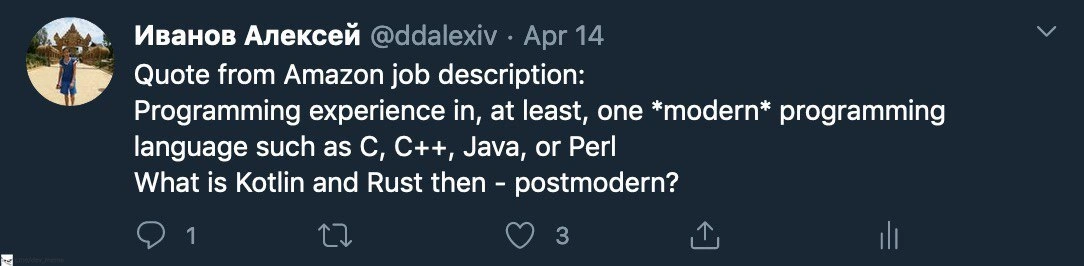
The tweet screenshot highlights a snippet from an Amazon job description that sounds like a time capsule from the 1990s. It asks for experience in at least one "modern programming language such as C, C++, Java, or Perl. This choice of words is delightfully absurd to experienced developers: all those languages are decades old. Calling C (first appeared 1972) or Perl (first released 1987) “modern” in 2020 feels like referring to Windows 95 as a cutting-edge OS today. The humor comes from this modern misnomer – Amazon’s HR terminology hasn’t caught up with the relentless evolution of programming languages. It’s as if the job description has been copy-pasted for years without updating what “modern” means. In corporate culture, especially at large companies like Amazon, job requirements often lag behind current trends, resulting in gems like this modern programming language joke. Senior developers instantly recognize the irony: those languages were modern when Nirvana topped the charts, but tech has moved on.
The tweet’s author quips: "What is Kotlin and Rust then – postmodern?". This punchline cleverly frames Kotlin and Rust – two post-2010 languages loved by many developers – as something beyond modern, i.e., postmodern. In other words, if Amazon’s hiring copy still thinks Java (1995) and C++ (1985) are the definition of modern programming, then truly contemporary languages like Rust (which had its first stable release in 2015) and Kotlin (first released 2011, popularized in Android development) must be in a whole new era beyond modern. The joke taps into developers’ shared awareness that tech moves fast. What was new and shiny 30 years ago is often legacy or “old-school” today. By invoking the term postmodern (borrowed from art and literature, where postmodernism denotes a movement that comes after the modern era), the tweet adds a tongue-in-cheek scholarly flair. It implies Kotlin and Rust are not just new, but philosophically beyond the old boundaries – a playful jab at how proud their communities are of being “next-generation” and how slow corporate HR is to acknowledge them.
Underneath the humor lies an industry truth: big companies like Amazon rely heavily on these older “modern” languages in their massive codebases. Java and C++ power countless backend services at scale; C underpins low-level systems and high-performance components; even Perl, though far past its 90s heyday, still scripts glue code in some corners. From Amazon’s perspective, these languages are “modern” in the sense of being current, standard tools for them – as opposed to truly ancient languages like COBOL or Fortran (which would be downright Jurassic in comparison). There’s an implicit generation gap between corporate tech stacks and the cutting-edge trends discussed on developer forums. CorporateCulture often breeds conservatism: if it ain’t broke (and C/Java reliably run your infrastructure), why change the job description? Experienced engineers reading this know that HR templates can persist unchanged for years, surviving like code legacy. It’s classic Career_HR humor: the people writing job listings may not be engineers, so they stick to what they’ve always written. The result? They inadvertently describe legacy technologies as if they’re hot and new, giving us prime DeveloperHumor material.
The tweet resonates because it validates the shared developer experience of language wars and hype cycles. Seasoned devs have seen this pattern: one era’s revolutionary language becomes the next era’s legacy bloat. The LanguageComparison here pits old giants vs. new darlings. Fans of newer languages like Rust often tout them as modern solutions to the shortcomings of older languages (memory safety issues in C/C++, verbosity in Java, etc.). Seeing Rust left out and Perl included under “modern” feels comically backwards. It’s a bit of tribal satire: Kotlin enthusiasts (often coming from Java) and Rust aficionados (often coming from C/C++) get to chuckle that their preferred tools are so advanced, they’re “postmodern.” Meanwhile, the cynical veteran programmers among us smirk and think: “HR is stuck in the past — maybe I should list BASIC on my résumé as a modern skill too.” The CorporateCulture takeaway is that terminology in official documents often lags reality, producing moments of unexpected comedy like this one.
Description
A screenshot of a tweet from user Иванов Алексей (@ddalexiv). The tweet quotes an Amazon job description which lists 'C, C++, Java, or Perl' as examples of 'modern' programming languages. The user then sarcastically asks, 'What is Kotlin and Rust then - postmodern?'. The image is a dark-mode screenshot of this tweet, capturing the text and the user's profile picture. This meme derives its humor from the absurdity of labeling languages like C (1972), C++ (1985), and especially Perl (1987) as 'modern' in the context of a 2020 job posting. For experienced engineers, this is a relatable jab at how large, slow-moving corporations can be wildly out of touch with current industry trends. The witty 'postmodern' comment for truly modern languages like Kotlin and Rust highlights this technological generation gap

Comments
7Comment deleted
That job description was probably written in Word, converted to PDF, faxed to legal, scanned as a JPEG, and then manually typed into the system by someone whose primary language is COBOL
Amazon HR: “Must know a modern language like C, C++, Java or Perl.” Engineering panel five minutes later: “Great, now whiteboard a lock-free queue in Rust and explain how we’ll rewrite it in Kotlin once finance approves next quarter’s ‘postmodernization’ budget.”
Amazon calling C "modern" is like calling your technical debt "technical investment" - technically true if you squint hard enough and your timeline starts at COBOL
Ah yes, the classic FAANG definition of 'modern': any language that predates the iPhone. By this logic, Kotlin and Rust aren't just postmodern - they're practically avant-garde experimental art. Meanwhile, Perl is sitting there like 'I'm modern!' while simultaneously being the reason your team has a 'legacy systems' budget line item. Nothing says 'we're hiring for innovation' quite like requiring expertise in languages that were mature when Netscape Navigator was peak technology. At least they're honest about what 'modern' really means in enterprise: 'we have 20-year-old codebases and need someone who won't immediately suggest a rewrite.'
“Modern language like C, C++, Java, or Perl” is HR-speak for “whatever our monolith will compile without a procurement ticket”; Kotlin and Rust are “postmodern” because we’d have to refactor the org chart before the codebase
If a JD calls C and Perl “modern,” expect a JNI bridge into a 2000s Perl daemon behind a CORBA adapter - and an ATS that still regex‑parses PDFs
Amazon's 'modern' means 'still has active COBOL interop' - Perl's been cutting-edge since dial-up