Your AI Girlfriend is Just Linear Algebra
Why is this AI ML meme funny?
Level 1: Dating a Calculator
Imagine your friend claims he has a super-smart computer girlfriend who lives in his phone. He talks about her like she’s almost human. But when you peek inside this so-called virtual girlfriend’s brain, you don’t find magic or feelings – you find a little math problem at work! It’s as if your buddy is dating a calculator. The meme is joking that something as personal-sounding as an “AI girlfriend” is really just a bunch of numbers being multiplied and added together. In simple terms, it’s like your friend fell in love with the answer to 2 + 2. The humor comes from seeing that this “girl” is basically a tiny math equation pretending to be a person. Even though the AI might say nice things and seem real, behind the scenes it’s doing arithmetic. That contrast – between the imaginary friend and the real math inside – is what makes it funny. It’s a playful reminder that even the most convincing virtual friend is ultimately a clever series of calculations, not a real girlfriend.
Level 2: Virtual Love, Real Math
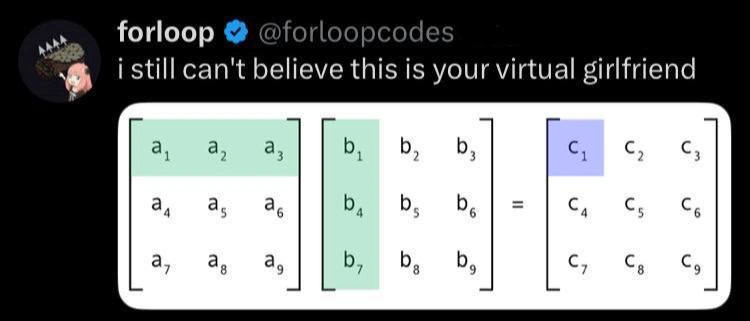
Let’s break down what’s happening without assuming you’ve taken a deep learning course. The meme’s image is illustrating a simple math concept: matrix multiplication. We have two matrices (basically grids of numbers) labeled A and B. Matrix A has elements $a_1$ through $a_9$ arranged in a 3×3 grid (three rows and three columns). Matrix B has elements $b_1$ through $b_9$ in its own 3×3 grid. The result of multiplying matrix A by matrix B is a third matrix C (also 3×3) with elements $c_1$ through $c_9$. How do we get those $c$ values? That’s where the row and column meeting comes in.
A row vector means one horizontal row of matrix A – in the picture, they shaded the entire first row of A (containing $a_1, a_2, a_3$) in light green. A column vector means one vertical column of matrix B – they shaded B’s first column (containing $b_1, b_4, b_7$) in the same green. To get the entry $c_1$ (the top-left of C, shaded purple), you take that row vector and that column vector and perform a dot product (also known as an inner product). The dot product multiplies each pair of corresponding entries and then adds them all up:
- First pair: $a_1$ times $b_1$
- Second pair: $a_2$ times $b_4$
- Third pair: $a_3$ times $b_7$
Now add those three results together: $(a_1 \cdot b_1) + (a_2 \cdot b_4) + (a_3 \cdot b_7)$. That sum equals $c_1$. In formula form, if we number the positions, it’s $c_{1,1} = \sum_{i=1}^{3} A_{1,i} \times B_{i,1}$. This is exactly how every entry of the product matrix is computed. Matrix multiplication is essentially a bunch of these row-times-column multiplications. The meme just shows one example of it (first row with first column) to convey the idea.
Why is this significant for an AI joke? Because this operation (multiplying and summing numbers) is literally what powers things like neural networks. In a typical neural network layer, you have an array of input numbers (which you can think of as a column vector) and a big grid of weights (which you can imagine as a matrix). When the network computes the next layer’s values, it multiplies that weight matrix by the input vector. What that really means is: it takes each row of the weight matrix, does a dot product with the input vector, and that gives one number output (one neuron’s activation). Then it does the same with the next row for the next neuron, and so on. So, for each neuron, a row of weights meets the input vector, and out pops a number – just like $c_1$ in the meme coming out of the first row of A and first column of B. A whole layer’s output is a collection of such dot products (one per row of the weight matrix). And a whole neural network is just layers and layers of these operations with some nonlinear steps in between. In other words, your fancy AI’s thinking process is built from nothing fancier than a ton of multiplications and additions on arrays of numbers. Kind of wild, right?
Now, the phrase “virtual girlfriend” implies an AI program that someone treats like a girlfriend – basically a chatbot or virtual companion with artificial personality. The tweet is poking fun at someone who might be emotionally invested in such an AI. The joke is that this supposedly complex, human-like deep learning system is, at its core, just doing math homework really fast. The highlighted dot product ($a_1 b_1 + a_2 b_4 + a_3 b_7$) is like saying, “Here’s your amazing AI girlfriend’s brain cell in action.” It diminishes the mystique in a funny way. If you’ve ever used a chatbot and wondered how it decides what to say, the truth is it’s scoring possible answers with internal math operations not too different from this example, just a whole lot more of them.
To make this concrete, here’s a tiny illustration in code. We’ll multiply two 3×3 matrices in Python (using NumPy) and check that top-left value:
import numpy as np
A = np.array([[1, 2, 3],
[4, 5, 6],
[7, 8, 9]])
B = np.array([[1, 2, 3],
[4, 5, 6],
[7, 8, 9]])
C = A.dot(B)
print(C[0, 0]) # 30, because 1*1 + 2*4 + 3*7 = 30
In this code, A.dot(B) performs a matrix multiplication. It takes each row of A and dots it with each column of B. For instance, C[0,0] (which we printed) is the result of the first row of A dotted with the first column of B. We got 30 because it did exactly $11 + 24 + 3*7. Every other entry C[i,j]` is computed the same way with row i of A and column j of B. Now, if A and B were huge matrices full of learned parameters and input data, this operation is basically what a neural network layer does. Libraries like NumPy, TensorFlow, or PyTorch call highly optimized routines under the hood to do these multiplications super fast (often leveraging your computer’s GPU, which is a piece of hardware great at parallel math). When people say a model has “billions of calculations,” a huge chunk of those are these dot products happening over and over.
So, putting it all together: the meme humorously reduces a high-level concept – having a relationship with a super-advanced AI (virtual_girlfriend_ai) – to the low-level reality of what that AI runs on: matrix math. It’s like showing the blueprints behind a theme park animatronic. For a junior developer or a student, the takeaway is both funny and educational: under the impressive AI/ML curtain, it’s rows meeting columns, multiplications, and sums. The virtual love is enabled by very real math. If you understand this picture, you understand one of the core operations of all modern machine learning. And maybe, just maybe, you’ll chuckle next time you hear someone say their AI friend “really understands me” – you’ll be picturing those numbers chugging away behind the scenes.
Level 3: Linear Algebra Love Story
On a more familiar level for seasoned developers, this meme is hilariously on-point about the contrast between AI mystique and its gritty implementation. The tweet says, “I still can’t believe this is your virtual girlfriend,” paired with what looks like a clipped page from a linear algebra textbook. The humor comes from juxtaposing the human idea of a “girlfriend” – something emotional, complex, seemingly alive – with a dry diagram of matrix multiplication. It’s a classic AI humor move: revealing that the emperor (or in this case, the virtual partner) has no clothes, just a lot of math under the hood. Anyone who has worked in MachineLearning or fiddled with NeuralNetworks will smirk here, because we’ve all heard the hype of AI companions and sentient-sounding chatbots. But behind those fluent chatbot replies and simulated personalities, we know it’s essentially giant matrices being multiplied at lightning speed. The meme zooms all the way in on the simplest possible piece of that process – a single dot product – and says, “Behold, your so-called love is literally this calculation.” It’s the same energy as a magician showing you the trapdoor and mirrors: once you see the trick, you can’t un-see it.
Think about generative AI models like advanced chatbots (the ones people sometimes jokingly or seriously call their “AI girlfriend” or virtual companion). Those models are massive bundles of numbers – parameters of neural network layers – that transform input tokens to output tokens. Millions of us have been amazed at how human-like their conversation feels. Yet, if you peek under the curtain, every time the AI “speaks,” it’s doing something utterly mechanical: multiplying matrices of weights by vectors of inputs, layer after layer. Each forward pass through a model is just a sequence of these operations. For example, when the AI is about to generate the next word in a sentence, it might take an internal state vector (just a list of numbers representing the AI’s “thoughts” at that moment) and multiply it by a huge embedding matrix to figure out which word to output. That single multiplication is essentially a collection of dot products – one for each possible word – to measure how well the state vector lines up with each word’s vector. Whichever word’s vector yields the highest score (dot product result) is the one the model selects. In a romantic context, one might poetically say the AI is “choosing its words carefully,” but an engineer sees a heap of floating-point multiplications and additions churning away. It’s a comical disconnect between what it feels like (a meaningful conversation with a virtual being) and what it actually is (linear algebra computations).
The diagram in the meme underscores this by highlighting the first row of matrix A and the first column of matrix B – color-shaded in matching green – and then highlighting the resulting entry $c_1$ in the product matrix C (shaded in purple). This visual is a straightforward explanation of how matrix multiplication works: to get the top-left element of the result (c₁), you take the entire first row of A and dot it with the entire first column of B. In other words, c₁ is literally the inner product of those two colored vectors. The punchline is that this mundane numeric procedure is being equated to a “virtual girlfriend.” It’s as if someone took the mystical idea of “two souls bonding” and replaced it with “two lists of numbers multiplying.” For those in the know, it pokes fun at the overly romanticized notions of AI. We’ve heard people marvel at how deep learning models seem almost alive or conscious. This meme dryly reminds us: “psst, it’s actually just a bunch of matrix ops.”
Many experienced devs will recall their first time implementing or optimizing a neural network and the moment it clicked: all the fancy terminology about “intelligence” and “learning” ultimately boils down to basic operations on arrays of numbers. There’s an ironic kind of beauty in that. For instance, the term matrix calculus might sound intimidating, but it just refers to doing calculus (like computing gradients) on functions of matrices – and the forward part of that, the actual evaluation of the function, is pure matrix math. So when our Twitter protagonist jokes about a “virtual girlfriend,” they’re embodying that veteran perspective: we can appreciate the cool AI result, but we’re also rolling our eyes a bit because we see the linear algebra making it happen. It’s the same feeling you get when non-dev friends gush that an AI chatbot is “so smart,” and you reply with a smile, “Well, it’s basically a very large Excel spreadsheet doing insanely fast calculations.”
Historically, this contrast between AI’s human-like veneer and its raw computational guts has always been meme-worthy. If you remember older AI like ELIZA (the 1960s chatbot) or even just formula-based bots, the secret was often simple algorithms with a lot of surface flair. Today’s neural nets are far more complex in scale, but not in the nature of their mechanics – they’re still just math. A senior engineer might reference the famous quote: “Any sufficiently advanced technology is indistinguishable from magic.” This meme cheekily inverts that, suggesting: “Any sufficiently advanced virtual girlfriend is indistinguishable from a dot product.” The shared laughter here comes from a bit of professional pride and relief – we deal in cold hard logic and math, even when it pretends to be a person. It’s a reminder that under the layers of training data and non-linear activation functions, the core operations are as un-romantic as can be. And honestly, that makes the AI humor even funnier: we’re laughing at ourselves for giving these linear algebra machines pet names and relationships. In the end, the meme delivers a lighthearted revelation: your incredible AI companion is, at the lowest level, just two vectors going on a “date” to compute a number. Nerd love, indeed.
Level 4: Dot Products All the Way Down
At the deepest technical level, this meme highlights the inner product as the atomic unit of artificial intelligence computation. In linear algebra terms, an inner product (or dot product) is a fundamental operation: you multiply corresponding components of two equal-length vectors and sum up the results, producing a single number (a scalar). Formally, if you have vectors $u = (u_1, u_2, ..., u_n)$ and $v = (v_1, v_2, ..., v_n)$, their dot product is $u \cdot v = \sum_{i=1}^{n} u_i v_i$. In the meme’s diagram, the highlighted entry c₁ is exactly that: $c_1 = a_1 b_1 + a_2 b_4 + a_3 b_7$ (multiplying each pair from the first row of A and the first column of B, then summing). This is the mathematical heart of matrix multiplication. The meme cheekily calls this out as a “virtual girlfriend,” implying that even something as seemingly magical as an AI persona boils down to repeated applications of this simple math. It’s a nod to pure mathematics lurking beneath modern AI glitz.
From a computer science perspective, these dot products are everywhere. In fact, every entry of a matrix product $C = A \times B$ is one dot product. If A is $m \times k$ and B is $k \times n$, then computing $C$ involves $m \times n$ separate dot products. When we say this operation “underpins every forward pass in modern deep-learning accelerators,” we mean that each time a neural network processes data (a forward pass), it performs massive numbers of these multiplications-and-sums. Each neuron in a neural network layer essentially computes a dot product between its weight vector and the input vector. This is repeated for thousands or millions of neurons across many layers in a model. So generating one response from a large language model or evaluating one frame in a deep learning system is, at its core, a giant pile of dot products.
Crucially, hardware designers know this well. Modern deep learning accelerators like GPUs and Google’s TPUs are built to do matrix multiplications (i.e. lots of dot products) at extreme speed. GPUs have specialized units (like NVIDIA’s Tensor Cores) that can perform many multiply-add operations in parallel. A dot product is essentially a series of multiply-adds, and hardware can pipeline these to churn through vectors with incredible throughput. For example, one NVIDIA Tensor Core can multiply two small matrices (like 4×4 each) in one go, which is effectively dozens of dot products computed simultaneously. Deep-learning chips use techniques like systolic arrays – grids of math units pumping data through like an assembly line – to crank out inner products by the billions. The reason big neural networks can chat like a “virtual girlfriend” in real time is because under the hood, specialized processors are grinding through linear algebra at blistering speeds. In technical terms, the AI’s “brain” is performing on the order of trillions of floating-point operations per second (TFLOPs), most of which are these multiply-accumulate steps that form dot products. There’s even a running joke among engineers that training machine learning models is just “matrix multiplications with better marketing” – a tongue-in-cheek way to say all the MachineLearning and DeepLearning magic reduces to highly optimized linear algebra (sometimes dubbed matrix calculus when we consider the calculus of gradients during training).
It’s fascinating to note that matrix multiplication has been studied for decades as a central computing task. The straightforward algorithm every student learns is $O(n^3)$ (where tripling the matrix size makes it 27 times slower), but theoretical computer science has found clever matrix multiplication algorithms (like Strassen’s algorithm and beyond) to whittle down the complexity. These advanced algorithms reduce the exponent in $O(n^p)$ (currently $p \approx 2.37$ for the best known methods) – though they’re mostly of theoretical interest for huge matrices. In practice, deep learning libraries stick to classic algorithms executed on hardware that is highly optimized for them. Low-level numeric libraries (BLAS routines like sgemm for single-precision matrix multiply) are hand-tuned in assembly to squeeze every bit of performance from caches and vector registers. All this is to say: the entire infrastructure of AI, from math theory to chip design, rallies around making row × column = result as fast as possible. So when this meme reduces an advanced AI girlfriend to just one highlighted dot product, it’s playfully pointing out a deep truth: no matter how sophisticated the AIHumor or persona, underneath lies an army of simple operations on numbers. In other words, neural networks are built on nothing more intimate or mysterious than multiplying vectors and adding them up. It’s dot products all the way down, and that’s both hilarious and astonishing.
Description
A screenshot of a tweet from the user 'forloop' (@forloopcodes) with the text 'i still can't believe this is your virtual girlfriend'. Below the text is a mathematical diagram illustrating the process of matrix multiplication. It shows two 3x3 matrices, labeled with elements 'a' and 'b', being multiplied to produce a third 3x3 matrix with elements 'c'. The calculation for the very first element of the resulting matrix, c₁, is highlighted. The first row of the first matrix ([a₁, a₂, a₃]) and the first column of the second matrix ([b₁, b₄, b₇]) are shaded in green, and the resulting element c₁ is shaded in blue, visually representing the dot product operation. The meme is a highly technical joke that demystifies the concept of complex AI, such as a 'virtual girlfriend,' by reducing it to its fundamental mathematical building block: matrix multiplication. This operation is central to how neural networks and machine learning models process data. The humor lies in the stark contrast between the human-like concept of an AI companion and the cold, mechanical reality of the linear algebra that powers it
Comments
10Comment deleted
So my relationship with an AI is just a high-dimensional dot product? Finally, a relationship I can actually optimize with SIMD instructions
Proof that your AI soulmate is literally O(n) work - romance bounded by computational complexity
After 20 years of optimizing matrix multiplication kernels, you realize the real relationship was with the L2 cache misses you made along the way - at least they're predictable, unlike your deployment pipeline
When your dating life is so dry that matrix multiplication becomes your most intimate relationship - at least it's deterministic, commutative properties are negotiable, and the complexity is only O(n³). Plus, unlike real relationships, you can always transpose your expectations and still get predictable results. Though fair warning: this relationship might be singular
She's the only partner who knows AB ≠ BA - keeps the relationship from getting too predictable
Your virtual girlfriend is literally c1 = row(A)·col(B); even BLAS calls it a dot product - she’ll ghost the moment you switch from float32 to bfloat16
That’s not a virtual girlfriend; it’s row1 sliding into col1’s DMs, officiated by FMA and shipped via SGEMM while you pray the tile fits in L2
whats the meme behind grok misa amane Comment deleted
great lingerie Comment deleted
Grok, jerk it a little Comment deleted