Calculus Vandalism: An Integrated Approach to Humor
Why is this Mathematics meme funny?
Level 1: Helpful Graffiti
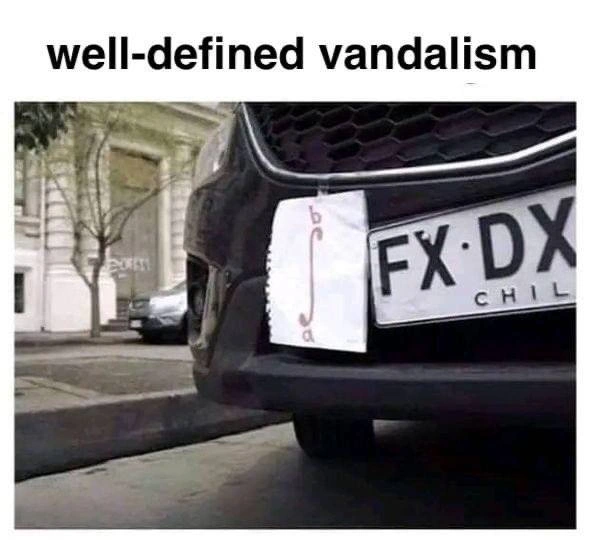
Imagine you’re looking at a big jigsaw puzzle and there’s one piece missing – it just looks incomplete. Along comes a friend who can’t stand the unfinished puzzle and pops in the last piece, making the picture whole. That’s basically what happened in this meme, except the “puzzle” was a math problem on a car’s license plate! The plate seemed to show a bit of a math formula that wasn’t finished, kind of like an unfinished sentence. A playful math fan spotted it and decided to finish the job by sticking a paper on the car with the missing part of the formula. It’s a bit of sneaky graffiti, but instead of scribbling something rude, they added something helpful. Now the math on the car actually makes sense, like a complete thought. It’s funny because normally vandals break or spoil things, but here one actually improved something (at least from a nerd’s point of view!). In simple terms, a clever passerby saw something was “wrong” with the car’s math and just had to fix it. The result? A prank that makes math lovers chuckle and leaves everyone else either confused or oddly impressed that even graffiti can be nerdy and nice.
Level 2: Limits & License Plates
Let’s break down the joke in simpler terms. The curved symbol drawn on the paper is an integral sign (∫), a staple of calculus in mathematics. Normally, when you see $\int f(x),dx$, you expect additional information: specifically, where to start and end the integration. These are called the limits of integration. If you put a number or symbol at the bottom of ∫ (like a) and one at the top (like b), you get a definite integral: $\int_a^b f(x),dx$. This definite integral gives you a specific number as the answer – it’s a complete operation, like a fully formed command. Without those limits, ∫ by itself usually means an indefinite integral, which is more like “find a formula that gives the area under the curve of $f(x)$ in general.” An indefinite integral doesn’t evaluate to one number; instead it yields a family of functions (you have to add a “+C”, an arbitrary constant, because there are infinitely many possible answers). In other words, writing $\int F X,dX$ on its own is like an unfinished math problem. It’s missing context, much like a story missing an ending.
Now, the license plate in the photo reads “FX-DX”, which a math geek would read as the characters F, X, D, X – that looks an awful lot like the notation f(x) dx. In calculus, $f(x),dx$ is the typical thing you integrate (imagine $F$ is some function of $x$). So to a nerdy eye, this plate was unintentionally showing an integral without the ∫ sign and limits – essentially half of a formula. That’s why the prankster’s addition is so perfect: by taping a piece of paper with ∫, a little a at the bottom, and b at the top (so it reads $\int_a^b$), they turned the plate into $\int_a^b F(x),dx$. Voilà! It’s now a proper definite integral from a to b. The once “floating” expression FX DX has been grounded with a start and end, making it a well-defined math statement.
In plainer words, someone basically saw that the car’s plate looked like a math equation that wasn’t finished. It bugged them (because nerds like things to be complete and correct), so they finished the equation. This is analogous to seeing a sentence that says “If at first you don’t succeed, try, try ___” and feeling the need to fill in “again.” The top text labels this prank as “well-defined vandalism” – vandalism because the person did stick paper on someone else’s car (a naughty, unsolicited action), but well-defined because they actually made the math clearer and correct. It’s a playful oxymoron: normally vandals make things messy, but this one made something more precise!
For those not familiar with the software term: a pull request (PR) is a way to suggest changes to someone’s code (like saying “I think this should be fixed/added”). A drive-by pull request is slang for when a person who isn’t a main contributor swoops in to make a quick fix or addition to a project – often minor, like correcting a typo or adding a small feature – and then disappears. In this meme, the prankster acted like an open-source contributor to a random car’s “project,” quickly patching up the math and then moving on. It’s as if the street is a GitHub repository and the license plate was a file with a small bug. The tags like NerdHumor and GeekHumor apply because you’d likely need to remember some calculus (a very CS fundamentals kind of math) to get why this is amusing. If you’ve ever taken calculus or studied engineering, you know the joy of a nicely solved integral – and the mild annoyance of missing boundaries or context. This meme brings that super niche joy into the real world (IRL). Even if you’re not a calculus expert, you can appreciate that someone literally completed a math joke on a car. It’s a combination of brainy and silly: adding a little mathematical order to the chaos of street graffiti. And yes, now that “FX DX” finally has its limits, any calculus professor would agree it finally integrates correctly!
Level 3: Curbside Code Review
From a senior developer’s perspective, this scenario looks like a drive-by pull request in real life. Imagine walking by a piece of code (or in this case, a license plate) that has something obviously missing – it begs to be fixed. The plate reads “FX-DX”, which to any CS grad or engineer with a math background instantly screams f(x) dx without a context. It’s as if someone left a function call with no parameters or a code snippet with a placeholder. A seasoned engineer’s reflex is to correct it on the spot, much like submitting a quick GitHub PR to add a missing semicolon or fix an off-by-one error. Here, our mystery contributor saw an “open issue” on the street and resolved it by taping a paper with integration limits a and b next to the FX DX. Problem solved – now the random formula on the car is a complete $\int_a^b f(x),dx$ expression. This is dubbed “well-defined vandalism” because the “vandal” didn’t spray-paint profanity or break anything; they essentially performed a code review on the car’s math and made it well-defined. It’s the kind of ultra-nerdy attention to detail that makes other engineers smirk and nod. After all, in programming we’re obsessed with specifying everything correctly: functions should have explicit inputs and outputs, we handle boundary conditions to avoid edge-case bugs, and we enforce type safety so nothing is left to guesswork. Seeing “FX DX” alone is like encountering a function with no return type or a loop with no end condition – it just feels wrong. The prankster acted like a lintern or a CI test for reality: “Error – integral limits not found. Please add bounds.” So they patched it! This resonates with senior devs because it satirizes our compulsive need to slam the brakes on undefined behavior wherever we see it, even on a random bumper. It’s Engineering Absurdity at its finest: treating a license plate like a misconfigured program and pushing a fix. We’ve all known colleagues who can’t resist correcting a minor bug or a typo in passing (the pedantic pull request). Here that impulse escaped the digital realm and turned into literal nerd humor graffiti. The phrase “finally integrates” in the title winks at the double meaning: the expression on the plate can now actually be integrated in the calculus sense (it has limits, so you could compute its value), and metaphorically the car’s math now “integrates” correctly into the universe of well-formed formulas. The whole thing is a big geeky grin: only in a community of developers and math enthusiasts would adding a couple of tiny letters on someone’s plate be seen as a helpful hotfix rather than pure mischief. It’s the Fundamental Theorem of Prankulus in action: if there's an incomplete equation lying around, a nerd will inevitably step in to complete it. And honestly, who among us can resist fixing a glaring issue when it’s right in front of our eyes? This meme captures that compulsion perfectly, turning an ordinary street scene into a covert code review comedy.
Level 4: Defining the Indefinite
At the highest geek level, this meme riffs on formal calculus concepts. In mathematics, an indefinite integral written as $\int f(x),dx$ represents a whole family of functions (the antiderivatives of $f$) and is inherently ambiguous – you can always add an arbitrary constant $C$ and still have a correct answer. It's not a single value; it's like an unfinished sentence in math form. By contrast, a definite integral $\int_{a}^{b} f(x),dx$ is a completely specified operation: it calculates a precise number (the net area under $f(x)$ from $x=a$ to $x=b$). The prankster in the meme essentially transformed an out-of-context integrand into a well-posed mathematical statement by adding those limits $a$ and $b$. In doing so, they enforced the sort of rigor you'd find in a real analysis textbook or a codebase with strict linting rules. This reflects a deep obsession with well-defined operations: much like how a function in code needs all its parameters and type definitions, a calculus expression needs its boundaries or initial conditions to yield a deterministic result. Formally, the definite integral exists only when you specify the interval of integration – otherwise, $\int F X,dX$ by itself is undefined behavior in the math sense (up to a +C). By tapping into this fundamental distinction, the meme appeals to the mathematically initiated. It’s poking fun at our inner mathematician who demands that every expression be properly bounded and defined. In fact, the prank is almost like a nod to the Fundamental Theorem of Calculus: it bridges the gap between an antiderivative and an area computation. Without limits, you’re just finding an antiderivative of F, but with limits $a$ and $b$, you’re computing a concrete result. The humor here comes from treating a random license plate as if it were a snippet of code or math that needed a formal spec. The prankster applied rigorous rules of integration in an everyday setting, effectively saying, “Let’s make this math correct.” It’s an academic-level joke: random street vandalism got upgraded into a mathematically valid form. Only folks who remember their calculus (or care about function definitions and boundary conditions in algorithms) will grin at this because they recognize the EngineeringAbsurdity of bringing such pedantic precision to a car bumper. The meme brilliantly merges a nerdy CSFundamentals mindset with pure Mathematics, demonstrating that even graffiti can have proper syntax and semantics if a determined geek has their way.
Description
The image displays a close-up of the front of a black car, with a white license plate that reads 'FX·DX CHIL'. To the left of the license plate, a piece of paper has been taped to the bumper. On this paper is drawn a large integral symbol (∫) with the limits of integration 'a' at the bottom and 'b' at the top. Above the image, a caption reads 'well-defined vandalism'. The humor is a sophisticated pun that combines elements of mathematics and wordplay. The license plate 'FX·DX' is interpreted as 'f(x) dx', which is the standard form for a function to be integrated. The taped-on symbol completes the mathematical expression for a definite integral: ∫ from a to b of f(x) dx. In calculus, an integral is 'well-defined' if it has a proper, computable value. The caption 'well-defined vandalism' is therefore a clever double entendre, referring both to the mathematical correctness of the expression created and the neatness of the prank. This joke is highly targeted at an audience with a background in mathematics, science, or engineering
Comments
11Comment deleted
Most vandalism just depreciates a car's value; this is the only case where it actually adds a function
Finally, a production hotfix that ships with clearly defined boundary conditions - math majors 1, entropy 0
This is the kind of 'undefined behavior' that actually compiles perfectly - though explaining to the cops why you're integrating their license plate database might require some serious exception handling
A license plate that's both continuous and differentiable - finally, a real-world application of calculus that doesn't involve optimizing profit margins or calculating rocket trajectories. The owner clearly understands that while most people see 'FX·DX' as random letters, to those who've survived multivariable calculus, it's a perfectly well-defined expression. Though one wonders if they got pulled over, would the officer ask them to evaluate the integral, or just cite them for having a non-standard plate format? Either way, this is the kind of mathematical vandalism that would make Leibniz proud and Newton slightly annoyed
Finally, vandalism with explicit bounds and a measure - if only our requirements shipped with a and b
Vandalism with impeccable limits - unlike most distributed system boundaries that diverge under load
Finally, vandalism with acceptance criteria: domain [a,b], integrable f, and a convergent output - if only our requirements were this well-defined
nicely integrated joke Comment deleted
how did you derive that? because I'm honestly at my limit right now. I hope nobody got hurt from this or they'd have to go to l'hospital. Comment deleted
'Chil' my friend Comment deleted
Nice to see you have a good understanding of quantum physics. So many people make jokes about Schrödiger's cat without understanding that superposition disapear as soon as you try to observe it Comment deleted