Skip to content
DevMeme
5092 of 7435
A Mathematical Way to Dismiss Opinions
Mathematics Post #5572, on Oct 11, 2023 in TG

A Mathematical Way to Dismiss Opinions

Why is this Mathematics meme funny?

Level 1: Sneaky Math Joke

Imagine your friend is using a secret code to be funny. They said something that looks really strange but actually hides a normal sentence. In this meme, the person wanted to say, “I don’t care about what you think.” But instead of using the regular word “opinion,” they replaced part of it with a number and a picture! They took the special number π (pi), which we say like “pie,” and put an onion picture after it. When you read that together, it sounds just like the word “opinion.” It’s kind of like writing “I 💗 you” with a heart symbol instead of the word “love” – you need to know the symbol to understand the message.

So the joke is a mix of math and a veggie to say a common phrase. The friends told this person to stop with the confusing math jokes (because they didn’t understand them). But the person didn’t stop – they answered with another math joke hidden in a normal sentence. It’s as if the friend said, “Hey, no more weird jokes!” and the person replied, “I’m not listening to your opinion” in a super nerdy way. It’s funny because it’s silly and clever at the same time: only people who know about π (that 3.14 number) will get why π + onion means opinion. It’s like a little puzzle. Even if the friends don’t get it, the person telling the joke is happy because they made a smart-funny comeback. In simple terms, it’s a goofy way of saying “I don’t care what you say” using a tiny bit of math magic!

Level 2: Peeling the π-onion

Let’s break down the pieces of this joke in plain terms and see how the math and wordplay come together:

  • π (Pi): Pi is a famous mathematical constant approximately equal to 3.14159. It’s the ratio of a circle’s circumference to its diameter. In school and programming you encounter π often — for example, many languages have Math.PI or math.pi which gives this value. Importantly for this meme, π is pronounced like “pie,” the same as a yummy pie you eat. So when you see the symbol π in a joke, you should think of the “pie” sound (and geeks immediately think math!). Using π here taps into CSFundamentals knowledge, since understanding it is like a basic badge of geekiness.

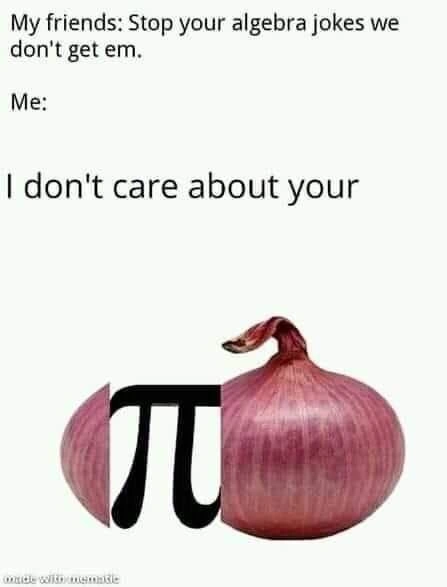
  • Onion (the image): An onion is a round vegetable with purple or brown skin and many layers inside. In the meme, a picture of a sliced onion is shown. The word “onion” sounds like the second part of the word “opinion” (o-PIN-yun). By itself, an onion has nothing to do with math or programming – and that randomness makes the joke sillier. But visually, pairing the onion with π spells out “πonion,” and our brains read that as “opinion.” The onion is basically a visual pun component, a stand-in for the syllable “-pinion.” It’s common in memes to use an image or icon to replace part of a word, a form of playful opinion_wordplay here.

  • “Opinion” (what it spells): An opinion is what someone thinks or believes. The full phrase “I don’t care about your opinion” means “Your thoughts don’t matter to me.” It’s usually a dismissive or humorous phrase. In this meme, the text started to say that, “I don’t care about your ...”, and then switched to the π + onion combo instead of writing the word opinion normally. So you have to interpret the symbol and image to get the meaning. The meme’s joke is literally hiding the word opinion inside a math puzzle! This is a form of nerdy wordplay where you need a bit of math knowledge to read the sentence. Once you realize πonion = opinion, you get the full sentence: “I don’t care about your opinion.” It’s a witty way of saying the same thing with a geek twist.

  • Algebra jokes: Algebra is a branch of math dealing with symbols and equations (like solving for x in 2x + 3 = 7). An algebra joke might be something like, “Dear Algebra, stop asking us to find your X – she’s not coming back.” These jokes play on math terms or processes. In the meme setup, the friends complain “Stop your algebra jokes, we don't get ’em.” Maybe the person was cracking nerdy jokes involving equations or math references that their friends found confusing. Essentially, the friends are saying “we don’t understand your geeky math humor.” It’s pretty common that a programmer or math lover has jokes that fly over others’ heads. Here they label all those jokes as “algebra jokes” (it could be any math, but algebra is the stereotype). So when they say stop, it’s like a cue that the math nerd has been overdoing it around people who aren’t into math_puns.

  • Inside joke: This term means a joke that only a specific group of people understands. If you’re not “inside” that group (in this case, people who know math symbols or ComputerScienceHumor), the joke will seem meaningless or unfunny. The π-onion gag is definitely an inside joke for math and CS enthusiasts. If someone hasn’t seen π used in this way or isn’t familiar with the concept of π at all, they’ll be baffled. That’s why the friends say “we don’t get ’em.” The humor is exclusive – which is exactly why the person in the meme finds it amusing to play it out. It’s almost a playful jab: the meme-maker knows their friends won’t get the π-onion pun either, but that’s the point – it’s a little geek rebellion. As newcomers to tech or math culture, once you learn these basics, you start becoming part of the “inside” crowd that laughs at such references.

Now, how would this look in a bit of code or technical context? Developers often use the value of π in code, but here we can literally use the π symbol to construct the word πonion. In many programming languages, you can include Unicode characters like π in a string. For example, in Python:

pi_symbol = "\u03C0"   # Unicode character for π
word = pi_symbol + "onion"
print("I don't care about your " + word)
# Output: I don't care about your πonion

In this snippet, we’re concatenating (joining) the pi symbol with the word "onion" to form "πonion" inside a sentence. When you run it, the output is exactly the meme’s key line. 🎉 This shows how the meme literally treats the symbol π as a character in a word. Just like in algebra you might substitute x = 3 into an expression, here we substitute π in place of the “op” of opinion. If you were a beginner writing a program and saw pi_symbol + "onion", you might double-take – but then you’d laugh when you realize it’s generating a cheeky phrase. It’s a fun example of how knowing your CSFundamentals and a bit of math can reveal jokes hidden in what looks like gibberish. As you start hanging around developer forums or meme pages, you’ll see that combining everyday words with technical symbols is a common formula for GeekHumor. It’s a tongue-in-cheek way to celebrate the fact that you know things like the Greek letter pi or other arcane tech references. So if you didn’t “get it” at first, don’t worry – now you’re in on this inside joke! 😉

Level 3: Irrational Layers of Humor

Friends: "Stop your algebra jokes, we don't get 'em."
Me: "I don't care about your π-onion."

In true NerdHumor style, this meme doubles down on a math pun when the audience (the friends) has already tapped out. The punchline visually spells “I don’t care about your opinion” by swapping part of the word opinion with a nerdy twist: the mathematical constant π (pi) and an actual onion image. This clever construction is a classic inside joke — it assumes the reader knows that π is pronounced like “pie” and will combine it with “onion” to hear “pie-onion” 🧅. If you say “pi-onion” out loud, it’s a phonetic match for “opinion.” The humor emerges from that a-ha! moment of decoding the pun, a reward for those versed in basic mathematics and geeky wordplay.

This nerdy comeback is legendary in math and developer meme circles because it’s both clever and cringey. The friends beg for mercy from the algebra jokes, essentially saying “we don’t speak your language of math puns.” The meme’s protagonist responds by escalating the situation: rather than explaining or easing up, they deploy an even geekier joke. It’s a π-onion pun delivered with zero apology. The phrase “I don’t care about your opinion” itself is a blunt, borderline rude dismissal, but here it’s wrapped in a CS_Fundamentals flavored gag. The subtext is, “I’m a proud math geek, and I’ll keep my jokes rolling even if you don’t get them.” For fellow nerds, that defiance is relatable and humorous – we’ve all been that person who can’t resist a good technical pun, social fallout be damned.

Why π and onion? It’s a perfect storm of opinion_wordplay: π is a beloved irrational number (3.14159…) that appears everywhere in science and engineering, and “onion” provides the remaining sound to complete the word. The two halves come from wildly different contexts (one from Mathematics, one from the grocery store) which makes the mashup absurd and thus funny. Plus, there’s an extra wink for the nerds: π’s decimal expansion goes on infinitely, and an onion has many layers – so this simple joke itself has layers. It operates on multiple levels of understanding, much like an onion’s structure or a layered software architecture. Seasoned engineers and mathematicians nod knowingly at this kind of ComputerScienceHumor. It’s reminiscent of writing code or an algebraic expression where you substitute symbols for values. In fact, the meme’s creator is effectively performing a playful algebraic substitution: they took the word “opinion” and replaced “op-” with π + onion. It’s like treating the phrase as a little equation:

  • Let π = “op” (since π gives the pi sound),
  • Then π + onion = “opinion.”

By solving that “equation,” the meme encodes a snarky message in a form only the in-crowd can parse. This kind of math_puns and algebra_jokes combo is both a brainy puzzle and a snappy comeback. It highlights a common geek trait: finding joy in references that go over others’ heads. The humor thrives on that contrast — the friends are left puzzled (or groaning), while the pun enthusiast is gleefully amused at their own GeekHumor concoction. In the tech world, where CSFundamentals often overlap with everyday life, we see this pattern a lot: we bond over quirky references (like “It’s always DNS” in ops humor, or using NULL in everyday conversation). Here, π (a math constant) and an onion (an ordinary object) join forces to create a nerdy gotcha. It’s a way of saying, “I know you don’t get my jokes, and that’s fine — I’ll entertain myself!” The result is a meme that mathematicians, engineers, and developers share with a grin, each appreciating the inside_jokes vibe and the commitment to punning, even in the face of polite protest.

Description

A multi-panel meme set against a plain white background. The top text sets up a scenario: 'My friends: Stop your algebra jokes we don't get em.' followed by 'Me:'. Below this, the punchline begins with the text 'I don't care about your'. The final word is represented by a visual pun: a red onion sliced in two with the black mathematical symbol for Pi (π) placed in the middle. The combination of the onion and the symbol phonetically spells 'o-pi-nion'. The meme's humor lies in using a nerdy, mathematical pun to express disregard for others' opinions, ironically proving the friends' point that the jokes are niche and not easily understood by everyone. A faint watermark 'made with mematic' is visible in the bottom-left corner

Comments

58
Anonymous ★ Top Pick My response to unsolicited architectural feedback from someone whose entire context is a two-sentence Jira ticket
  1. Anonymous ★ Top Pick

    My response to unsolicited architectural feedback from someone whose entire context is a two-sentence Jira ticket

  2. Anonymous

    Laugh at my π-onion pun all you want - it's still the most coherent Onion Architecture I’ve seen: an irrational PI at the core, layers around it, and only the stakeholders end up in tears

  3. Anonymous

    This is what happens when you spend too much time optimizing floating-point arithmetic - you start seeing irrational numbers everywhere, even in your produce drawer. Next you'll be telling me your opinion on whether tau is superior to 2π for circular calculations

  4. Anonymous

    This is the kind of humor that separates those who understand why pi is irrational from those who think it's just a dessert. The real tragedy isn't that your friends don't get your algebra jokes - it's that they'll never appreciate the elegant simplicity of expressing indifference through mathematical constants and alliums. At least in code reviews, your colleagues understand that O(n-ion) complexity is a legitimate concern

  5. Anonymous

    Architecture review: everyone brings their opinionated framework; I bring a π‑onion - still layered, provably irrational, and guaranteed to make the room cry

  6. Anonymous

    Keep your pi-nion; in onion architecture, opinions live in the outer layer - the core is math and benchmarks

  7. Anonymous

    Onion Architecture vibes: slicing open layers to embed π opinions only fellow architects digest

  8. @Sp1cyP3pp3r 2y

    π🚪

    1. @rglrd 2y

      "Please, use English in comments and discussions"

      1. @Sp1cyP3pp3r 2y

        My lawyer advised to not elaborate any further

  9. @Silkaridze 2y

    Jaka kurwa ciepibula

    1. dev_meme 2y

      Please, use English in comments and discussions

      1. @colllapse 2y

        why?

      2. dev_meme 2y

        that is a known joke though

      3. @CcxCZ 2y

        Made joke about not getting the joke and applying it to Polish. Hence untranslatable. (But should still have been tagged as such)

      4. @kitbot256 2y

        Looks English to me. The letters are definitely English…shy

      5. @deadgnom32 2y

        it's a common meme joke to this picture

      6. @deadgnom32 2y

        Google it

      7. @klemaai 2y

        Are you a bot?

      8. @Dzima_is 2y

        You need to learn your memes

      9. @sylfn 2y

        "what the fuck is ciepibula <ciebula = onion in Polish>"

      10. @arnonrdp 2y

        If you press any message there is a option called “Translate”. Try below:

        1. @vova0_2 2y

          joke is not translatable... but funny😂

      11. @D13410N3 2y

        You didn't get a joke

    2. @kitbot256 2y

      I LOL'd

  10. @mekosko 2y

    onion

  11. @s0mby 2y

    Onion

  12. @kitbot256 2y

    ergo, if you get this joke you are not their friend

  13. dev_meme 2y

    Please, use English in comments and discussions

  14. @ax1lewf 2y

    Opienion?

    1. @kitbot256 2y

      o-pi-nion There is no e in π

      1. @ax1lewf 2y

        I meant how it's should be pronounced

        1. @kitbot256 2y

          Why not “opinion”?

        2. @CcxCZ 2y

          It shouldn't thought. That's just English speakers butchering it.

        3. @Diotost 2y

          It should be pronounced pee

    2. @gokling 2y

      why did you put the "e" xD

  15. @callofvoid0 2y

    PIaz

  16. @unrealmahan 2y

    someone explain this 🫠

    1. @ural_bass 2y

      O pi inion

      1. @unrealmahan 2y

        oooow dmn thanks

  17. @heito_r 2y

    O-pái-nion?

    1. @deadgnom32 2y

      oppai nion

  18. @heito_r 2y

    This joke only makes sense to English Second Languagers

  19. @callofvoid0 2y

    wtf

  20. @callofvoid0 2y

    there is an imposter among us

    1. @endisn16h 2y

      sus

    2. @ZgGPuo8dZef58K6hxxGVj3Z2 2y

      🚟

  21. @ZgGPuo8dZef58K6hxxGVj3Z2 2y

    I love how half of the explainers are just wrong spellings lmao

  22. @Diotost 2y

    Kronstadt

  23. @timrin 2y

    πenis

  24. @dsmagikswsa 2y

    Dad joke…

  25. @moyuefeng 2y

    Oopai(Japanese) 🤫

  26. @arnonrdp 2y

    Cebola

    1. @sylfn 2y

      It relies on 1. people having somewhat recent telegram client 2. people having powers to press that "translate" button 3. detecting language which can lead to errors and misinterpretations 4. inaccurate and sometimes incorrect translations 5. reader being online at the moment 6. message being written in only one language, or telegram client which is able to translate only selection 7. message being translatable at all That's a fucking lot, and it is almost the same thing as with voice messages: you save people their time by making your messages accessible to more participants. The rules exist for a reason and I hope I've explained some reasons behind them

    2. @sylfn 2y

      And yes, telegram translation in my client suggests "Portuguese > English: Onion", but I can't be exactly sure about the output even though I think it's probbaly correct

  27. @arnonrdp 2y

    I do not disagree w/ you. I think one language is better for all. I just wanted to share this functionality.

  28. @kitten_teto 2y

    o.....oppai?

  29. @AndrewEastwood 2y

    piece pi the rest onion

Use J and K for navigation