The Slippery Slope of Inclusive Naming in Tech
Why is this VersionControl meme funny?
Level 1: Feeling Called Out
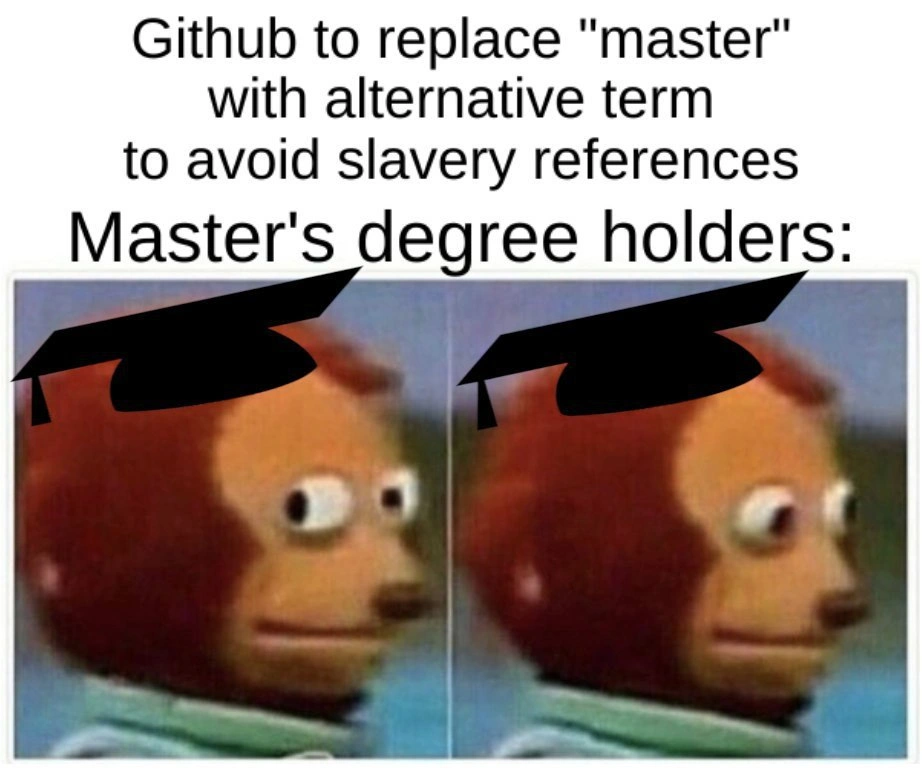
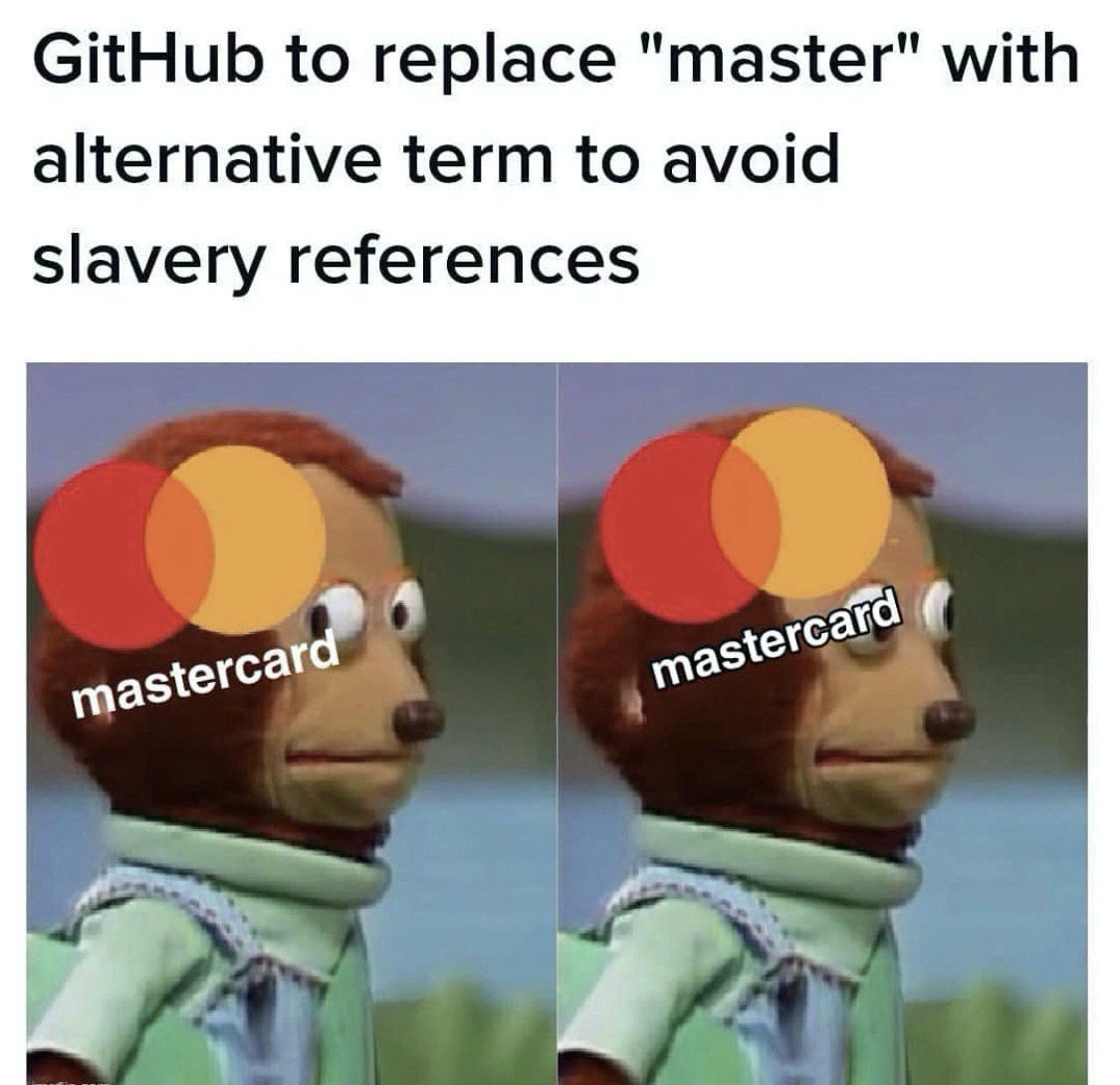
Imagine you’re in school and everyone has a big notebook called the “Master Notebook” that the class has always used for important stuff. One day the teacher says, “Hmm, let’s stop calling it ‘Master’ because that word reminds us of something not nice from history. We’ll call it the ‘Main Notebook’ instead so it’s kinder.” Everyone agrees and starts saying “Main Notebook.” Now picture your friend who, coincidentally, has a nickname Master (maybe he’s really good at a game so friends called him “Master Joe”). Suddenly, when the teacher announces the change, your friend’s eyes go wide like a cartoon monkey puppet looking side to side. He’s thinking, “Uh-oh, my name has that word… is everyone going to stare at me now?” He feels a little awkward and called out, even though nobody was actually picking on him. In the end, no one is mad at your friend – it’s just a funny, uncomfortable moment because his name used a word that the class decided to avoid. That’s exactly what’s happening in the meme: the company Mastercard sees the word “master” being changed everywhere and is glancing around uncomfortably, kind of like, “Please don’t notice that my name has ‘master’ in it!” The humor is in that silly, relatable feeling when a rule changes and you suddenly worry it’s about you, even if it isn’t.
Level 2: From Master to Main
In June 2020, GitHub (a huge platform where developers store and share code) announced it would change the name of the default code branch from “master” to “main.” To understand why that’s a big deal, remember that Git is a popular version control system – basically a tool that tracks changes in code. In Git, a branch is like a separate working version of the code. Developers use branches to add features or fix bugs without messing up the main line of code. Traditionally, when you created a new repository (a new project) in Git, the primary branch (the one you eventually release or deploy from) was named “master” by default. For a long time, most people didn’t question that name – it was just how things were set up. But as the tech community started paying more attention to inclusive language, some noticed that “master” can remind people of master/slave terminology, which is associated with slavery and oppression. In computing, master/slave has been used to describe relationships where one device or process controls others (for example, a master database replicating to slave databases). Even though the master branch in Git isn’t actually paired with a “slave” concept (it probably came from the idea of a “master copy”), the word master alone still made a lot of folks uncomfortable. InclusiveLanguage efforts mean we try to avoid terms that could make anyone feel marginalized or bring up painful historical connotations. So GitHub, being a big part of DevCommunities, led by example and chose a more neutral term – main – which simply implies the main line of development. This change meant that developers and organizations had to adjust their BranchingStrategy a bit: updating scripts, changing default settings, and getting used to typing git push origin main instead of origin master. It was a notable moment in tech because it showed how even something as small as a branch name isn’t immune to cultural progress. Now, the meme image itself combines this serious change with humor: it shows the familiar “awkward monkey puppet” meme. In that meme format, a puppet looks forward normally in one panel and then side-eyes away in the next panel, as if feeling suddenly nervous or guilty. Here, the puppet has the Mastercard logo on its face. Mastercard is a major credit card company, and the name “Mastercard” has the word master in it. The joke is that after hearing GitHub wants to drop the word “master” due to its negative connotations, poor Mastercard is left glancing to the side like, “Uh… please don’t look at our name.” It’s as if Mastercard suddenly feels self-conscious or “seen.” Of course, Mastercard’s name wasn’t the target of GitHub’s change – they just share the word master. But the meme humorously personifies Mastercard, making it react the way a developer or company might when a term they’ve always used casually is suddenly tagged as offensive. For a junior developer or someone new to these discussions, the takeaway is: the tech world is actively rethinking some old terms. This can lead to quirky situations and jokes, like this one, where a completely unrelated brand name gets caught in the crossfire of a linguistic update. The community finds it funny because it highlights how language evolves and how things like a NamingThings decision in programming can echo into pop culture. If you’re new to Git: don’t worry, “master” and “main” are just names – the underlying concept (your primary code branch) is the same. But this change is part of making tech a bit more welcoming, one word at a time, and apparently giving us some good memes along the way!
Level 3: Naming Things Is Hard
The meme riffs on a real shift in the developer world: GitHub deciding to stop calling the default Git branch “master” in favor of “main” as an act of inclusive language reform. For seasoned devs, this hits on the classic truth that “naming things” in software is notoriously difficult – now it’s not just about clarity or convention, but social consciousness too. The awkward humor comes from the side-by-side of a serious tech news headline with the wide-eyed awkward puppet monkey image labeled as Mastercard. It’s a collision of software terminology and a global brand: Git’s master branch versus Mastercard’s name. In mid-2020, many tech organizations began purging terms with oppressive connotations (like replacing “master/slave” with primary/replica or “whitelist/blacklist” with allowlist/denylist). GitHub’s move to rename the master branch was part of that industry-wide push by the developer community to make coding terms more welcoming. The meme implies that when GitHub made “master” a problematic word, even a giant company with “master” in its name suddenly had an Oh no, is it me? moment. It’s funny because Mastercard obviously never meant “master” in the slave sense – the brand name dates back decades to “master charge” meaning the prestigious card. But in the current context, that innocent word gets unexpected side-eye. Essentially, the developer community’s introspection about words has reached a point where even unrelated uses catch our attention. Experienced engineers chuckle because they recognize the pattern: tech culture is evolving (for the better), yet it can produce these surreal scenarios. The VersionControl domain is usually about branching strategies and merge conflicts, not social issues – until suddenly it is. This meme captures that crossover perfectly. A mundane repository detail (the master branch name) became a talking point in Dev communities about representation and inclusion. And leave it to internet humor to take that earnest change and poke light fun at an unlikely subject – poor Mastercard, sitting there with “master” literally on its face, now feeling scrutinized. It’s a wry nod at how sweeping changes can make even bystanders sweat, and it resonates especially with senior devs who’ve lived through many “standard” conventions (tabs vs spaces, anyone?) being reexamined. They appreciate the irony: we finally fix an old naming issue in VersionControl, and suddenly one of the world’s largest credit card companies feels like the joke’s on them. In true developer humor fashion, the meme connects a serious change (inclusive naming) with a playful “what about them?” twist, leaving those in the know smirking at how uniquely our tech jargon can ripple out into the wider world.
Description
A meme commenting on the trend of replacing the term 'master' in tech. The top of the image has black text on a white background stating, 'GitHub to replace "master" with alternative term to avoid slavery references'. Below this headline are two identical images of the 'Awkward Look Monkey Puppet' meme. The puppet, a brown character with large, expressive eyes, is shown looking straight ahead and then nervously glancing to the side. Superimposed over the puppet's head is the Mastercard logo, with the word 'mastercard' written below it. The humor comes from the juxtaposition, implying that Mastercard is now worried about its own brand name in light of the push for more inclusive language, satirizing the perceived overreach or 'slippery slope' of such corporate initiatives
Comments
7Comment deleted
Mastercard's emergency rebranding meeting: 'Okay team, hear me out... PrimaryCard. Or maybe... DebitCard?'
GitHub: “We switched ‘master’ to ‘main’ over the weekend.” Mastercard’s legacy team: “Cute - now excuse us while we sed 4,000 COBOL jobs, patch every JCL, and convince the ’99 AS/400 that it’s now called mainframecard.”
We spent six months migrating every repo to 'main' while our primary database still runs on master-slave replication and nobody's touching that architectural debt with a ten-foot pole
GitHub spent months planning the master-to-main migration, updating documentation, tooling, and CI/CD pipelines across millions of repositories. They coordinated with Git maintainers, IDE vendors, and the entire ecosystem to ensure a smooth transition. Yet somehow, nobody in those planning meetings looked up and said, 'Hey, about that credit card company...' It's the perfect metaphor for software engineering: we can orchestrate distributed systems across continents, but we'll still miss the obvious thing right in front of us. At least Mastercard's merge conflicts are purely financial
GitHub renames 'master' to 'main'; Mastercard: the last unchallenged overlord in your git remotes
Somewhere a senior did sed -i 's/master/main/g' across the monorepo, and our PCI pipeline went red because 'Mastercard' became 'Maincard' - defaults really are part of your API
Renaming master→main took 5 minutes; undoing the sed that helpfully converted “Mastercard” to “Maincard” took two sprints and a very confused finance team